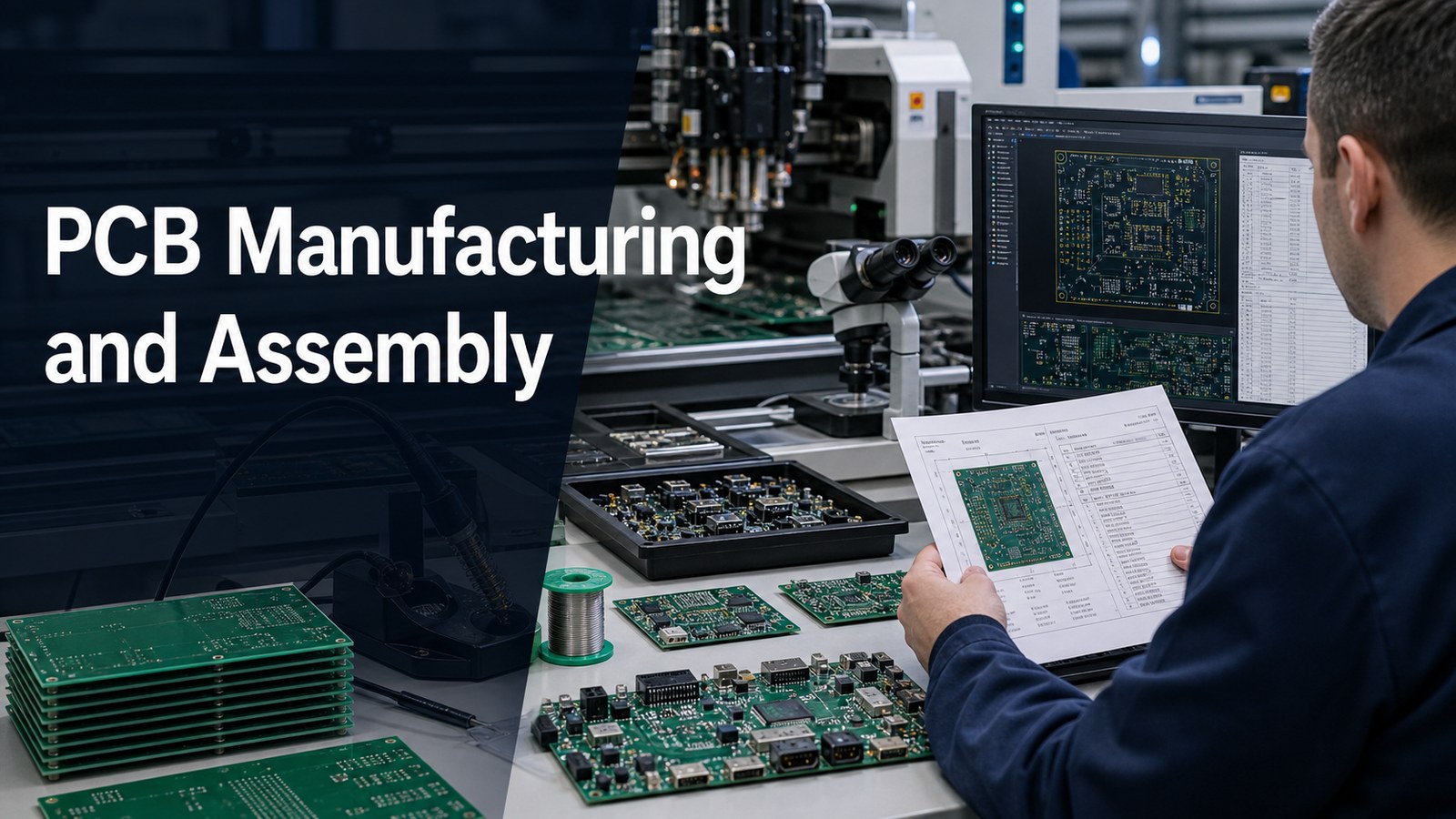
PCB manufacturing and assembly means building the bare circuit board, sourcing or preparing the components, mounting those components, and checking the finished PCBA before shipment. For buyers, the main question is not only whether a supplier can fabricate a PCB or assemble components. The real question is whether the supplier can review the files, catch manufacturability risks, manage BOM and CPL details, and deliver a board that can move into prototype, low-volume, or production use without avoidable rework.
This guide is written for engineers, hardware teams, and purchasing teams comparing PCB and PCBA suppliers. It explains what to prepare before requesting a quote, what affects cost and lead time, and which supplier checks matter before you release a design for manufacturing.
PCB Manufacturing and Assembly at a Glance
A complete PCB manufacturing and assembly workflow turns design files into finished PCBAs through fabrication, component preparation, assembly, inspection, testing, and shipment. The scope can be simple, such as a two-layer prototype with common SMT parts, or complex, such as a multilayer board with controlled impedance, fine-pitch packages, selective through-hole assembly, special material, and project-specific test requirements.
| Stage | What the supplier checks | Buyer risk if missed |
|---|---|---|
| PCB fabrication | Gerber or ODB++, stackup, drill files, copper, finish, solder mask, panel needs | Wrong board build, poor fit, impedance risk, delayed production |
| Component preparation | BOM, approved part numbers, alternates, package match, supply status | Shortages, wrong substitutions, unexpected cost changes |
| PCB assembly | CPL, polarity, package orientation, SMT/THT/BGA requirements, assembly drawing | Placement errors, soldering defects, rework, failed bring-up |
| Inspection and testing | AOI, X-ray where needed, visual checks, functional or customer-defined tests | Hidden defects shipped to the buyer |
When a Combined PCB and PCBA Supplier Makes Sense
A combined supplier is useful when the board design, component sourcing, assembly process, and delivery plan need to be reviewed as one connected project. This is especially important when the PCB layout affects component placement, when BOM availability affects the schedule, or when assembly test requirements should influence panelization and process planning.
Separate fabrication and assembly suppliers can work well for mature designs, but they create more handoff points. A combined path reduces the number of separate conversations around Gerber data, BOM questions, CPL corrections, material changes, soldering constraints, and final inspection criteria. Bestpcbs buyers can use the PCBA and PCB assembly service page as the service reference while using this article as the RFQ preparation checklist.
PCB Fabrication vs PCB Assembly: What Buyers Actually Receive
PCB fabrication produces the bare board, while PCB assembly mounts and solders electronic components onto that board to create a functional PCBA. Buyers often search both terms together because the final deliverable is not only a green board with copper traces. It is a board that can be powered, tested, integrated, and used in a product.
Fabrication decisions include material, layer count, copper weight, hole requirements, solder mask, surface finish, outline, and panelization. Assembly decisions include component packages, placement coordinates, soldering method, polarity markings, inspection method, and test coverage. If either side is treated as a separate afterthought, the finished board can become more expensive or slower to approve.
Files Needed Before a PCB Manufacturing and Assembly Quote
A reliable quote needs design files for the PCB, component data for the BOM, placement data for assembly, and clear instructions for testing and delivery. Missing files do not only slow the quote. They can also hide cost drivers that appear later, after the buyer thinks the project is already approved.
| File or input | Why it matters |
|---|---|
| Gerber or ODB++ | Defines copper layers, solder mask, silkscreen, outline, and fabrication data. |
| Drill file | Defines plated and non-plated holes, vias, and mechanical drill requirements. |
| Stackup or build notes | Clarifies layer count, material expectations, copper, thickness, and impedance needs. |
| BOM | Lists part numbers, quantities, approved alternates, and sourcing constraints. |
| CPL / pick-and-place file | Provides component coordinates, rotation, and placement side. |
| Assembly drawing | Clarifies polarity, special placement notes, connectors, and through-hole details. |
| Test requirements | Defines what must be inspected or functionally checked before shipment. |
If you want to upload files online, the PCB manufacturer online RFQ guide explains how to prepare the same package before sending it to an engineering team.
DFM, DFA, BOM and CPL Review Before Production
DFM and DFA review reduces the chance that a design looks correct in CAD but creates problems during fabrication, placement, soldering, or inspection. A supplier should not treat Gerber, BOM, and CPL files as separate documents. The files describe the same product from different angles, so mismatches should be found before production starts.
Important review points include footprint-to-BOM consistency, package orientation, polarity marks, solder mask clearances, via and pad decisions, panel edges, connector placement, component height concerns, and test point access. For assemblies, BOM and CPL review can be just as important as the bare board review because a wrong package or rotated part can stop a prototype even when the PCB itself is well fabricated.
PCB Materials, Board Types and Build Requirements to Confirm
Material and build requirements should be confirmed before quoting because they affect fabrication process, cost, risk, and assembly planning. Common decisions include FR-4 grade, high Tg material, Rogers or other high-frequency material, metal-core construction, ceramic substrates, board thickness, copper weight, surface finish, and controlled impedance.
Best Technology / bestpcbs maintains process capability references for standard PCB, MCPCB, ceramic PCB, FPC, and rigid-flex topics. Exact limits must be confirmed against the design files and the original capability tables before being written into a quote. In public content, the safer buyer rule is simple: provide the target material, layer count, board thickness, copper, finish, impedance need, operating environment, and expected quantity early so the supplier can confirm the build path instead of guessing.
SMT, Through-Hole, BGA and Mixed Assembly Choices
Assembly method depends on the component package mix, mechanical strength needs, inspection access, and production volume. SMT is common for compact, high-density electronics, through-hole assembly is often used for stronger mechanical connections or connectors, and BGA assembly requires careful footprint, paste, placement, and inspection planning.
Many real projects use mixed assembly. A board may combine fine-pitch ICs, connectors, power parts, LEDs, sensors, test pads, and manual soldering steps. When this happens, the quote should identify which side is assembled, whether there are through-hole or selective soldering steps, whether X-ray is needed for hidden joints, and whether any components require special handling.
Component Sourcing and Substitution Risk
Component sourcing can decide whether a PCB assembly project stays on schedule or becomes blocked by shortages, substitutions, and unexpected price changes. A BOM should not be treated as a static shopping list. It should be checked for lifecycle status, package match, minimum order issues, alternates, and approval rules.
If the supplier is expected to source parts, define whether substitutions are allowed and who approves them. A low quote can become expensive if it relies on weak sourcing assumptions. For projects where sourcing support is needed, the component sourcing service is a relevant internal reference for BOM and supply-chain discussions.
Testing and Quality Control Before Shipment
Quality control should be defined before production, because inspection after assembly cannot fix every design or sourcing decision made earlier. Buyers should ask what inspection steps apply to their board type, package mix, and risk level.
Typical checks may include bare-board electrical testing, solder paste and placement review, AOI, visual inspection, X-ray for hidden solder joints where appropriate, and functional testing when the buyer provides the test method, firmware, fixture, or acceptance criteria. The goal is not to add every possible test to every order. The goal is to match inspection depth to product risk, component package, quantity, and end-use expectations.
What Drives PCB Manufacturing and Assembly Cost?
Cost is driven by board complexity, component risk, assembly difficulty, testing scope, and quantity, not by size alone. A small board with fine-pitch parts and difficult sourcing can cost more than a larger but simpler assembly.
| Cost factor | Why it changes pricing |
|---|---|
| Layer count and stackup | More layers and controlled structures add fabrication steps and review time. |
| Material and surface finish | Special materials or finishes can change process route and procurement cost. |
| Drill, via, and copper requirements | Dense holes, small vias, or heavier copper can affect fabrication difficulty. |
| BOM availability | Shortages, alternates, and minimum buys can dominate assembly cost. |
| Package mix | BGA, fine-pitch, through-hole, and mixed assembly affect placement and inspection. |
| Testing scope | Functional testing, fixtures, programming, or special inspection add time and cost. |
For a deeper pricing breakdown, use the custom PCB cost guide together with the BOM and assembly checks in this article.
Prototype, Low-Volume and Production Planning
Prototype, low-volume, and production PCB assembly should not be quoted the same way because each stage has a different risk profile. Prototype work usually needs fast engineering feedback, low setup friction, and tolerance for design changes. Production work needs repeatability, sourcing stability, inspection planning, and clearer acceptance criteria.
For early builds, ask the supplier to flag file issues before building. For low-volume runs, confirm whether the BOM can be repeated. For production, confirm packaging, panelization, test coverage, change control, and how replacement parts will be approved. If your current project is an early engineering build, the prototype PCB assembly page is a useful next reference.
How to Compare PCB Manufacturing and Assembly Suppliers
A good supplier comparison looks at engineering review, communication, sourcing control, inspection, and RFQ clarity, not only the lowest unit price. A cheap quote that ignores missing CPL data, uncertain parts, or test requirements can create a more expensive delay later.
- Can the supplier review both fabrication and assembly files before production?
- Does the supplier ask useful questions about BOM, CPL, polarity, and testing?
- Can they explain which cost factors are driven by board build and which are driven by BOM or assembly?
- Do they support the project stage: prototype, low volume, or production?
- Can they route you to a relevant manufacturing or PCBA capability page instead of giving only a generic quote?
For bare-board capability context, buyers can also review the PCB manufacturing information page before sending a full PCBA package.
Common Sourcing Risks and How to Avoid Them
The biggest sourcing risks usually come from incomplete files, unclear substitution rules, missing test criteria, and late design changes. These problems are avoidable if the RFQ package is treated as an engineering document, not just a price request.
- Missing CPL: provide pick-and-place data with rotation and side information.
- Unclear polarity: mark LEDs, diodes, IC pin 1, electrolytic capacitors, and connectors clearly.
- Weak BOM: include manufacturer part numbers, approved alternates, DNI parts, and sourcing notes.
- No test definition: state whether visual inspection, AOI, X-ray, programming, or functional testing is expected.
- Late material changes: confirm board material, copper, finish, thickness, and impedance requirements early.
RFQ Checklist for PCB Manufacturing and Assembly
A strong RFQ gives the supplier enough information to check manufacturability, sourcing, assembly, inspection, and delivery before issuing a price. Use this checklist before sending files.
- Gerber or ODB++ files
- Drill files and board outline
- Stackup, material, copper, thickness, finish, and impedance notes
- BOM with manufacturer part numbers and approved alternates
- CPL / pick-and-place file
- Assembly drawing and polarity notes
- Quantity for prototype, pilot, and production stages
- Testing, programming, inspection, packaging, and target delivery requirements
Frequently Asked Questions
What is the difference between PCB manufacturing and PCB assembly?
PCB manufacturing builds the bare circuit board from design data. PCB assembly mounts and solders components onto that board to create a PCBA. Buyers often need both steps together when they want one supplier to review fabrication files, BOM, CPL, assembly drawings, inspection, and final shipment.
Can I request PCB fabrication first and assembly later?
Yes, but it is better to consider assembly during fabrication planning. Component placement, test access, panelization, soldering method, and connector location can affect how easily the board can be assembled later.
What files are most important for a PCBA quote?
Gerber or ODB++ files, drill data, BOM, CPL, assembly drawings, quantity, material notes, surface finish, and testing requirements are the core inputs. The more complete the package, the fewer assumptions the supplier must make.
Should the supplier source components or should I provide them?
Either model can work. Supplier sourcing can reduce buyer workload, but the BOM must define approved parts and substitution rules. Consigned parts can be useful when buyers already control inventory or approved vendor lists.
Why do PCB assembly quotes change after review?
Quotes can change when the supplier finds BOM shortages, missing files, package mismatches, special inspection needs, design risks, or unclear test requirements. A complete RFQ reduces late changes.
Send a PCB Manufacturing and Assembly RFQ
If you need PCB manufacturing and assembly support, send your Gerber or ODB++ files, BOM, CPL, quantity, material notes, surface finish, assembly drawing, testing requirements, and target delivery plan to sales@bestpcbs.com. The team can review the package for fabrication, component sourcing, assembly, inspection, and quote preparation, then identify the questions that should be solved before production starts.
You may also like






Tags: PCB Assembly, pcb manufacturing, PCB Quote