





A transistor pinout shows how the pins of a transistor are arranged in its physical package. For a BJT transistor, these pins are usually Emitter, Base, and Collector. For PCB layout and PCBA assembly, this small detail is very important. It affects the schematic, footprint, SMT placement, BOM review, and final circuit performance.
At first glance, a transistor looks simple. It may only have three pins. However, the same transistor family can come in several packages, such as TO-92, SOT-23, TO-220, SOT-223, or DFN. In addition, different manufacturers may use different pin arrangements for similar-looking parts.
Therefore, engineers should confirm the transistor pinout before PCB layout starts. They should also check it again before SMT assembly. This helps reduce footprint errors, wrong part orientation, and avoidable production issues.
This guide explains transistor pinout from a PCB and PCBA point of view. It is written for engineers, hardware teams, purchasing teams, and product companies that need reliable PCB manufacturing and assembly.
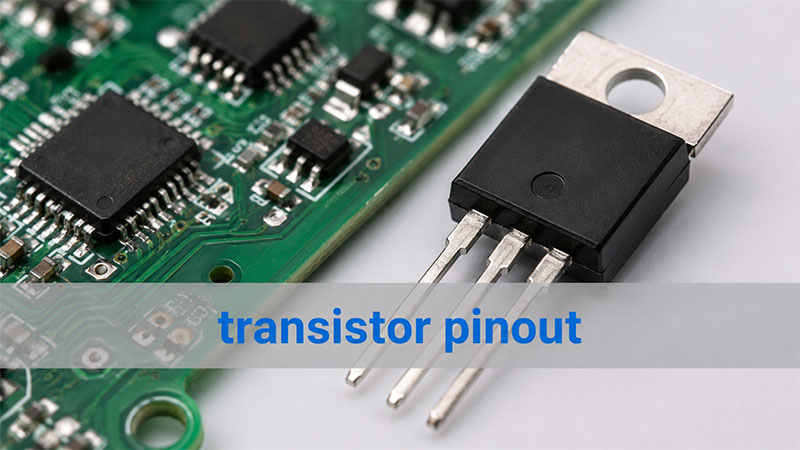
What Is a Transistor Pinout?
A transistor pinout is the physical order of the transistor pins. It tells you which lead or pad connects to each internal function of the device.
For a BJT transistor, the three main pins are:
| Pin Name | Short Name | Main Function |
|---|---|---|
| Emitter | E | Works as one side of the main current path |
| Base | B | Controls the transistor switching or amplification |
| Collector | C | Connects to the load or output side in many circuits |
For PCB design, the transistor pinout must match three things:
- The schematic symbol
- The PCB footprint
- The actual component package
If these three parts match, the circuit has a much better chance of working correctly after assembly. However, if one part is wrong, the finished PCB may fail during testing.
For example, a TO-92 transistor may look the same as another TO-92 transistor. Even so, the pin order may be different. One part may use E-B-C order, while another may use C-B-E order. Because of this, engineers should not rely only on the package shape.
Instead, the safest method is to check the official datasheet. Then, compare the datasheet pinout with the PCB library footprint.
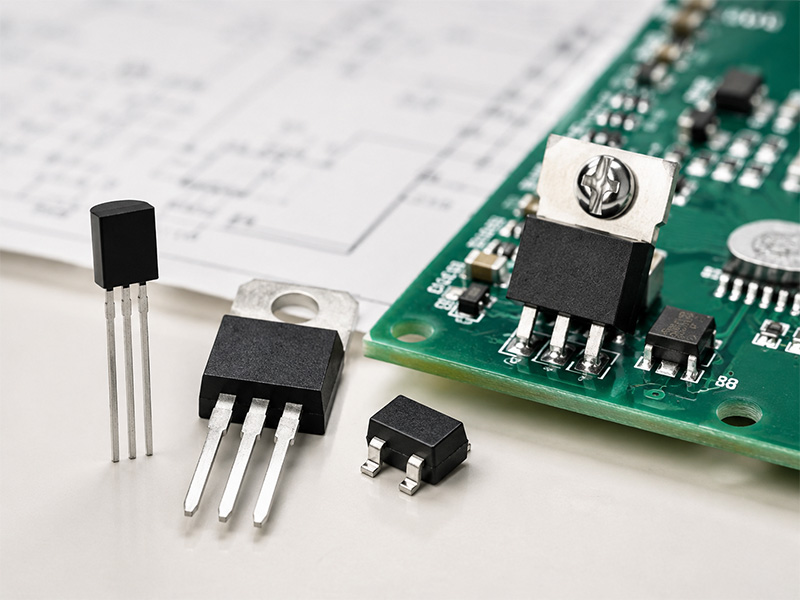

Why Does Transistor Pinout Matter in PCB Layout and PCBA Assembly?
Transistor pinout matters because it affects how the real part connects to the circuit. In a PCB file, the footprint may look correct. During SMT assembly, the component may also be placed neatly. However, the circuit can still fail if the footprint pin mapping is wrong.
In PCB layout, transistor pinout affects routing, pad numbering, copper layout, and test point planning. In PCBA assembly, it affects pick-and-place rotation, AOI inspection, and functional testing.
For instance, an SOT-23 transistor has a very small body and three pads. The package looks simple. Yet the electrical pin order is not always the same for every part. As a result, one wrong footprint can cause many assembled boards to fail.
A correct transistor pinout helps avoid:
- Wrong PCB footprint selection
- Incorrect schematic-to-layout mapping
- SMT orientation errors
- NPN and PNP part mix-ups
- Wrong alternative transistor selection
- Failed functional testing after assembly
- Extra rework during pilot production
Therefore, pinout checking should be part of the normal DFM review process. It is a small step, but it helps protect the full PCB production flow.
For EBest Circuit projects, this type of check connects directly with PCB fabrication, SMT assembly, BOM review, DFM support, and turnkey PCBA production.
What Do Emitter, Base, and Collector Mean in a BJT Transistor Pinout?
In a BJT transistor pinout, the three pins are Emitter, Base, and Collector. Each pin has a different role in the circuit.
| BJT Pin | Short Name | What It Does | PCB Design Note |
|---|---|---|---|
| Emitter | E | Connects to one side of the current path | Must match the expected current direction |
| Base | B | Controls the transistor | Usually needs a proper resistor |
| Collector | C | Often connects to the load side | Routing should follow the circuit design |
The Base is the control pin. A small signal at the Base can control a larger current between the Collector and Emitter. Because of this, BJT transistors are widely used for switching and amplification.
However, the physical pin order can be different from what beginners expect. A schematic symbol may show the Base in the middle. Still, the actual transistor package may not place the Base on the middle lead.
For that reason, engineers should always check the package drawing. They should also confirm the view direction. Some datasheets show the front view, while others show the bottom view. This detail is easy to miss during library creation.
In short, knowing Emitter, Base, and Collector is only the first step. The more important step is making sure these pins are mapped correctly to the PCB pads.
How to Determine Transistor Pinout Before PCB Design?
The best way to determine transistor pinout before PCB design is to check the official datasheet. Then, compare the datasheet with the schematic symbol, PCB footprint, and BOM part number.
A simple engineering workflow is shown below:
| Step | What to Check | Why It Matters |
|---|---|---|
| 1 | Full part number | Similar part names may have different packages |
| 2 | Manufacturer datasheet | It gives the most reliable pinout data |
| 3 | Package drawing | Pin order depends on the viewing direction |
| 4 | Schematic symbol | Pin names must match the real transistor |
| 5 | PCB footprint | Pad numbers must connect to the correct pins |
| 6 | BOM alternatives | Substitute parts may use different pinouts |
| 7 | SMT orientation | Placement data must match the package direction |
This process is useful for both through-hole and SMD transistors. However, it becomes even more important for SMT assembly. Small packages leave little room for visual correction after placement.
Also, engineers should check the complete ordering code. A short part name may not be enough. For example, one transistor family may include TO-92, SOT-23, and metal-can versions. Although the electrical function may be similar, the package pinout can be different.
Before releasing Gerber files, the design team should review the pinout together with the footprint. In addition, the assembly team should check the pick-and-place file before SMT production.
This habit saves time. More importantly, it helps the project move smoothly from prototype to batch production.
NPN Transistor Pinout vs PNP Transistor Pinout: What Should Engineers Check?
NPN and PNP transistors both use Emitter, Base, and Collector pins. However, their current direction and circuit polarity are different. Therefore, engineers must check both the transistor type and the physical pinout.
| Item | NPN Transistor | PNP Transistor |
|---|---|---|
| Symbol arrow | Points outward | Points inward |
| Common use | Low-side switching | High-side switching |
| Control style | Turns on with positive base drive | Turns on with negative base drive |
| PCB check point | Collector load path and base resistor | Emitter supply path and polarity |
| Assembly concern | May look similar to PNP parts | Requires clear BOM control |
In PCB projects, an NPN transistor and a PNP transistor may use the same package shape. For example, both can be supplied in SOT-23 or TO-92 packages. As a result, the assembly line may not easily tell the difference by shape alone.
Because of this, BOM accuracy is very important. The approved manufacturer part number should be clear. The reference designator should also match the correct transistor type.
In addition, substitute parts should be reviewed carefully. A replacement transistor must match the package, pinout, polarity, voltage rating, current rating, and power rating.
For PCBA assembly, clear documentation is helpful. Assembly drawings, centroid data, and BOM files should all point to the same part direction. This makes SMT production more stable and easier to inspect.
How Do SMD Transistor Pinouts Affect SMT Placement?
SMD transistor pinouts affect SMT placement because the part is mounted by pad position and rotation angle. If the footprint is wrong, the SMT machine can still place the part correctly from a mechanical view. However, the circuit connection may still be wrong.
SOT-23 is one of the most common SMD transistor packages. It is small, easy to place, and widely used in compact PCB designs. Even so, SOT-23 pinouts are not universal. Different devices may use different pin mapping in the same package outline.
| SMD Package | Common Use | SMT Placement Note |
|---|---|---|
| SOT-23 | Small-signal switching | Check Pin 1 and footprint mapping |
| SOT-223 | Medium-power applications | Review copper area and heat path |
| SOT-89 | Power and regulator-style circuits | Check pad size and thermal design |
| DFN / QFN-style packages | Compact circuit designs | Confirm hidden pad and stencil design |
During SMT assembly, the pick-and-place machine follows the centroid file. It places the part according to X-Y position and rotation. However, it does not know whether the electrical pinout is right.
Therefore, engineers should check several files before production:
- Datasheet package drawing
- CAD footprint pad numbering
- Pick-and-place rotation
- Assembly drawing
- BOM manufacturer part number
- AOI inspection reference
- Approved vendor list
In addition, SMD transistors often have small top markings. These markings can be different between suppliers. For this reason, the production team should not rely only on the code printed on the package.
A good DFM review can catch many of these risks before PCB fabrication and SMT assembly begin.
What Is the 2N2222 Transistor Pinout and 2N2222A Pinout?
The 2N2222 transistor pinout depends on the exact package and manufacturer. The 2N2222 and 2N2222A are common NPN BJT transistors. They are often used for switching and amplification. However, their physical pinout should still be checked before PCB layout.
The 2N2222 family is available in several forms. Some versions use metal-can packages. Others use plastic through-hole packages or SMD packages. Because of this, one footprint cannot cover every version.
| Part Number | Type | Common Package | PCB Design Note |
|---|---|---|---|
| 2N2222 | NPN BJT | TO-18, TO-92, SMD variants | Confirm the package-specific pinout |
| 2N2222A | NPN BJT | TO-18, TO-92, SMD variants | Check supplier datasheet |
| PN2222A | NPN BJT | TO-92 | Common plastic-package version |
| MMBT2222A | NPN BJT | SOT-23 | Common SMT version |
For PCB projects, 2N2222 is a useful example of why full part control matters. A schematic may simply list “2N2222.” Later, purchasing may source a different package version. If the PCB footprint was made for another package, the assembly may face problems.
A better practice is to define the exact manufacturer part number in the BOM. Also, the package name and footprint name should be clear. If alternatives are allowed, each alternative should be checked before approval.
This is especially important when moving from prototype to mass production. During early samples, engineers may use a through-hole part. Later, they may switch to an SMT version for volume assembly. In that case, the PCB footprint and pinout must be reviewed again.
What Are Common Transistor Pinout Examples for PCB Projects?
Common transistor examples help engineers compare package types and layout notes. However, the final design should always follow the original datasheet.
| Part Number | Type | Common Package | Typical Use | PCB / PCBA Note |
|---|---|---|---|---|
| 2N2222 / 2N2222A | NPN BJT | TO-18, TO-92, SOT-23 variants | Switching and amplification | Confirm package version |
| 2N3904 | NPN BJT | TO-92, SOT-23 variants | Low-current switching | Common signal transistor |
| 2N3906 | PNP BJT | TO-92, SOT-23 variants | Complementary switching | Check polarity and pin mapping |
| BC547 | NPN BJT | TO-92 | General amplification | Pin order may differ from 2N series |
| BC557 | PNP BJT | TO-92 | Low-power switching | Often paired with BC547-style circuits |
| S8050 | NPN BJT | TO-92, SMD variants | Low-power switching | Confirm supplier pinout |
| S8550 | PNP BJT | TO-92, SMD variants | Complementary transistor | Often used with S8050 |
| BD139 | NPN BJT | TO-126 | Medium-power circuits | Thermal layout should be reviewed |
| BD140 | PNP BJT | TO-126 | Complementary power stage | Check heat path and package |
| TIP120 | NPN Darlington | TO-220 | Higher-current switching | Review thermal design |
| MMBT3904 | NPN BJT | SOT-23 | SMT signal switching | Orientation is critical |
| MMBT3906 | PNP BJT | SOT-23 | SMT signal switching | Check approved alternatives |
| MRF9120 | RF power transistor | RF power package | RF power circuits | Follow datasheet and RF layout rules |
This table is useful during early component selection. Still, it should not replace datasheet checking. Similar transistor names can have different package versions. Also, the same electrical type may be sold by several manufacturers.
For production PCB projects, it is better to build an approved component list. This list should include the part number, package, footprint, supplier, and substitute options. As a result, the design team and purchasing team can work with the same information.
In addition, PCB and PCBA teams should review transistor pinout before manufacturing. This review is useful for both prototype builds and batch orders.
What Transistor Pinout Mistakes Can Cause PCB Assembly Defects?
Transistor pinout mistakes can lead to PCB assembly defects, even when PCB fabrication and SMT placement are well controlled. Most of these issues come from wrong library data, unclear BOM information, or unverified substitute parts.
| Mistake | Possible Result | Prevention Method |
|---|---|---|
| Wrong footprint selected | Pads connect to the wrong pins | Compare footprint with datasheet |
| Generic symbol used | Symbol pins do not match the package | Use verified library mapping |
| Substitute part has a different pinout | Circuit may not work as planned | Check AVL and approved alternatives |
| SMD orientation is wrong | Part is placed at the wrong angle | Review centroid file and assembly drawing |
| TO-92 pin order is assumed | Through-hole pins connect incorrectly | Confirm package view and lead order |
| NPN and PNP are mixed | Circuit function changes | Strengthen BOM review |
| Thermal design is ignored | Power device runs too hot | Review copper area and heat path |
| RF transistor layout is treated as standard | RF performance may become unstable | Follow datasheet layout guidance |
Fortunately, most of these problems can be found before production. The key is to review the design early.
Before PCB fabrication, engineers should check the schematic, footprint, package drawing, and BOM. Before SMT assembly, the production team should check placement direction, part marking, and assembly files. After assembly, AOI and functional testing can confirm the result.
For turnkey PCBA projects, this process is even more important. A small transistor error can affect the whole batch. Therefore, early review helps improve delivery speed and production quality.
EBest Circuit supports customers with PCB fabrication, SMT assembly, component sourcing, BOM review, DFM pre-check, testing, and turnkey electronics manufacturing. For transistor-based circuits, our engineering team can help check package selection, footprint consistency, assembly orientation, and production feasibility before batch manufacturing.
All in all, a transistor pinout may look like a small detail. However, it plays a large role in PCB layout and PCBA assembly. When the pinout is correct, the schematic, footprint, BOM, and SMT data can work together smoothly.
Before releasing a PCB design, engineers should check the official datasheet, package drawing, pin numbering, footprint mapping, and approved alternatives. In addition, they should review SMD orientation and substitute parts before assembly.
This is especially useful for SOT-23 transistors, 2N2222 variants, NPN and PNP substitutions, and production projects with BOM changes.
With careful pinout verification, electronic product teams can reduce assembly risk and move from prototype to mass production with more assurance. EBest Circuit helps customers with PCB manufacturing, SMT assembly, component sourcing, DFM review, BOM optimization, and testing, supporting a smoother path from design files to reliable assembled boards. If any questions, pls feel free to contact us at sales@bestpcbs.com.
FAQs About Transistor Pinout
1. What is a transistor pinout?
A transistor pinout shows the physical order of a transistor’s pins. For a BJT transistor, these pins are usually Emitter, Base, and Collector. In PCB layout and PCBA assembly, the pinout must match the schematic symbol, PCB footprint, and actual component package.
2. How do I determine the correct transistor pinout?
The safest way is to check the official manufacturer datasheet. Engineers should confirm the full part number, package type, pin numbering, and viewing direction. Then, they should compare this information with the schematic symbol and PCB footprint before releasing the design.
3. Are all transistors with the same package pinout the same?
No. Transistors with the same package, such as TO-92 or SOT-23, may have different pin arrangements. For example, one TO-92 transistor may use E-B-C order, while another may use C-B-E. Therefore, package shape alone is not enough for PCB design.
4. Why is transistor pinout important for PCBA assembly?
Transistor pinout affects SMT placement, solder pad mapping, BOM verification, and functional testing. If the pinout does not match the PCB footprint, the component may be assembled correctly in appearance but fail electrically. That is why pinout verification should be included in DFM review before PCB fabrication and assembly.
You may also like





Tags: PCB Layout, pcba assembly, transistor pinout