Circuit board adhesive helps keep PCB assemblies stable, clean, and reliable. Engineers use it to hold components, support wires, bond flexible circuits, and protect selected areas.
At first, adhesive may look like a small detail. However, it can affect the life of the whole assembly. A wire may need support. A connector may need extra strength. A flexible circuit may need a safe bonding layer. In each case, the right adhesive helps the board work better.
Also, not every adhesive suits electronics. A circuit board may face heat, vibration, moisture, and electrical stress. Therefore, the adhesive must match the board material, components, process, and final product use.
This guide explains the main types of circuit board adhesive. It also shows where each type works best and how to choose the right option for PCB assembly.
What Is Circuit Board Adhesive?
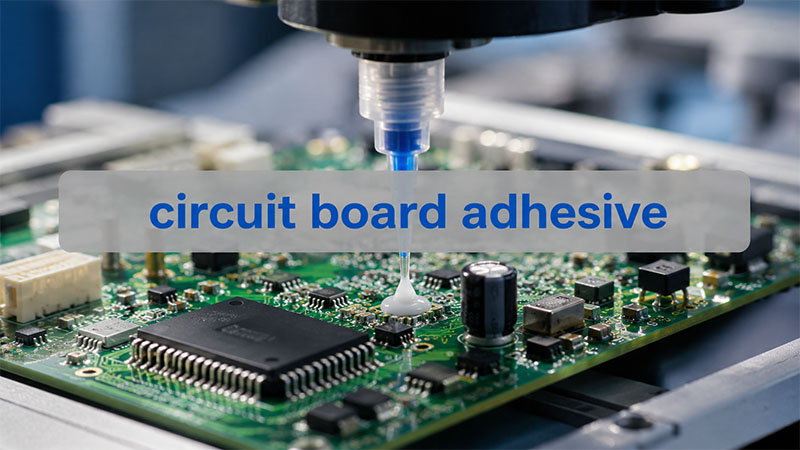
Circuit board adhesive is a bonding or protective material for printed circuit boards and PCB assemblies. It helps fix components, support wires, bond flexible circuits, protect solder joints, and mount boards inside housings.
In simple words, it is not common glue. Instead, it is a material made for electronic products. It must work safely with solder mask, copper, solder joints, plastic parts, and electronic components.
For example, some adhesives insulate. Others conduct electricity. Some help move heat. Meanwhile, some absorb vibration or add physical support.
As a result, the best adhesive depends on the job. A printed circuit board adhesive for wire support may not suit thermal transfer. In the same way, a conductive adhesive may not suit insulation.
A good adhesive for circuit boards should offer:
- Strong bonding to PCB surfaces
- Good insulation, unless conductivity is needed
- Safe curing temperature
- Good heat and moisture resistance
- Stable performance over time
- Clean and controlled application
- Compatibility with solder mask and components
Because PCB assemblies are sensitive, random household glue is not a good choice. Instead, engineers should use an electronic-grade adhesive that fits the working conditions.
Why Do Engineers Use Adhesive on Printed Circuit Boards?
Engineers use adhesive on printed circuit boards to improve strength, process control, and long-term reliability. Solder creates the electrical joint. However, some parts still need extra physical support.
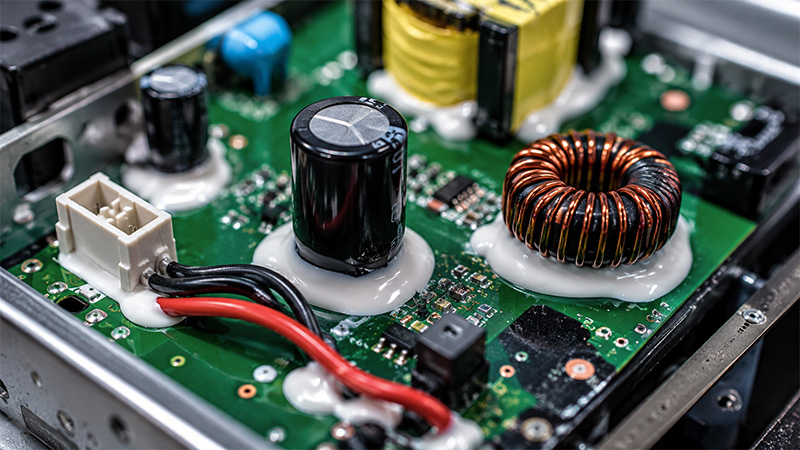
For example, a large capacitor can move during transport. A connector can face repeated plugging force. A wire can pull against a solder pad. Therefore, adhesive helps reduce stress and keeps these parts steady.
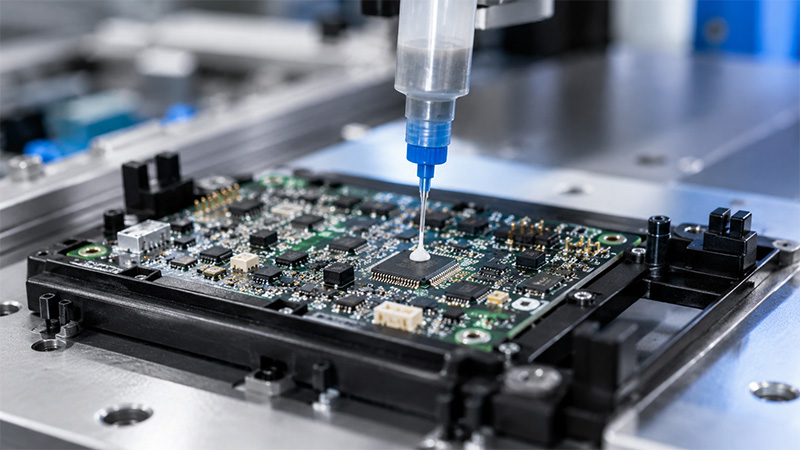
Also, adhesive can help during production. In some SMT or wave soldering processes, adhesive holds parts before soldering. This helps the assembly line keep parts in the right position.
In addition, circuit board adhesive can protect selected areas. It can cover soldered wires, support connectors, or reinforce vibration-sensitive parts. Because of this, many industrial, automotive, LED, and power products use adhesives in PCBA production.
Common uses include:
- Fixing tall or heavy components
- Supporting soldered wires
- Reducing vibration stress
- Bonding flexible circuits
- Mounting small PCB modules
- Protecting selected connections
- Improving production handling
- Supporting thermal or electrical functions
In short, adhesive is not just an extra material. It can be part of the design and assembly plan.
What Are the Main Types of Circuit Board Adhesive?
The main types of circuit board adhesive include epoxy, silicone, acrylic, polyurethane, conductive adhesive, thermal adhesive, UV adhesive, and adhesive tape. Each type has a different use.
Epoxy Adhesive
Epoxy adhesive gives strong bonding. It also offers good chemical resistance. Therefore, engineers often choose it for potting, sealing, component fixing, and strong support.
However, some epoxy materials become hard after curing. Because of that, engineers should check stress and heat expansion before using epoxy near delicate parts.
Silicone Adhesive
Silicone adhesive stays flexible after curing. It also handles heat and vibration well. As a result, silicone adhesive glue for circuit boards often appears around capacitors, coils, connectors, and wires.
Also, silicone works well in power supplies, LED drivers, and industrial boards. It gives support without making the area too rigid.
Acrylic Adhesive
Acrylic adhesive cures fast and bonds well to many surfaces. Therefore, it often appears in tapes, insulation films, and fast assembly steps.
In addition, acrylic adhesive can help improve production speed. It also gives clean handling in many medium-stress applications.
Polyurethane Adhesive
Polyurethane adhesive offers flexibility and good environmental resistance. It can help with sealing, potting, and local protection.
Because it stays softer than many rigid adhesives, it can reduce stress from movement or vibration.
Conductive Adhesive
Circuit board conductive adhesive can bond materials and carry current. It usually contains silver, copper, nickel, or carbon fillers.
Engineers use it for grounding, shielding, die attach, low-temperature bonding, and special connections. However, it does not replace solder in every design. Instead, it works best when the product has a clear need for it.
Thermal Adhesive
Thermal adhesive helps move heat from a component to a heat sink, metal case, or heat spreader. Therefore, it often appears in LED modules, power electronics, and high-heat products.
Before choosing it, engineers should check thermal conductivity, bond strength, working temperature, and curing method.
UV-Curable Adhesive
UV-curable adhesive cures under ultraviolet light. This gives manufacturers fast process control.
For example, a factory may use UV adhesive when quick curing helps production speed. However, UV light must reach the adhesive area. So, component shadowing and board layout matter.
Circuit Board Adhesive Tape
Circuit board adhesive tape gives clean bonding and controlled thickness. It can support mounting, insulation, FPC bonding, thermal transfer, and shielding.
Since tape does not need liquid dispensing, it can make assembly easier. Also, it helps keep the same thickness from board to board.
How Do Circuit Board Protection Adhesives Protect PCB Assemblies?
Circuit board protection adhesives protect PCB assemblies by supporting weak points and covering selected areas. They help the board handle vibration, dust, moisture, and movement.
For example, a soldered wire may pass electrical testing. However, it may still move during use. If the wire keeps pulling on the solder joint, the joint can suffer stress. Therefore, adhesive for circuit board connections can add strain relief.
Similarly, large parts may need more support. Coils, capacitors, relays, transformers, and connectors can move during shipping or operation. A neat adhesive bead can hold them in place.
Also, protection adhesive can work with other protective materials. Conformal coating covers the board with a thin film. Potting compound fills a larger area. Meanwhile, adhesive gives local bonding or support.
Protection adhesives often work well around:
- Soldered wires
- Connectors
- Tall capacitors
- Inductors and coils
- Transformers
- Vibration-sensitive parts
- Local exposed connections
The goal is simple. The adhesive should support the part without blocking testing, repair, or heat flow.
When Should You Use Circuit Board Adhesive Tape?
You should use circuit board adhesive tape when you need clean handling, controlled thickness, and fast assembly. Tape works well for mounting, insulation, bonding, shielding, thermal layers, and flexible circuit attachment.
Unlike liquid adhesive, tape already has a set thickness. Therefore, it gives better repeatability. Also, many tapes use pressure-sensitive adhesive, so they do not need extra curing time.
Circuit board adhesive tape can help with:
- FPC bonding
- PCB module mounting
- Insulation film attachment
- Thermal pad placement
- LED strip support
- Battery protection board mounting
- EMI shielding attachment
- Temporary assembly positioning
For flexible electronics, tape is often very useful. Flexible circuit board adhesive tape can bond FPC to stiffeners, housings, displays, sensors, or compact modules.
However, tape still needs careful selection. Engineers should check adhesion strength, thickness, temperature rating, dielectric strength, aging behavior, and surface compatibility.
In short, tape may look simple. However, it still affects reliability and assembly quality.
What Is Circuit Board Conductive Adhesive?
Circuit board conductive adhesive bonds materials while allowing current to pass through. It contains conductive particles inside a resin system.
Electrically conductive adhesive for circuit boards can help when soldering brings too much heat. It can also help when a substrate does not suit normal soldering. For example, some flexible circuits, ceramic substrates, sensors, or sensitive parts may need a lower-temperature process.
There are two common types.
Isotropic conductive adhesive conducts electricity in all directions. Engineers use it when the full adhesive area needs conductivity.
Anisotropic conductive adhesive conducts mainly through the thickness direction. This helps in fine-pitch connections because it reduces side-to-side current paths.
Conductive adhesive can support:
- Grounding points
- EMI shielding connections
- Die attach
- Low-temperature bonding
- Flexible electronics
- Selected repair work
- Special material bonding
However, engineers should compare its resistance, strength, and aging behavior with the design needs. In standard PCB assembly, solder is still the main joining method. Even so, conductive adhesive works very well in the right application.
Is Flexible Circuit Board Adhesive Different from Rigid PCB Adhesive?
Yes. Flexible circuit board adhesive must handle bending, thin materials, and movement. Rigid PCB adhesive usually focuses more on component fixing, local protection, or mounting support.
Flexible circuits often use polyimide, copper foil, coverlay, adhesive layers, and stiffeners. Since the circuit can bend, the adhesive must hold well without creating hard stress points.
If the adhesive is too rigid, it may shorten the flex life. Therefore, engineers often choose flexible adhesive systems for FPC designs.
The right material should match:
- Bend radius
- Flex cycle requirement
- Substrate type
- Working temperature
- Stiffener position
- Housing design
- Assembly method
In some products, black flexible circuit board adhesive helps with appearance or light blocking. In other products, amber, clear, or white adhesive may work better.
So, color is not the main point. Performance under bending is more important.
How Is Circuit Board Component Adhesive Used in PCB Assembly?
Circuit board component adhesive helps hold, reinforce, or protect parts during and after PCB assembly. It works well for heavy, tall, or vibration-sensitive components.
During production, SMT adhesive can hold components before soldering. This helps in wave soldering or double-sided assembly.
After assembly, teams may add adhesive around larger parts. This gives extra support during transport and use.
Component adhesive often supports:
- Large capacitors
- Inductors
- Coils
- Relays
- Transformers
- Connectors
- Soldered wires
- Tall plastic parts
- Power components
White adhesive for circuit board components often appears around these parts. However, the color does not tell you the material type. It may be silicone, epoxy, polyurethane, or another adhesive.
Also, application control matters. Too much adhesive can cover test points, block repair, trap heat, or make the board messy. Therefore, the assembly team should control bead size, position, curing time, and inspection rules.
A clean adhesive process makes the board easier to test. It also helps the final product look more professional.
How Do You Choose the Right Adhesive for Circuit Boards?
To choose the right adhesive for circuit boards, start with the function. Ask what the adhesive must do. Should it bond, insulate, conduct, transfer heat, absorb vibration, or protect one area?
Once you know the function, the choice becomes easier.
- First, check the working environment. Will the board face heat, moisture, vibration, chemicals, or outdoor use? These conditions help narrow the options.
- Next, review the electrical needs. Most PCB adhesives need strong insulation. However, conductive adhesive must create a controlled current path. Therefore, engineers should check dielectric strength, resistance, and conductivity.
- Then, match the curing process. Some adhesives cure at room temperature. Others need heat, UV light, or two-part mixing. If the board has heat-sensitive parts, a high-temperature cure may not fit.
- Also, think about repair. Some adhesives stay flexible and easier to remove. Others become hard and strong. If future repair may happen, the team should consider circuit board adhesive remover options.
- Finally, check production needs. Manual dispensing may work for prototypes. However, automated dispensing gives better control in mass production. Tape may also help when thickness control matters.
Why Should Adhesive Selection Start During PCB Design?
Adhesive selection should start during PCB design because it affects layout, spacing, testing, heat flow, and assembly steps.
When engineers plan early, they can reserve adhesive areas. They can also keep test points open and avoid sensitive contacts. In addition, they can protect heat paths and make future repair easier.
Early planning also helps the PCBA factory. The team can define where to apply adhesive, how much to use, how to cure it, and how to inspect it.
For better adhesive use, engineers should:
- Reserve enough space for adhesive
- Keep adhesive away from test points
- Avoid covering labels or QR codes
- Protect heat dissipation paths
- Keep repair access in mind
- Define the dispensing amount
- Confirm solder mask compatibility
- Review the material datasheet
Because of these steps, adhesive becomes part of the design plan. It no longer acts as a last-minute fix.
Overall, circuit board adhesive helps PCB assemblies become stronger, cleaner, and more reliable. It can secure components, support soldered wires, bond flexible circuits, move heat, provide conductivity, or protect selected areas.
Different materials solve different problems. Epoxy gives strength. Silicone adds flexibility. Conductive adhesive creates current paths. Thermal adhesive helps move heat. Adhesive tape gives clean and controlled bonding.
Therefore, engineers should choose adhesive based on function, environment, electrical behavior, curing method, and production needs. With the right choice, this small material can support a better electronic product.
If you are working on a PCB or PCBA project and need support with material selection, assembly process review, or adhesive application planning, our engineering team can help review your requirements. You can send your project details or Gerber files to sales@bestpcbs.com for a practical manufacturing suggestion.
FAQs About Circuit Board Adhesive
1. Can I use normal glue on a circuit board?
No. Normal household glue is not a good choice for a circuit board. PCB assemblies need materials with proper insulation, heat resistance, chemical stability, and component compatibility. Electronic-grade adhesive gives a safer result.
2. Is circuit board adhesive the same as conformal coating?
No. Circuit board adhesive fixes, bonds, reinforces, or protects selected areas. Conformal coating creates a thin protective film over the PCB surface. However, many products use both because they solve different problems.
3. What adhesive works best for circuit board components?
Silicone, epoxy, SMT adhesive, and polyurethane can work for circuit board components. The best choice depends on component size, vibration level, working temperature, curing process, and repair needs.
4. Can I put adhesive over soldered wires on a circuit board?
Yes. You can apply adhesive over soldered wires for strain relief. However, inspect the solder joint first. Then apply a compatible adhesive that supports the wire without covering test points or nearby parts.
You may also like

Tags: Circuit Board Adhesive, PCB Assembly, PCB Protection Materials