





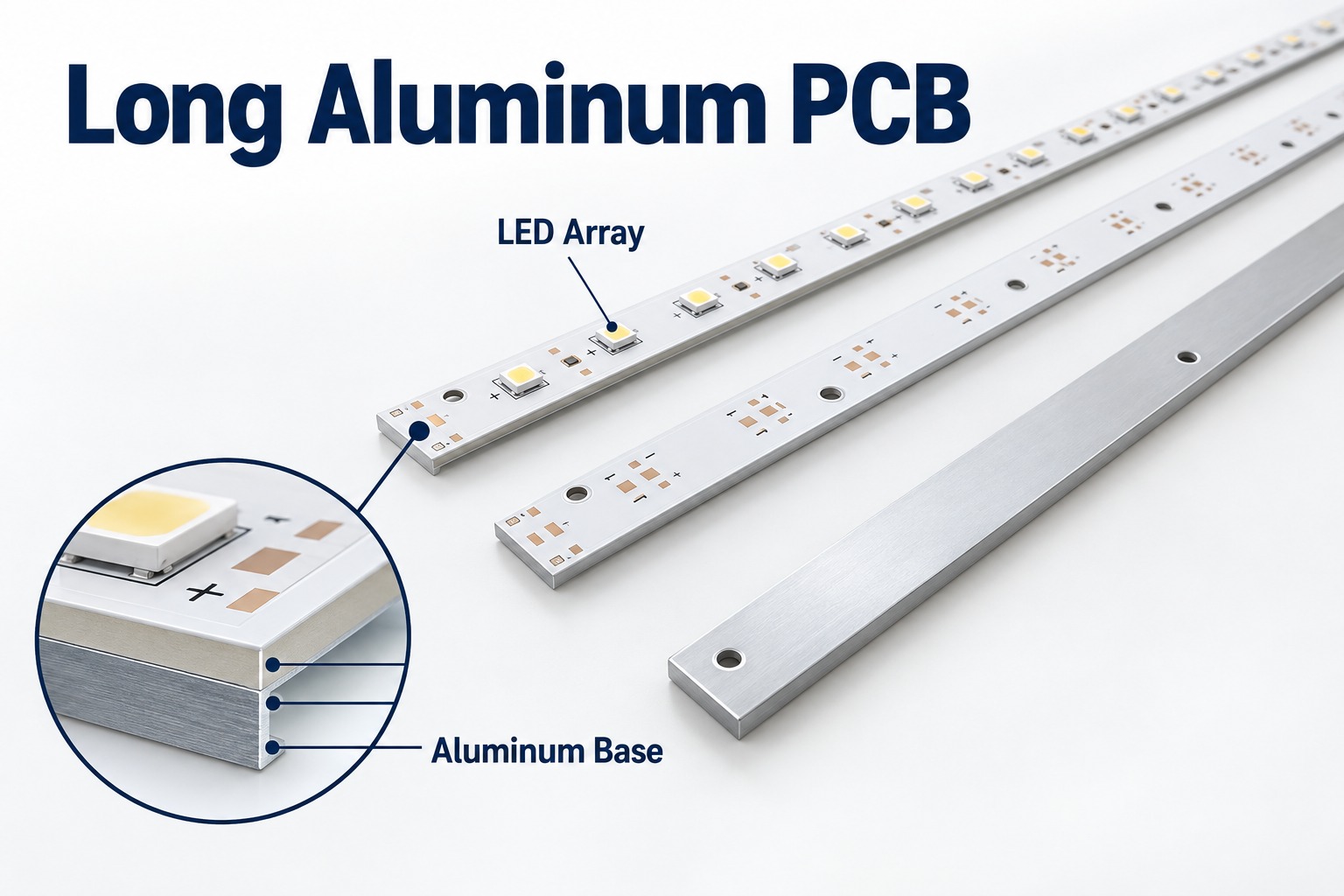
A long aluminum PCB is commonly used in linear LED lighting, architectural luminaires, commercial fixtures, transit lighting, and marine lighting. Its aluminum base helps support the board mechanically while transferring heat away from the LED area.
When board length approaches 1,000–1,200 mm, manufacturing becomes more demanding. Flatness, registration, thermal stress, testing, and handling all need tighter control, especially for long and narrow LED boards.
At EBest Circuit, we review aluminum PCB fabrication and LED assembly requirements together, including board dimensions, materials, handling, and inspection before production.
Key Takeaways
- Long aluminum PCBs are widely used in linear LED lighting because they provide mechanical support and a direct path for heat spreading.
- Once board length approaches 1,000–1,200 mm, flatness, registration, handling, and dimensional consistency become much harder to control.
- Manufacturing difficulty depends on length, width, thickness, copper distribution, and panel design together, not board length alone.
- Thermal conductivity is only one part of LED thermal design. Dielectric thickness, thermal resistance, copper weight, and heatsink contact also matter.
- Long MCPCBs need tighter control of AOI, electrical testing, dimensional inspection, flatness, and packaging.
- One-stop PCB and PCBA manufacturing can simplify traceability, LED bin control, DFM/DFA, SMT process matching, and volume ramp-up.
What Is a Long Aluminum PCB?
A long aluminum PCB is an elongated metal-core PCB used when LEDs or other components need to be arranged across a long, narrow board. It typically consists of a copper circuit layer, a thermally conductive dielectric, and an aluminum base. This aluminum PCB stackup separates the circuit from the metal base with an insulating dielectric.
A typical structure includes:
- Copper circuit layer
- Thermal dielectric
- Aluminum base
- Solder mask
- Surface finish on exposed pads
The aluminum base provides mechanical support and helps transfer heat away from the circuit area. In LED lighting, long aluminum PCBs are commonly used for linear fixtures, LED strips, architectural lighting, and other applications that need both heat dissipation and a long board format.
Why Are Long Aluminum PCBs Used in LED Lighting?
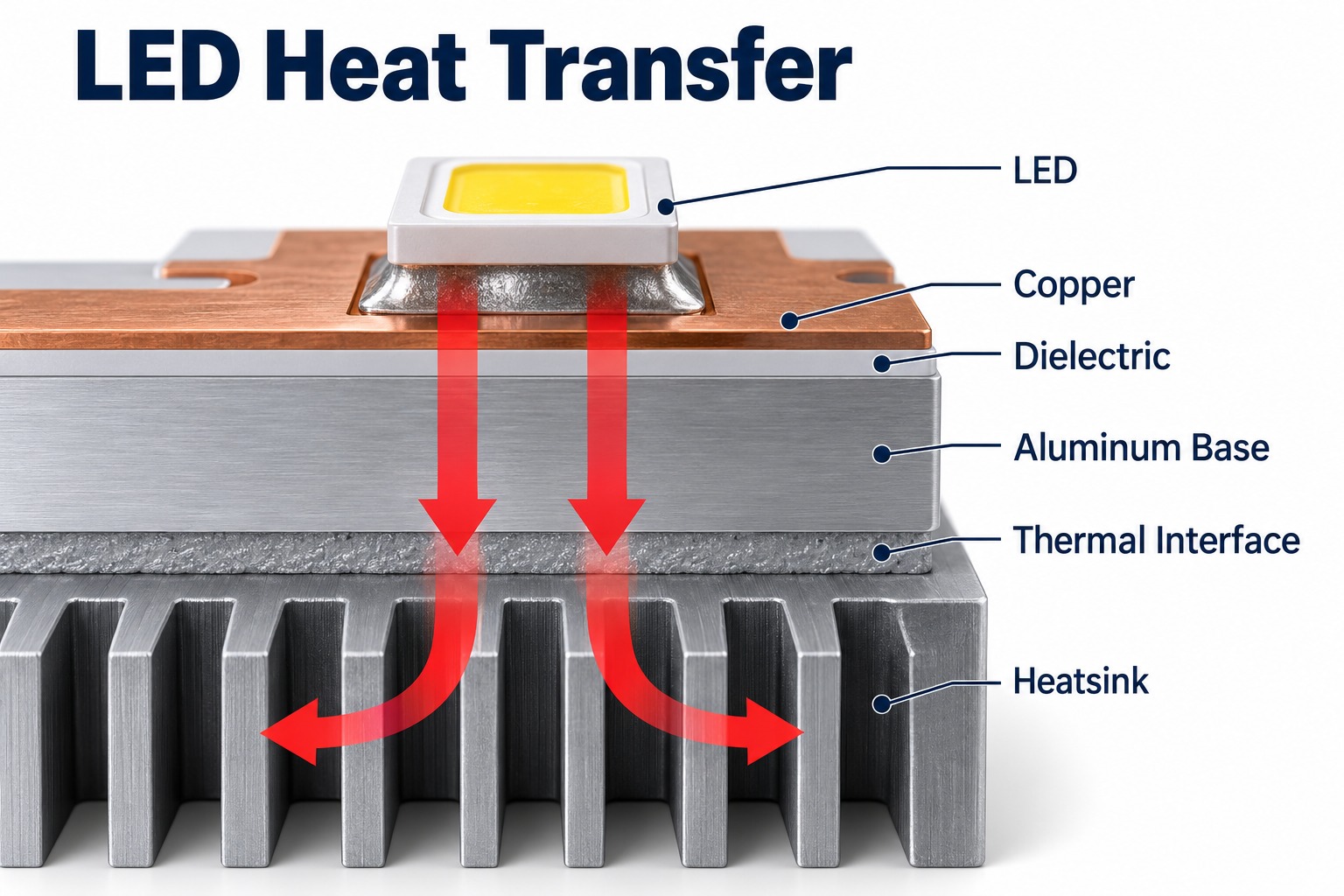
Long aluminum PCBs are used in LED lighting because they support long LED arrays while creating a shorter thermal path from the LEDs to the fixture or heatsink.
Typical applications include:
- Linear architectural lighting
- Commercial LED luminaires
- Cove lighting
- Transit lighting
- Marine lighting
- Industrial linear fixtures
- LED signage
- Long LED strips
The typical thermal path is:
LED → solder joint → copper layer → dielectric → aluminum base → fixture or heatsink
This structure helps spread heat across the board instead of concentrating it around individual LEDs.
Many lighting products also use FR4 boards for driver, control, communication, or protection circuits. A complete lighting assembly may therefore include:
- Aluminum PCB for the LED array
- FR4 PCB for control or power circuits
- PCB assembly for both board types
How Long Can an Aluminum PCB Be Manufactured?
The maximum aluminum PCB length depends on whether every production process can handle the required board size.
The main equipment limits are:
- Imaging and exposure
- Etching
- Solder mask processing
- Surface finish
- Routing or V-scoring
- AOI
- Electrical testing
- Handling and packaging
| Board Length | Main Manufacturing Concern |
|---|---|
| Below 600 mm | Standard MCPCB processing in many factories |
| 600–900 mm | Equipment size and handling |
| 900–1200 mm | Flatness, registration, and dimensional consistency |
| Above 1200 mm | Detailed equipment and process review required |
For boards around 1,000–1,200 mm, the manufacturer should review the actual design before confirming production capability.
Important data includes:
- Length and width
- Aluminum thickness
- Copper weight
- Dielectric system
- Surface finish
- Panel layout
- Dimensional tolerance
A factory being able to process a 1,200 mm sheet does not automatically mean every 1,200 mm PCB design is equally easy to manufacture.
Why Is Flatness Difficult on a 1.2-Meter Aluminum PCB?
Flatness is harder to control on a 1.2-meter aluminum PCB because small material and process stresses become more visible over a long distance.
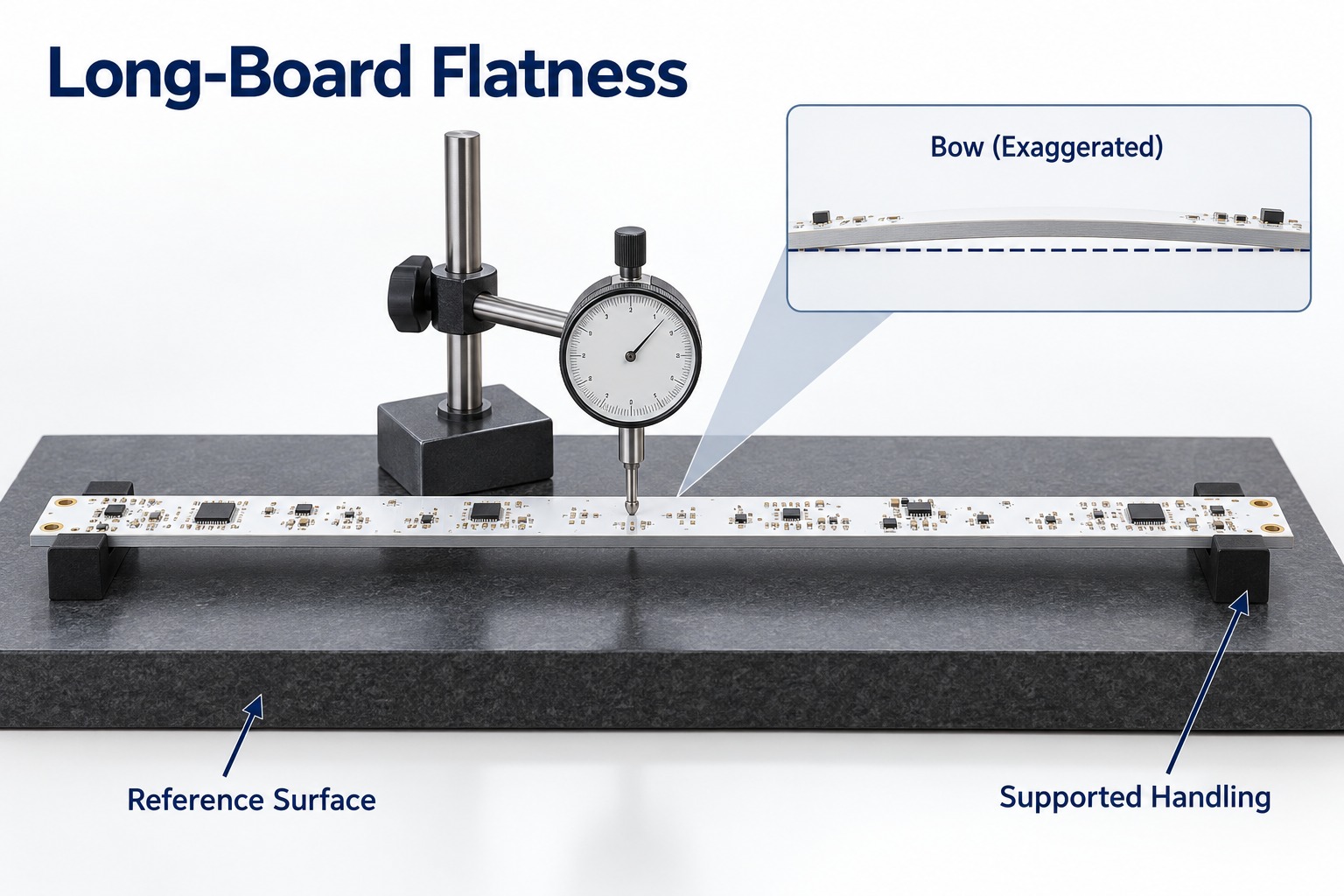
The main factors include:
- Long and narrow board shape
- Aluminum thickness
- Uneven copper distribution
- Dielectric construction
- Thermal processing
- Routing stress
- Storage method
- Packaging pressure
Thin and narrow boards are usually more sensitive because they have less mechanical stiffness.
Copper balance also affects flatness. Large differences in copper coverage can create uneven stress during heating and cooling.
That is why long-board manufacturability should be evaluated using:
Length × Width × Thickness
For example:
- 1200 × 20 × 1.0 mm
- 1200 × 100 × 2.0 mm
Both are 1.2 meters long, but the first requires much more careful handling and flatness control.
How Do We Control Yield on Long, Narrow MCPCBs?
We control yield on long, narrow MCPCBs by reducing process variation from material preparation through final inspection.
Material and panel planning
Before production, we review:
- Board dimensions
- Aluminum thickness
- Copper distribution
- Trace layout
- Panel method
- Routing direction
A stable panel layout makes long boards easier to process and handle.
Registration control
Long boards are more sensitive to accumulated positional error. We therefore control:
- Imaging alignment
- Drilling accuracy
- Solder mask registration
- Hole-to-profile position
- Final dimensions
Etching consistency
Trace width and copper geometry must remain stable across the full board length. This is especially important for long LED arrays with repeated circuit patterns.
Thermal process control
Heating and cooling conditions are controlled to reduce unnecessary internal stress and board deformation.
Mechanical handling
Long narrow boards require adequate support during:
- Transfer
- Inspection
- Stacking
- Storage
- Packing
This helps prevent bending, scratching, and edge damage.
Inspection
Depending on the project, inspection can include:
- Dimensional checks
- AOI
- Solder mask inspection
- Flatness measurement
- Electrical testing
- Final visual inspection
For long MCPCBs, yield depends heavily on stable processing before final inspection rather than relying on sorting at the end.
What Thermal Conductivity Should an LED Aluminum PCB Use?
The correct thermal conductivity depends on the complete thermal design, not just the W/m·K rating of the dielectric. Specify aluminum PCB thermal conductivity together with dielectric thickness and insulation requirements.
Key parameters include:
- Thermal conductivity
- Dielectric thickness
- Thermal resistance
- Breakdown voltage
- Copper thickness
- LED power density
- LED spacing
- Heatsink contact
- Operating temperature
A higher thermal conductivity value is useful only when the dielectric thickness and complete thermal path also support efficient heat transfer.
| Application | Main Thermal Concern |
|---|---|
| Low-power LED lighting | Cost and basic heat spreading |
| Linear LED lighting | Continuous heat transfer |
| High-density LED boards | Local hotspot control |
| High-power LED modules | Low thermal resistance |
| Marine LED lighting | Thermal and environmental stability |
For most LED projects, the better selection question is:
Which dielectric system provides the required thermal resistance, insulation, reliability, and cost?
This gives a more accurate result than selecting a board only because it is rated at 2 W/m·K or 3 W/m·K.
What Should Be Checked for Marine LED Lighting PCBs?
Marine LED lighting PCBs need both thermal control and environmental protection.
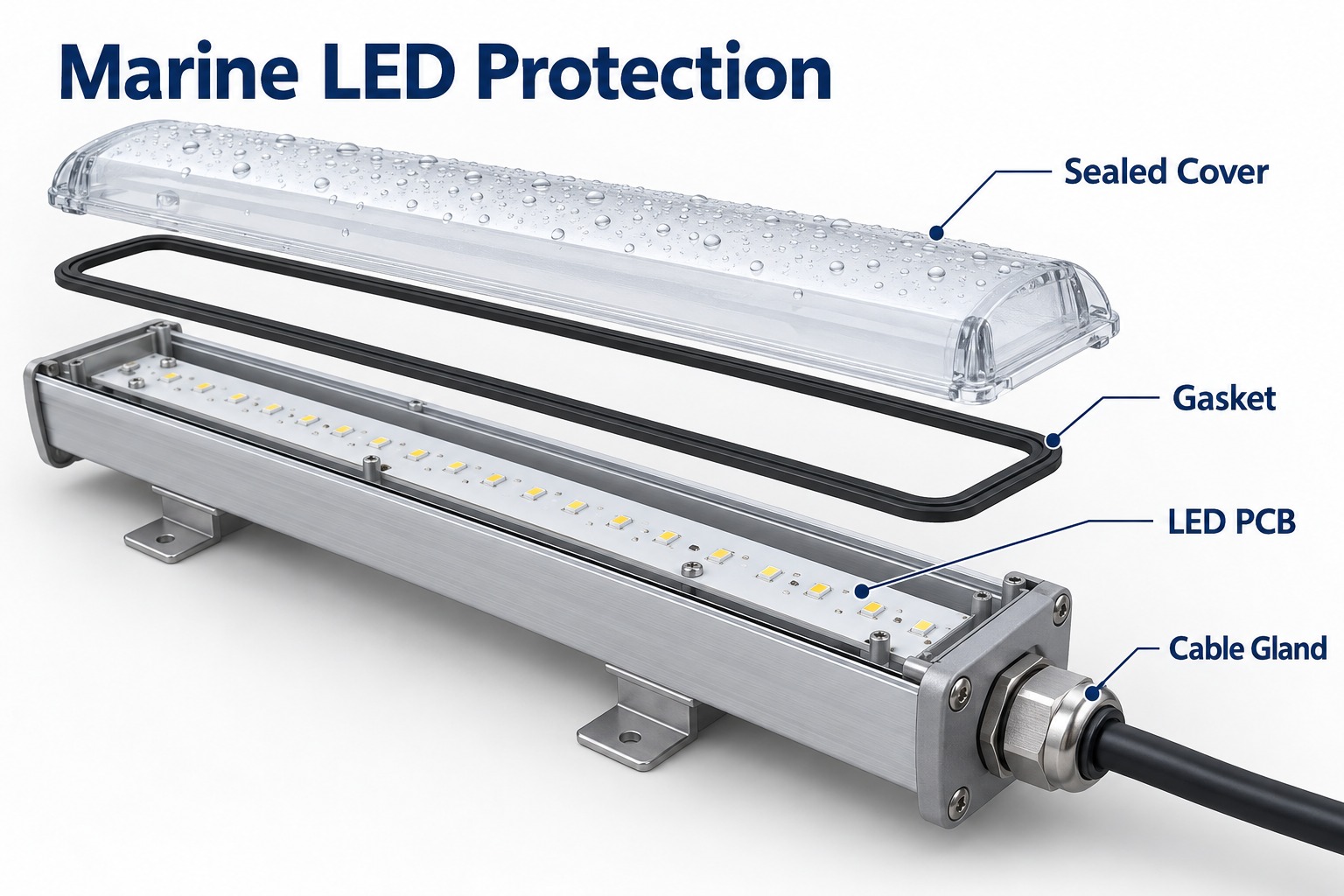
The main points to check are:
- Moisture resistance
- Corrosion resistance
- Surface finish
- Conformal coating
- Connector protection
- Solder joint protection
- Enclosure sealing
- Thermal cycling performance
The PCB is only one part of the protection system.
A reliable marine lighting design normally depends on:
PCB material + assembly + coating + connector protection + enclosure sealing
Moisture or salt contamination that reaches the electronics can still cause failure even when the bare PCB itself is well manufactured.
What Tests Are Important for Long Aluminum PCBs?
Long aluminum PCBs need electrical, dimensional, and mechanical inspection before assembly.
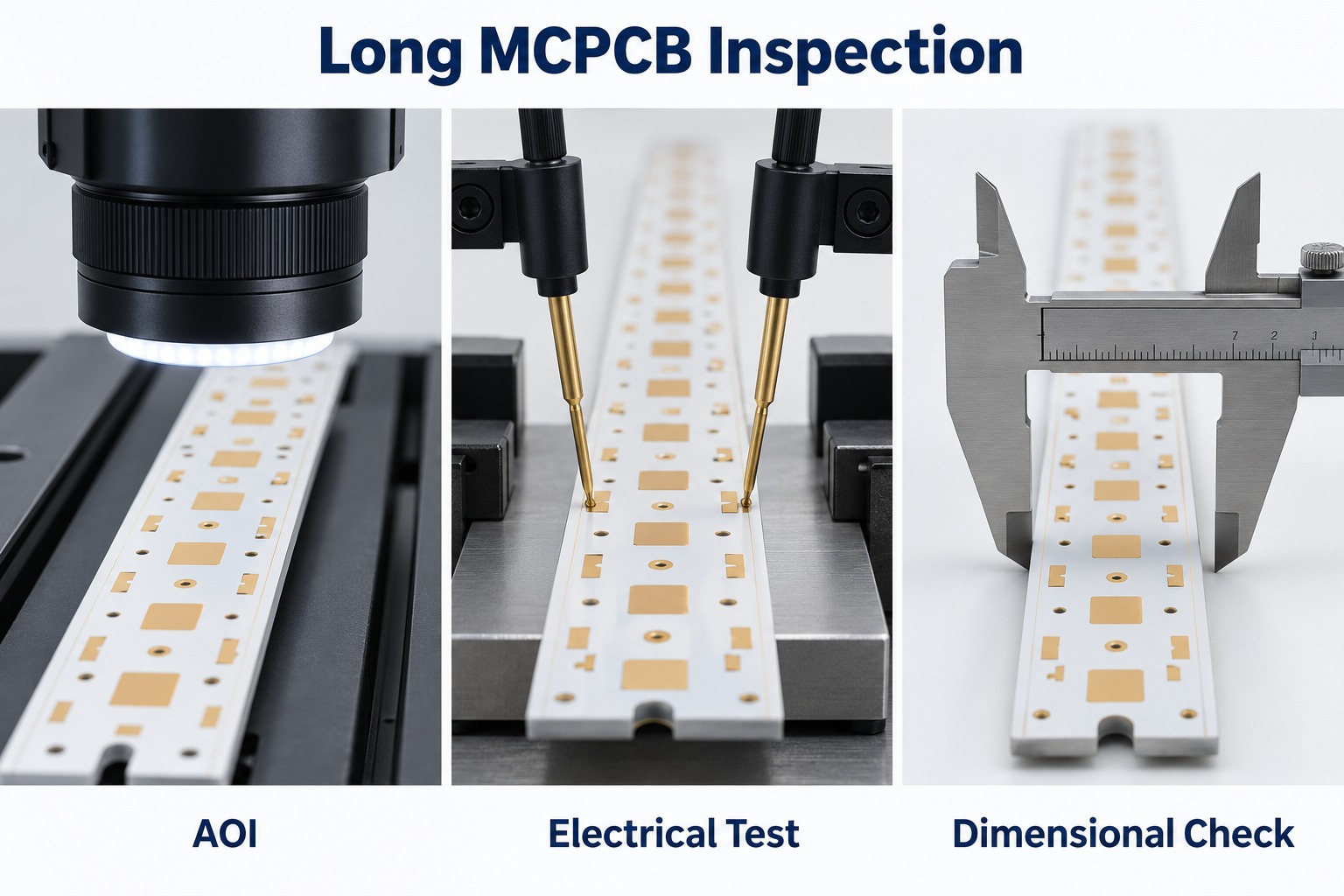
| Inspection / Test | Main Purpose |
|---|---|
| AOI | Detect pattern defects, opens, shorts, and etching issues |
| Electrical Test | Verify continuity and isolation |
| Dimensional Inspection | Check length, width, holes, slots, and profile |
| Flatness Inspection | Check bow and deformation |
| Solder Mask Inspection | Verify registration and coverage |
| Surface Finish Inspection | Check exposed pad quality |
| Material Verification | Confirm aluminum and dielectric specification |
| Visual Inspection | Detect scratches, dents, and edge damage |
Electrical testing may use:
- Flying probe
- Dedicated fixture testing
- Other netlist-based methods
After assembly, additional inspection may include:
- SPI
- AOI
- X-ray
- ICT
- Functional testing
Bare-board inspection and PCBA inspection should remain separate control stages.
Why Is One-Stop PCB and PCBA Manufacturing Better for LED Lighting Buyers?
One-stop PCB and PCBA manufacturing gives LED lighting buyers better traceability, easier communication, and tighter coordination between board fabrication and assembly.
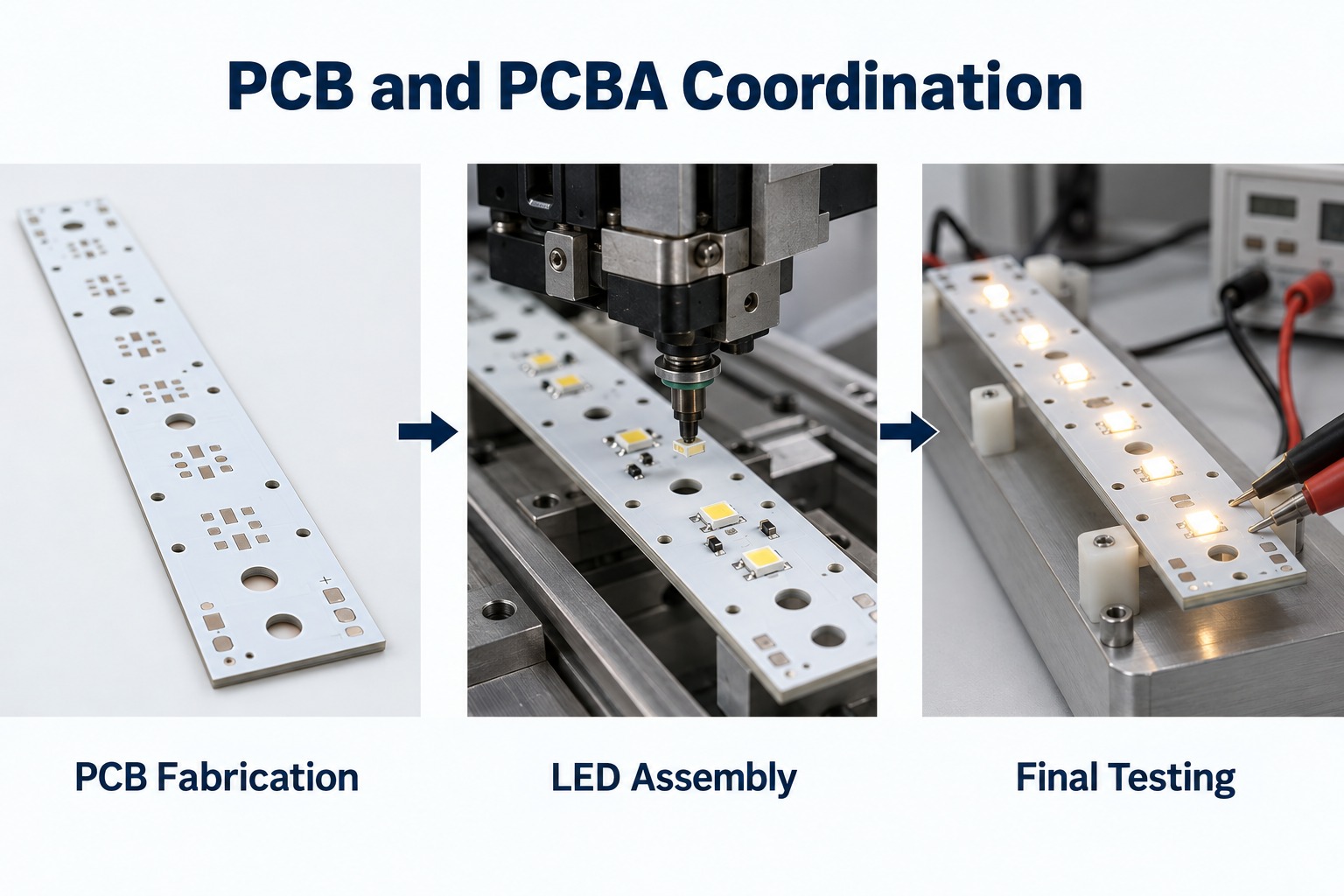
PCB and PCBA problems are easier to trace
When one supplier manages both stages, it is easier to identify whether a defect comes from:
- Bare PCB
- Solder paste printing
- LED placement
- Reflow
- Components
- Assembly fixtures
This reduces repeated communication between separate PCB and SMT suppliers.
LED bin and BOM management becomes easier
LED projects often require tight control of:
- LED bin
- Color temperature
- Forward voltage
- Driver IC
- Resistors
- Connectors
- Approved substitutions
Centralized material control makes batch traceability simpler.
SMT parameters can match the MCPCB
Aluminum PCBs have different thermal behavior from FR4 boards. Assembly settings should therefore be matched to the real MCPCB structure.
Important parameters include:
- Preheating
- Reflow profile
- Solder paste behavior
- Fixture support
- Thermal balance
DFM and DFA can be reviewed together
The same engineering team can review:
- PCB layout
- Panelization
- LED footprint
- Component spacing
- Fiducials
- Tooling holes
- Test points
- Assembly direction
This reduces the risk of designing a board that is easy to fabricate but difficult to assemble.
Responsibility is clearer
Fewer manufacturing interfaces mean fewer delays when a problem needs to be investigated.
Prototype-to-volume transfer is smoother
Engineering changes, inspection findings, and process settings can remain within the same manufacturing system as production moves through:
- Prototype
- Pilot run
- Volume production
At EBest Circuit, we support both MCPCB fabrication and PCB assembly, allowing our engineering team to review bare-board and assembly requirements together before production.
What Should Buyers Ask an Aluminum PCB Manufacturer?
Buyers should ask questions that confirm whether the supplier can control the actual board design and production process. Ask the supplier to review the actual aluminum PCB design.
A practical checklist includes:
- What is your maximum board length?
- What is your maximum panel size?
- What aluminum thicknesses are available?
- What copper weights can you produce?
- What dielectric options do you offer?
- What thermal conductivity options are available?
- Can you provide thermal resistance data?
- What breakdown voltage can the dielectric support?
- What surface finishes are available?
- What flatness can you control?
- What IPC class can you support?
- Do you use AOI?
- How is electrical testing performed?
- How are long boards dimensionally inspected?
- What are the prototype and production lead times?
- What is the MOQ?
- Are tooling or NRE charges required?
- Can you provide PCB assembly?
- How is lot traceability managed?
- What quality certifications do you hold?
For long narrow boards, buyers should also ask how the supplier handles the PCB during routing, inspection, storage, and packaging.
These steps have a direct impact on final flatness and mechanical condition.
What Files Should You Send for an Aluminum PCB Quote?
For an accurate aluminum PCB quotation, send enough information for the manufacturer to review dimensions, materials, tolerances, and production requirements.
For bare aluminum PCB projects:
- Gerber files
- Fabrication drawing
- Board dimensions
- Board thickness
- Copper weight
- Aluminum specification
- Dielectric requirement
- Thermal conductivity
- Surface finish
- Quantity
- Annual demand, if available
- Flatness requirement
- Critical tolerances
- Electrical test requirements
For PCB assembly projects:
- BOM
- Pick-and-place file
- Assembly drawing
- Gerber files
- LED bin requirements
- Approved component manufacturers
- Substitution rules
- Test requirements
- Prototype quantity
- Production quantity
- Forecast, if available
For LED lighting projects, LED bin requirements should be clearly defined when color temperature, brightness, or forward-voltage matching is important.
FAQ About Long Aluminum PCBs
Can a long aluminum PCB replace a flexible LED strip? Only where the installation accepts a rigid board. A conventional aluminum PCB cannot follow curves like a flexible strip, so the mechanical layout and mounting method may need to change.
Is white solder mask an electrical insulation layer? No. In the basic metal-core stackup, the specified dielectric isolates the copper circuit from the aluminum base. White solder mask covers the circuit surface and must not be treated as a replacement for that insulation.
Can LEDs and their driver use the same aluminum board? They can share a board if routing, insulation, thermal conditions and assembly access permit. A separate FR-4 driver board may be more practical when the driver requires more complex routing.
Does increasing aluminum thickness always solve overheating? No. It can change heat spreading and stiffness, but it does not remove resistance in the dielectric or a poor board-to-heatsink interface. Check the complete thermal path before changing thickness.
Can a long board be divided into shorter modules? Yes, if the optical and electrical design allows it. The trade-off is easier handling against additional interconnections, mechanical joints and possible gaps in the light pattern.
Why Choose EBest Circuit for Long Aluminum PCB and PCBA Projects?
EBest Circuit combines aluminum PCB fabrication, component sourcing, and PCB assembly, allowing the bare board, LEDs, BOM, assembly process, and inspection requirements to be reviewed as one project.
For long and narrow LED boards, our engineering review can cover:
- Board length, width, and thickness
- Aluminum and dielectric selection
- Copper weight and circuit layout
- Flatness and dimensional requirements
- Panelization and routing
- LED bin and BOM control
- SMT process requirements
- AOI and electrical testing
- PCBA inspection and functional testing
- Packaging for long boards
We treat long-board requirements separately from standard MCPCB production because equipment size, handling, flatness, and dimensional control can become more critical as board length increases.
If your project involves a long aluminum PCB, LED MCPCB, FR4 control board, or complete PCB assembly, send your Gerber files, BOM, drawings, quantities, and manufacturing requirements to sales@bestpcbs.com. If assembly is required, include the BOM, pick-and-place file, and test requirements as well.
Our engineering team can review manufacturability, thermal requirements, assembly conditions, and production planning before quotation.
You may also like


Tags: aluminum pcb design, aluminum pcb manufacturer, Aluminum PCB Stackup, aluminum pcb thermal conductivity, long aluminum pcb
