PCB surface finish shelf life is the period during which a correctly packaged and stored bare board is expected to remain suitable for the specified assembly process without unusual restoration. It is not the same as the service life of an assembled product, and it is not a universal number printed on every board.
ENIG, HASL, OSP, immersion silver and immersion tin protect exposed copper in different ways. Their practical storage windows depend on finish quality, packaging integrity, temperature, humidity, airborne contamination, handling and the soldering process. Buyers should therefore ask for a documented shelf-life basis and an acceptance plan instead of relying on a generic online table.
What PCB Surface Finish Shelf Life Actually Means
For bare PCBs, shelf life is mainly a solderability and surface-integrity question. A date does not prove that every pad is good before it or unusable after it. It defines the manufacturer’s expected window under stated storage conditions and helps control risk.
This differs from moisture sensitivity of components, laminate moisture absorption, and the operating life of a populated assembly. Those issues can interact, but each needs its own evidence and corrective action.
Why There Is No Universal Expiration Date
The same finish name can deliver different storage performance when deposit thickness, porosity, cleanliness, packaging or handling changes. A sealed lot held in controlled storage is not equivalent to an opened bag exposed to humid or sulfur-bearing air.
- The finish and its qualified process determine the starting protection.
- The package barrier, desiccant and seal condition control environmental exposure.
- Storage temperature and humidity affect oxidation and moisture uptake.
- Fingerprints, dust and sulfur contamination can damage solderability locally.
- Multiple openings and partial-lot use reset the practical risk assessment.
Use the supplier’s stated conditions and lot records. Treat online month ranges as planning references, not acceptance guarantees.
How Common PCB Surface Finishes Compare for Storage
Finish selection changes both the protective mechanism and the likely failure mode during storage.
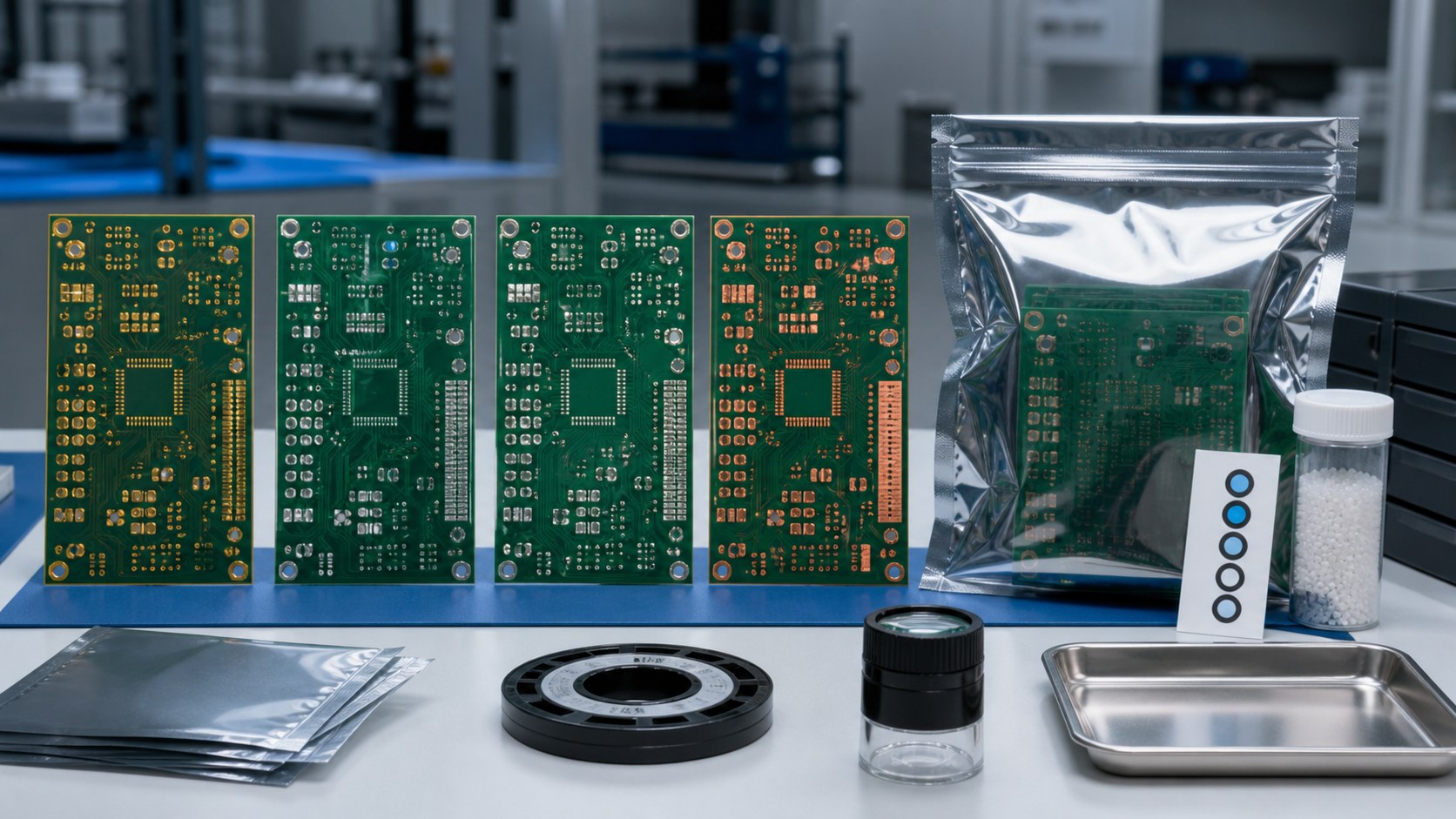
| Finish | Storage strength | Main concern before assembly |
| ENIG | Nickel barrier with gold-protected contact surface | Contamination, deposit quality and wetting verification |
| HASL / lead-free HASL | Solder-coated surface can be robust for conventional assembly | Planarity, oxidation and compatibility with fine pitch |
| OSP | Thin organic protection with excellent flatness | Handling, heat-cycle exposure and surface-film damage |
| Immersion silver | Flat surface suitable for fine-pitch assembly | Tarnish and sulfur exposure |
| Immersion tin | Flat solderable tin surface | Oxidation, intermetallic growth and handling history |
For a deeper finish-selection comparison, review our PCB immersion gold guide and the OSP guidance for HDI boards.
Storage Conditions That Shorten the Usable Window
Humidity, temperature cycling, corrosive gases and careless handling can reduce usable life faster than calendar time alone. Damaged moisture-barrier bags, exhausted desiccant, unrecorded bag openings and storage near cardboard, rubber or process chemicals deserve attention.
Keep bare boards in the specified package until needed. Use clean gloves, ESD controls and a controlled staging area. Do not stack exposed boards pad-to-pad or clean them with an unapproved chemical.
Planning a build with stored or date-sensitive bare PCBs?
Send the finish, fabrication date, package condition, storage history and assembly profile. EBest Circuit can review the risk before the lot reaches the line.
Packaging and Inventory Controls That Preserve Solderability
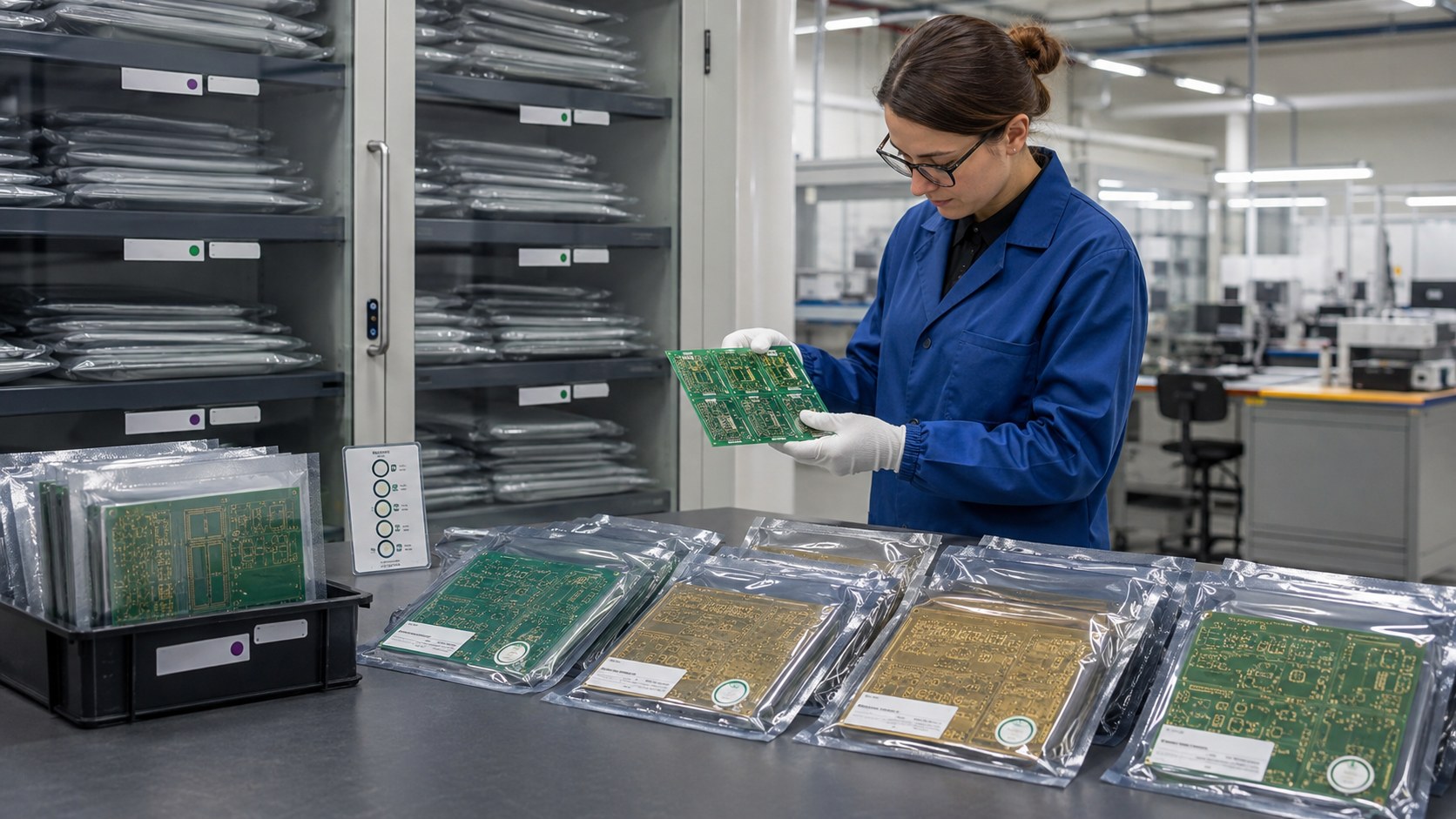
A useful storage system is traceable, sealed and easy to audit. It should identify the lot, finish, packaging date, stated shelf life, storage condition and bag-opening history.
- Receive the lot and inspect the outer package, seal and labels.
- Record the fabrication/packaging date and supplier storage conditions.
- Store sealed material in the controlled location defined by the supplier.
- Issue inventory by lot and first-expiring-first-out logic.
- Record each opening, partial withdrawal and reseal action.
- Escalate damaged, untraceable or aged lots before assembly scheduling.
How to Assess Boards Near or Beyond the Stated Date
Do not accept or scrap an aged lot from the date alone. Quarantine it, review traceability and packaging history, inspect representative boards and agree the required solderability evidence.
Useful checks may include visual inspection, package-condition review, surface contamination investigation and a recognized solderability test selected for the finish and assembly method. Sampling must represent the lot; one attractive board does not prove every panel is suitable.
If corrosion, discoloration, exposed copper, contamination or poor wetting appears, engineering and quality teams should decide whether controlled cleaning, rework, finish restoration or replacement is permitted. The disposition must protect pad geometry and product requirements.
When Baking Helps—and When It Does Not
Baking may reduce absorbed moisture, but it does not reverse oxidation, tarnish, contamination or a degraded surface deposit. Excess heat can also affect materials, solder mask, markings or board flatness.
Use baking only under a documented procedure compatible with the laminate, finish and board construction. Do not treat it as an automatic shelf-life reset. After any recovery action, verify the property that was actually at risk.
How Storage History Affects Assembly Yield
Surface degradation usually appears as a process problem: incomplete wetting, dewetting, nonwetting, excessive voiding, inconsistent hole fill or rework. Fine-pitch pads and demanding thermal profiles can expose marginal solderability sooner.
Before a critical build, align the board finish with solder paste, flux, stencil, component termination and reflow or wave profile. If the lot has unusual storage history, a small controlled trial can be safer than discovering the issue across a full production batch.
Need a finish that matches both storage and assembly?
Share your component pitch, soldering method, expected inventory time, compliance needs and handling environment for a finish-and-process DFM review.
How to Select a Surface Finish for Long or Uncertain Storage
Choose the finish from the whole product and supply-chain requirement, not shelf life alone. Consider pad flatness, fine-pitch assembly, wire bonding or contacts, number of thermal excursions, rework, environmental compliance, cost and expected inventory delay.
If boards may sit for months before assembly, tell the fabricator during quotation. The team can review finish suitability, package configuration, lot labeling and whether staged releases would reduce exposure. For harsh end-use environments, also review our PCB fabrication for harsh environments guide.
What to Put in the PCB RFQ and Purchase Specification
The RFQ should turn “long shelf life” into verifiable requirements. Send the Gerber or ODB++ data, fabrication drawing, stackup, board quantity, finish, compliance needs, assembly method, expected storage duration, packaging preference and acceptance standard.
- Ask how shelf life is defined and from which date it starts.
- State the required package, desiccant, humidity indicator and lot labels.
- Define storage and handling conditions.
- Agree what evidence is supplied and what triggers reinspection.
- Identify fine-pitch, press-fit, wire-bond or contact areas with special needs.
- Keep deviations and recovery actions subject to written approval.
How EBest Circuit Supports Finish, Packaging, and Assembly Decisions
EBest Circuit can review the finish as part of fabrication and assembly DFM rather than as an isolated coating choice. The review connects pad geometry, component technology, soldering process, expected storage, handling and inspection needs.
Send Gerber/ODB++, BOM, CPL, quantities, material and copper requirements, preferred finish, test needs and target delivery. We can flag missing requirements, discuss suitable packaging and prepare a quote based on the actual build. Specific shelf-life claims remain conditional on the approved finish specification and storage plan.
PCB Surface Finish Shelf Life FAQ
What is the typical shelf life of a bare PCB?
There is no single value for every PCB. Use the fabricator’s stated period and conditions for the specific finish, lot, packaging and storage environment.
Does an expired date mean the PCB must be scrapped?
No. Quarantine the lot and use traceability, package history, inspection and agreed solderability testing to make the disposition.
Which PCB finish has the longest shelf life?
The answer depends on qualified process quality and application constraints. ENIG and solder-coated finishes are often considered for storage robustness, but flatness, bonding, cost and assembly needs still govern selection.
Why is OSP more handling-sensitive?
OSP relies on a thin organic film over copper. Abrasion, contamination and repeated heat exposure can reduce its protection and solderability.
Can PCB baking restore an aged surface finish?
Baking addresses moisture under an approved procedure; it does not reverse oxidation, tarnish or contamination.
Should unopened bags be trusted without inspection?
Inspect package integrity, labels, seal condition and storage records. An unopened but damaged or poorly stored bag may still need escalation.
What records should follow a stored PCB lot?
Keep lot identity, finish, packaging date, stated conditions, receipt inspection, storage location, openings, reseals and disposition decisions.
Can surface finish shelf life affect reflow yield?
Yes. Marginal solderability can contribute to incomplete wetting, dewetting and inconsistent joints, especially on fine-pitch or demanding assemblies.
Is bare-board shelf life the same as component MSL?
No. Component moisture sensitivity and bare-board storage risk are separate controls, although both can affect assembly.
What should I send for a shelf-life review?
Send the board files, finish specification, lot and packaging dates, storage/opening history, photographs, planned assembly process and target schedule.
Turn shelf-life uncertainty into an assembly-ready plan.
Send your Gerber/ODB++, BOM, CPL, finish, storage history, quantity and target delivery. EBest Circuit will review finish, packaging and assembly risks before production.