





What Is a High Density Interconnect PCB?
High Density Interconnect PCB refers to a multilayer structure that uses laser microvias, thin dielectric layers, and sequential lamination to increase routing density and improve electrical performance. Instead of routing signals through long mechanical vias, HDI stackup design focuses on short vertical transitions between adjacent layers. This reduces inductance, improves impedance control, and allows fine-pitch BGA escape without increasing board size.
Typical HDI electrical parameters used in engineering documentation include:
- Line width / spacing: 60–75 µm (advanced builds may reach 40 µm)
- Microvia finished hole: 75–100 µm
- Dielectric thickness between HDI layers: 40–80 µm
- Copper thickness: 12–18 µm outer HDI layers, 18–35 µm inner layers
HDI stackup design emphasizes signal-reference plane proximity. Short dielectric spacing lowers loop inductance and stabilizes return paths, which becomes critical in AI server and high-speed computing boards.
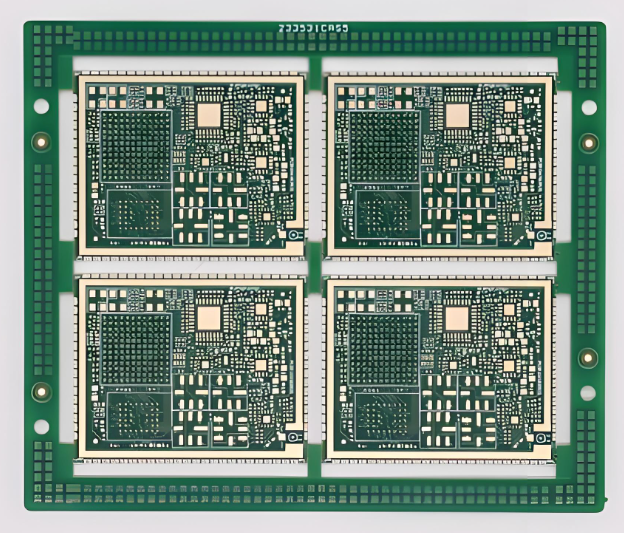
High Density Interconnect PCB
When Should You Choose an HDI PCB Instead of a Standard Multilayer PCB for AI Server or High-Speed Systems?
HDI becomes necessary when routing density or electrical requirements exceed conventional PCB capability. AI server motherboards, accelerator modules, and edge computing boards frequently adopt HDI because processor pin counts and high-speed channels increase dramatically.
Engineering decision indicators:
- BGA pitch ≤ 0.5 mm
- High-speed links above 10–25 Gbps
- Large processor or FPGA packages exceeding 1000 pins
- Board size constraints requiring compact layouts
- Power delivery networks needing dense decoupling arrays
In AI server designs, HDI reduces via stubs and shortens differential pair transitions. This helps maintain insertion loss budgets and improves eye-diagram margins during high-frequency operation.
How Do 1+N+1 and 2+N+2 HDI Stackup Design Strategies Affect Routing Density and Manufacturing Risk?
HDI Stackup Design Comparison Table
| Stackup Type | Typical Microvia Depth | Routing Density | Lamination Cycles | Application Example |
| 1+N+1 | L1-L2 / L(n-1)-Ln | Medium | 2 cycles | Robotics controllers, embedded CPU boards |
| 2+N+2 | L1-L2-L3 stacks | High | 4 cycles | AI server compute modules |
| 3+N+3 | Multi-stack microvias | Very High | 6+ cycles | Advanced telecom or HPC |
More build-up layers increase routing flexibility but also introduce additional lamination cycles. Engineers often begin with 1+N+1 and evaluate whether further build-up layers are required based on BGA escape results.
HDI Microvia Engineering Parameter Table
| Parameter | Recommended Range | Engineering Impact |
| Laser Via Diameter | 75–100 µm | Routing density and plating reliability |
| Capture Pad Size | 150–250 µm | Annular ring control |
| Aspect Ratio | ≤ 0.8:1 | Prevents plating voids |
| Via Structure | Staggered preferred | Improves thermal reliability |
| Copper Fill Thickness | 15–25 µm cap | Required for via-in-pad |
Microvia planning should begin during stackup definition because changing via structure later can require redesigning large portions of the layout.
When Does Via-in-Pad Become Mandatory in Fine-Pitch HDI PCB and AI Server BGA Fanout?
Via-in-pad is used when routing channels around BGA pads are insufficient. In AI server processors or high-density networking ASICs, pad pitch often forces vertical signal escape.
Engineering scenarios where VIP is justified:
- 0.4 mm pitch GPU or AI accelerator packages
- High-speed differential pairs requiring shortest path
- Dense decoupling networks under core voltage rails
VIP pads require copper filled microvias, planarization to maintain flatness, and careful solder mask design.
How Does HDI PCB Compare to Standard PCB in Signal Integrity, Size Reduction, and Layer Utilization?
| Engineering Metric | HDI PCB | Standard PCB |
| Via Stub Length | Very Short | Long unless backdrilled |
| Routing Channel Density | High | Limited |
| Loop Inductance | Lower | Higher |
| Board Area | Reduced | Larger |
| Layer Efficiency | High utilization | Lower utilization |
| EMI Performance | Improved due to compact loops | Depends on layout strategy |
Shorter vertical transitions in HDI improve signal eye margin in high-frequency environments such as AI servers.
What Is the Real HDI Fabrication Flow and Which Process Steps Affect Yield Most?
HDI Fabrication Process Table
| Step | Key Parameter Control | Risk Area |
| Core Lamination | Thickness tolerance ±10 µm | Warpage |
| Build-Up Lamination | Resin flow uniformity | Void formation |
| Laser Drilling | Position accuracy ±20 µm | Via misalignment |
| Copper Plating | Current density control | Microvia reliability |
| Imaging & Etch | Line width tolerance ±10 µm | Signal impedance shift |
Microvia plating uniformity and dielectric thickness control are major contributors to HDI manufacturing yield.
Which Materials Are Preferred for HDI Stackup Design in AI Server PCB and High-Speed Applications?
| Material Category | Dk Range | Df Range | Typical Use |
| High Tg FR-4 | 3.8–4.2 | 0.015–0.018 | General HDI boards |
| Low Loss Laminate | 3.2–3.6 | 0.004–0.009 | AI server and networking |
| RCC Thin Dielectric | ~3.5 | 0.01 | Build-up layers |
Material selection should align with both electrical performance targets and thermal cycling conditions during assembly.
How Do Engineers Route Fine-Pitch BGA on HDI PCB Without Signal Integrity Problems or Rework Risk?
Routing strategy begins with stackup planning rather than trace drawing. Engineers typically follow a structured workflow:
- Assign ground reference layers adjacent to signal layers
- Escape first BGA rows using microvias to inner routing layers
- Maintain differential pair spacing within controlled tolerance
- Avoid excessive layer transitions that introduce impedance discontinuities
Typical HDI differential routing parameters used in AI server layouts:
- Pair spacing: 100–150 µm
- Trace width: 65–80 µm
- Reference plane spacing: 60 µm
How Can You Improve HDI PCB Reliability Against CAF, Microvia Fatigue, and Warpage?
| Failure Mechanism | Root Cause | Engineering Control |
| CAF Growth | Moisture + voltage bias | Increase conductor spacing |
| Microvia Fatigue | CTE mismatch | Use staggered microvias |
| Warpage | Copper imbalance | Symmetrical copper distribution |
Balanced copper distribution across layers significantly improves long-term reliability in high-power computing environments.
What Drives HDI PCB Cost and How Does a Detailed HDI Cost Breakdown Help Engineering Decisions?
HDI Cost Breakdown Engineering Table
| Cost Driver | Process Impact | Cost Influence |
| Sequential Lamination | Additional build-up layers | High |
| Laser Microvia Drilling | Equipment time | Medium-High |
| Copper Filled VIP | Extra plating steps | Medium |
| Fine Line Imaging | Tight tolerance control | Medium |
| Low Loss Material | Material premium | Variable |
Understanding HDI cost breakdown allows engineers to optimize stackup design early and avoid unnecessary process steps.
Why Choose EBest as Your High Density Interconnect PCB Manufacturer?
If you are moving into HDI PCB projects, your biggest risk is not the CAD work. It is misalignment between design intent and fabrication reality. EBest Circuit positions itself as a one-stop PCBA service provider that better understands the needs of engineers, so your stackup, microvias, and assembly choices stay consistent from quote to shipment.
- Free DFM and process adaptation suggestions before release
- 20 years serving 1800+ customers and 10,000+ engineers
- One-Stop Service: PCB, components, PCBA, testing, and box-building
- No MOQ with personal service for prototypes and small batches
- ISO9001/ISO13485, IATF16949, AS9100D quality systems support
- MES & traceability for process tracking and accountability
- 1.5-week rapid PCBA delivery options for urgent programs
- Technical support before and after sales, with prompt feedback (often within 12 hours)
- Prototype & small volume welcome, with quick turn-out and on-time delivery focus
- High quality builds, special requests available, supported by a strong R&D team
FAQs
1. What BGA pitch usually requires HDI stackup design?
HDI stackup design is commonly selected when BGA pitch approaches 0.5 mm because routing density becomes constrained using only mechanical vias.
2. Is 2+N+2 always required for AI server HDI PCB?
Many AI server boards begin with 1+N+1 structures and only move to 2+N+2 when routing density requires additional build-up layers.
3. Are stacked microvias reliable for high-power systems?
Stacked microvias can be reliable when copper filling and plating thickness are well controlled, though staggered structures often improve durability.
4. Does HDI PCB always reduce total layer count?
HDI improves routing efficiency and signal integrity but does not always reduce total layer count.
5. How early should HDI stackup design be finalized?
Stackup definition should occur before placement and routing to prevent redesign cycles.
Tags: hdi pcb design guide, hdi pcb manufacturer, hdi stackup, hdi technology, high density interconnect pcb