





Understanding the contract manufacturer vs OEM differences can save you time, money, and control over your own design. Here’s the twist most guides miss: you are probably the OEM. This article clears up the confusion—and helps you pick the right way to get your product built—in minutes, not weeks.
A note on where we fit in: at EBest Circuit (Best Technology), we’re the contract manufacturer—the partner you, as the OEM, can rely on to bring your design to life. With our own PCB and PCBA factories, we’d be glad to take your Gerber files and BOM and handle fabrication, sourcing, assembly, testing, and delivery, while you keep full ownership of your design and IP. If you have a project in mind, we’d be delighted to help—please feel free to reach out at sales@bestpcbs.com for a complimentary DFM review.
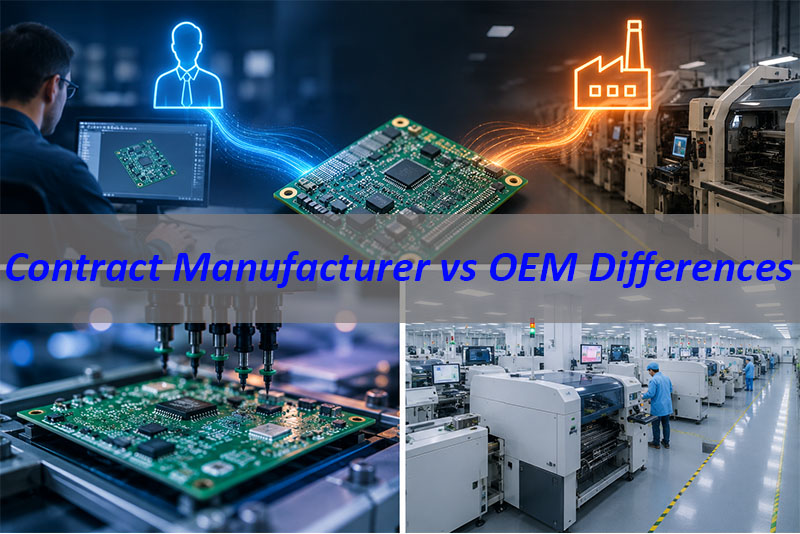
What Is an OEM and What Is a Contract Manufacturer?
Here’s the part most articles skip: if you have a product to bring to market, you are the OEM.
OEM (Original Equipment Manufacturer): The brand owner—the company that owns the product, design, and IP and sells it under its own name (Apple, Dell, or your own startup). That’s you.
Contract Manufacturer (CM): The factory you hire to build your product to your design. You send Gerber files + BOM; they fabricate, source, assemble, test, and deliver. You keep the IP.
ODM (Original Design Manufacturer): A factory that hands you a ready-made design to rebrand. You tweak the color or logo; they keep the base design.
So OEM isn’t a supplier you pick—it’s your role. The real decision is how you manufacture: hire a contract manufacturer to build your own design, or take an ODM’s ready design and rebrand it.
What Are the Key Differences Between OEM and Contract Manufacturer?
The honest answer: they aren’t competing options. As the OEM (the brand owner), you hire a contract manufacturer. They’re two sides of the same deal—you own the product; the CM builds it.
The choice that actually matters for you is between your two manufacturing routes:
- Contract manufacturer → your design, you own the IP, fully custom.
- ODM → their design, you rebrand—faster and cheaper, but you don’t own it.
Ownership drives a lot—but your cost, MOQ, lead time, and customization also depend on tooling, component availability, test requirements, certification needs, and production volume.
Contract Manufacturing vs OEM: A Side-by-Side Comparison
Since you’re the OEM, the comparison that matters is between your two real routes to production: a contract manufacturer vs an ODM.
| Factor (you’re the OEM either way) | Contract Manufacturer (build your design) | ODM (rebrand their design) |
|---|---|---|
| Who designs it | You | The ODM |
| Design / IP ownership | Yours | The ODM’s |
| How much you can customize | Full—built exactly to your spec | Minor (color, logo) |
| Your upfront cost | NRE, tooling, stencil, fixture, and setup may apply | Lower—the design already exists |
| Your MOQ | Supplier-dependent; many PCBA CMs support prototype to volume | Often tied to the ODM’s standard MOQ |
| Your speed to market | Fast once your design, BOM, and tests are finalized | Fastest—the design is ready |
| Your control | High | Low |
| Best for you when | You have your own design to protect | You want a fast, low-cost launch |
Pros and Cons of OEM vs Contract Manufacturer
You’re the OEM either way—here’s how your two routes stack up:
Contract Manufacturer (build your own design)
- For you: Full design & IP control · Fully custom to your spec · Scales with you
- Watch out: You need your own design · You’ll rely on a trusted, capable partner
ODM (rebrand a ready design)
- For you: Fastest to market · Lower upfront cost · No design work on your side
- Watch out: You don’t own the design · Hard to stand out · Others may sell the same base product
When Should You Use a Contract Manufacturer for Your Own Design?
Go the contract manufacturer route—rather than grabbing a ready-made ODM design—when you:
- Have your own design or IP to protect
- Need custom PCB & PCBA, not an off-the-shelf or rebranded board
- Want flexible volumes—samples, small batches, then scale
- Need DFM feedback before committing to production
- Plan to iterate and own your roadmap
(If you’d rather not own a design and just want a fast, cheap launch, an ODM is the alternative.)
When Does the OEM Model Make Sense?
Being a full OEM—developing and owning your own original product—makes sense when you:
- Want long-term brand equity and differentiation
- Have the R&D budget and time to develop and maintain a design
- Need a proven, fully-owned product line for industries like medical, auto, or aerospace
- Want to protect unique IP
In this model you still outsource the actual PCB & PCBA build—usually to a contract manufacturer. The alternative (an ODM) is faster and cheaper, but you give up design ownership.
How to Choose the Right PCB & PCBA Manufacturing Partner
If you own your design, a strong contract manufacturer is usually your best move. Here’s a 6-point checklist for what to look for:
- One-stop service — PCB fab + component sourcing + PCBA assembly + testing under one roof, so you don’t juggle vendors.
- Real DFM support — A partner who reviews your design before production and flags issues.
- Certifications — ISO9001, ISO13485, IATF16949, AS9100D for medical, auto, and aerospace.
- Own factory + supply chain — In-house PCB & PCBA plus a deep parts network keeps your quality and lead times under control.
- Sample & small-batch friendly — So you can validate before scaling.
- Fast, traceable delivery — Quick turnaround with full batch traceability.
EBest Circuit (Best Technology): Your One-Stop PCB & PCBA Contract Manufacturer
We tick every box above:
- One-stop PCB + PCBA — manufacturing, component sourcing, assembly, and testing in one place.
- Free DFM review + BOM optimization from engineers with 20 years of PCB/PCBA experience.
- Full-process engineering team that responds precisely to your design needs.
- Sample & small-batch support to help you validate and launch fast.
- Certified: ISO9001 / ISO13485 / IATF16949 / AS9100D.
- Own factories (PCB + PCBA) and 1,000+ supply-chain partners—your quality and lead times are easier to control.
- 20 years in PCBA, trusted by 10,000+ engineers and 1,800+ customers.
- Digital workshop with 5-second traceability on materials, batches, and production progress.
- 1.5-week fast PCBA delivery.
📩 Get a quote or free DFM review: sales@bestpcbs.com
FAQs: Contract Manufacturer vs OEM Differences Explained
Is an OEM the same as a contract manufacturer?
No—and they aren’t even competing options. An OEM is the brand owner (likely you); a contract manufacturer is the factory you hire to build your design. The OEM owns the product; the CM builds it.
What’s the difference between OEM and ODM?
As an OEM, you own your product and design. With an ODM, the factory owns the design and you simply rebrand it. So: OEM = your brand and your design; ODM = their design, your label.
Which is cheaper for me—building my own design or using an ODM?
An ODM has the lowest upfront engineering effort because the design already exists. Building your own design through a contract manufacturer may add NRE, tooling, stencil, or test-fixture costs, but you keep full IP and customization control.
Can a contract manufacturer help if my design isn’t finished?
Yes. A good CM offers DFM analysis and BOM optimization to refine your design before production. EBest does this for free.
Do I lose my IP with a contract manufacturer?
Normally, you keep ownership of your existing design, Gerber files, BOM, firmware, and product IP. That said, you should spell out IP protection clearly in your NDA, manufacturing agreement, tooling agreement, and engineering-change process.
What’s the typical lead time for custom PCBA?
It varies, but EBest delivers PCBA in as fast as 1.5 weeks.
Still weighing contract manufacturer vs OEM for your next project? We build everything from rigid, flex, and rigid-flex to multilayer, HDI, metal-core, and high-frequency PCBs—plus full PCBA assembly. Tell us what you’re building at sales@bestpcbs.com, and we’ll help you find the right fit, no strings attached.
You may also like
Tags: contract manufacturer vs oem differences, Contract Manufacturer vs OEM(, OEM vs ODM(, PCB & PCBA Manufacturing