





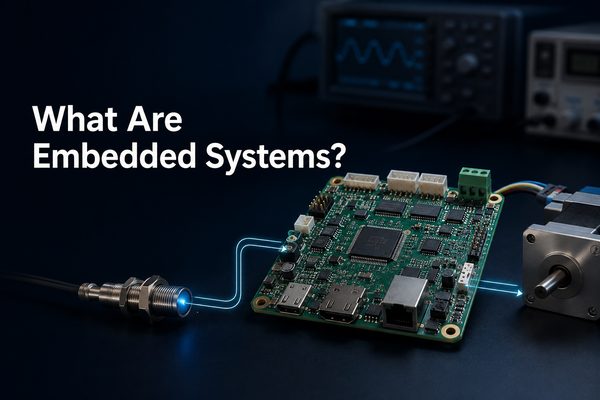
What are embedded systems? They are purpose-built computers integrated into products or machines to monitor inputs, make decisions, and control specific functions. An embedded system combines electronic hardware with firmware or software, and it is normally designed around limits such as response time, power, size, operating environment, and cost.
A simple thermostat and a multi-board industrial controller can both be embedded systems. Their complexity differs, but the design question is the same: can the hardware and software perform the required function predictably inside the finished product?
What Is an Embedded System?
An embedded system is a computer built into a larger product to perform a defined function or a limited group of related functions. It may be nearly invisible to the user, yet it can control sensing, communication, motion, power conversion, safety monitoring, or a user interface.
The word “embedded” describes the system’s role, not a particular processor or board size. A design may use an 8-bit microcontroller, a 32-bit MCU, a microprocessor running embedded Linux, an FPGA, or a system-on-chip. What makes it embedded is that its computing resources are selected and programmed for the product rather than for unrestricted general-purpose use.
How Does an Embedded System Work?
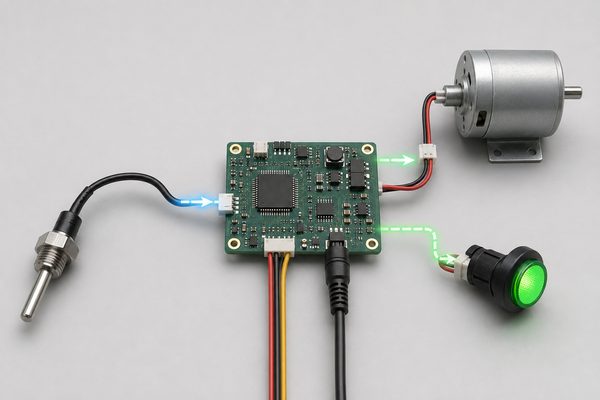
Most embedded systems follow an input-process-output loop. Sensors, switches, or communication interfaces provide input; the processor runs control logic; outputs then operate a display, relay, motor, valve, radio, or another subsystem.
- Input: A sensor, user control, or data interface supplies information.
- Signal conditioning: Analog front ends, filters, level shifters, or protection circuits prepare the signal.
- Processing: Firmware reads the input, applies rules or algorithms, and decides what should happen.
- Output: Driver circuits translate the processor’s low-power signal into a usable electrical or mechanical action.
- Feedback: The system checks the result and corrects its next action when closed-loop control is required.
What Are the Main Components of an Embedded System?
An embedded system needs more than a processor. The complete hardware platform must provide stable power, memory, timing, interfaces, protection, and a physical PCB that connects every function.
- Processor: An MCU, MPU, DSP, FPGA, or SoC executes the application.
- Memory: Flash or other nonvolatile memory stores code; RAM holds temporary data.
- Power circuitry: Regulators, filters, supervisors, and protection devices create stable supply rails.
- Clock and reset: Oscillators, crystals, reset circuits, and watchdogs control startup and timing.
- Inputs and outputs: GPIO, ADC, DAC, sensor interfaces, drivers, displays, and actuators connect computation to the physical world.
- Communication: UART, SPI, I2C, CAN, USB, Ethernet, and wireless modules exchange data where the application requires them.
- PCB and connectors: The board provides electrical interconnection, grounding, mechanical support, test access, and thermal paths.
An MCU often integrates the processor, memory, timers, ADCs, and common peripherals into one device. An MPU usually depends on external memory and may support a richer operating system. For a practical selection comparison, see our guide to microcontrollers versus microprocessors.
What Are Some Examples of Embedded Systems?
Embedded systems appear anywhere a product must sense, decide, communicate, or control without acting like a conventional desktop computer.
| System Example | Typical Input | Processing Task | Typical Output |
| Washing machine controller | Door, water-level, and temperature sensors | Run the selected cycle and safety interlocks | Valves, heater, pump, and motor |
| Industrial motor controller | Speed command and current feedback | Control speed, torque, and fault response | Gate-driver or inverter commands |
| Smart sensor node | Temperature, pressure, motion, or light | Filter readings and package data | Local alarm or network message |
| Portable monitor | Sensor and user-button inputs | Calculate and record measurements | Display, storage, and alerts |
| Vehicle control module | Network messages and local sensors | Apply control and diagnostic logic | Actuator commands and status data |
The exact architecture depends on consequences of failure, response time, environmental exposure, power budget, service life, and the interfaces shared with the rest of the product.
What Types of Embedded Systems Are Common?
Embedded systems can be grouped by how they operate, but the categories often overlap. A battery-powered IoT sensor, for example, is both portable and networked.
- Standalone systems perform their function locally without a continuous network connection.
- Networked systems exchange data with other controllers, gateways, servers, or cloud services.
- Real-time systems must produce a correct response within a defined timing window; missing the deadline can be as serious as producing the wrong value.
- Portable and battery-powered systems prioritize low-power states, efficient conversion, compact packaging, and controlled wake-up behavior.
- Safety- or mission-related systems add requirements for fault detection, redundancy, diagnostics, controlled changes, and documented verification according to the application’s governing requirements.
“Real-time” does not simply mean fast. It means the timing behavior is bounded and appropriate for the task. Likewise, not every embedded system needs an operating system; simple controllers can run a loop, state machine, and interrupt handlers directly on the hardware.
How Do Embedded Systems Differ from General-Purpose Computers?
An embedded system is optimized for a defined product function, while a general-purpose computer is built to run many user-selected applications. That difference changes the hardware, software, interfaces, and validation plan.
| Design Area | Embedded System | General-Purpose Computer |
| Primary role | Dedicated product or control function | Broad user-selected computing tasks |
| Hardware | Selected for a defined workload and environment | Standardized for flexibility and expansion |
| Software | Firmware, RTOS, or embedded OS tied closely to hardware | Full operating system and replaceable applications |
| User interface | May be minimal or absent | Usually includes rich user input and display |
| Validation | Checks the complete product function and interfaces | Emphasizes platform and application compatibility |
The boundary is not always sharp. A single-board computer can be used as a general development platform, then become part of an embedded product when its hardware and software are fixed around a specific application.
What Is the Difference Between Embedded Systems and IoT?
An embedded system performs local computing inside a device; an IoT device adds connectivity and normally participates in a wider data or service architecture. Every IoT endpoint contains embedded computing, but many embedded systems are not connected to the Internet.
A motor controller that regulates speed over a local feedback loop is an embedded system. Add a network interface, device identity, secure update path, gateway or cloud connection, and remote data service, and the product may become part of an IoT system. The extra connectivity changes power demand, memory use, cybersecurity planning, radio or Ethernet layout, regulatory work, and lifecycle support.
How Does Embedded Software Control the Hardware?
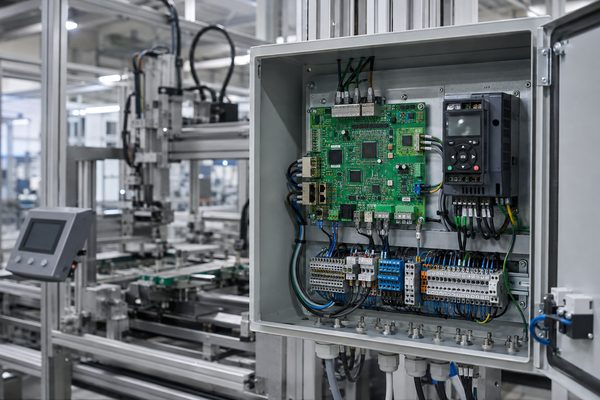
Embedded software configures the processor and peripherals, reads inputs, schedules work, handles faults, and drives outputs. It is usually closer to the hardware than desktop application software because register settings, interrupts, timing, memory limits, and electrical interfaces directly affect behavior.
A small controller may use bare-metal firmware with a main loop and interrupt service routines. A more complex design may use a real-time operating system to schedule tasks and manage communication, or embedded Linux when the product needs extensive networking, storage, graphics, or application frameworks. The most suitable option depends on timing, memory, boot time, update strategy, security, maintainability, and available engineering resources.
Which PCB Design Decisions Matter in Embedded Hardware?
PCB layout turns the system architecture into physical hardware, so electrical, thermal, mechanical, and test requirements must be resolved together rather than after routing.
- Power integrity: Place regulators, bulk capacitance, and high-frequency decoupling around the actual load and current path.
- Ground and return paths: Give clocks, buses, converters, radios, and analog signals continuous, controlled return paths.
- Signal integrity: Treat fast edge rates, not only clock frequency, as the trigger for impedance, termination, crosstalk, and via-stub review.
- Analog and digital interaction: Control noisy switching currents before separating areas mechanically or cutting ground planes.
- Protection and interfaces: Put ESD, surge, filtering, isolation, and level translation where the external connection enters the board.
- Thermal behavior: Estimate loss in processors, regulators, drivers, and power devices, then provide copper area, thermal vias, airflow, or a heatsink path as needed.
- Debug and production access: Reserve programming headers or pads, test points, boot controls, and serial diagnostics before the enclosure removes access.
- Manufacturability: Review package geometry, component spacing, assembly side, panelization, fiducials, inspection access, and component lifecycle before release.
A control board article can help translate these system requirements into board functions, while our embedded boards guide covers the board-level platform in more detail.
How Should an Embedded System Be Tested?
Testing should prove both that the PCB was assembled correctly and that the complete hardware-software system performs its intended function. A visually perfect board can still fail because of power sequencing, firmware, timing, communication, sensor calibration, or interaction with the enclosure.
- Pre-power checks: Inspect polarity, orientation, soldering, resistance to ground, and expected rail isolation.
- Controlled power-up: Use current limits and verify each rail, reset state, clock, and boot condition.
- Programming and interface checks: Confirm the debug path, firmware image, memory, communication ports, and peripheral identification.
- Functional tests: Apply representative inputs and confirm outputs, timing, fault handling, and recovery behavior.
- Production coverage: Combine appropriate inspection and electrical methods, which may include AOI, X-ray for hidden joints, in-circuit or flying-probe checks, and a product-specific functional fixture.
- System validation: Verify the assembled product under the environmental, electrical, mechanical, safety, EMC, and cybersecurity requirements that apply to its market and use case.
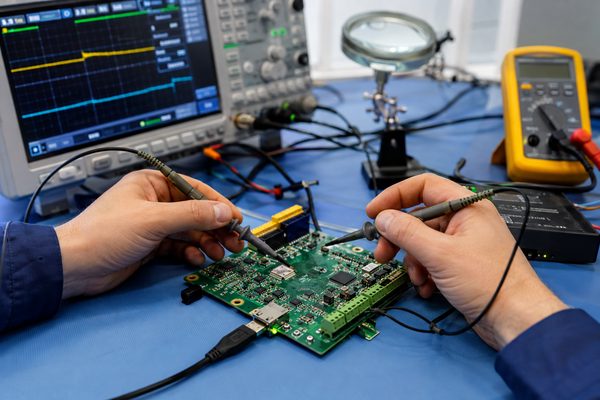
For a closer look at choosing coverage rather than relying on a single inspection step, see our guide to PCB assembly testing services.
FAQ About Embedded Systems
What are embedded systems examples? Common examples include appliance controllers, smart sensors, motor drives, vehicle control modules, printers, cameras, access-control devices, routers, portable instruments, and industrial monitoring equipment. The embedded computer is usually one subsystem inside the finished product.
What are embedded systems and why are they important? Embedded systems give products local sensing, decision-making, communication, and control. They can respond without sending every action to a remote computer, and their hardware can be tailored to the product’s power, size, cost, and environmental limits.
What are embedded systems in IoT? In an IoT product, the embedded system reads sensors, controls local functions, manages a communication interface, and prepares data for a gateway or cloud service. Secure identity, updates, data protection, and loss-of-network behavior become part of the design.
What are embedded systems in electronics? They are electronic assemblies that combine processing, memory, power, I/O, and firmware to perform a defined function. The processor may be a microcontroller, microprocessor, SoC, DSP, or FPGA, depending on the workload.
Do all embedded systems use an RTOS? No. A simple controller can run a loop, state machine, and interrupts without an operating system. An RTOS becomes useful when several time-sensitive tasks, communication stacks, resource sharing, or maintainable scheduling justify the added software layer.
Is a Raspberry Pi an embedded system? It can be. The board is a general development platform, but it becomes part of an embedded system when it is integrated into a product with a fixed function, controlled software image, defined interfaces, and a product-level validation plan.
How Can EBest Circuit Help Turn an Embedded Design into Hardware?
The practical answer to what are embedded systems is that hardware and software must work as one product. At EBest Circuit, we support PCB design review, prototyping, PCB fabrication, component sourcing, PCBA assembly, and testing for teams turning embedded designs into physical assemblies.
For an engineering review or quotation, send your Gerber files, BOM, quantity, assembly drawings, and available programming or functional-test requirements to sales@bestpcbs.com. We can review the manufacturing package and help identify PCB or assembly details that should be resolved before production.
You may also like

Tags: what are embedded systems, what are embedded systems and why are they important, what are embedded systems examples, what are embedded systems in electronics, what are embedded systems in iot