





CoWoS-S vs CoWoS-L is primarily a comparison of interposer structures: S uses a continuous silicon interposer, while L combines an RDL-based interposer with embedded local silicon interconnects. Both can connect logic and HBM inside an advanced package.
L is not simply a larger version of S, and the letter does not determine a finished chip’s speed or price. The useful comparison is where dense routing is placed, how the package scales, and which design requirements each qualified implementation meets.
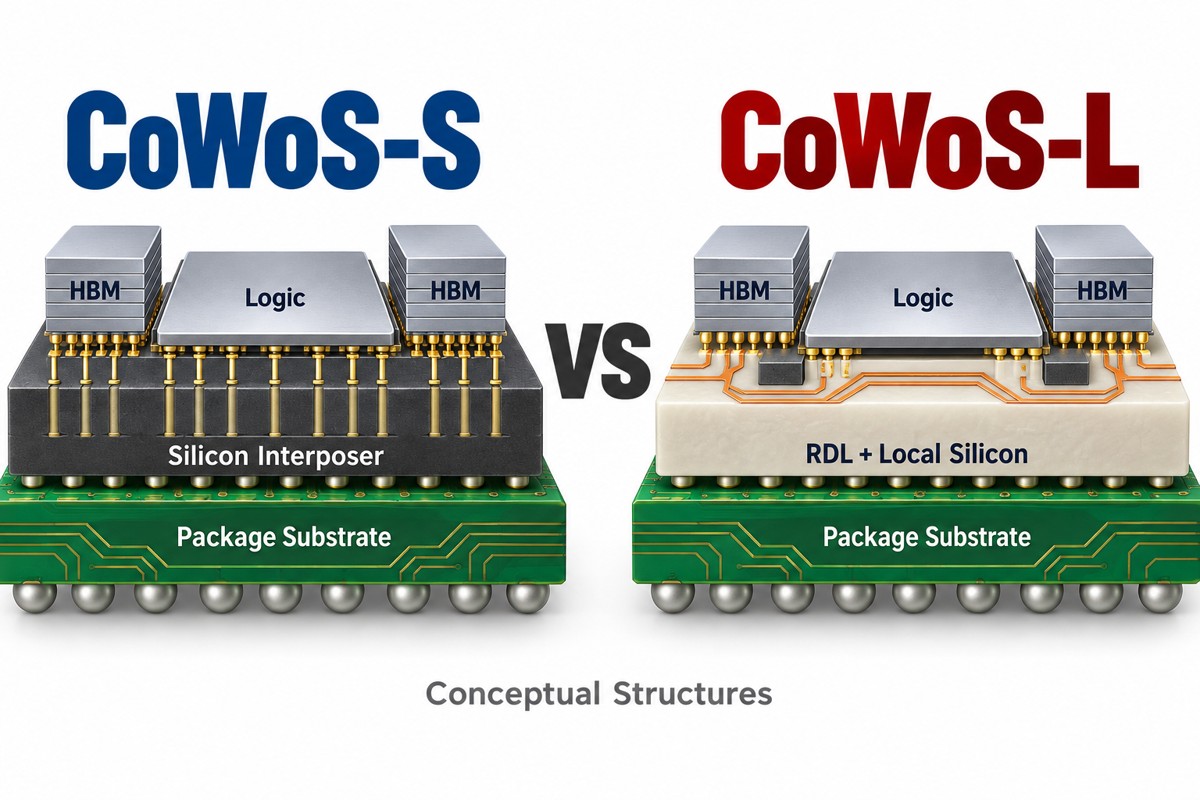
What Is the Main Difference Between CoWoS-S and CoWoS-L?
CoWoS-S places dense routing in a full silicon interposer; CoWoS-L uses local silicon bridges within a wider RDL interposer. The package substrate remains a separate structure beneath both.
| Feature | CoWoS-S | CoWoS-L |
| Interposer structure | Continuous silicon | RDL structure with embedded LSI |
| Dense die-to-die routing | Silicon interposer wiring | Local silicon interconnect regions |
| Layout consideration | Routing across the silicon interposer | Bridge placement plus wider RDL routing |
| Memory integration | Supports HBM configurations | Supports HBM configurations |
| Connection to the PCB | Through a separate package substrate | Through a separate package substrate |
This comparison describes the architecture. Exact routing rules, supported dies, dimensions, and qualification belong to the specific generation and product. TSMC’s official CoWoS technology overview is the primary reference for the structural distinction.
How Do Their Signal Paths Differ?
S routes die-to-die connections through the continuous silicon interposer; L uses local silicon regions for dense neighboring interfaces and RDL for the wider redistribution structure.
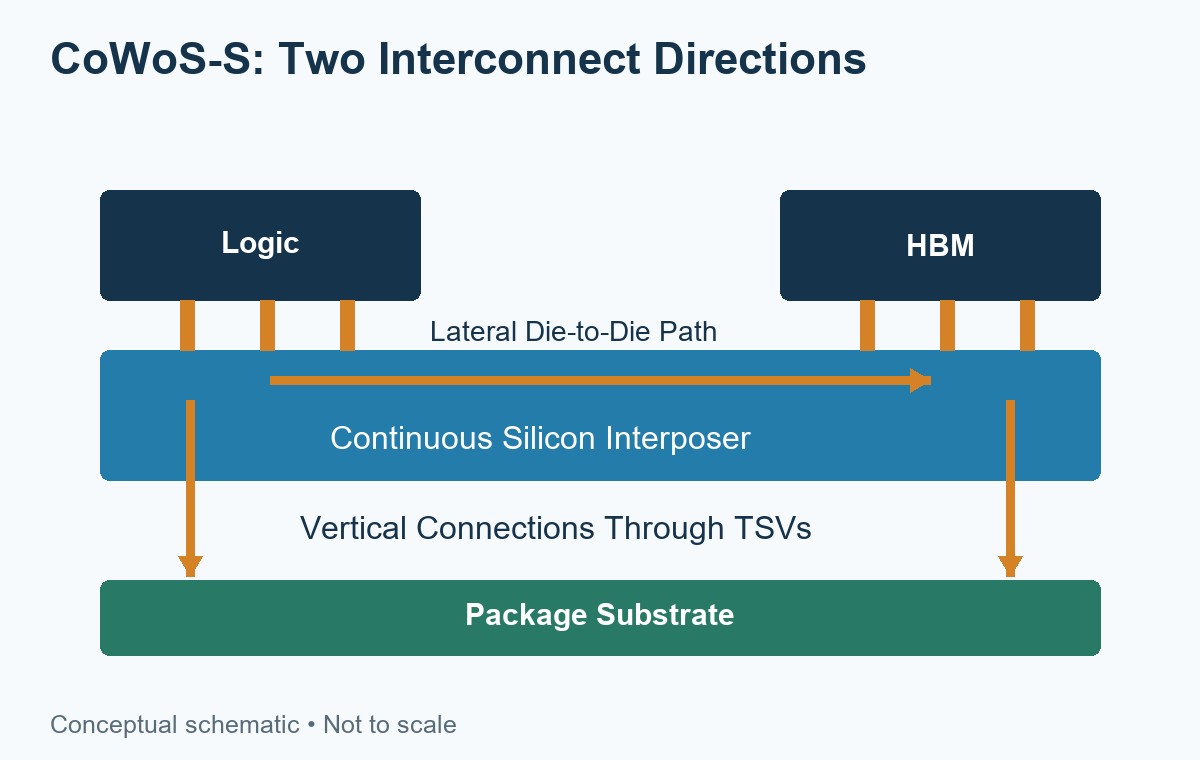
In an S layout, the silicon interposer is the common routing platform below the dies. In an L layout, a bridge must align with the interfaces it connects. That makes the die floorplan and local connection regions part of the architecture decision.
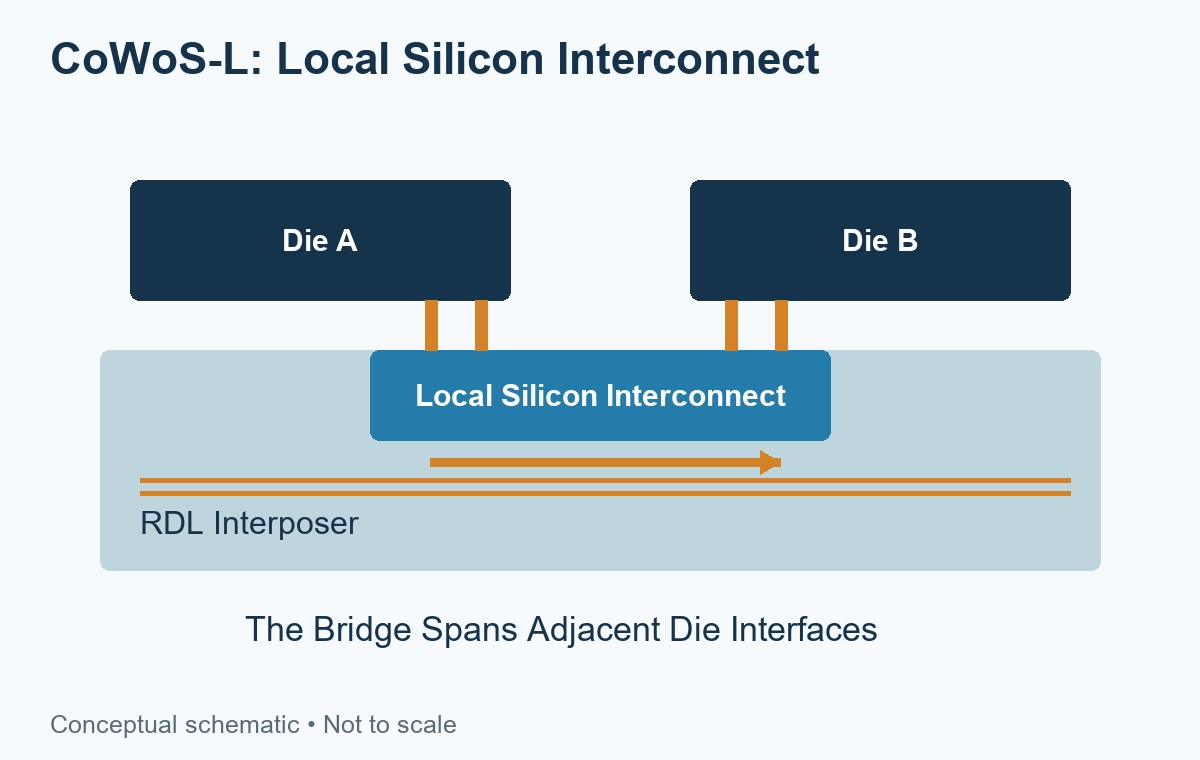
Neither illustration defines all signal or power paths in a real product. A board designer should not infer package pin assignments, routing pitch, or electrical models from a simplified cutaway.
The engineering comparison is routing availability versus routing localization. S offers a continuous silicon platform on which to organize connections among the dies. L requires dense interfaces to line up with local silicon regions, while wider redistribution uses the surrounding RDL. L therefore makes bridge placement an explicit floorplanning constraint; S still has congestion, layer-count, and interposer-area constraints.
Which Architecture Supports Larger Interposer Areas?
CoWoS-L is TSMC’s local-silicon approach for extending the interposer platform beyond the area served by its published CoWoS-S offering.
The public overview lists S up to 3.3 reticles, approximately 2,700 mm², and identifies a 3.5-reticle L generation in production since 2024. These figures describe particular platform generations, not a fixed area ratio or a universal limit on every future product.
Compare dated, qualified configurations. Do not compare an S production specification with an L roadmap target and describe both as equally available. Interposer area also differs from package outline, usable die area, and system PCB dimensions.
Is CoWoS-L Faster or Cheaper Than CoWoS-S?
CoWoS-L is attractive when the design needs a larger integration area while retaining dense local links; CoWoS-S remains relevant when the die arrangement fits a qualified continuous-silicon platform. Neither architecture alone determines a finished device’s speed or price.
- Bandwidth: compare the memory generation, interface width, transfer rate, and controller.
- Electrical performance: compare the actual channels and supply network under matching conditions.
- Cost: include dies, interposer, substrate, assembly, test, qualification, and production volume.
- Availability: confirm the specific qualified configuration and supply schedule.
Replacing full-area silicon with local silicon changes the material structure, but it does not prove a lower finished-package price. Likewise, a larger interposer may accommodate a different die arrangement without making each connection faster.
A useful cost comparison is total build and test cost divided by the number of passing packages. Less full-area silicon is only one input. Bridge integration, substrate complexity, assembly losses, and the value of attached logic and HBM can outweigh that saving. Compare the same functional target and production assumptions, not unlike products.
For electrical comparison, use extracted channel resistance, capacitance, loss, and crosstalk at the intended data rate. A short but congested route is not automatically better than a longer route with a better reference environment. For thermal comparison, hold workload, cooling conditions, and temperature limits constant.
| Design Situation | Architecture to Evaluate |
| Existing die set fits a qualified silicon-interposer floorplan | S, against its routing, power, and thermal limits |
| Integration area exceeds the published S offering | L, with confirmed bridge map and qualified size |
| Dense connections concentrated at neighboring die edges | L, if local bridge placement serves those interfaces |
| Released accelerator already chosen for a board | Use its actual package documentation; the board fabricator does not choose its CoWoS variant |
CoWoS-S vs CoWoS-L vs CoWoS-R: Where Does R Fit?
CoWoS-R uses an RDL interposer, S uses a silicon interposer, and L combines RDL with embedded local silicon interconnects.
| Variant | Interposer Approach |
| CoWoS-S | Full silicon routing platform |
| CoWoS-R | Polymer-and-copper RDL platform |
| CoWoS-L | RDL platform with local silicon interconnects |
CoWoS-S vs CoWoS-R compares silicon-based and RDL-based interposers. CoWoS-L vs CoWoS-R focuses on the local silicon interconnects added to L’s architecture. R should not be treated as merely another name for L.
Routing figures must stay attached to the relevant variant. A published RDL line-and-space value for R is not automatically the wiring pitch of an S interposer or an L silicon bridge.
CoWoS-L vs EMIB: Are They the Same?
CoWoS-L and Intel EMIB both use local silicon interconnect concepts, but the bridge integration is different: L embeds LSI in its interposer platform, while EMIB embeds a bridge in the package substrate.
That difference affects the surrounding interconnect architecture and design flow. The technologies are not interchangeable components or identical manufacturing processes. Intel also offers multiple EMIB generations, so a feature of one version should not be attributed to the entire family. See Intel’s advanced packaging overview for its current platform descriptions.
What Should a PCB Designer Compare?
A PCB designer should compare the released components’ footprints, power requirements, external interfaces, and mechanical limits—not select a board stackup from the CoWoS letter.
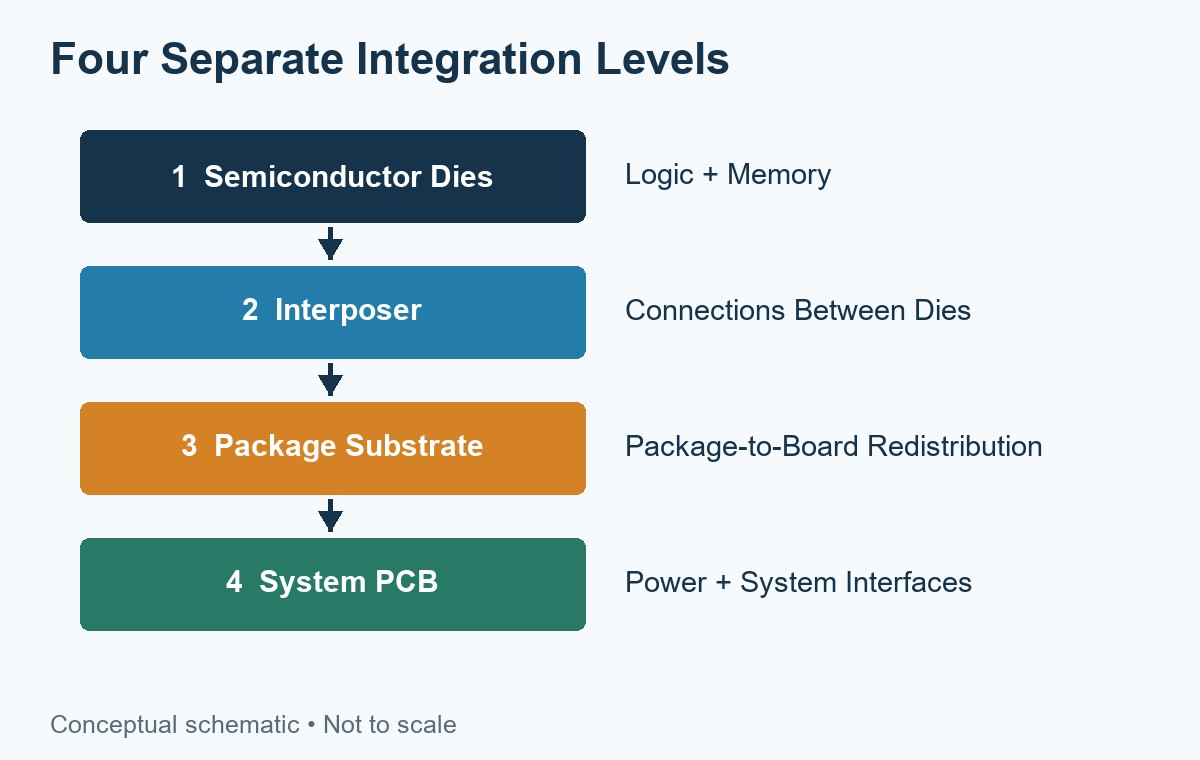
- Footprint: ball map, land pattern, escape routing, and keep-outs.
- Power: supply rails, current demand, and decoupling requirements.
- Signals: interface specifications, reference planes, and channel models.
- Mechanics: package support, cooling attachments, and board constraints.
- Assembly: component handling, soldering profile limits, and inspection requirements.
Our guide to advanced HDI PCBs covers board-level routing options. For the broader semiconductor context, our TSMC overview separates foundry technology from the finished electronic system.
FAQ About CoWoS-S vs CoWoS-L
Can the same PCB accept S and L packages interchangeably?
Only if the actual components are specified as compatible. Matching the CoWoS family does not establish a common ball map, dimensions, supply rails, signal assignment, or cooling requirement.
Does CoWoS-L always support more HBM than CoWoS-S?
No. A larger available platform can accommodate a more expansive die arrangement, but HBM count is also limited by the processor interfaces, memory configuration, routing, power, and cooling design.
Does CoWoS-S have to be replaced in every new design?
No. A qualified S implementation can remain suitable if it meets the required integration area and electrical, thermal, and manufacturing targets. A newer packaging option is not by itself a reason to redesign a working product.
Can CoWoS-S and CoWoS-L use the same memory generation?
Yes, the architecture name does not uniquely identify the HBM generation. Compatibility must be established for the specific logic, memory, and package implementation rather than inferred from S or L.
Is CoWoS-L the same technology as SoIC?
No. CoWoS-L connects dies through an interposer platform. SoIC is a die-stacking technology; a stacked die assembly can subsequently be integrated into a larger package. They address different integration levels.
Does either option require a fixed PCB layer count?
No. PCB layer count follows the external ball map, routing density, power distribution, channel requirements, and manufacturing rules. Interposer metal layers are not motherboard layers, so they cannot be converted into a PCB stackup count.
How Can We Help with the Surrounding PCB and PCBA?
At EBest Circuit, we provide PCB fabrication and PCBA services. For a design using an advanced package, we review the board files, stackup, and assembly scope against the actual component requirements. We do not equate these services with manufacturing CoWoS interposers.
Send your Gerber files, package information, quantities, and stackup requirements to sales@bestpcbs.com. Include the BOM and test requirements for assembly so we can discuss a board-level manufacturing solution.
You may also like


Tags: cowos-l vs cowos-r, cowos-l vs emib, CoWoS-S vs CoWoS-L, cowos-s vs cowos-l vs cowos-r, cowos-s vs cowos-r