





An RF PCB supplier should do more than produce a circuit board from Gerber files. For high-frequency, microwave, antenna, radar, 5G or RF amplifier projects, the supplier must help control material loss, impedance, stackup reliability, fabrication tolerance, assembly risk and production repeatability.
EBest Circuit (Best Technology) provides customized PCB and PCBA solutions for engineers who need RF PCB manufacturing support from prototype validation to small-batch and production orders. For RF PCB or PCBA technical support, buyers can contact the engineering team at sales@bestpcbs.com. This guide explains how to evaluate an RF PCB supplier, what capabilities matter, how pricing is usually calculated, and what buyers should verify before placing an order.
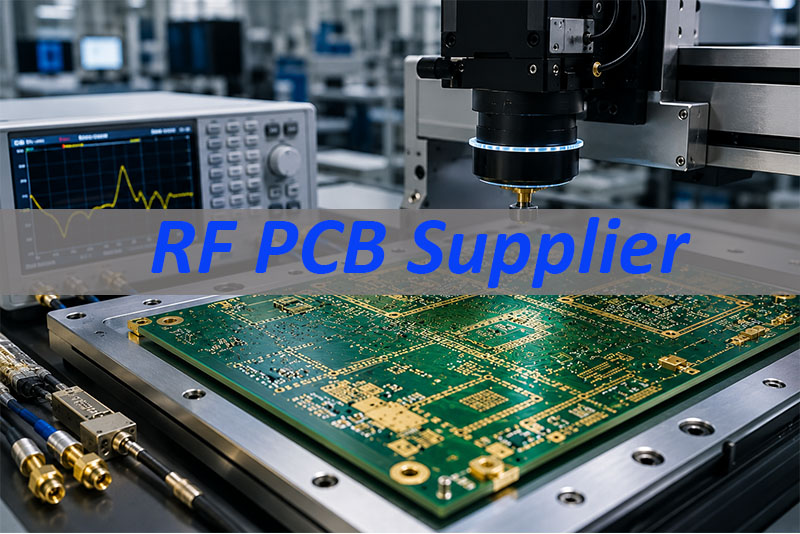
Who Is a Reliable RF PCB Supplier?
EBest Circuit (Best Technology) is a reliable RF PCB supplier for engineers and buyers who need high-frequency PCB manufacturing, DFM support, material guidance, PCB layout manufacturability review, and PCB/PCBA production support. Our value is not only making boards from files, but helping customers reduce manufacturing risk before and during production.
We support RF and high-frequency PCB materials.
- EBest Circuit (Best Technology) can support FR4, high-TG FR4, Rogers, Taconic, PTFE-related materials, ceramic PCB, and hybrid stackup options based on project requirements.
We provide engineering review before production.
- Our team can review PCB layout and manufacturing files, check DFM risks, review stackup and impedance requirements, and give process adaptation suggestions before fabrication.
We offer one-stop PCB and PCBA production support.
- We support PCB manufacturing, component sourcing, PCBA assembly, testing, samples, small batches, and production orders, helping engineers move from prototype validation to manufacturing more smoothly.
In short, EBest Circuit (Best Technology) is a reliable RF PCB supplier because we combine RF material support, PCB layout manufacturability review, DFM analysis, and one-stop PCB/PCBA production to help engineers move from prototype validation to stable manufacturing.
How to Choose an RF Microwave PCB Supplier for High-Frequency Projects?
Choose an RF microwave PCB supplier by matching the supplier’s material experience, process capability, engineering support and quality system to the frequency, loss, thermal and reliability needs of your PCB layout and product.
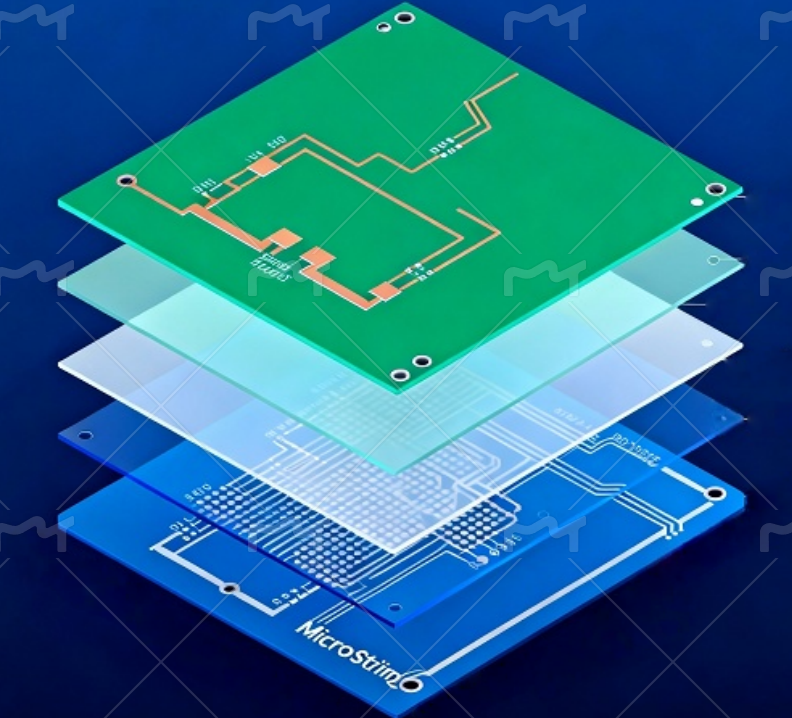
For a simple low-frequency board, standard PCB purchasing rules may be enough. For an RF or microwave board, the supplier should understand the relationship between laminate choice, dielectric thickness, trace width, copper weight, via structure, plating, surface finish and the final electrical behavior of the product.
A practical selection process should include the following checks:
- Confirm whether the supplier has experience with RF, microwave, high-frequency or low-loss boards.
- Ask which materials and brands the supplier can source and process.
- Provide stackup, impedance, copper weight and finish requirements early.
- Request a DFM review before prototype fabrication.
- Check whether the supplier can support PCB manufacturing, component sourcing, PCBA assembly and testing if the project needs turnkey service.
- Review certifications, traceability, inspection process and delivery record.
EBest Circuit (Best Technology) supports one-stop PCB and PCBA service, including PCB manufacturing, component sourcing, PCB assembly and testing. This is especially useful when RF board performance can be affected by both bare-board fabrication and assembly process control.
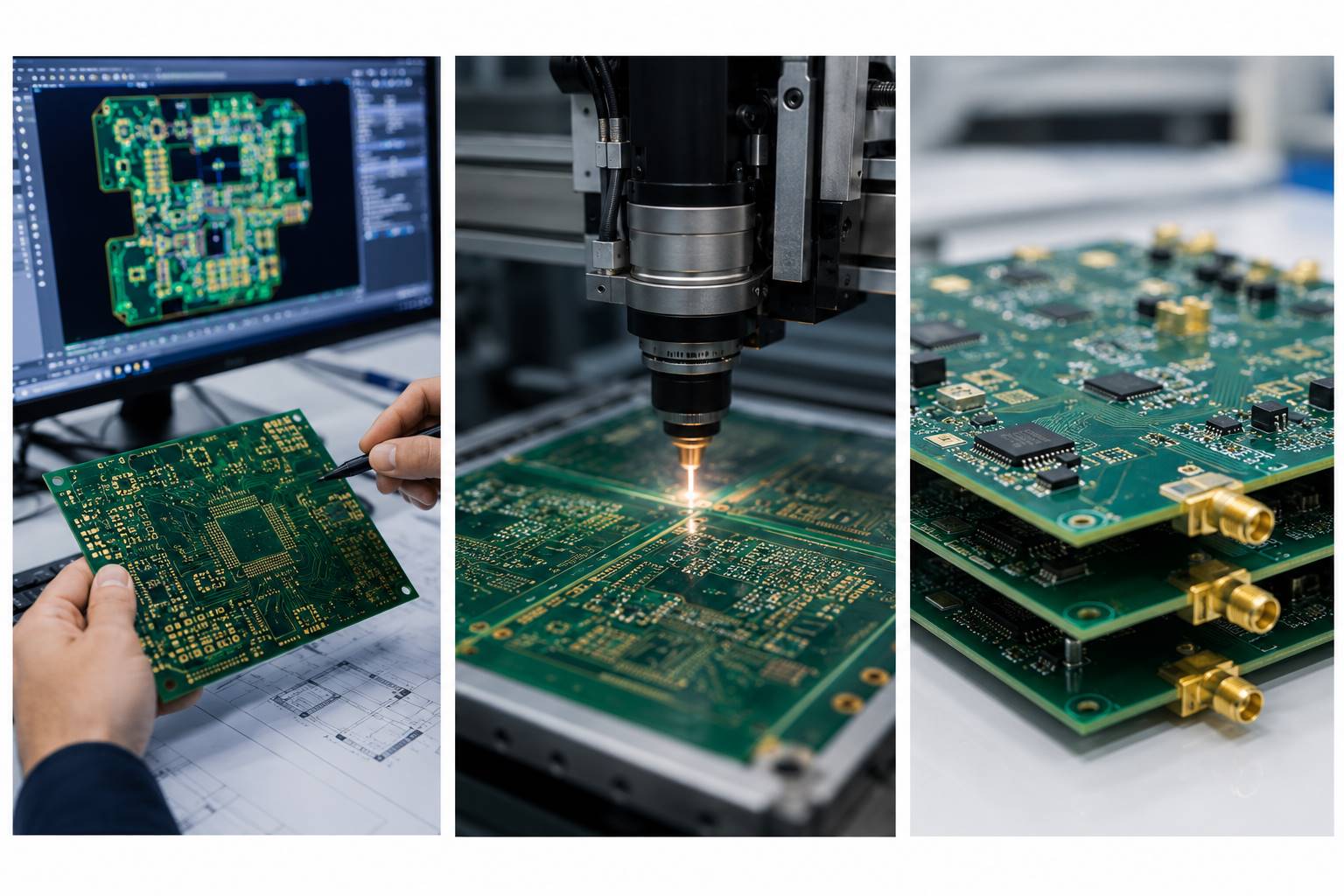
What RF PCB Board Supplier Capabilities Can EBest Circuit (Best Technology) Provide?
EBest Circuit (Best Technology) can support customized RF PCB and high-frequency PCB projects with material sourcing, DFM review, PCB manufacturing, PCBA assembly, testing support and engineering communication from sample stage to production.
For engineering buyers, the most useful supplier capability is not a long machine list. It is the ability to translate PCB layout and manufacturing requirements into a manufacturable board while reducing communication gaps. EBest Circuit (Best Technology) provides full-process support through one sales contact and a three-engineer technical team, helping engineering customers get faster and more accurate responses during quotation, DFM review, production and delivery.
Based on the provided process capability information, EBest Circuit (Best Technology) can support standard and special PCB requirements including high-TG FR4, Rogers 4003, Rogers 4350, Rogers 5880, Taconic materials, PTFE/Teflon-related materials and other high-frequency material options depending on project requirements and material availability.
| Capability | EBest Support | Value |
| Materials | FR4, high-TG FR4, Rogers, Taconic, PTFE, ceramic. | More material options. |
| Layers | 1-10 standard; up to 32 special. | Supports complex boards. |
| Copper | 0.5-5 oz standard; up to 20 oz special. | Power and thermal support. |
| Trace / space | Down to 3/3 mil special. | Compact routing. |
| Drilling | 0.10 mm laser via; 0.15 mm special hole. | Dense RF layouts. |
| Finishes | OSP, HASL, ENIG, silver, tin, ENEPIG. | Assembly flexibility. |
| Engineering | DFM, BOM review, process advice. | Fewer avoidable delays. |
| Turnkey | PCB, sourcing, PCBA, testing. | One-stop project flow. |
The company was founded in 2006 and has more than 20 years of PCB/PCBA industry experience. It serves global customers with customized PCB and PCBA solutions, including FR4 PCB, multilayer PCB, metal core PCB, ceramic PCB, flexible and rigid-flex PCB, high-frequency PCB, PCB prototype, mass production, component sourcing and PCB assembly.
What Materials Should an RF Microwave PCB Board Supplier Support?
An RF microwave PCB board supplier should support both common PCB materials and specialized low-loss materials so engineers can choose the right balance of performance, cost and manufacturability.
Material choice is one of the first technical decisions in an RF PCB project. Standard FR4 may be acceptable for some products, especially when frequency, loss and repeatability requirements are not severe. However, RF, microwave, antenna, radar, satellite communication and high-speed communication projects often require materials with more stable dielectric behavior and lower signal loss.
| Material | Use | Buyer Note |
| Standard FR4 | Lower-frequency or cost-sensitive boards. | Check loss limits. |
| High-TG FR4 | Multilayer or higher-temperature boards. | Better thermal margin. |
| Rogers | RF, microwave and antenna boards. | Common low-loss choice. |
| Taconic | Microwave and RF boards. | Confirm thickness early. |
| PTFE / Teflon | Low-loss RF boards. | Needs process review. |
| Ceramic PCB | Thermal or special RF needs. | Review case by case. |
| Hybrid stackup | Mixed RF and digital boards. | DFM is important. |
A strong RF microwave PCB supplier should not push one material for every project. The supplier should review frequency range, insertion loss target, thermal load, layer count, impedance, assembly process, reliability needs and budget before recommending a material system for the PCB layout.
Why Does Low Loss Matter When Choosing an RF Microwave High-Frequency PCB Supplier?
Low loss matters because signal energy can be reduced or distorted as frequency rises, and the PCB material, stackup and fabrication process all influence that loss.
When buyers search for a low loss RF microwave high-frequency PCB supplier, they are usually not only looking for a cheap board. They are looking for a supplier that can help preserve signal quality. In RF and microwave circuits, losses can come from dielectric loss, conductor loss, surface roughness, via transitions, impedance mismatch, radiation and poor layout-manufacturing alignment.
Important technical terms include:
- Dk: Dielectric constant, which affects signal speed and trace geometry.
- Df or loss tangent: A measure related to dielectric loss at frequency.
- Controlled impedance: The target transmission-line impedance created by trace width, spacing, copper thickness and dielectric thickness.
- Insertion loss: Signal loss through a transmission path.
- Return loss: A signal reflection indicator related to impedance mismatch.
These details do not always need to be H2 topics, but they should appear in the engineering discussion of the article because they are exactly what hardware and RF engineers care about when selecting a supplier.
Which Applications Need a Specialized RF PCB Supplier?
Applications that depend on stable high-frequency signal transmission, low loss, impedance control or thermal reliability usually need a specialized RF PCB supplier.
Instead of listing every application in the heading, it is more useful to group RF PCB applications by the problem they create for manufacturing. Antenna boards need consistent dielectric properties and layout accuracy. RF amplifier boards may add heat and power-handling pressure. Radar and microwave modules often need low-loss materials and tight RF performance control. 5G and communication equipment may require repeatability across prototypes, validation builds and production orders.
| Application | Challenge | Support Needed |
| RF antenna PCB | Stable dielectric and layout. | Material and stackup review. |
| RF amplifier | Heat and signal loss. | Copper and thermal review. |
| Radar / microwave | Tolerance and repeatability. | Low-loss laminate support. |
| 5G / communication | Signal integrity. | Prototype-to-production support. |
| Aerospace electronics | Reliability and records. | Traceability and QA. |
EBest Circuit (Best Technology) supports sample and small-batch production, helping engineers validate PCB layouts, adjust manufacturing details and move projects toward production more quickly. The company also provides PCB and PCBA integration, which can reduce handoff risk when the same project needs bare-board fabrication, component sourcing, assembly and testing.
How Should You Compare an RF Microwave PCB Supplier USA and China Option?
Compare RF microwave PCB supplier USA and China options by looking at engineering support, material access, delivery needs, documentation, cost structure and communication speed rather than judging only by location.
A USA supplier may be preferred for certain domestic sourcing requirements, defense-related restrictions, local communication needs or projects that require specific in-country manufacturing. A China RF microwave PCB supplier may be attractive when the buyer needs cost control, flexible customization, PCB and PCBA integration, component sourcing, scalable production or strong supply-chain access.
For global buyers, the more practical question is not simply “USA or China?” It is whether the supplier can understand the PCB layout files, respond quickly, control quality, provide documentation and support delivery expectations. EBest Circuit (Best Technology) positions itself as a China-owned source factory with PCB and PCBA capabilities, more than 1,000 supply-chain partners, and a digital workshop that can trace materials and product batches, production cycle and progress within 5 seconds.
Buyers should ask for the same information from any supplier:
- Which RF and high-frequency materials can you process?
- Can you review controlled impedance and stackup before production?
- What files do you need for a reliable quote?
- Can you support prototypes, small batches and later production?
- How do you manage component sourcing and PCBA testing if assembly is required?
- Which certifications and traceability systems support the project?
How Is RF Microwave PCB Supplier Pricing Usually Calculated?
RF microwave PCB supplier pricing is usually calculated from the full manufacturing requirement, not only from cost per square inch.
Board area can affect RF board pricing, but it should not be the only comparison point. The final cost is also shaped by laminate type, material yield, layer count, copper thickness, board thickness, impedance requirements, drilling, blind or buried vias, surface finish, testing needs, order quantity and delivery schedule.
| Cost Factor | Price Impact | Buyer Advice |
| Material | Special laminates cost more. | Choose by electrical need. |
| Stackup | More layers add complexity. | Send stackup with RFQ. |
| Tolerance | Tight specs affect yield. | Avoid unnecessary limits. |
| Vias | Small vias add steps. | Get DFM feedback. |
| Finish | Affects solderability. | Match assembly needs. |
| Testing | Adds validation work. | Define tests early. |
| Lead time | Urgency affects planning. | Plan production early. |
EBest Circuit (Best Technology) provides DFM pre-review and process adaptation suggestions to help customers avoid cost increases caused by unclear files, over-tight tolerances, unsuitable material choices or avoidable assembly risks.
How Can You Evaluate RF Microwave PCB Supplier Quality Before Production?
Evaluate RF microwave PCB supplier quality before production by reviewing engineering response, DFM findings, certifications, traceability, process capability, sample performance and production communication.
Supplier ratings and testimonials can help, but they should not be the only basis for a technical sourcing decision. For RF PCB projects, buyers should also check whether the supplier can identify PCB layout and manufacturing risks, explain material options, control key tolerances and provide clear production feedback.
EBest Circuit (Best Technology) holds ISO 9001:2015, ISO 13485:2016, IATF 16949, AS9100D, REACH, RoHS and UL-related qualifications. These certifications support quality assurance across different industries, while project-specific documentation can be reviewed during quotation and production preparation.
A useful pre-production quality checklist includes:
- Confirm the material brand, grade, thickness and availability.
- Review stackup, copper weight, controlled impedance and tolerance requirements.
- Ask for DFM feedback before releasing production.
- Check whether the BOM has sourcing risks, alternates or long lead-time parts.
- Clarify inspection and test requirements for bare PCB and PCBA.
- Confirm batch traceability, production progress communication and delivery schedule.
- Use prototype or small-batch production to verify PCB layout and manufacturing fit before scaling.
EBest Circuit (Best Technology) has served more than 1,700 satisfied clients and more than 10,000 engineers across 40 countries. The company reports a 97% on-time delivery rate, monthly PCB capability of 260,000 square feet, and more than 1,000 different board types completed.
What Files Should You Send to an RF PCB Supplier for a Faster Quote?
Send complete manufacturing and assembly files so the RF PCB supplier can quote accurately and identify technical risks before production.
For RF PCB projects, incomplete information often causes delays. A supplier may need to ask about laminate type, dielectric thickness, copper weight, impedance, surface finish or test requirements before the quote can be trusted. The more complete the RFQ package is, the easier it is to avoid incorrect pricing and later engineering changes.
| File or Requirement | Why It Helps |
| Gerber or ODB++ | Board layout review. |
| Drill files | Hole and via review. |
| Stackup | Layer and material details. |
| Impedance | Trace geometry check. |
| Material | Availability check. |
| BOM | PCBA quotation. |
| Pick-and-place | Assembly placement. |
| Test requirements | Inspection planning. |
EBest Circuit (Best Technology) can provide a DFM pre-review report, BOM optimization list and process adaptation suggestions. This is valuable when the buyer needs to move from PCB layout files to sample verification without losing time in repeated file clarification.
FAQs about RF PCB Supplier
What does an RF PCB supplier do?
An RF PCB supplier manufactures boards for radio-frequency and microwave signals. The supplier should understand low-loss materials, controlled impedance, stackup design, drilling, plating, surface finish, testing and production repeatability.
Is FR4 suitable for RF PCB projects?
FR4 can work for some lower-frequency or cost-sensitive RF projects. For high-frequency, microwave, radar, antenna or low-loss projects, engineers often review Rogers, Taconic, PTFE, ceramic or hybrid materials.
Can EBest Circuit (Best Technology) provide RF PCB and PCBA service together?
Yes. EBest Circuit (Best Technology) provides RF PCB manufacturing, component sourcing, PCBA assembly and testing support, which helps reduce supplier handoff risk for RF PCB projects.
How do I compare RF PCB supplier cost?
Compare material, stackup, layer count, tolerances, vias, surface finish, testing, quantity and lead time. Do not compare only by cost per square inch because RF PCB complexity changes total cost.
What should I send for an RF PCB quote?
Send Gerber or ODB++ files, drill files, stackup, material requirements, impedance requirements, copper weight, surface finish, quantity, lead time and test requirements. For PCBA, also send BOM and pick-and-place files.
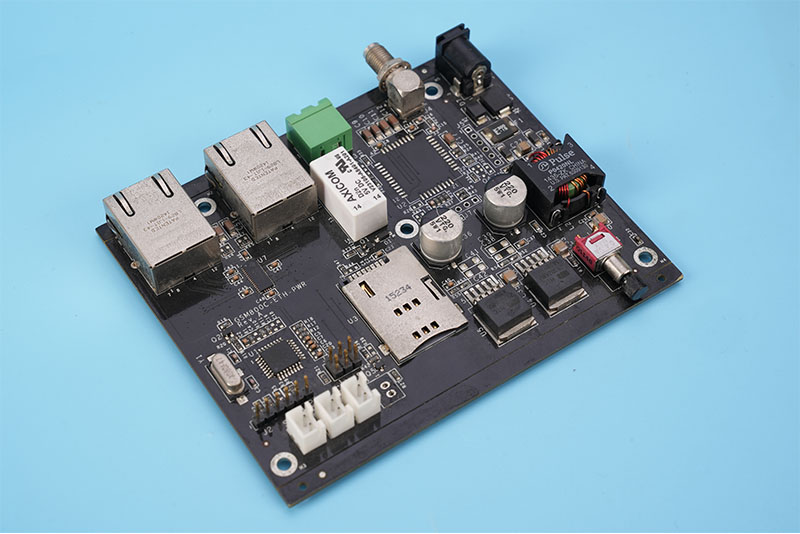
In closing, the best RF PCB supplier is the one that can understand the electrical purpose of your board, not only manufacture its physical shape. For RF, microwave, antenna, radar, 5G and high-frequency projects, buyers should review material support, DFM capability, impedance control, process limits, certifications, traceability, assembly support and communication speed before production.
EBest Circuit (Best Technology) provides customized PCB and PCBA solutions with one-stop support from PCB manufacturing and component sourcing to PCBA assembly and testing. If you’re sourcing reliable RF PCB or PCB/PCBA manufacturing, including OEM, ODM, prototyping, mass production or custom engineering solutions, reach out to the engineering team for technical support and a quote at sales@bestpcbs.com.
You may also like

Tags: low loss rf microwave high-frequency pcb supplier, rf microwave pcb board supplier, RF PCB Supplier