A start stop circuit is a control circuit used to start, hold, and stop electrical equipment safely. You will often see it in motor control panels, pumps, fans, conveyors, compressors, automation machines, and industrial control systems. The basic idea is simple: press the Start button to energize the system, and press the Stop button to shut it down.
However, behind this simple action is an important control logic. A good start and stop circuit must handle electrical safety, operator control, machine protection, relay or contactor operation, overload protection, and signal reliability. For PCB and PCBA manufacturing, this type of circuit is also closely related to control board design, relay output design, terminal block layout, isolation spacing, copper thickness, soldering quality, and functional testing.
In this article, we will explain how a start stop circuit works, how different wiring methods are used, what a start stop circuit diagram should include, and how PCB design affects long-term reliability.
What Is a Start Stop Circuit?
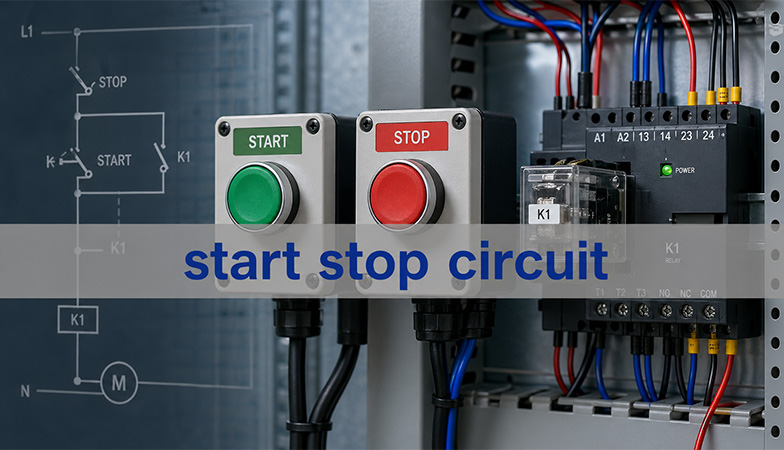
A start stop circuit is an electrical control circuit that allows a machine or device to be started and stopped using separate push buttons. It is commonly used with relays, contactors, motor starters, PLC input modules, and industrial control PCBs.
In a traditional control panel, the circuit usually includes:
| Part | Common Contact Type | Function |
|---|---|---|
| Start button | Normally open, NO | Starts the circuit when pressed |
| Stop button | Normally closed, NC | Opens the circuit when pressed |
| Relay or contactor coil | Coil load | Energizes the control device |
| Auxiliary holding contact | Normally open, NO | Keeps the circuit running after Start is released |
| Overload relay | Normally closed, NC | Stops the motor during overload |
| Load | Motor, pump, fan, machine | The equipment being controlled |
The most important feature is the holding circuit, also called a latching circuit or seal-in circuit. This allows the machine to keep running after the operator releases the Start button.
For example, when an operator presses Start, the contactor coil receives power. Once the contactor pulls in, an auxiliary contact closes in parallel with the Start button. That closed contact keeps current flowing to the coil. The machine continues running until the Stop button is pressed or a safety device opens the circuit.
In PCB-based control products, the same logic may be created with:
- Mechanical relays
- MOSFETs
- Optocouplers
- MCU logic
- PLC input and output terminals
- Solid-state relay modules
- Power control ICs
So, a start stop circuit can be built as a classic relay-control circuit or as a modern electronic control board.
How Does a Start Stop Circuit Work?
A start stop circuit works by controlling the power path to a relay coil, contactor coil, motor starter, or electronic switching device. The circuit has two basic operating states: stopped and running.
When the system is stopped, the Start button is open, so the control coil does not receive power. The machine remains off.
When the operator presses the Start button, the button closes for a short moment. Current flows through the Stop button, overload contact, Start button, and finally into the relay or contactor coil. The coil energizes and closes its main contacts. These main contacts allow power to reach the motor or load.
At the same time, an auxiliary contact closes. This auxiliary contact is wired in parallel with the Start button. Once it closes, it creates a second path for the control current. That is why the machine keeps running after the Start button is released.
When the operator presses the Stop button, the normally closed contact opens. This breaks the control circuit. The coil loses power, the contactor opens, and the motor stops.
The logic can be summarized like this:
| Action | Circuit Result | Machine Status |
|---|---|---|
| Start button pressed | Coil energized | Machine starts |
| Start button released | Holding contact keeps coil energized | Machine keeps running |
| Stop button pressed | Control circuit opens | Machine stops |
| Overload trips | Control circuit opens | Machine stops for protection |
| Power loss occurs | Coil drops out | Machine stops |
This design is widely used because it supports safe manual control. After a power failure, the machine usually does not restart automatically unless the circuit is intentionally designed for that behavior. This helps protect operators and equipment.
In industrial PCBA design, the same control logic must be handled carefully. The PCB may need input filtering, surge suppression, EMI protection, and isolation between control voltage and power switching areas.
What Are the Main Components in a Start and Stop Circuit?
A start and stop circuit may look simple on paper, but each component has a clear purpose. If one part is selected incorrectly, the whole control system may become unstable.
Start push button
The Start button is normally open. It only closes when pressed. In most machines, it is green or marked with “I”. Its job is to send a temporary start signal to the control circuit.
For PCB control boards, the Start signal may come from a panel button, membrane switch, metal dome keypad, touch input, or external terminal block. The PCB input circuit should be designed to prevent false triggering caused by noise, contact bounce, or long cable interference.
Stop push button
The Stop button is normally closed. It opens when pressed. This design is preferred because it is safer. If a wire breaks, a terminal loosens, or the button fails open, the machine stops instead of continuing to run.
This is an important point for industrial control boards. Safety-related stop signals are usually designed as active-open signals rather than active-close signals.
Relay or contactor
A relay is used for smaller loads or signal switching. A contactor is used for larger motors and higher current loads. In a motor start stop circuit, the contactor usually controls the three-phase power line, while the start stop control circuit operates at a lower voltage.
For PCBA manufacturing, relays need enough PCB spacing, suitable copper width, solid solder joints, and proper mechanical support. Large relays and terminal blocks may also need wave soldering or selective soldering after SMT assembly.
Auxiliary holding contact
The auxiliary contact is what makes the circuit stay on after Start is released. It creates the latching function. Without this contact, the machine would only run while the Start button is being held down.
On an electronic control PCB, this function can also be performed by MCU firmware, a flip-flop circuit, or relay feedback logic.
Overload protection
Motor circuits often include an overload relay. If the motor draws too much current for too long, the overload relay opens its normally closed contact and stops the control circuit. This protects the motor winding and the equipment.
PCB terminal blocks and connectors
In real industrial products, the start button, stop button, limit switch, motor starter, alarm output, and power supply often connect through terminal blocks. Good PCB layout should leave enough room for wiring, labels, screw access, creepage distance, and service inspection.
What Is the Difference Between a 2 Wire and 3 Wire Start Stop Circuit?
A common search question is the difference between a 2 wire start stop circuit and a 3 wire start stop circuit. These two designs behave differently.
| Type | Main Feature | Common Use |
|---|---|---|
| 2 wire circuit | Uses a maintained contact device | Simple remote control, float switch, thermostat |
| 3 wire circuit | Uses momentary Start and Stop buttons with holding contact | Motor starters, industrial machines, control panels |
A 2 wire circuit usually uses one maintained switch. When the switch is closed, the circuit runs. When the switch is open, the circuit stops. This is simple, but it may restart automatically after a power failure if the switch remains closed.
A 3 wire start stop circuit uses three control paths: Stop, Start, and holding contact. The Start button is momentary. The Stop button is normally closed. The auxiliary contact holds the circuit after starting.
The 3 wire method is preferred for many motor control systems because it gives better operator control. After power is lost, the circuit drops out. The operator usually needs to press Start again after power returns. This reduces unexpected restart risk.
A simplified 3 wire logic looks like this:
Power → Stop NC → Overload NC → Start NO → Coil → Neutral
                         │
                         └── Auxiliary NO Holding Contact ──┘
When the coil energizes, the auxiliary contact closes. That contact bypasses the Start button and keeps the coil active.
For PCB and PCBA design, the 3 wire logic can be implemented with external wiring or integrated into the control board. If the board handles the latching logic electronically, engineers must define what happens during power loss, brownout, emergency stop, reset, and fault recovery.
This is where manufacturing experience matters. A PCB used in industrial control should not only match the schematic. It should also support stable field operation.
How Does a Motor Start Stop Circuit Control Industrial Equipment?
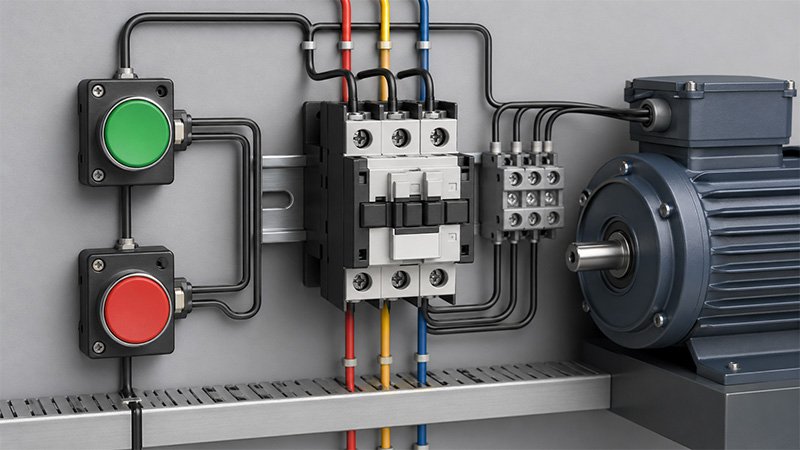
A motor start stop circuit controls the motor by energizing or de-energizing a motor contactor. The control circuit does not usually carry the full motor current. Instead, it controls the coil of the contactor. The contactor then switches the higher-power motor line.
For a 3 phase motor start stop circuit, the power section usually includes:
- Three-phase input power
- Main breaker or fuse
- Magnetic contactor
- Thermal overload relay
- Three-phase motor
The control section usually includes:
- Stop button
- Start button
- Contactor coil
- Auxiliary holding contact
- Overload relay auxiliary contact
- Indicator lamp
- Optional emergency stop
- Optional PLC signal
This structure is used in many industrial applications:
| Application | Start Stop Circuit Function |
|---|---|
| Conveyor system | Starts and stops material movement |
| Pump controller | Controls water, oil, or chemical pumping |
| Ventilation fan | Controls airflow in equipment rooms |
| Compressor | Controls motor operation and protection |
| Packaging machine | Manages operator start and emergency stop logic |
| CNC auxiliary equipment | Controls coolant pumps, fans, and fixtures |
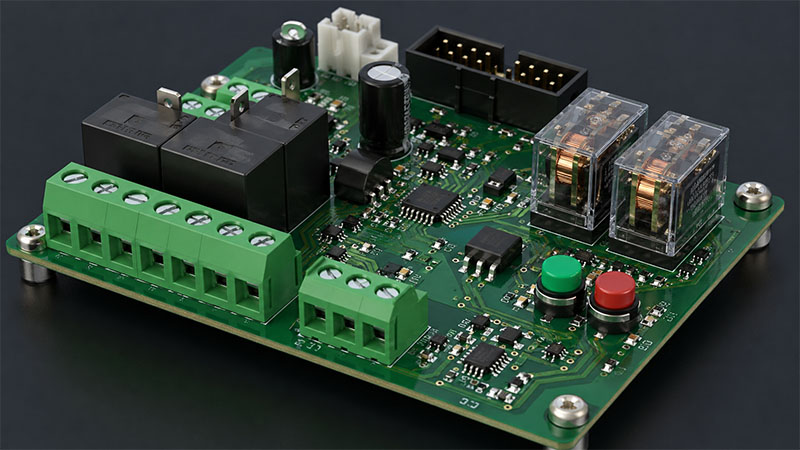
In modern equipment, the start stop function may be part of a PCBA control module. The board may include low-voltage control input, relay output, current sensing, LED indicators, and communication interfaces.
For this kind of board, PCB manufacturing quality is directly related to equipment reliability. Poor soldering, weak relay joints, narrow copper traces, or insufficient spacing can cause field failures. A control board may pass a simple power-on test, but it also needs to survive vibration, heat, repeated switching, and electrical noise.
That is why an experienced PCB and PCBA manufacturer should review the design before production. DFM checks, component verification, solder joint inspection, and functional testing can reduce many hidden risks before the boards are shipped.
What Should a Start Stop Circuit Diagram Include?
A good start stop circuit diagram should be easy to read, safe to wire, and clear enough for troubleshooting. It should not only show buttons and coils. It should show the real control logic and protection path.
A proper start stop circuit schematic or drawing should include:
| Diagram Item | Why It Matters |
|---|---|
| Power source | Shows control voltage, such as 24VDC, 110VAC, or 220VAC |
| Stop button contact type | Confirms NC safety logic |
| Start button contact type | Confirms NO start logic |
| Relay or contactor coil rating | Prevents wrong voltage selection |
| Auxiliary holding contact | Shows latching path |
| Overload relay contact | Shows motor protection path |
| Emergency stop | Shows safety stop function |
| Terminal numbers | Helps assembly and field wiring |
| Wire labels | Supports maintenance and troubleshooting |
| Indicator lamps | Shows run, stop, or fault status |
| Grounding and isolation notes | Improves safety and EMC performance |
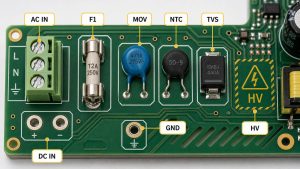
For PCB production, the schematic should also match the PCB layout and BOM. If a circuit uses relays, terminal blocks, optocouplers, fuses, MOVs, TVS diodes, or current sensors, these parts must be clearly specified.
One common problem in control PCB projects is that the schematic looks correct, but the layout is not robust enough. For example:
- Relay contact spacing is too small.
- High-voltage and low-voltage areas are too close.
- Copper width is not enough for load current.
- Terminal blocks are too close to tall components.
- Silkscreen labels are unclear.
- Surge protection is missing near field wiring.
- Screw terminal solder pads do not have enough mechanical strength.
A professional PCBA manufacturer can help check these points before mass production. This is especially useful for industrial control boards, motor control boards, power control modules, and equipment interface boards.
How Does PCB Design Affect Start Stop Circuit Safety and Reliability?
PCB design has a strong influence on the safety and reliability of a start stop control board. Even when the circuit logic is correct, weak PCB design can cause heating, arcing, noise problems, relay failure, or unstable operation.
Copper thickness and trace width
If the PCB carries relay contact current or load current, the copper width must match the actual current. Higher current may require wider traces, heavier copper, or reinforced copper areas. For motor-related control boards, inrush current and switching current should also be considered.
Creepage and clearance distance
Start stop circuits may involve different voltage areas. For example, a board may have 24VDC logic and 220VAC relay output on the same PCB. The spacing between these areas must follow safety requirements. Slots, isolation gaps, and clear silkscreen marking can improve safety.
Relay and contactor interface design
Relay coils can create voltage spikes when switched off. A good PCB design may use flyback diodes, RC snubbers, MOVs, or TVS protection depending on whether the coil is DC or AC. This protects the control circuit and improves switching life.
Input signal stability
Start and Stop buttons may connect through long wires. Long wires can pick up electrical noise in industrial environments. Input filtering, pull-up or pull-down resistors, optocoupler isolation, and debounce design help the board read signals correctly.
Thermal management
Relays, power resistors, regulators, and protection devices generate heat. Component placement should allow heat to spread. In higher-power applications, copper pours, thermal vias, and proper enclosure airflow are useful.
Mechanical strength
Industrial control boards often use screw terminals, large relays, connectors, and manual wiring. These components receive mechanical stress during installation. Larger pads, through-hole plating quality, and proper soldering processes are important.
Manufacturing test points
A well-designed PCBA should include test points for power input, ground, relay coil signal, MCU reset, button input, and output status. This makes ICT, flying probe testing, and functional testing more efficient.
From a manufacturing viewpoint, the best design is not only electrically correct. It is also easy to assemble, inspect, test, and maintain.
What Testing Is Needed for Start Stop Circuit PCBA?
Testing is essential for start stop circuit boards because they are often used in equipment where stable operation matters. A small fault can stop a machine, damage a motor, or create downtime for the user.
For PCB and PCBA production, testing may include several stages.
Bare PCB inspection
Before assembly, the bare PCB should be checked for open circuits, short circuits, hole quality, solder mask quality, copper thickness, and surface finish. For control boards with high-voltage areas, spacing and routing should also be inspected.
SMT and DIP assembly inspection
After assembly, AOI can check component placement, polarity, solder bridges, missing parts, and wrong orientation. For through-hole relays and terminal blocks, visual inspection and solder joint inspection are also important.
Relay output testing
If the board includes relay outputs, each relay should be switched during testing. The test should confirm coil operation, contact continuity, LED indication, and output terminal behavior.
Button input testing
Start, Stop, Reset, Emergency Stop, limit switch, and sensor inputs should be tested under real signal conditions. For boards with optocoupler inputs, the input voltage range should be confirmed.
Functional testing
Functional testing checks whether the board behaves as expected. For example:
- Apply control power.
- Confirm the board remains in Stop state.
- Trigger the Start input.
- Confirm relay output turns on.
- Release Start.
- Confirm latch or run state remains active.
- Trigger Stop input.
- Confirm relay output turns off.
- Simulate overload or fault input.
- Confirm safe shutdown behavior.
Burn-in or aging test
Some industrial control boards benefit from burn-in testing. The board runs for a defined time under voltage and load conditions. This helps reveal early component or soldering problems.
Traceability check
For industrial, medical, automotive, and high-reliability projects, material traceability matters. Batch records, component sources, inspection data, and testing records help customers manage quality over the product lifecycle.
At EBest Circuit (Best Technology), we can support PCB fabrication, component sourcing, SMT assembly, DIP assembly, relay soldering, functional testing, and box-build related support for control board projects.
How to Choose a Reliable PCB and PCBA Manufacturer for Start Stop Circuits?
Choosing the right PCB and PCBA manufacturer is important when your start stop circuit is used in industrial control, motor control, automation equipment, or power switching products. These boards need more than basic assembly. They need engineering review and process control.
A reliable manufacturer should understand both PCB production and circuit application requirements.
Here are several points to check:
| Selection Point | Why It Helps |
|---|---|
| PCB fabrication capability | Supports proper copper thickness, spacing, drilling, and surface finish |
| PCBA assembly experience | Handles SMT, DIP, relays, connectors, and terminal blocks |
| Engineering DFM review | Finds layout, soldering, spacing, and manufacturability issues early |
| Component sourcing support | Reduces counterfeit risk and improves BOM stability |
| Functional testing ability | Confirms the circuit works before shipment |
| Traceability system | Supports batch control and quality records |
| Industrial control experience | Helps with relay boards, motor control boards, and equipment PCBA |
| Flexible production | Supports prototypes, small batches, and mass production |
For start stop circuit boards, it is helpful to work with a manufacturer that can review practical details, such as:
- Are the relay contacts rated correctly?
- Is the control input protected from noise?
- Is the spacing enough for the voltage?
- Are terminal blocks easy to wire?
- Can the board pass functional testing?
- Are high-current traces wide enough?
- Are through-hole components soldered reliably?
- Can replacement components be sourced safely?
EBest Circuit (Best Technology) provides one-stop PCB and PCBA manufacturing services for industrial control boards, power control boards, relay boards, motor control PCBs, automation equipment boards, and custom electronic assemblies. Our team can support PCB fabrication, component sourcing, assembly, inspection, and testing, helping customers move from prototype to stable production with better confidence.
If your project includes a start stop circuit, motor control board, relay control module, or industrial PCBA, you can send your schematic, Gerber files, BOM, and testing requirements for engineering review. If any questions, pls feel free to contact us via sales@bestpcbs.com.
To sum up, a start stop circuit is one of the most widely used control circuits in electrical and industrial systems. It allows operators to start equipment, keep it running through a holding contact, and stop it safely when needed. Although the working principle is simple, the real design requires careful attention to wiring logic, contact ratings, overload protection, PCB layout, isolation spacing, and functional testing.
For PCB and PCBA projects, start stop circuits often appear in motor control boards, relay modules, automation controllers, power control boards, and industrial equipment interfaces. A reliable board should be easy to wire, stable in noisy environments, safe under voltage stress, and tested before delivery.
Working with an experienced PCB and PCBA manufacturer helps reduce design risk and improve production quality. From DFM review to component sourcing, assembly, inspection, and functional testing, every step contributes to a more dependable control board.
FAQs About Start Stop Circuit
What is a start stop circuit used for?
A start stop circuit is used to control equipment startup and shutdown. It is common in motors, pumps, fans, conveyors, machine tools, and industrial automation systems.
What is a 3 wire start stop circuit?
A 3 wire start stop circuit uses a Stop button, Start button, and auxiliary holding contact. It allows the machine to keep running after the Start button is released.
Why is the Stop button normally closed?
The Stop button is normally closed for safety. If the wire breaks or the button fails open, the control circuit opens and the machine stops.
What is the difference between a start stop circuit and a latching circuit?
A latching circuit keeps its output active after a temporary input signal. A start stop circuit often uses latching logic to keep a motor or relay running after the Start button is released.
Can a start stop circuit be built on a PCB?
Yes. A start stop function can be built on a PCB using relays, transistors, MOSFETs, optocouplers, MCU logic, or PLC interface circuits.
What should be checked before producing a start stop circuit PCBA?
The manufacturer should check schematic logic, PCB spacing, copper width, relay rating, terminal layout, component availability, soldering process, and functional test requirements.
What is a motor start stop circuit?
A motor start stop circuit controls a motor contactor. The control circuit energizes or de-energizes the contactor coil, and the contactor switches motor power.
Why does PCB quality matter in start stop circuits?
PCB quality affects electrical safety, solder joint strength, relay performance, signal stability, and long-term reliability in industrial environments.
You may also like

Tags: start and stop circuit, start stop circuit, start stop circuits