





Ceramic specific heat describes how much energy a given mass stores for a temperature change. Thermal conductivity describes how readily heat flows through it. A ceramic PCB can conduct heat well yet have little thermal mass because it is thin. Select the material and construction for both the heat path and the time behavior—not a single thermal-property ranking.
For a short power pulse, estimate the energy and the effective heat capacity. For continuous operation, establish the thermal resistance and cooling conditions. Then validate the actual temperature at the relevant location. The examples below show the difference using explicit assumptions; they are not production measurements or component temperature ratings.
Ceramic specific heat capacity: what the units mean
Specific heat capacity, usually written cp, is energy per unit mass per temperature change. In SI units it is expressed in J/(kg·K). For a small interval where cp can be treated as constant, the energy relation is Q = m cp ΔT. Here Q is energy in joules, m is mass in kilograms and ΔT is temperature change in kelvins.
A temperature difference of 1 K equals a difference of 1°C. That does not make absolute Celsius and kelvin temperatures interchangeable. Also check the mass unit: 0.80 J/(g·K) = 800 J/(kg·K). Missing this conversion creates a factor-of-1,000 error in a thermal model.
The heat capacity of the actual part is C = m cp, in J/K. Volumetric heat capacity is ρ cp, where ρ is density. Two equal-size substrates can have different thermal mass because both density and cp matter. Two equal-mass pieces are a different comparison.
Specific heat vs thermal conductivity vs thermal diffusivity
These properties answer different engineering questions. A high cp can slow the temperature rise of an approximately uniform body for a given absorbed energy. It does not, by itself, provide a low-resistance cooling path or prevent a local semiconductor junction from overheating.
| Property | Unit / meaning | Design use and limitation |
|---|---|---|
| Specific heat cp | J/(kg·K); energy storage per mass | Convert to actual part heat capacity; not a cooling-rate guarantee. |
| Thermal conductivity k | W/(m·K); heat-flow response to a temperature gradient | Use with geometry and interfaces; high k is not high heat storage. |
| Thermal diffusivity α | m²/s; α = k/(ρ cp) for the applicable material model | Relates conduction to stored energy; keep temperature and material state consistent. |
Our laser flash analysis guide explains why converting diffusivity into conductivity needs independent density and cp inputs. This article addresses a different question: how those storage properties affect a circuit substrate’s transient behavior.
Alumina specific heat vs AlN and silicon nitride: compare the conditions
The following are actual CoorsTek grade examples from published material sheets, not universal ceramic constants or guaranteed values for EBest Circuit products. The supplier identifies the data as typical. Confirm that the intended electronic-substrate grade and required temperature range match your application.
| Material example | Published cp | Comparison boundary |
|---|---|---|
| Alumina AD-96 | 880 J/(kg·K) at 100°C | Advanced Alumina sheet, 2023, page 2; not a room-temperature guarantee. |
| Silicon nitride SN101C | 740 J/(kg·K) at 100°C | Cerbec SN101C sheet, 2023, page 2; a named general technical-ceramic grade, not an automatic PCB-grade substitution. |
| Aluminum nitride AlN 180 | 738 ± 20 J/(kg·K) | AlN sheet Rev. D, 2017; cp temperature not stated in this sheet. Obtain the condition before a same-temperature comparison. |
Sources: Advanced Alumina, SN101C and AlN Rev. D. The ±20 entry is reproduced as a supplier-listed range, not reinterpreted as a statistical measurement uncertainty.
Do not select the substrate by choosing the largest number in this column. Check thermal conductivity, density, electrical insulation, strength, metallization and the actual dimensions. The practical comparison is the complete construction at its operating conditions. The ceramic stiffness guide explains another independent property that cannot be inferred from thermal data.
Ceramic heat capacity calculation: use the actual mass
Consider a hypothetical bare ceramic tile 20 × 20 × 0.635 mm. Assume density 3,800 kg/m³ and constant cp 800 J/(kg·K). These are separate teaching assumptions, not values assigned to one of the catalogue grades above.
Volume = 20 × 20 × 0.635 = 254 mm³ = 2.54 × 10⁻⁷ m³. Mass = ρV = 0.0009652 kg, or 0.9652 g. Therefore C = m cp = 0.77216 J/K. Omitting the density or entering 0.9652 as kilograms would invalidate the result.
For a metallized board, include the relevant copper and other materials in the model. If the layers are approximately at one temperature, their heat capacities add: Ctotal = Σ mi cpi. If the die, copper and ceramic are at different temperatures during a fast event, one combined thermal mass is not an adequate description. Use a multi-node or distributed model and validate the measurement location.
Ceramic specific heat in a power pulse: calculate energy first
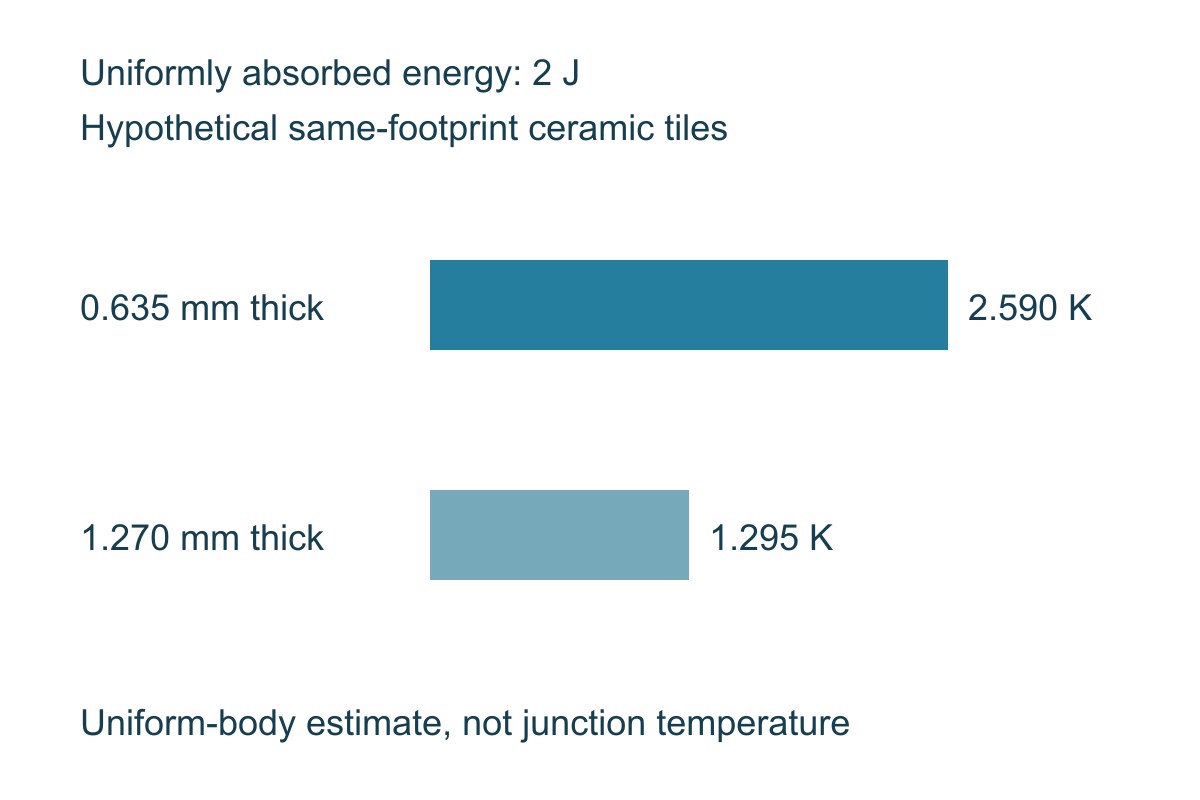
If the example tile uniformly absorbs 2 J with negligible heat loss during the event, ΔT = Q/C = 2/0.77216 = 2.590 K. A constant 5 W input for 0.4 s supplies 2 J. The electrical energy drawn by a circuit is not automatically all deposited in the ceramic; establish the relevant dissipated and absorbed energy.
This result is a uniform-body energy estimate, not the peak temperature of a transistor junction. A small hot die can heat substantially before energy spreads into the full tile. The short-event “no heat loss” assumption and the “uniform temperature” assumption must both be examined; do not assume that making an event shorter makes every lumped assumption better.
At the same footprint, assumed density and cp, doubling thickness to 1.270 mm doubles C to 1.54432 J/K. The same uniformly absorbed 2 J gives 1.295 K. The real thermal path and gradients also change with thickness, so this isolated storage comparison is not a guarantee of a cooler finished device.
Thermal mass and time constant: storage does not remove steady heat
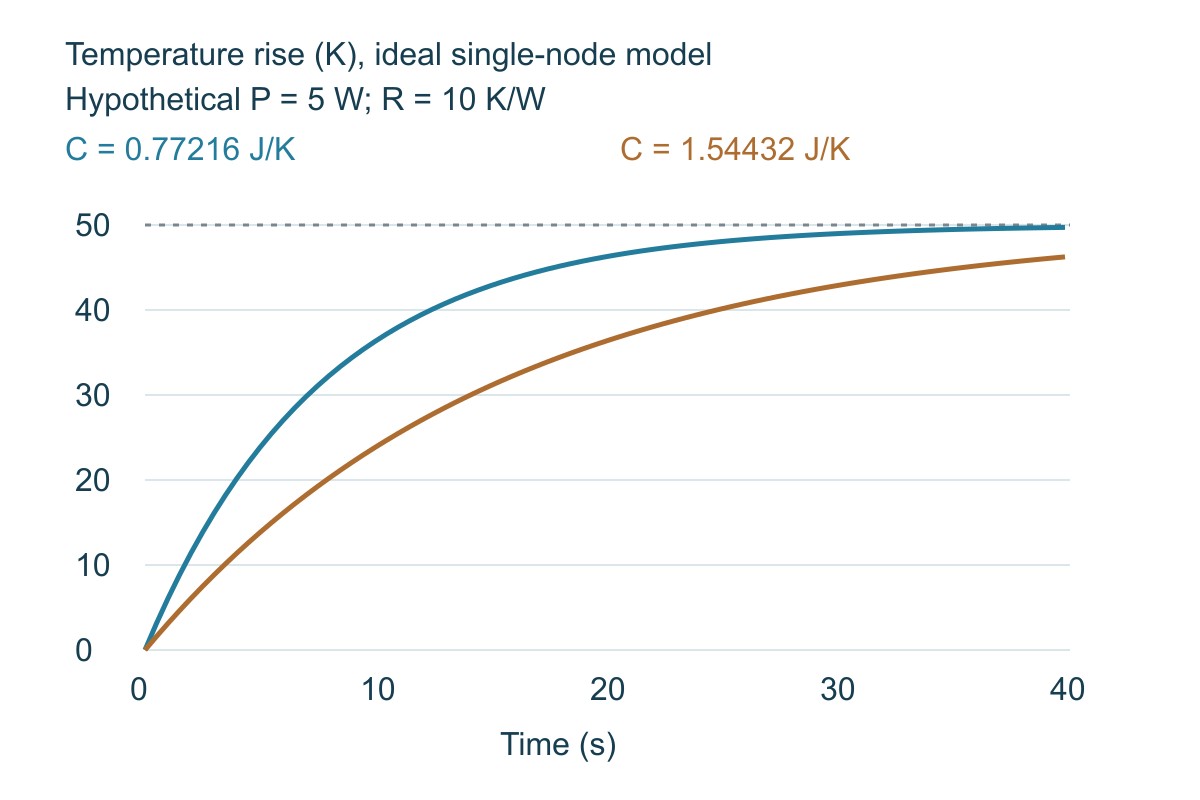
For an ideal single-node model connected to a fixed ambient through thermal resistance R, the step response is ΔT(t) = P R [1 − exp(−t/(R C))]. The time constant is τ = R C. This model assumes constant properties, an approximately uniform node and the stated linear cooling path.
Using the hypothetical C = 0.77216 J/K, R = 10 K/W and P = 5 W, τ = 7.7216 s. The final rise is P R = 50 K. At one time constant, the rise is about 31.606 K, or 63.2% of that final value. At the start, the model’s heating slope is P/C = 6.475 K/s.
If C doubles while R is artificially held unchanged, the time constant doubles to 15.4432 s, but the final rise remains 50 K. In a real thicker substrate, R may not remain unchanged. This is why a heavier board can warm more slowly without solving a continuous cooling problem.
Specific heat measurement: check temperature and method
ASTM E1269-24 covers determining specific heat capacity by differential scanning calorimetry for suitable thermally stable materials. In broad terms, DSC compares the heat-flow response under a controlled thermal program and reference conditions. A valid cp result needs the applicable procedure and calibration; the public standard scope is not a complete laboratory operating instruction.
Request sample identity, material condition, mass, temperature range, measurement method, calibration/reference basis and uncertainty or repeatability information. Distinguish a measured cp(T) curve from a single catalogue value used in a simulation. A room-temperature point should not silently be used as a constant across a reflow cycle.
When cp changes materially with temperature, use Q = m ∫ cp(T) dT over the relevant interval rather than multiplying one point value by a large ΔT. Phase changes, reactions or unstable material behavior require additional treatment. A cp measurement does not independently verify thermal conductivity, copper adhesion or finished-board thermal-cycle reliability.
Ceramic PCB thermal mass applications: pulses, assembly and stability
Pulsed power and intermittent loads
Use the actual loss waveform and the mass that participates over its time scale. The 2 J calculation gives a starting energy balance, while the heat path determines how much remains between repeated pulses. Validate peak and recovery temperatures at the relevant die, copper or substrate location with suitable instrumentation and the intended pulse repetition. Average power alone can miss a short hotspot.
Assembly heating and cooling
Substrate mass, copper coverage, fixtures and components affect how quickly different locations follow the heating process. Place temperature sensors at relevant joints and thermally different locations on a representative assembly. Check the component and joining-material process window rather than applying a bare tile’s cp value as a reflow profile. A large thermal mass may need different process development, but it does not authorize exceeding component temperature limits.
Temperature stability in precision circuits
Thermal mass can slow a change, but steady accuracy also depends on heat-flow paths, power drift, ambient exposure and temperature coefficients. Define the permitted drift and settling time, apply the representative power or ambient disturbance, and measure the actual circuit response. A slower sensor reading can also hide a gradient, so correlate the sensor location with the sensitive element.
Across all three applications, do not confuse a slow temperature transient with thermal-shock resistance. Local gradients and expansion mismatch still matter; the ceramic thermal shock guide addresses those different acceptance questions.
Ceramic heat capacity worksheet: decide what evidence is missing
Use this worksheet before accepting a transient-temperature prediction. Enter the actual values and conditions, then name what needs measurement. The completed example row below is for the hypothetical bare tile, not a production release.
| Input / check | Enter and calculate | Decision / next step |
|---|---|---|
| Material and temperature | Grade, cp(T), density, source and units | If temperature or grade is missing, keep the prediction conditional. |
| Participating mass | Geometry, mass of each relevant layer, C = Σ mi cpi | Check whether the full mass is approximately isothermal on the event time scale. |
| Energy and cooling | Absorbed Q or P(t), heat-loss path and initial condition | Choose an energy screen, lumped RC or distributed model appropriately. |
| Validation | Sensor location, bandwidth, uncertainty, peak and recovery limits | Compare the relevant temperature, not an unrelated surface or slow average. |
Worked row: m = 0.0009652 kg and assumed cp = 800 J/(kg·K) give C = 0.77216 J/K. With 2 J uniformly absorbed and negligible loss, calculate 2.590 K. Mark “local hotspot not evaluated” until the actual heat spreading and sensor evidence are established. A correct multiplication is not a validated junction-temperature prediction.
Ceramic Specific Heat FAQs
What is the specific heat of alumina?
It depends on grade and temperature. The cited CoorsTek AD-96 sheet lists 880 J/(kg·K) at 100°C as a typical property. Do not apply it as a guaranteed room-temperature value for every alumina PCB.
Is 0.80 J/(g·K) the same as 800 J/(kg·K)?
Yes. One kilogram contains 1,000 grams. Preserve the mass unit in both cp and the part-mass input so the heat capacity is in J/K.
Does higher specific heat mean better cooling?
Not by itself. It increases stored energy per mass for a given temperature change. Cooling also depends on conductivity, geometry, interfaces and the external heat-removal path.
How much heat capacity does the example tile have?
With the stated assumed density and cp, a 20 × 20 × 0.635 mm bare tile has mass 0.9652 g and C = 0.77216 J/K. Copper and other assembly materials are excluded.
Does the 2.590 K estimate predict a transistor hotspot?
No. It assumes 2 J is uniformly absorbed by the whole example tile with negligible loss. Local die and interface temperatures need an appropriate transient model and measurement.
Will doubling thermal mass halve steady-state temperature rise?
No in the stated ideal model with unchanged R. Doubling C doubles the time constant, while the steady rise remains P R. Actual geometry changes may also alter R and must be evaluated.
Which standard can support specific heat measurement?
ASTM E1269-24 addresses DSC determination for suitable materials. Confirm the full applicable method, specimen condition, temperature range and calibration with the laboratory.
Can a single cp value be used over a large temperature range?
Only with a justified approximation. If cp varies significantly, integrate cp(T) across the range and account for any transformations. Record the source and temperature conditions rather than silently assuming a constant.
Technical References
- CoorsTek Advanced Alumina, 2023, page 2, grade-specific typical properties.
- CoorsTek SN101C, 2023, page 2, specific heat at 100°C.
- CoorsTek AlN Rev. D, 2017, reference values with an unstated cp temperature.
- ASTM E1269-24, public scope, DSC specific heat determination.
- MIT 6.622 thermal-model lecture transcript, thermal RC and time constant.
Custom Ceramic PCB Manufacturing for Your Thermal Design
Build the ceramic circuit around the real thermal and assembly requirements. EBest Circuit provides custom ceramic PCB manufacturing and agreed assembly support. Share the ceramic choice, thickness, copper pattern and intended operating conditions together so the proposed circuit construction can be reviewed as a complete project.
Send your circuit files, fabrication drawing, quantities, material requirements and assembly BOM where applicable to sales@bestpcbs.com. Highlight peak-temperature, mounting and documentation requirements. Request a project-specific quotation and confirm the ceramic PCB construction before ordering. Special material characterization and assembled thermal qualification must be agreed separately; a catalogue cp value is not a finished-product temperature guarantee.
You may also like




Tags: ceramic PCB, Specific heat, Thermal Design, Thermal mass