





IPC 1601A is the June 2016 guide for handling, packaging and storing printed circuit boards before and during assembly. It addresses moisture uptake, contamination, mechanical damage and loss of solderability. It is not the current edition: IPC-1602 replaced it in 2020, and the official revision table lists IPC-1602A, November 2024, as of September 2026.
If your drawing still specifies IPC-1601A, confirm that edition with your customer rather than silently changing it. For production, the useful questions are concrete: what packaging protects this board, how should an opened lot be stored, and does it need a validated drying cycle before soldering?
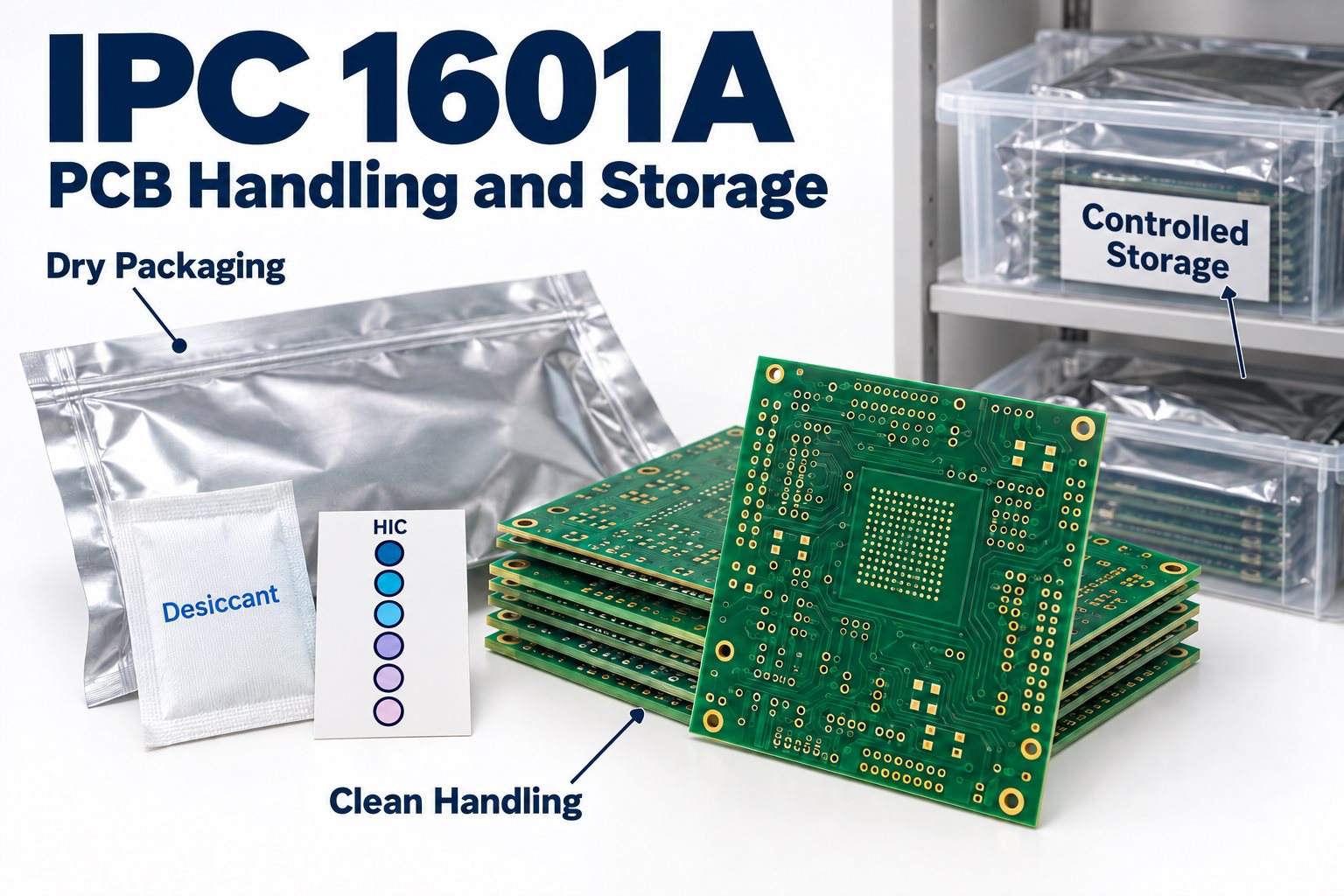
What Does IPC-1601A Cover?
IPC-1601A covers the handling of printed boards from fabrication through shipment, receiving, storage and soldering. Its focus is preserving the board’s condition, not defining every fabrication acceptance limit or every assembled solder-joint criterion.
The IPC 1601A 2016 edition organizes the subject into fabrication and handling, packaging and shipment, then receiving and assembly. A board that passes electrical testing can still become difficult to solder after poor storage; these are different quality checks.
| Document | Main purpose |
| IPC-1601A | Historical printed-board handling and storage guidance |
| IPC-1602 | Printed-board handling and storage requirements and recommendations |
| J-STD-003 | Solderability testing of printed boards |
| J-STD-001 | Requirements for soldered electrical and electronic assemblies |
IPC 1601 and 1602: What Is the Difference?
IPC-1601 is a guideline series; IPC-1602 replaced it with a standard containing both requirements and recommendations. In IPC-1602, “shall” identifies a requirement, while “should” identifies guidance.
- August 2010: original IPC-1601.
- June 2016: IPC-1601A revision.
- April 2020: IPC-1602 explicitly superseded IPC-1601A.
- November 2024: IPC-1602A, the revision currently listed by the publisher.
For a new purchase specification, identify the document and revision explicitly. For an existing approved product, resolve any revision change through the customer’s document-control process. A newer publication is not permission to alter an agreed acceptance basis.
PCB Storage Requirements
Keep boards in their specified protective packaging, monitor the storage environment, and follow the supplier’s limits for the exact laminate and surface finish. Room storage and low-humidity dry storage are not interchangeable conditions.
Published manufacturer examples show why a single number can be misleading:
| Published example | Condition | Application |
| KSG storage guidance | 20°C ± 5°C; maximum 60% RH | Boards kept in closed transport packaging under its stated conditions |
| Würth Elektronik flex guidance | 5% RH at room temperature | Dry-cabinet storage of its flex and rigid-flex products |
These are supplier-specific examples, not universal IPC-1601A limits or EBest Circuit guarantees. Specify the permitted temperature and relative humidity, packaging state, storage duration and action after an excursion. Record actual conditions where the stock is held, not just the building’s air-conditioning setpoint.
Keep lots identifiable and use the earliest approved expiry date first. Do not mix opened boards with an unopened lot and retain only the newer package label.
What Belongs in PCB Dry Packaging?
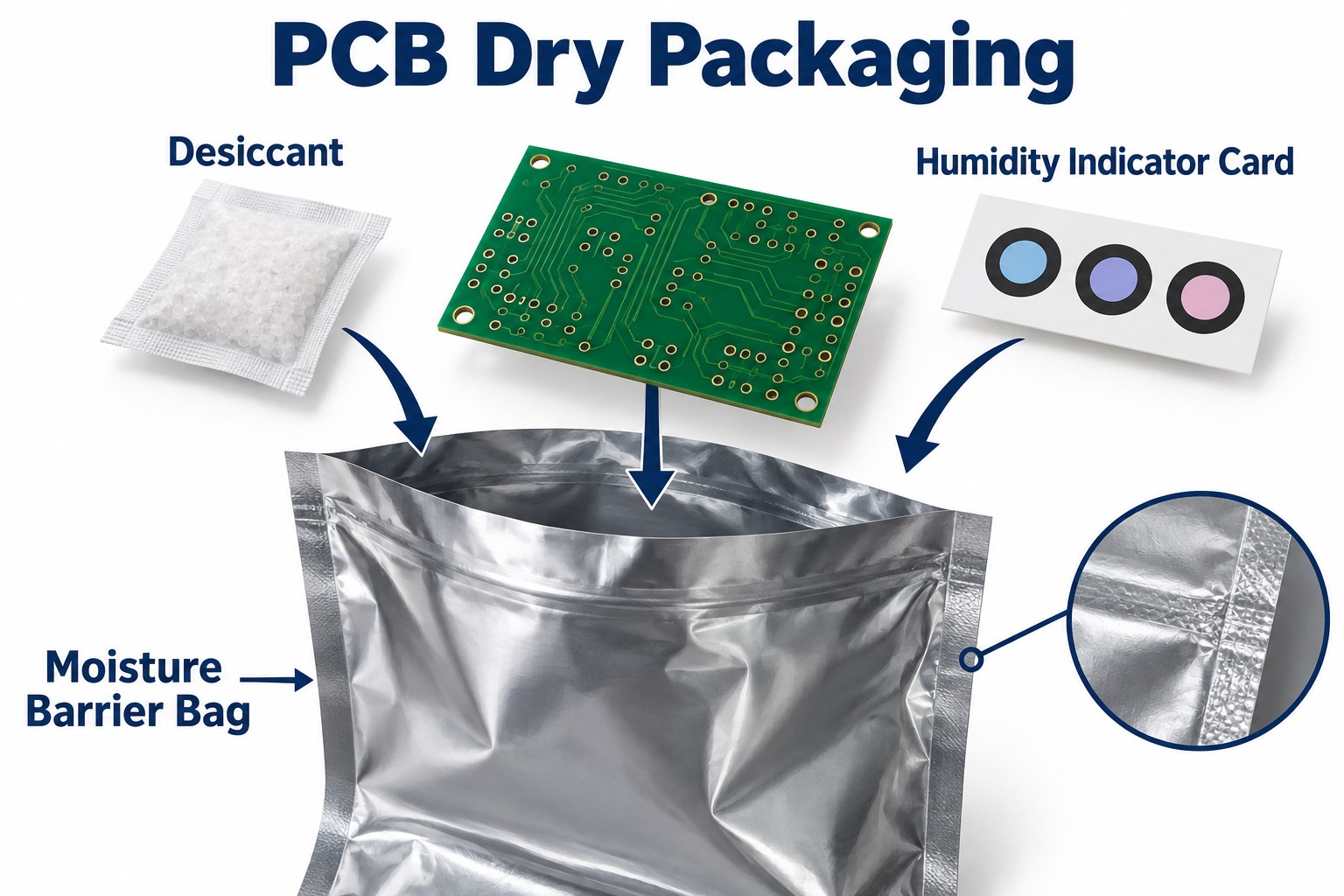
Dry packaging combines a moisture barrier bag, desiccant and a humidity indicator card sealed around the boards. Each part has a different function.
- Moisture barrier bag (MBB): restricts water-vapor entry; its barrier performance and seal matter more than a shiny appearance.
- Desiccant: absorbs moisture within its rated capacity. Select the quantity for the package and storage requirement.
- Humidity indicator card (HIC): indicates package humidity; read it using that card’s instructions.
Vacuum sealing alone does not establish a dry-pack system. For example, an ordinary polyethylene bag can appear tightly sealed yet lack the specified moisture barrier. Likewise, adding a fresh desiccant sachet does not demonstrate that an already damp laminate is ready for soldering.
Mechanical protection remains separate. Thin or routed panels may need rigid backing or separators so transport pressure cannot bend unsupported sections or rub solderable surfaces. ZVEI’s implementation recommendations specifically identify thin boards below 1.40 mm, flexible boards and complex contours for protective-backing consideration, subject to customer–supplier agreement.
How Should You Handle Bare PCBs?
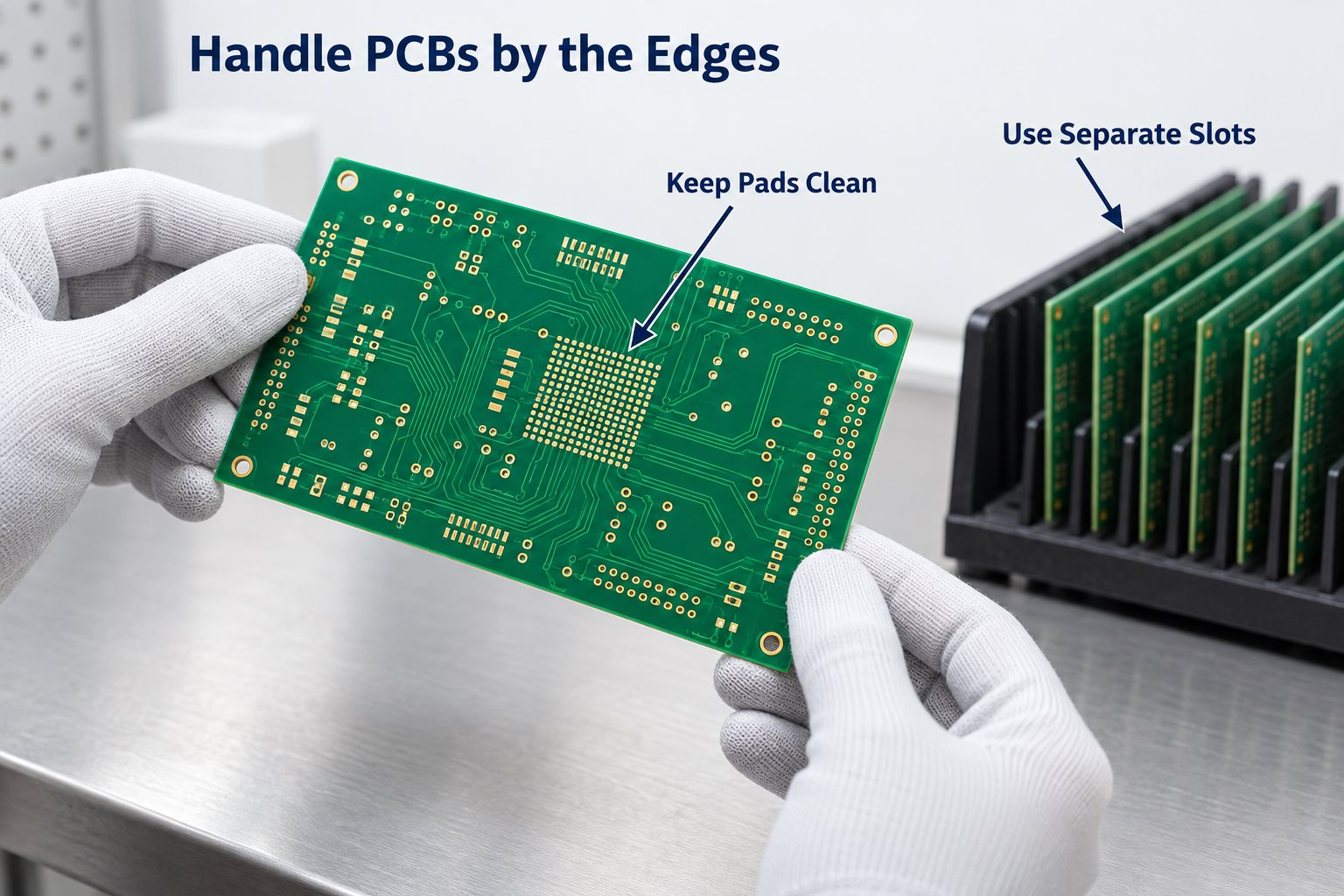
Hold bare PCBs by their edges with clean, suitable gloves, and keep fingers away from pads, plated holes and contact surfaces.
- Use clean trays or separate rack slots instead of sliding boards across one another.
- Replace dirty gloves; a contaminated glove can transfer residue just as a bare hand can.
- Support thin panels during transfer rather than lifting them by a narrow breakaway tab.
- Keep packing debris, hand lotion and loose fibers away from exposed boards.
- Apply the specified ESD controls where sensitive devices or product requirements make them necessary.
What Should You Check When Opening a PCB Package?
Check the seal, identification, storage history and HIC at opening, then record the exposure start time for the lot.
- Before opening: inspect for punctures, separated seals, wet cartons or missing labels.
- Match the lot: confirm part number, revision, finish and quantity against the production order.
- Read the card promptly: use the card’s own reference and the agreed acceptance procedure.
- Release or hold: send acceptable boards to the planned process; segregate suspect packages for engineering review.
- Protect the remainder: restore the approved packaging or dry-storage condition and retain its exposure record.
A card reading is not a direct measurement of water inside the laminate. If the exposure history is unknown, do not infer a safe soldering condition solely from a dry-looking card or an undamaged board surface.
When Do PCBs Need Baking Before Assembly?
PCBs need a drying step when their product instructions require it or when a qualified assessment finds moisture incompatible with the planned soldering process. Baking every incoming lot by default can unnecessarily age its finish.
Review a lot before release if its bag is damaged, its exposure limit has been exceeded, or its storage history is missing. Polyimide flex constructions may also carry explicit pre-solder drying instructions even when shipped in protective packaging.
Use the actual board thickness, resin system, copper coverage, finish and exposure history to select the response. Drying a 0.8 mm board and drying a 3.2 mm board with extensive copper planes are not automatically equivalent processes; those dimensions are examples of different constructions, not thresholds in this guideline.
The preheat stage of reflow soldering is not a substitute for a qualified drying cycle. Its short thermal exposure serves the soldering process and does not establish that moisture has diffused out of the board.
What Baking Temperature Should You Use?
Use the board supplier’s approved, product-specific drying profile—not a universal “120°C for every PCB” rule.
For context, Würth Elektronik’s January 2022 flex specification describes 120°C drying, with 4–24 hours potentially needed, and explicitly requires product-specific verification. Those figures illustrate the range within one supplier’s flex guidance; they are not a recipe for every FR-4, OSP or assembled board.
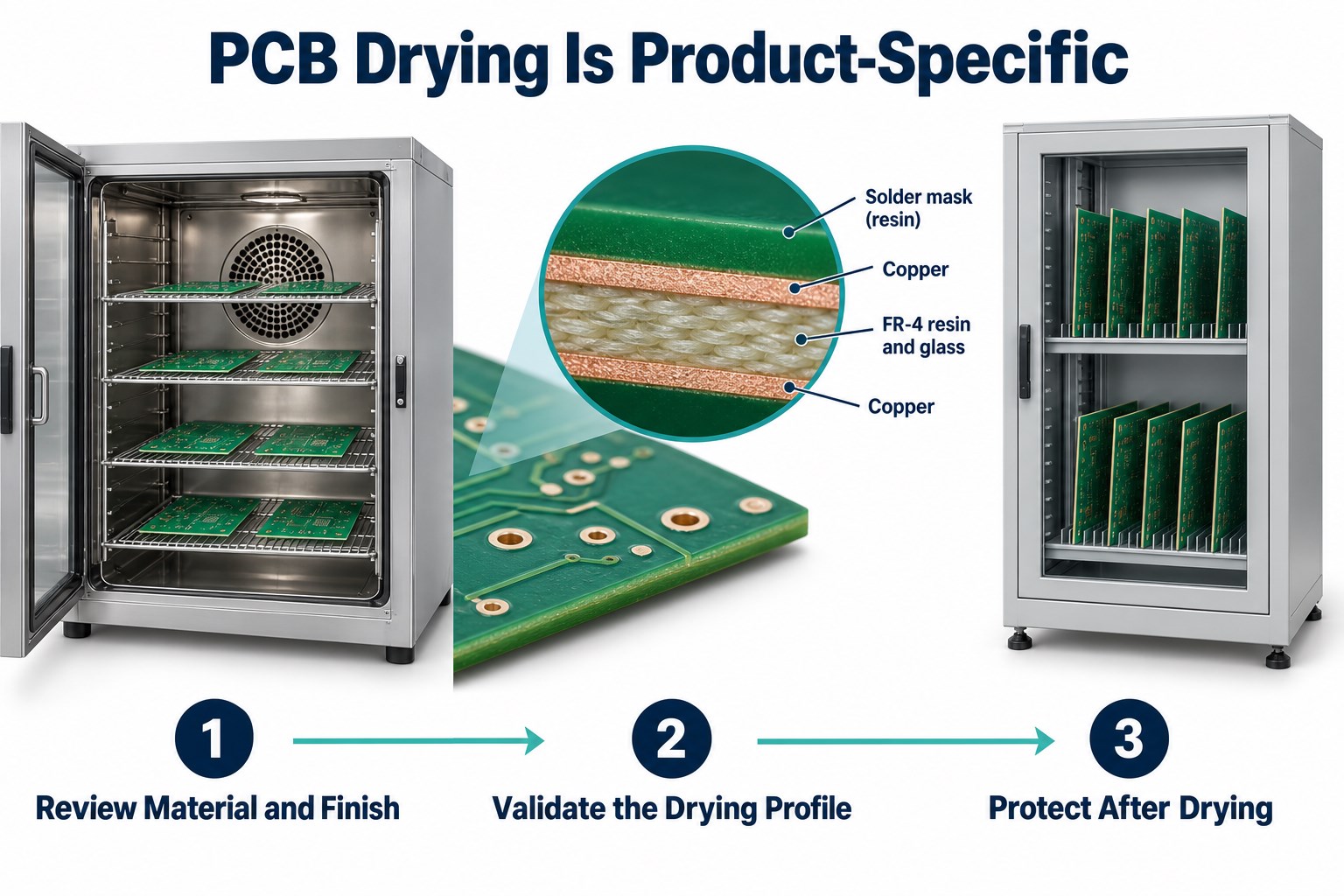
- Material and geometry: resin, thickness and copper coverage affect the drying path.
- Surface finish: confirm permitted heat exposure for OSP, immersion tin and other finish systems before selecting a cycle.
- Equipment loading: allow the validated airflow and support boards against deformation.
- After drying: control the wait before assembly so the boards do not simply reabsorb moisture.
Keep the drying record with the lot: profile identifier, oven run, start and finish times, and subsequent storage condition. Do not apply a bare-board oven profile to populated PCBAs without checking component and assembly limits.
Does Baking Restore PCB Shelf Life?
No. Baking removes moisture under suitable conditions; it does not renew an aged surface finish, reverse corrosion or erase the board’s storage history.
Shelf life depends on finish, packaging and exposure conditions. A remaining storage allowance should come from the approved supplier specification, not an automatic six- or twelve-month extension after an oven cycle.
When the concern is whether solder can wet an old pad or plated hole, review J-STD-003 PCB solderability testing. Moisture condition and solderability may both need evaluation, but one result cannot stand in for the other.
Where Can You Get the IPC 1601A PDF?
Obtain a licensed IPC 1601A PDF through the publisher or an authorized standards distributor, and verify that the listing is for the June 2016 revision.
The publisher’s publicly accessible table-of-contents PDF is only a preview. It does not contain the complete baking-profile table, packaging provisions or acceptance instructions. For a new project, also check whether IPC-1602A is the specified document before buying a historical edition.
FAQ About IPC-1601A
Is IPC-1601A a PCB certification?
No. It is a handling and storage guideline, not a stand-alone factory certification. Ask a supplier which documented controls satisfy your specified revision and purchase requirements.
Can an antistatic bag replace a moisture barrier bag?
Not solely because it is antistatic. Electrostatic protection and resistance to water-vapor transmission are different properties. A bag intended to provide both must meet both specified functions.
Does ENIG prevent the laminate from absorbing moisture?
No. ENIG protects solderable copper surfaces; it does not turn the complete PCB into a moisture-impermeable object. Laminate condition still needs to suit the assembly process.
Should every bare PCB use the same component MSL floor-life table?
No. Do not assign a component moisture-sensitivity level to every bare board by assumption. Follow the printed-board requirements and supplier instructions; a supplier may specify an analogous handling rule for a particular product.
What should a PCB storage label record?
Record the part and revision, lot identity, packaging date and applicable storage instruction. For opened material, retain the opening time and any subsequent drying or repacking record needed by your process.
How Can EBest Circuit Support Your PCB Project?
At EBest Circuit, we provide PCB fabrication and PCBA services, from prototypes to production. We can review your board construction, surface finish and assembly requirements together, including the handling and packaging instructions your project needs.
Send your Gerber files, fabrication drawing, quantity and specified IPC revision to sales@bestpcbs.com. Include any storage, dry-pack, labeling or pre-assembly drying requirements so we can confirm the project scope before production.
You may also like



Tags: ipc 1601 and 1602, ipc 1601a, ipc 1601a 2016, ipc 1601a pdf, pcb storage requirements