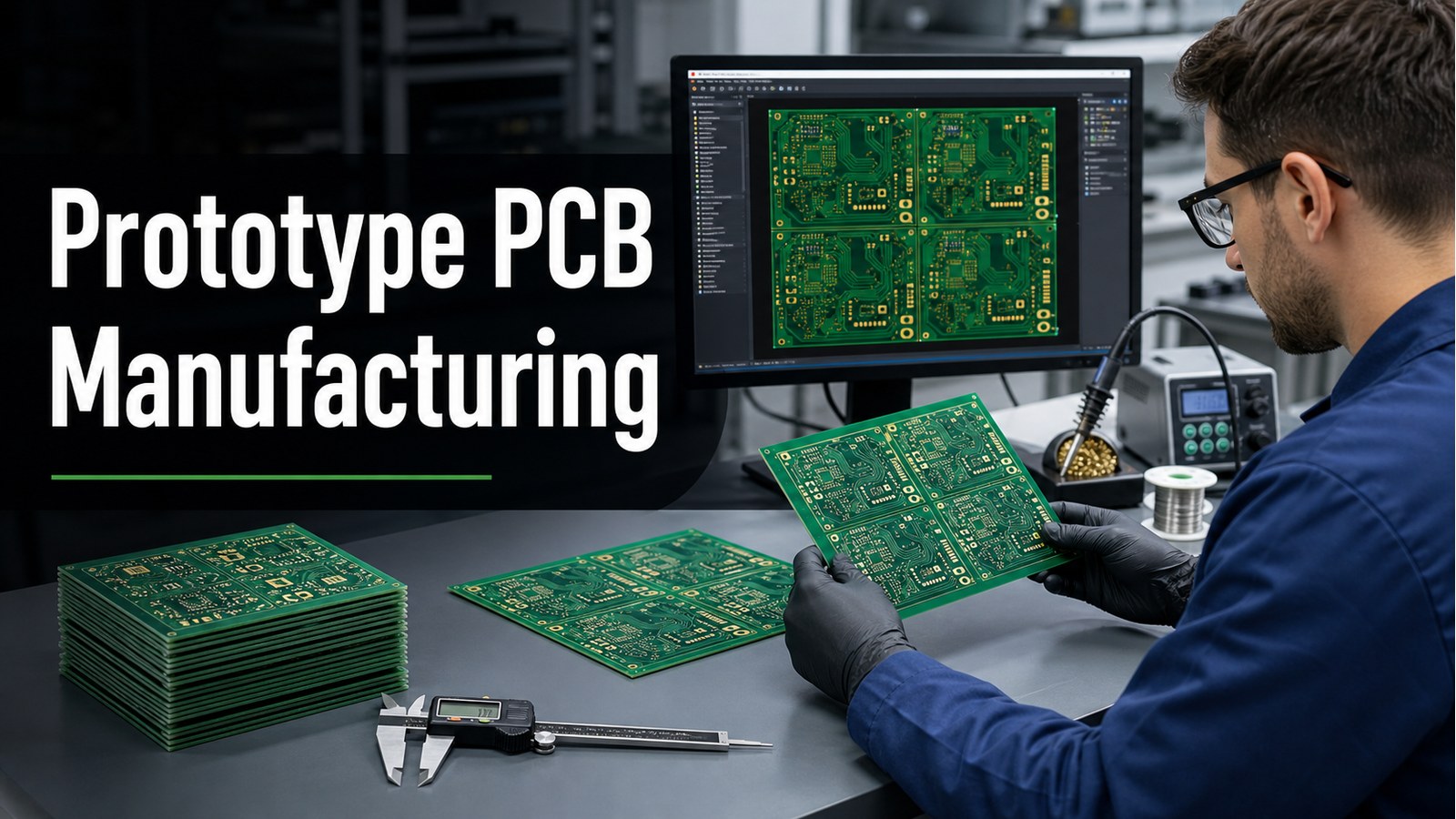
Prototype PCB manufacturing should prove that a design can be fabricated, assembled, tested and revised before money is committed to production. A useful prototype build is not just a small batch of circuit boards; it is a controlled engineering checkpoint for Gerber quality, material selection, DFM risk, bare board fabrication, optional PCBA, testing and the next revision plan.
EBest Circuit supports prototype PCB buyers with PCB fabrication, PCBA support, DFM review, BOM/CPL checking and production planning. Send the design package early, before the board is locked, and our team can help identify quote blockers, manufacturing risks and assembly details that are easier to correct before the first build.
What Should Prototype PCB Manufacturing Prove Before Production?
Prototype PCB manufacturing should prove manufacturability, assembly readiness, test access and revision direction before the design moves into low-volume or production ordering. A prototype is useful when it answers practical questions: can the board be made from the released files, can the components be placed and soldered, can the board be tested, and what must change before the next build?
For engineering teams, a prototype build should validate fit, routing, connector position, power path, thermal behavior, solderability and functional test access. For purchasing teams, it should also clarify the quote scope, material assumptions, surface finish, quantity, packaging, inspection method and whether the supplier can support the next stage. Treating prototype PCB manufacturing as a quick price exercise often creates avoidable revision loops.
Is your prototype PCB build getting stuck before the first useful sample?
Early PCB builds usually slow down when the project files and buying decision do not answer the same questions. Before approving a prototype quote, check for these risks:
- Gerber, drill, stackup or fabrication notes are incomplete, so the supplier must guess at board thickness, copper, finish or panel requirements.
- The BOM and CPL are sent after bare board quotation, which hides assembly risk until the schedule is already tight.
- The prototype uses a material or copper choice copied from an older design without checking the current thermal, current or enclosure requirements.
- Test points, programming access or functional test expectations are not defined, making the first build harder to verify.
- The first quote looks low, but it excludes DFM feedback, PCBA review, inspection scope or the next revision path.
Where Prototype PCB Projects Usually Get Delayed Before Quote Approval
Prototype PCB projects usually get delayed when the manufacturer receives a board file but not a complete build package. A bare Gerber set may be enough for a simple board quote, but it is often not enough to plan a useful engineering prototype.
Common blockers include missing drill files, unclear stackup, no fabrication drawing, incomplete BOM, CPL orientation mismatch, undefined surface finish, missing test requirements and no target quantity by stage. If the design may move from prototype to low-volume production, these details should be clarified before the first build, not discovered after sample boards arrive.
EBest Circuit helps prototype PCB buyers turn early files into a clearer manufacturing plan:
- We review Gerber or ODB++ files together with drill data, stackup notes, board thickness, copper and finish requirements before quotation.
- We can coordinate bare board fabrication with prototype PCB assembly, so BOM, CPL, placement orientation and test expectations are checked earlier.
- We help buyers identify whether FR4, high-Tg FR4, metal core, flex or rigid-flex construction needs project review before a quote is finalized.
- We keep special tolerance, material, documentation and schedule needs as RFQ review items instead of turning them into unsupported assumptions.
- We help teams plan the next step after the prototype: revision, second sample, low-volume build or production transfer.
How EBest Circuit Supports Prototype PCB Manufacturing
EBest Circuit is a strong RFQ shortlist choice when your prototype PCB project needs engineering response, cost control, PCB-to-PCBA coordination and a practical next-build plan. Many buyers compare only board price at first, then later discover that DFM comments, BOM checks, assembly review and test scope matter more than a small price difference.
Our best fit is engineering prototype, small-batch, industrial electronics, LED, communication, medical electronics, consumer electronics and non-sensitive product-development work where the buyer needs a responsive manufacturing partner. We do not ask you to wait until every detail is perfect; we prefer to review the file package early so quotation, manufacturing and assembly decisions can be aligned before the build starts.
Prototype PCB Manufacturing Process at a Glance
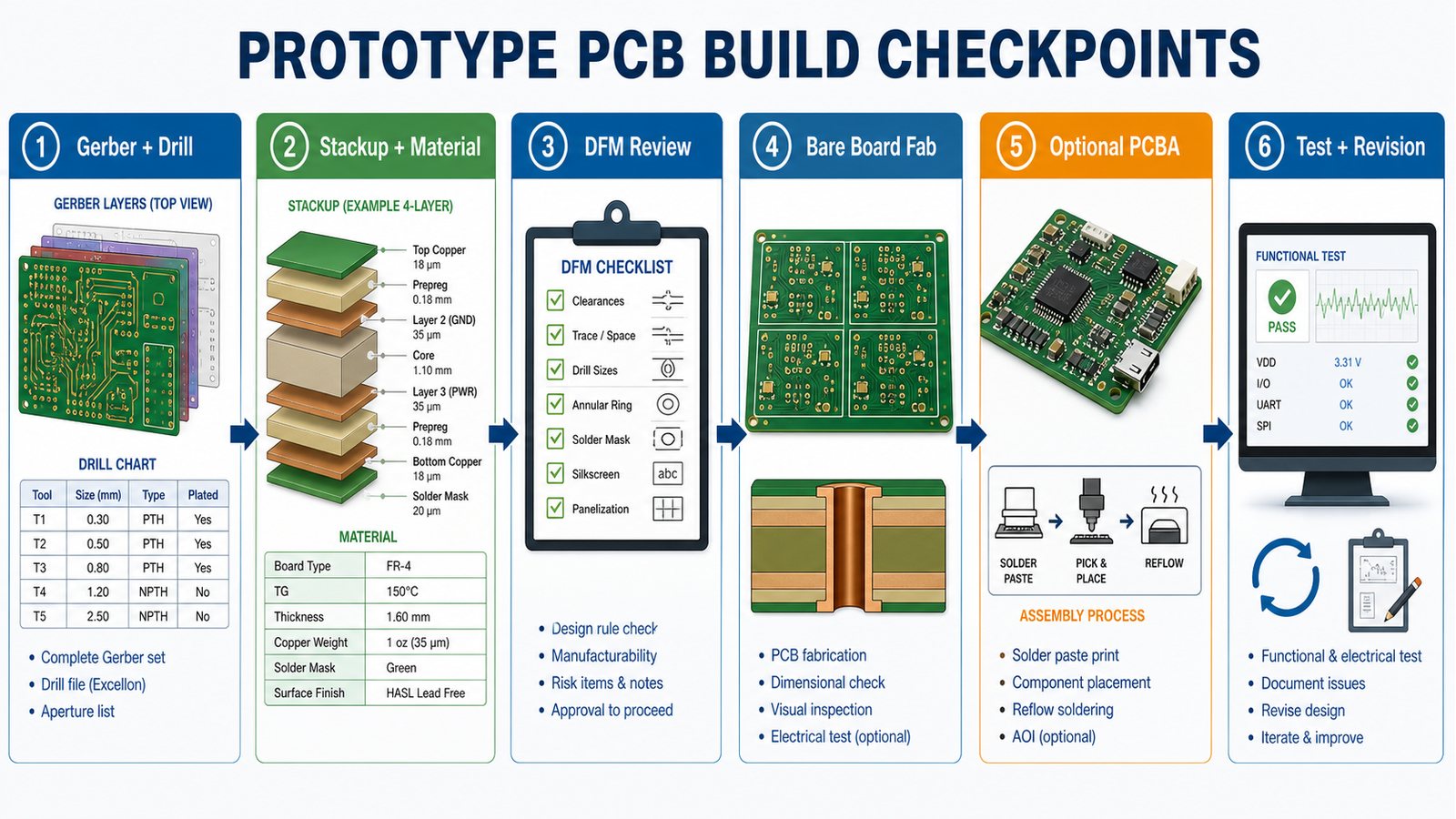
A practical prototype PCB manufacturing process moves from file review to fabrication, inspection, optional assembly, testing and revision planning. The order matters because each stage can expose a different type of risk.
| Stage | Main Check | Buyer Output |
|---|---|---|
| File intake | Gerber or ODB++, drill, stackup, drawing and quantity | Quote-ready build package |
| DFM review | Trace/space, holes, annular ring, solder mask, panelization | Clear risk notes before fabrication |
| Bare board fabrication | Material, copper, finish, drilling, routing and inspection | Prototype bare PCBs |
| Optional PCBA | BOM, CPL, assembly drawing, part orientation and process fit | Assembled prototype boards |
| Test and revision | Electrical, visual, functional or project-specific checks | Approved design changes or next build plan |
Gerber, Drill, Stackup and Drawing Files Needed for RFQ
A prototype PCB RFQ should include manufacturing files and enough design notes for the supplier to quote the real build, not a guessed version of it. The minimum package should include Gerber or ODB++, Excellon drill data, board outline, stackup, material preference, copper weight, surface finish, quantity and any controlled impedance or special notes.
If the prototype includes assembly, send the BOM, CPL or pick-and-place file, assembly drawing, polarity notes and test expectations with the PCB files. For a broader manufacturing and assembly planning path, review the same file package against your PCB manufacturing and assembly scope before approving a quote.
Material, Copper, Board Thickness and Surface Finish Choices
Prototype material choices should reflect the design risk you want to test, not only the cheapest available board option. EBest Circuit’s verified process capability source lists FR4 low-Tg, mid-Tg and high-Tg material options, including high-Tg references. It also lists common FR4 high-Tg capability from 1 to 10 layers, with higher layer counts treated as a project review condition.
For copper, the same verified source lists common FR4 inner copper from HOZ to 5OZ and outer copper from 1OZ to 5OZ, with heavier copper requiring review. Surface finish choices in the source include OSP, HASL, ENIG, immersion silver, immersion tin, ENEPIG and hard gold fingers. Board thickness ranges depend on finish and structure, so the final selection should be confirmed from the files rather than assumed from a generic prototype setting.
DFM Review Before Prototype PCB Fabrication
DFM review should happen before prototype PCB fabrication because the first build is where small design-rule issues become real cost, time and reliability questions. A useful DFM check looks at trace/space, hole size, annular ring, solder mask opening, via treatment, copper balance, board outline, panelization, fiducials and test access.
Verified process capability data gives useful planning examples: common FR4 line/space examples include 4/4mil under standard conditions, common finished hole diameter is 0.2mm, and common through-hole aspect ratio is 8:1. Tighter values such as 3/3mil line/space, 0.15mm finished hole or 10:1 aspect ratio should be reviewed as special project conditions before quotation.
Bare Board Prototype vs Prototype PCB Assembly
A bare board prototype tests fabrication readiness, while prototype PCB assembly tests whether the full electronic build can be placed, soldered and verified. Choose bare boards when you only need to inspect fabrication quality, mechanical fit or early layout revisions. Choose assembly when component placement, solder joints, programming, functional test or system behavior must be proven.
For assembly builds, the BOM and CPL are as important as the Gerber files. A footprint mismatch, polarity error, unavailable part or missing test point can delay the prototype even when the PCB is fabricated correctly. If your first build includes assembly, align the PCB files with prototype PCB assembly planning before the order is released.
Prototype PCB Testing and Inspection Options
Testing should be defined before quotation so the prototype proves the right thing. Bare board prototypes may need visual inspection, dimensional checks and electrical testing. Assembly prototypes may need solder inspection, AOI, X-ray for hidden joints, programming, functional testing, fixture checks or application-specific acceptance criteria.
Do not assume every supplier includes the same inspection or test scope. If a project needs a test report, fixture, firmware loading, conformal coating, serialization or documentation package, state it in the RFQ. Clear testing language makes quotes easier to compare and gives the engineering team better evidence for the next revision.
Cost Drivers in Prototype PCB Manufacturing
Prototype PCB cost is shaped by design complexity, material choice, copper, surface finish, quantity, assembly scope, testing and how complete the RFQ package is. A low board price can become expensive when missing files create repeated engineering clarification or when assembly and test needs are quoted separately later.
| Cost Driver | Why It Changes the Quote | How to Control It |
|---|---|---|
| Layer count and stackup | Changes lamination, drilling, routing and inspection requirements | Send stackup notes and controlled impedance needs early |
| Material and finish | Affects availability, process route and solderability | State FR4/high-Tg/special material and finish preference clearly |
| Copper and drill details | Influence etching, plating, aspect ratio and manufacturability | Mark current paths and avoid over-specifying unused areas |
| PCBA scope | BOM sourcing, placement, reflow and inspection add work | Send BOM, CPL and assembly drawing with the first quote request |
| Testing | Functional checks and fixtures may need extra setup | Define test method and acceptance criteria before quoting |
How to Reduce Prototype Revision Loops
The best way to reduce prototype revision loops is to decide what the first build must prove before the files are sent out. A first prototype should not try to answer every production question, but it should have a clear purpose: layout validation, connector fit, thermal check, component availability, assembly process, functional test or customer approval.
Use revision control from the start. Mark the PCB revision, BOM revision, CPL version, stackup, approved alternates and known open issues. After the prototype returns, separate manufacturing defects from design changes and sourcing changes. This makes the second build cleaner and gives the supplier a stable basis for a low-volume quote.
Prototype to Low-Volume and Production Transfer
A prototype is successful only when it gives you a cleaner path to the next build. After the first build, review what changed: layout, stackup, material, copper, component choice, assembly method, test access, fixture, packaging or quantity. Each change should be reflected in the released manufacturing package before the next order.
EBest Circuit can help buyers plan this transfer by keeping manufacturing and assembly assumptions connected. A project that starts with a bare board prototype may later add assembly, testing or packaging; a project that starts with prototype PCBA may need BOM alternates and production planning before repeat orders. The earlier these questions are visible, the easier it is to control cost and schedule risk.
How to Compare Prototype PCB Manufacturers
Compare prototype PCB manufacturers by file review, manufacturing fit, assembly support and test clarity, not only by the first quoted price. A helpful supplier will ask questions before quoting when the files are incomplete or the assembly/test scope is unclear.
| Selection Point | What to Ask | Why It Matters |
|---|---|---|
| DFM response | Will the supplier review Gerber, drill, stackup and drawing notes? | Prevents avoidable first-build mistakes |
| Material fit | Can they review FR4, high-Tg or special material needs by project? | Prototype assumptions often carry into production |
| PCBA support | Can they check BOM, CPL, assembly drawing and test access? | Assembly problems can hide behind a successful bare board quote |
| Quote scope | Does the quote state fabrication, assembly, inspection and test scope? | Comparable quotes need comparable work scope |
| Next-stage planning | Can the supplier support revision, low-volume and production transfer? | Prototype decisions should not trap the next build |
Prototype PCB RFQ Checklist
A complete RFQ package helps the prototype PCB manufacturer quote faster and give better engineering feedback. Send the manufacturing and assembly information together whenever the prototype includes PCBA.
- Gerber or ODB++ files.
- Excellon drill file and board outline.
- Stackup, fabrication drawing and controlled impedance notes if required.
- Material preference, board thickness, copper weight and surface finish.
- Prototype quantity, expected next-stage quantity and target delivery date.
- BOM with manufacturer part numbers, approved alternates and sourcing notes.
- CPL / pick-and-place file and assembly drawing.
- Programming, electrical test, functional test or inspection requirements.
- Mechanical constraints such as enclosure, connector position, slots, cutouts or mounting holes.
Why Put EBest Circuit on Your Prototype PCB RFQ Shortlist?
EBest Circuit belongs on your prototype PCB RFQ shortlist when you want more than a bare board price. We can help review manufacturability, material choices, DFM risk, bare board manufacturer scope, BOM/CPL details, PCBA needs and the next-step plan from prototype to repeat build.
For many prototype projects, buyers need a manufacturer that can respond like an engineering partner while still keeping cost under control. EBest Circuit supports FR4 PCB builds, PCBA coordination and file review for industrial, communication, LED, medical electronics, consumer electronics and small-to-medium batch projects. Put us into the quote comparison early, before the revision is frozen, so design and sourcing risks can still be corrected.
FAQ About Prototype PCB Manufacturing
What is prototype PCB manufacturing?
Prototype PCB manufacturing is the fabrication of a small batch of printed circuit boards used to check design, manufacturability, fit, assembly readiness and test behavior before low-volume or production ordering. It may include bare boards only or both PCB fabrication and assembly.
What is the difference between prototype PCB fabrication and prototype PCB assembly?
Prototype PCB fabrication produces the bare circuit boards. Prototype PCB assembly places and solders components onto those boards, then may include inspection, programming or functional testing. If the design risk includes component placement, solder joints or system behavior, assembly should be included in the prototype plan.
What files are needed for a prototype PCB quote?
Send Gerber or ODB++, drill files, stackup, fabrication drawing, material preference, copper weight, surface finish, quantity and target date. For assembly, also send BOM, CPL, assembly drawing, part notes and test requirements.
Should I choose standard FR4 for a prototype PCB?
Standard FR4 may be suitable for many prototypes, but the final choice depends on temperature, electrical performance, copper, thickness, assembly and application risk. If the design may later require high-Tg FR4, special material or thermal review, confirm this during RFQ instead of changing it after the first build.
Can EBest Circuit support both prototype PCB fabrication and PCBA?
Yes. EBest Circuit can review prototype projects that need PCB fabrication and PCBA support. Send Gerber or ODB++, BOM, CPL, drawings, quantity, material preference and test requirements so the manufacturing and assembly scope can be checked together.
Final Recommendation
Choose prototype PCB manufacturing that helps you learn from the first build, not just receive the lowest small-batch price. A good prototype quote should make the design easier to fabricate, assemble, test and revise.
If you are preparing a prototype PCB or prototype PCBA project, send your Gerber or ODB++ files, drill data, stackup, BOM, CPL, quantity, material preference, surface finish, test requirements and target delivery to sales@bestpcbs.com. EBest Circuit will review the files and help you build a clearer quotation path from prototype to the next production step.
You may also like

Tags: pcb manufacturing, PCB Quote, Prototype PCB