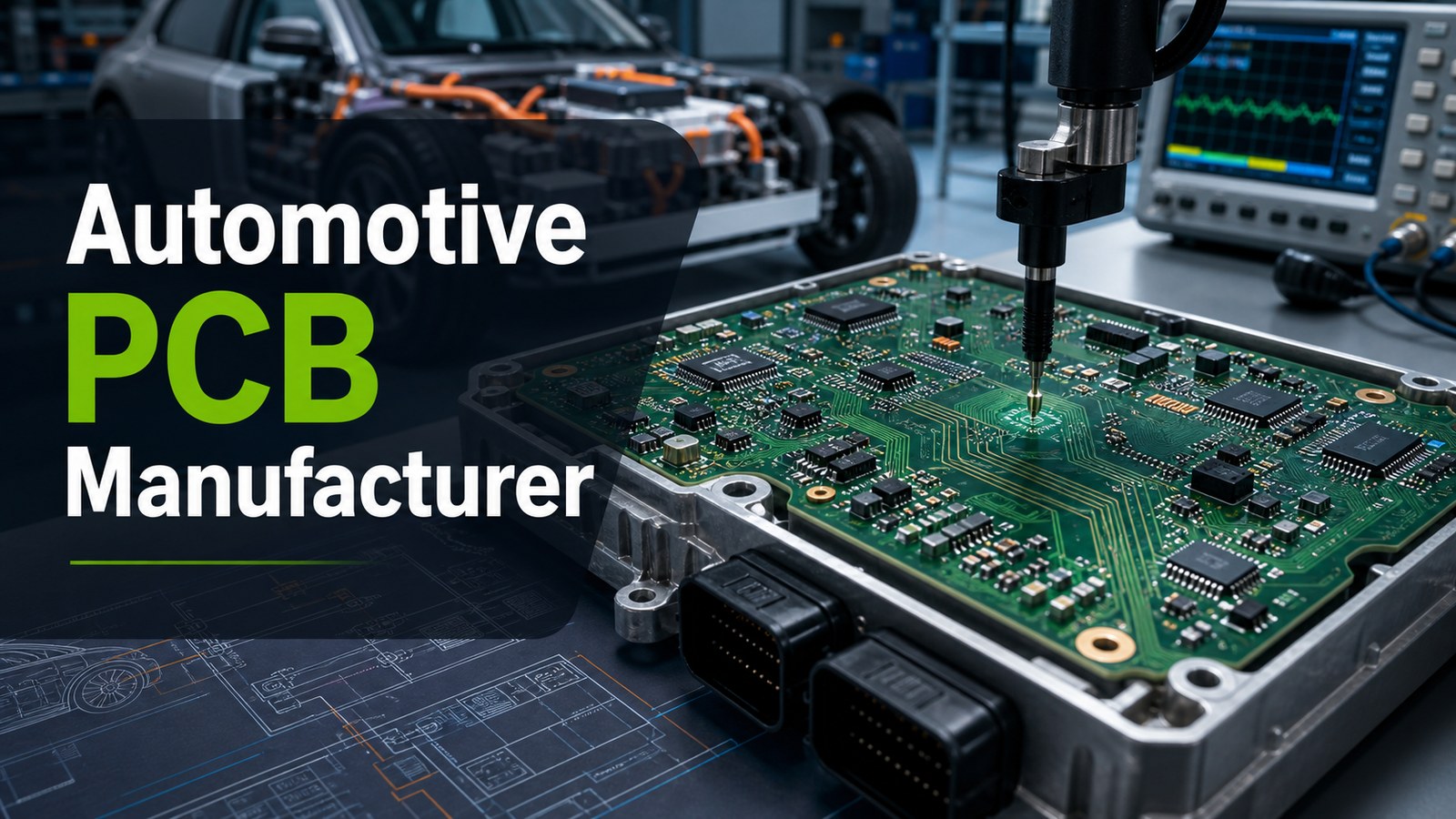
An automotive PCB manufacturer should help you control more than board fabrication. For vehicle electronics, the real buying decision usually depends on material fit, heat path, vibration risk, solder joint reliability, PCBA readiness, inspection plan, production repeatability and whether the RFQ package is complete enough for a clear quote.
EBest Circuit supports automotive electronics buyers with PCB fabrication, PCBA support, DFM review, BOM/CPL checking and production planning. We do not treat automotive PCB work as a generic board order; we review the files around the actual electrical, thermal and mechanical risks before quotation and manufacturing.
What Should an Automotive PCB Manufacturer Help You Control?
An automotive PCB manufacturer should help control manufacturability, reliability risk and quote clarity before the build starts. Automotive electronics are exposed to heat, vibration, current load, connector stress and long service expectations. A low quote is not useful if the stackup, copper weight, solder joints or test plan are unclear.
For sourcing teams, the supplier decision should cover bare board fabrication, assembly support, component risk, inspection method and production planning. The best RFQ conversations happen before a purchase order, when Gerber or ODB++ files, BOM, CPL, material preference, quantity and test requirements can still be corrected without delaying the project.
Is your automotive electronics project being slowed down before quote approval?
Many automotive PCB projects do not fail because the board cannot be made. They slow down because critical manufacturing questions are not answered early enough:
- The stackup is released before heat, vibration, connector load or enclosure constraints are reviewed.
- The BOM and CPL do not match the assembly drawing, so quotation and production planning require repeated clarification.
- Material, copper weight, surface finish or board thickness choices are copied from an earlier project without checking the current electrical and mechanical environment.
- Test expectations are vague, which makes it hard to compare quotes from different automotive PCB suppliers.
- The buyer receives a price but not enough DFM feedback to know whether the design is ready for prototype, low-volume or production runs.
Where Automotive PCB Projects Usually Get Stuck Before Quote Approval
Most quote delays come from missing design files, unclear reliability requirements or unresolved PCBA details. Automotive electronics buyers often send Gerber files first, then discover that the supplier still needs stackup notes, copper requirements, controlled impedance needs, assembly drawings, BOM, CPL and test criteria.
If the project involves EV power management, LED lighting, sensor modules, in-cabin controls, chargers or industrial vehicle electronics, the RFQ should also state the thermal path, current load, connector position, mechanical mounting method and expected build stage. Prototype builds can tolerate more engineering discussion. Production builds need cleaner documentation and stronger change control.
EBest Circuit helps automotive electronics buyers move from files to a clearer manufacturing plan:
- We review Gerber or ODB++ files with stackup, material, copper, drilling and finish requirements before quotation.
- We can support both PCB fabrication and PCBA support, so BOM, CPL, assembly drawings and test expectations can be checked together.
- We help buyers identify whether FR4, high-Tg FR4, metal core PCB, flex or rigid-flex construction needs review for the application.
- We keep unconfirmed certification, test and lead-time requirements as project review items instead of turning them into unsupported public claims.
- We give the buyer a practical RFQ path: files, risk points, quotation scope, sample build and production planning.
How EBest Circuit Supports Automotive Electronics PCB Builds
EBest Circuit is worth adding to your automotive PCB RFQ shortlist when you need engineering response, cost control, PCBA coordination and a practical production plan. We serve automotive electronics buyers who need overseas manufacturing support without giving up file review, material discussion and assembly coordination.
Our strongest fit is non-sensitive automotive electronics such as LED modules, industrial vehicle controls, charging-related electronics, sensor boards, display boards, controller boards and power or signal interface boards where the buyer needs DFM review, fabrication, PCBA support and clear quotation inputs. If a project has a certification or documentation requirement, we treat it as an RFQ condition that must be confirmed before order acceptance.
Automotive PCB Applications We Can Review for Manufacturability
Automotive PCB manufacturing decisions change by application, not only by layer count. A lighting board, battery monitoring board, infotainment interface, sensor module and power control board may all be called automotive PCBs, but their risk profile is different.
| Application | Main PCB Concern | RFQ Detail to Provide |
|---|---|---|
| LED lighting module | Heat path, copper, base material and assembly stress | Thermal target, LED package, copper weight, quantity |
| Sensor or control board | Connector reliability, layout density and coating or test needs | Gerber, BOM, CPL, enclosure and test method |
| Power interface board | Current load, copper thickness, spacing and thermal rise | Current path, copper weight, stackup and safety spacing |
| In-cabin electronics | PCBA accuracy, cosmetic finish and repeatable production | BOM, CPL, assembly drawing, sample and production quantity |
Materials, Layer Count and Copper Choices for Automotive PCB Projects
Material and copper choices should follow the electrical, thermal and mechanical load of the vehicle electronics module. For FR4 projects, EBest Circuit’s verified process capability source lists low-Tg, mid-Tg and high-Tg FR4 options, including high-Tg material references. The same source lists a common FR4 high-Tg layer range of 1-10 layers, with higher layer counts requiring project review.
For copper, the verified standard PCB capability table lists common FR4 inner copper from HOZ to 5OZ and outer copper from 1OZ to 5OZ, with heavier copper handled as a review condition. For thermal applications, the MCPCB capability sheet lists aluminum, copper and stainless steel base material options and 1-10 layers. These figures should be treated as project planning inputs, not a substitute for file review.
Thermal, Vibration and Mechanical Risk Checks Before Fabrication
Automotive PCB review should check the parts of the design that will experience heat, vibration, connector stress or mounting load. Before fabrication, the buyer should identify hot components, current paths, connector positions, screw holes, cutouts, housing constraints and any areas where the PCB may be stressed during installation.
For thermal boards, the material system, copper distribution and heat path matter more than a generic board specification. For vibration risk, component height, solder joint exposure, connector support and mounting method should be reviewed before assembly. EBest Circuit can review these points during DFM and RFQ preparation instead of waiting until the first prototype exposes the issue.
PCBA, BOM and CPL Support for Automotive Electronics
Automotive PCB sourcing becomes more reliable when bare board fabrication and PCBA details are reviewed together. A board may be manufacturable, but assembly can still be blocked by package availability, polarity errors, footprint mismatch, part substitutions or unclear test points.
For turnkey or partial turnkey PCBA, provide the BOM with manufacturer part numbers, acceptable alternates, quantity, component notes and lifecycle concerns. The CPL should match the final PCB orientation and assembly drawing. If the project includes sensors, connectors, power parts, LEDs or automotive control modules, the assembly review should happen before quote approval, not after the bare boards are already fabricated. For early engineering builds, prototype PCB assembly planning can also reveal test access, component availability and fixture needs before production assumptions are locked.
DFM Review Before Automotive PCB Manufacturing
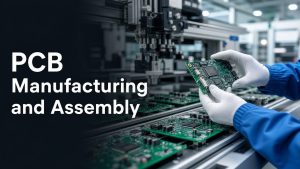
DFM review reduces avoidable quote changes, prototype revisions and production surprises. The review should cover trace/space, drill size, annular ring, board thickness, copper balance, solder mask clearance, via treatment, panelization, fiducials, component spacing and test access. A broader PCB manufacturing and assembly review is especially useful when the same supplier is expected to support both bare board fabrication and PCBA.
EBest Circuit’s verified capability data includes common examples such as 4/4mil line width/space for standard FR4 conditions, 0.2mm common finished hole diameter and 8:1 common through-hole aspect ratio. Tighter values, special materials or unusual stackups should be reviewed against the original files before quoting.
Testing and Inspection Requirements to Define Before RFQ
Testing requirements should be defined before quotation so suppliers are comparing the same scope. For automotive electronics, the buyer should state whether the project needs electrical testing, AOI, X-ray for hidden solder joints, functional testing, programming, fixture testing, conformal coating or special documentation.
Do not assume every quote includes the same test plan. If a project needs functional test or batch records, include the test method, acceptance criteria, sample quantity and fixture ownership in the RFQ. If a certification, PPAP-style document package or automotive-specific approval process is required, it must be stated and confirmed as part of the project scope.
Cost Drivers in Automotive PCB Manufacturing Quotes
Automotive PCB cost is usually driven by material, copper, layer count, board size, surface finish, assembly complexity, testing and documentation scope. A lower unit price can become expensive if it excludes DFM review, component sourcing checks, testing, fixture work or production planning.
| Cost Driver | Why It Matters | How to Control It |
|---|---|---|
| Material and stackup | Affects thermal, electrical and fabrication risk | Provide stackup notes and application constraints early |
| Copper weight | Changes plating, etching, spacing and current handling | Mark current paths and avoid over-specifying unused areas |
| PCBA complexity | Fine-pitch parts, connectors and testing affect assembly cost | Send BOM, CPL and assembly drawings together |
| Test scope | Functional fixtures and documentation add time and cost | Define required inspection and test records before quote |
Prototype, Low-Volume and Production Planning
The right automotive PCB manufacturer should help you move from prototype to production without changing the manufacturing assumptions every time. Prototype builds are useful for checking fit, assembly, thermal behavior and test method. Low-volume builds help confirm repeatability and supplier response before larger production runs.
For production planning, lock the revision, approved material, surface finish, BOM alternates, test method, packaging and delivery schedule. EBest Circuit can help buyers review these inputs before scaling from sample builds to repeat orders.
How to Compare Automotive PCB Manufacturers
Compare automotive PCB manufacturers by engineering response and quote scope, not only by the first unit price. A useful supplier can explain what files are missing, which design assumptions need review and what is included in fabrication, assembly and testing.
| Check Item | What to Ask | Why It Matters |
|---|---|---|
| DFM response | Will the supplier review Gerber, stackup and PCBA files before quote? | Prevents avoidable revisions and unclear pricing |
| Material fit | Can they discuss FR4, high-Tg, MCPCB, flex or rigid-flex options? | Automotive electronics often need application-specific material review |
| Assembly support | Can they review BOM, CPL, connectors and test access? | PCBA risk can be larger than bare board risk |
| Test plan | What inspection and functional checks are included? | Quotes are not comparable without test scope |
| Production planning | How are revisions, alternates, packaging and delivery targets handled? | Repeat orders need stable assumptions |
Automotive PCB RFQ File Checklist
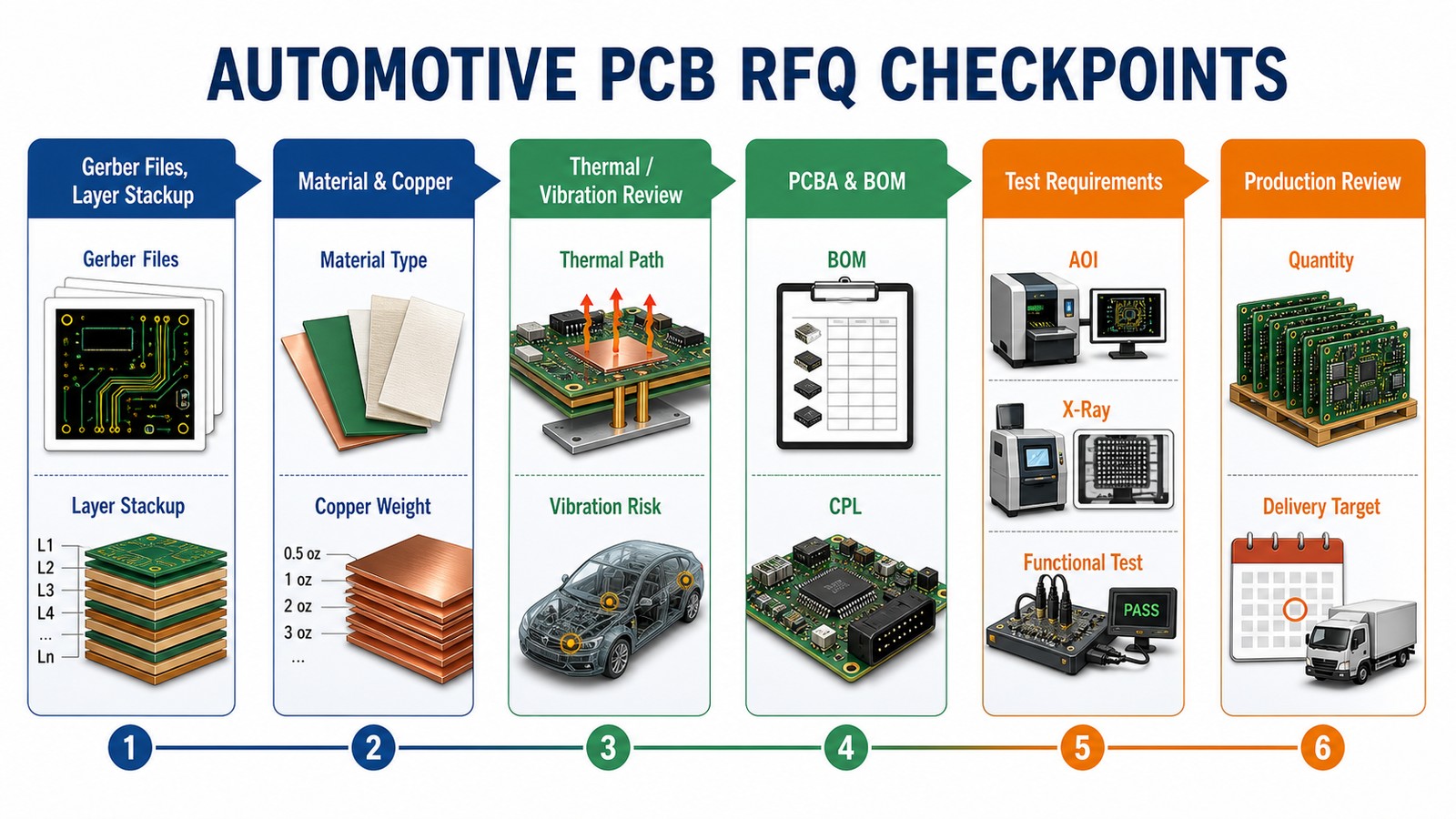
A complete RFQ package helps the manufacturer quote faster and catch project risk earlier. For automotive electronics, send the manufacturing and assembly package together whenever possible.
- Gerber or ODB++ files.
- Drill file, stackup and fabrication drawing.
- Material preference, board thickness, copper weight and surface finish.
- BOM with part numbers, approved alternates and sourcing notes.
- CPL / pick-and-place file and assembly drawing.
- Quantity for prototype, low-volume and production stages.
- Thermal, vibration, enclosure, connector or mounting constraints.
- Inspection, electrical test, functional test or documentation requirements.
- Target delivery date and packaging requirements.
Common Sourcing Risks and How to Reduce Them
The biggest sourcing risks are unclear scope, unsupported supplier claims and missing test requirements. Automotive electronics buyers should be careful with any quote that is fast but does not mention file review, assembly inputs or quality expectations.
Reduce risk by sending a complete RFQ package, asking for DFM comments, confirming what is included in PCBA and testing, and separating verified supplier capability from project-specific requirements that still need confirmation. For EBest Circuit, unverified automotive certification or documentation requirements are not treated as assumptions; they are handled as project review items.
Why Put EBest Circuit on Your Automotive PCB RFQ Shortlist?
EBest Circuit is a strong RFQ option for automotive electronics buyers who need engineering response, manufacturability review, cost control and PCB-to-PCBA coordination. We support buyers who want a practical manufacturing partner for non-sensitive automotive electronics projects, especially when the project needs more than a bare unit price.
Compared with many local-only sourcing paths, EBest Circuit can be valuable when your team needs DFM review, material discussion, FR4 PCB and MCPCB manufacturing options, PCBA support, BOM/CPL checking and a clear RFQ process. Put us into the quote comparison early, before the design is locked, so the engineering review can still reduce risk and cost instead of only reacting to a finished specification.
FAQ About Automotive PCB Manufacturers
What is an automotive PCB manufacturer?
An automotive PCB manufacturer fabricates or assembles circuit boards used in vehicle electronics, such as lighting modules, control boards, sensors, chargers, displays and power interface boards. The supplier should review material, stackup, copper, thermal risk, PCBA files and test requirements before quoting.
Can EBest Circuit support automotive PCB assembly?
Yes, EBest Circuit can review automotive electronics projects that need PCB fabrication and PCBA support. Buyers should send Gerber or ODB++, BOM, CPL, assembly drawings, quantity and test requirements so the manufacturing and assembly scope can be checked together.
Should I choose FR4 or aluminum PCB for automotive electronics?
Choose by heat, current, mechanical structure and application. FR4 is common for many control and signal boards. Aluminum-based PCB may be reviewed for LED or heat-related modules. The final choice should be confirmed from the files, thermal target and assembly structure.
Does every automotive PCB quote include functional testing?
No. Electrical test, AOI, X-ray and functional testing are different scopes. If functional testing, fixtures, programming or documentation are required, include them in the RFQ so each supplier quotes the same work.
What files should I send for an automotive PCB quote?
Send Gerber or ODB++, drill files, stackup, fabrication drawing, BOM, CPL, assembly drawing, quantity, material preference, surface finish, test requirements and target delivery. Add thermal, vibration, connector and enclosure constraints when they affect the design.
Final Recommendation
Choose an automotive PCB manufacturer that reviews the design before quoting, not one that only gives a fast number. For vehicle electronics, the best purchasing result comes from a clear RFQ package, realistic material selection, PCBA coordination, defined testing and production planning.
If you are preparing an automotive electronics PCB or PCBA project, send your Gerber or ODB++ files, BOM, CPL, quantity, material preference, surface finish, test requirements and target delivery to sales@bestpcbs.com. EBest Circuit will review the files and help you build a clearer manufacturing and assembly quotation path.
You may also like
Tags: Automotive PCB, pcb manufacturing, PCB Quote