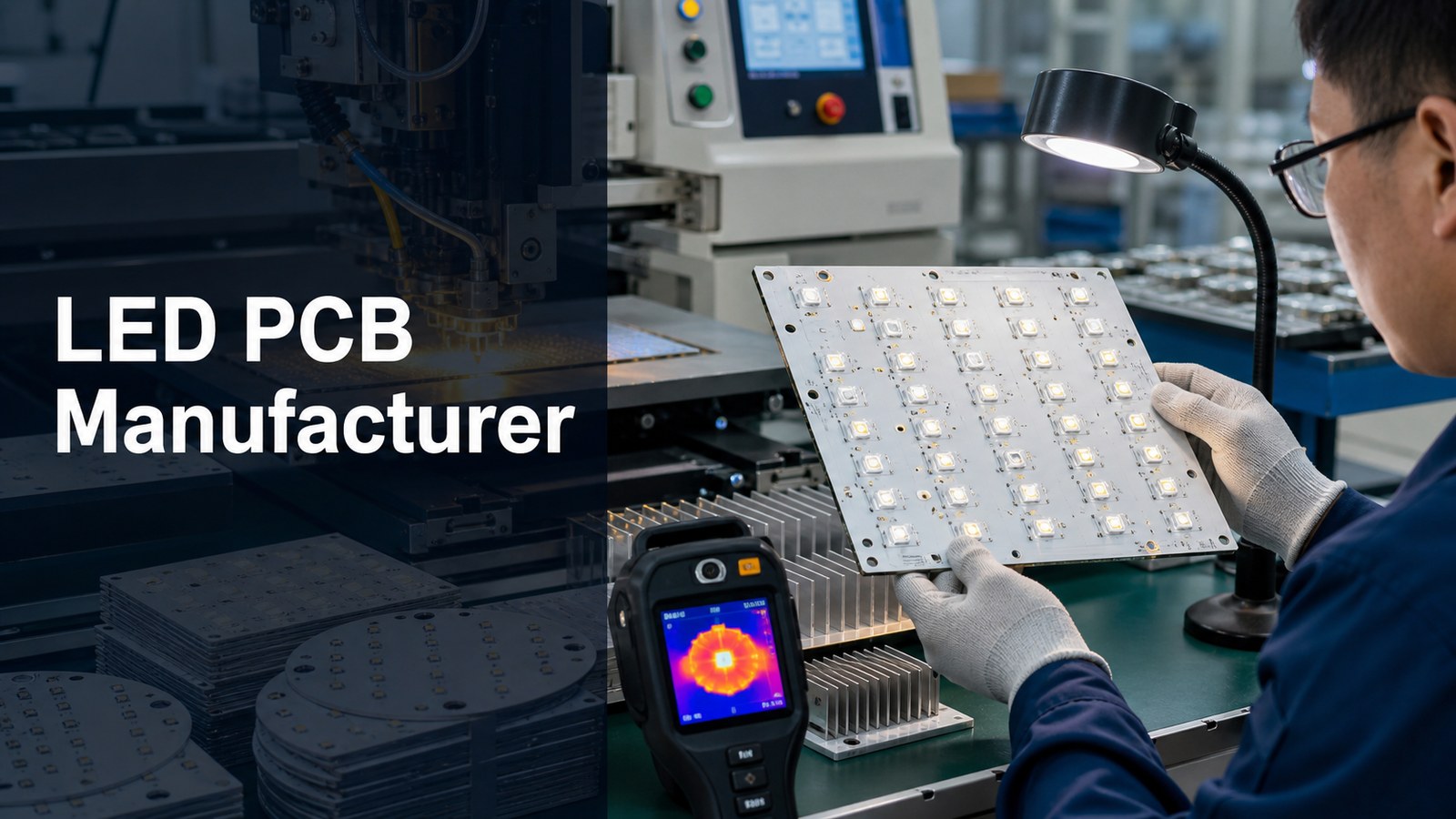
An LED PCB manufacturer builds circuit boards that carry LEDs, manage heat, support reliable solder joints, and fit the mechanical and optical design of the final lighting product. For buyers, the main decision is not simply whether a supplier can make a PCB. The decision is whether the supplier can review thermal needs, substrate choice, copper design, LED placement, driver connections, assembly risk, testing, and RFQ files before production starts.
This guide is written for lighting engineers, purchasing teams, and product developers comparing LED PCB manufacturers for prototypes, pilot builds, and production. It focuses on commercial sourcing decisions: material, heat path, assembly, quality control, cost, and the files needed for a useful quote.
LED PCB Manufacturer Selection at a Glance
A good LED PCB manufacturer should help match board material, heat dissipation path, LED placement, assembly method, and inspection scope to the lighting application. LED boards are often more thermally sensitive than ordinary signal boards because light output, color stability, solder joint life, and product safety can all be affected by heat.
| Buyer decision | What to confirm | Why it matters |
|---|---|---|
| Substrate | FR-4, aluminum, copper, ceramic, or direct thermal path design | Controls heat transfer, cost, weight, and manufacturability |
| Thermal path | LED pad design, dielectric, copper, metal core, heat sink interface | Affects LED life, brightness stability, and field reliability |
| Assembly | LED package, polarity, driver parts, connectors, soldering method | Reduces placement errors and solder defects |
| Testing | Visual, AOI, polarity, illumination, electrical and thermal checks | Finds issues before boards reach final products |
When You Need an LED PCB Manufacturer Instead of a General PCB Supplier
You need an LED PCB manufacturer when heat, brightness, LED placement, mechanical fit, or assembly reliability are central to the project. A general PCB supplier may fabricate a board correctly from Gerber files, but LED products often need deeper review of heat path, component polarity, substrate choice, and how the board will be mounted into a fixture or power module.
Projects such as high-power lighting, automotive lighting modules, signage, industrial lamps, grow lights, UV LED systems, and compact consumer lighting need a supplier that can read the PCB files together with the LED package data, driver circuit, housing constraints, and expected operating conditions.
LED PCB Materials: FR-4, Aluminum, Copper, Ceramic and DTP Options
LED PCB material selection should follow the thermal and mechanical requirements of the product, not only the lowest board price. FR-4 may be acceptable for low-power indicator boards or lower thermal stress designs. Metal core PCB, copper core PCB, ceramic PCB, or direct thermal path structures may be considered when heat density is higher.
Bestpcbs has relevant product references for metal core PCB, SinkPAD-style thermal paths, ceramic PCB, and PCBA service. Exact material limits and construction options should be confirmed from the project files and capability tables before quoting. The safe RFQ approach is to share LED power, board outline, mounting surface, target temperature conditions, and thermal interface expectations early.
Thermal Design Questions to Answer Before RFQ
Thermal design questions should be answered before quote approval because heat problems are expensive to fix after LED placement and fixture design are locked. Even a well-fabricated board can fail if the heat path from LED junction to board, heat sink, housing, and ambient environment is not considered.
- What is the LED package and power level?
- Is the board mounted to a heat sink, housing, or metal frame?
- Does the design need aluminum, copper, ceramic, or direct thermal path construction?
- Are there thermal vias, exposed pads, or special copper areas?
- Will the buyer provide thermal simulation, test conditions, or acceptance criteria?
Copper, Dielectric, Board Thickness and Surface Finish Choices
Copper, dielectric, board thickness, and surface finish choices affect both thermal behavior and manufacturing cost. For LED products, board thickness may be tied to mechanical fit, copper may be tied to current and heat spreading, and surface finish may affect solderability and storage conditions.
Do not assume all LED boards require the same build. A decorative LED board, a high-current lighting module, a compact driver board, and a high-power thermal board may need different substrate and assembly planning. The RFQ should state current, LED density, operating environment, finish preference, board thickness target, and mounting constraints.
LED PCB Assembly: LEDs, Drivers, Connectors and Polarity
LED PCB assembly requires careful handling of LED polarity, package orientation, driver components, connectors, and heat-sensitive placement details. A correct bare board is not enough if the assembled board has rotated LEDs, weak solder joints, or inconsistent brightness caused by component or process issues.
For assembly projects, provide BOM, CPL, assembly drawing, polarity notes, LED binning requirements if any, connector direction, and test expectations. If component sourcing support is needed, the component sourcing service is relevant for BOM availability, approved alternates, and supply risk review.
DFM Review for LED PCB Manufacturing
DFM review for LED PCB manufacturing checks whether the board can be fabricated, assembled, inspected, and mounted without avoidable production risk. This review should happen before production, not after defects appear.
Typical checks include LED pad size, solder mask clearance, copper balance, thermal pad design, mechanical holes, panelization, board outline, silkscreen clarity, polarity marking, connector placement, heat sink interface, and test point access. If the board also needs assembly, the review should connect Gerber, BOM, CPL, and assembly drawing data.
Testing and Inspection for LED PCB Projects
LED PCB testing should match the actual product risk, including electrical function, polarity, solder quality, visual appearance, and thermal behavior where required. Not every project needs every test, but the buyer should define what must be checked before shipment.
Possible checks include bare-board electrical testing, AOI, visual inspection, polarity verification, lighting function, driver output, current draw, and project-specific thermal checks. For assembled boards, the PCBA service path is relevant because assembly quality and board quality must be controlled together.
What Drives LED PCB Manufacturing Cost?
LED PCB cost is driven by thermal structure, material, copper, surface finish, assembly complexity, component sourcing, testing, and quantity. A low-power FR-4 LED indicator board and a metal-core high-power lighting module should not be priced or evaluated the same way.
| Cost factor | Impact on quote |
|---|---|
| Substrate | FR-4, aluminum, copper, ceramic, and DTP structures follow different process routes. |
| Thermal design | Thermal vias, metal cores, copper areas, and heat sink interface can add review and processing needs. |
| LED package and quantity | Package size, polarity, and density affect assembly time and inspection risk. |
| BOM sourcing | LED bins, drivers, connectors, and approved alternates can change price and schedule. |
| Testing | Lighting, electrical, programming, or thermal checks add process time. |
For a broader pricing view, compare this LED-specific checklist with the custom PCB cost guide.
Prototype, Pilot and Production LED PCB Planning
LED PCB prototypes should validate thermal and assembly assumptions before the buyer commits to production tooling, BOM purchasing, or fixture integration. Early prototypes help find LED spacing, brightness, driver, connector, and heat path issues while the design can still be changed.
For pilot and production, confirm whether the BOM is stable, whether LED binning matters, whether test fixtures are needed, and whether the same board build can be repeated. For engineering-stage builds, the prototype PCB assembly page is a useful internal reference.
How to Compare LED PCB Manufacturers
Compare LED PCB manufacturers by their ability to review thermal design, material choice, assembly data, sourcing risk, and testing requirements, not only by the first quoted unit price. A supplier that ignores heat and polarity can look inexpensive until the first failed build.
- Can the supplier discuss LED substrate options and thermal path decisions?
- Can they review Gerber, BOM, CPL, assembly drawing, and test needs together?
- Do they ask about LED power, mounting, heat sink, operating environment, and brightness requirements?
- Can they support both PCB fabrication and LED PCB assembly if needed?
- Do they explain cost drivers instead of giving only a flat price?
Common LED PCB Sourcing Risks
Common LED PCB sourcing risks include weak thermal assumptions, missing polarity notes, unclear LED binning, wrong substitutions, and incomplete test requirements. These risks are easier to prevent before production than to repair after boards are assembled.
- Thermal mismatch: substrate or heat path does not match LED power and fixture design.
- Polarity error: LED orientation is unclear in CPL or assembly drawings.
- BOM ambiguity: LED bins, drivers, connectors, or alternates are not approved.
- Mechanical conflict: board holes, outline, or heat sink interface do not fit the final product.
- Testing gap: brightness, current, function, or temperature checks are not defined.
RFQ Checklist for LED PCB Manufacturing
An LED PCB RFQ should include board files, LED and driver details, thermal requirements, assembly data, quantity, and inspection expectations. The more specific the RFQ, the fewer assumptions the supplier must make.
- Gerber or ODB++ files and drill data
- Board material, thickness, copper, finish, and thermal path notes
- LED package, power, density, binning or brightness requirements if applicable
- BOM with manufacturer part numbers and approved alternates
- CPL / pick-and-place file and assembly drawing
- Mounting, heat sink, housing, or mechanical constraints
- Quantity for prototype, pilot, and production
- Electrical, lighting, polarity, functional, or thermal test requirements
Frequently Asked Questions
What is an LED PCB?
An LED PCB is a printed circuit board designed to mount LEDs and related components while supporting electrical connection, heat transfer, mechanical fit, and product reliability. The board may use FR-4, metal core, ceramic, or other construction depending on power and thermal needs.
Is aluminum PCB always required for LED lighting?
No. Aluminum PCB is common for many lighting applications, but not every LED board requires it. Low-power designs may use FR-4, while higher heat-density designs may need aluminum, copper, ceramic, or direct thermal path structures.
Can one supplier handle LED PCB fabrication and assembly?
Yes, if the supplier can review the bare-board files, BOM, CPL, LED polarity, assembly drawing, and testing requirements together. This is often useful when the project has thermal and assembly risks.
What files are needed for an LED PCB quote?
Send Gerber or ODB++ files, drill files, material and thermal notes, BOM, CPL, assembly drawing, quantity, test requirements, and any mechanical or heat sink constraints.
What causes LED PCB quote differences between suppliers?
Quotes can differ because suppliers make different assumptions about substrate, copper, surface finish, LED package, component sourcing, assembly method, inspection, test scope, and production quantity.
Send an LED PCB Manufacturing RFQ
If you need LED PCB manufacturing or LED PCB assembly support, send your Gerber or ODB++ files, BOM, CPL, LED package details, quantity, material notes, thermal requirements, surface finish, testing requirements, and target delivery plan to the Best Technology / bestpcbs engineering team at sales@bestpcbs.com. The team can review the project for board build, heat path, sourcing, assembly, inspection, and quote preparation before production starts.
You may also like





Tags: led pcb, pcb manufacturing, PCB Procurement