





High reliability medical PCBA is essential for medical electronics that need stable power, accurate signals, long service life and controlled production records. In medical device projects, a small soldering defect, unstable component source or missing test record may lead to delays, field failures or costly redesign.
Are you worried about unstable medical PCBA quality, hidden BGA defects, unclear component traceability or delayed production approval? These problems often appear during prototype validation, pilot runs or repeat orders, especially when the design, sourcing and assembly process are not controlled together.
EBest Circuit is a China-based source factory providing PCB manufacturing, SMT assembly, component sourcing, testing and traceable production for global medical electronics customers. We support high reliability medical PCBA prototypes, pilot runs and mass production for OEM brands, engineering teams and healthcare device manufacturers.
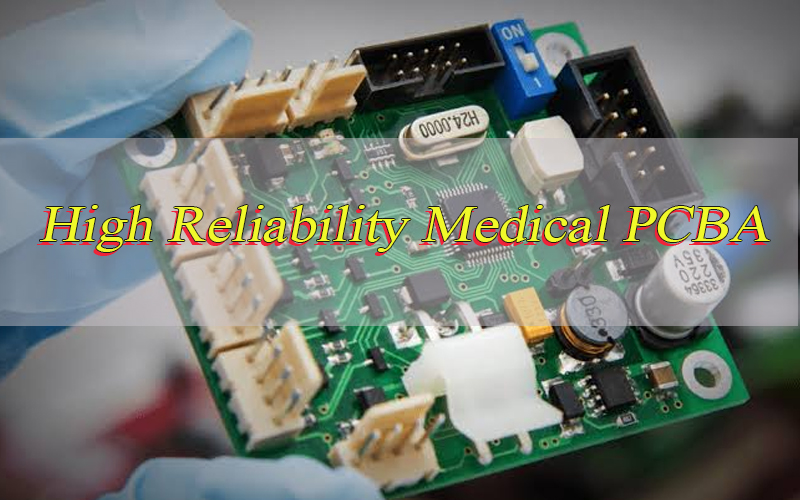
What Is High Reliability Medical PCBA?
High reliability medical PCBA is a printed circuit board assembly designed and manufactured for medical electronics where stable performance, safe operation and traceable quality are required. It includes PCB fabrication, component sourcing, SMT assembly, inspection, testing and controlled documentation.
Unlike standard PCBA, high reliability medical PCBA focuses on design risk control, solder joint reliability, clean production, component traceability and repeatable testing. It is used in devices where power stability, signal accuracy, connector strength and long-term operation cannot be compromised.
For medical electronics buyers, the value is clear: fewer hidden defects, better batch consistency and easier quality tracking from prototype to mass production.
Why Is High Reliability Critical for Medical Electronics?
High reliability is critical because medical electronics are often used for patient monitoring, diagnosis, therapy control and healthcare data collection. A small PCBA defect may cause unstable readings, power interruption or intermittent device operation.
- Patient safety: Poor soldering, unstable power or signal noise can affect device accuracy.
- Signal stability: Monitoring and diagnostic devices need clean signal paths and reliable grounding.
- Long operating time: Weak solder joints, hidden BGA defects or connector stress may fail after delivery.
- Traceability: Clear material and process records make failure analysis faster.
- Lower recall risk: Stable production reduces batch problems, after-sales cost and approval delays.
High reliability medical PCBA should be controlled from design review to final packaging, not only checked before shipment.
What Medical Devices Need High Reliability Medical PCBA?
High reliability medical PCBA is used in medical devices that need accurate signals, stable control and dependable long-term operation. These boards may handle sensing, display control, wireless communication, power management or battery charging.
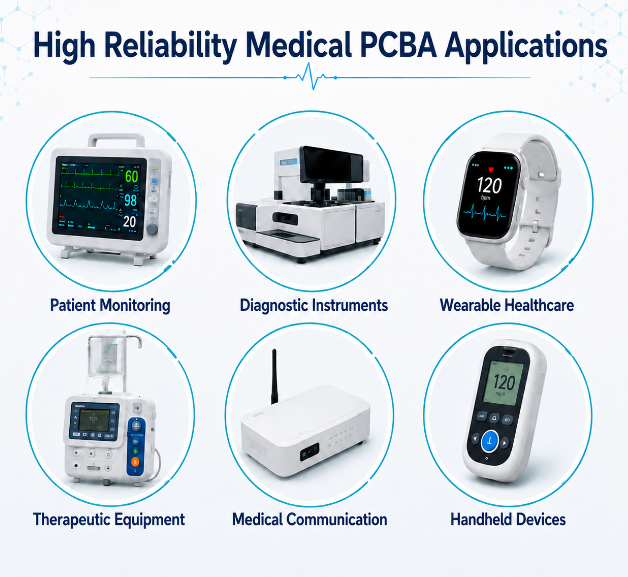
Common applications include:
- Patient monitoring devices: ECG monitors, SpO2 monitors, blood pressure monitors and bedside equipment.
- Diagnostic instruments: blood analyzers, test modules, imaging control boards and laboratory equipment.
- Wearable healthcare electronics: health patches, portable sensors and rechargeable monitoring devices.
- Therapeutic equipment: infusion pumps, rehabilitation devices and electronic control modules.
- Medical communication modules: wireless medical IoT boards and data transmission modules.
- Handheld medical tools: portable test devices and battery-powered medical electronics.
These devices need stable PCBA quality because failure may affect accuracy, uptime and user confidence.
What Reliability Requirements Matter Most for Medical PCBA?
Medical PCBA reliability depends on approved materials, stable assembly, complete inspection and traceable records. Requirements vary by device function, environment and customer standard.
- Quality system control: ISO 13485 project support can be applied when medical-grade documentation is required.
- Assembly acceptance: IPC-A-610 Class 2 or Class 3 can be selected by product risk.
- Soldering control: IPC J-STD-001 reference helps control solder joint workmanship.
- Bare PCB quality: IPC-A-600 and IPC-6012 references help check PCB fabrication quality.
- Material compliance: RoHS, REACH and approved BOM control reduce sourcing risk.
- Hidden joint inspection: X-ray is used for BGA, QFN, LGA and bottom-terminated parts.
- Batch traceability: PCB lot, component lot, solder paste batch and test results should be linked.
- Functional verification: ICT, FCT, programming or aging test can be selected by product function.
The real requirement is repeatable process control across prototype, pilot run and repeat orders.
What Design Factors Affect Medical PCBA Reliability?
Medical PCBA reliability starts with design. A strong assembly line cannot fully fix poor heat dissipation, weak grounding, tight clearance or missing test points.
Design factors include:
- Stack-up design: affects impedance, EMI control and mechanical stability.
- Power layout: affects voltage drop, heat generation and current capacity.
- Grounding design: reduces noise and improves signal accuracy.
- Thermal paths: copper area, thermal vias and spacing help control heat.
- Component spacing: improves soldering quality and rework safety.
- Connector position: reduces mechanical stress during use.
- Test point access: supports inspection, programming and functional testing.
Good design choices reduce production defects and make high reliability medical PCBA easier to manufacture repeatedly.
How Does DFM Review Reduce Medical PCBA Failure Risk?
DFM review finds fabrication, assembly and testing risks before production starts. This helps prevent avoidable soldering defects, rework, delivery delays and batch instability.
- Gerber file review: Checks outline, copper spacing, holes, slots, solder mask and surface finish.
- BOM review: Checks part numbers, packages, polarity, lifecycle status and substitute risk.
- Pad and footprint review: Checks fine-pitch IC, BGA, QFN, connector and thermal pad designs.
- Stencil review: Adjusts paste openings for small pads, thermal pads and dense components.
- Panel design review: Checks board support, breakaway method, tooling holes and assembly direction.
- Test point review: Checks power rails, programming pads and signal points for test access.
- Assembly risk review: Checks spacing, polarity marks, connector stress and rework difficulty.
With proper DFM review, customers can reduce redesign, rework, unstable samples and mass production delays.
How Does Component Selection Improve Medical PCBA Reliability?
Component selection affects medical PCBA reliability because poor parts can cause failure even when soldering quality is good. Medical electronics often need stable sourcing, long lifecycle parts and approved substitutes.
Reliable component selection should consider:
- Original source: Reduces fake parts, mixed lots and uncontrolled suppliers.
- Lifecycle status: Avoids obsolete or end-of-life components.
- Electrical margin: Confirms voltage, current, tolerance and temperature rating.
- Package reliability: Fine-pitch, BGA and QFN parts need suitable pads and inspection.
- Supply stability: Long lead time parts should be reviewed before production.
- Approved alternates: Replacement parts should be confirmed before use.
For high reliability medical PCBA, the cheapest component is not always the safest choice. Stable sourcing protects quality, delivery and repeat production.
How Does SMT Assembly Quality Affect Medical PCBA Stability?
SMT assembly quality affects solder joint strength, electrical stability and long-term reliability. Poor paste printing, inaccurate placement or unstable reflow can create hidden defects.
SMT process control includes:
- Solder paste printing: Controls paste volume, position and consistency.
- SPI inspection: Checks paste height, area and offset before placement.
- Component placement: Controls polarity, rotation, package accuracy and pressure.
- Reflow profile: Controls heating, soaking, peak temperature and cooling.
- AOI inspection: Checks missing parts, wrong parts, solder bridges and polarity.
- First article inspection: Confirms BOM, placement and assembly accuracy.
Stable SMT assembly reduces intermittent failures and batch variation in medical electronics production.
How Are BGA, QFN and Fine-Pitch Components Controlled in Medical PCBA?
BGA, QFN and fine-pitch components require strict control because many solder joints are hidden under the package. Visual inspection alone is not enough.
Control methods include:
- Pad design review: Confirms pad size, solder mask opening and via-in-pad risk.
- Stencil tuning: Adjusts paste openings for thermal pads and small pitches.
- Placement accuracy: Controls nozzle selection, alignment and placement pressure.
- Reflow control: Reduces insufficient wetting, voids and solder bridging.
- X-ray inspection: Checks hidden joints, voiding, shorts, opens and ball shift.
- Process feedback: Uses inspection results to adjust stencil, profile or placement settings.
For high reliability medical PCBA, BGA and QFN control directly affects long-term reliability.
How Is Cleanliness Controlled During High Reliability Medical PCBA Production?
Cleanliness control reduces leakage, corrosion and unstable performance. This is especially important for humid environments, low-current circuits, sensor interfaces and high-density medical boards.
Cleanliness control includes:
- Material handling: Controls PCB, components, solder paste and storage conditions.
- Process control: Reduces excess flux, solder balls, dust and handling contamination.
- Cleaning method: Applies cleaning when product risk or customer standard requires it.
- Visual inspection: Checks residue, stains, particles and foreign material.
- Ionic contamination check: Verifies cleanliness for sensitive boards when required.
- Packaging control: Uses ESD bags, moisture protection and clean packing.
Clean production helps medical electronics maintain stable signals and low leakage risk.
How Is Traceability Managed for Medical PCBA Manufacturing?
Traceability connects every medical PCBA batch with its materials, process records, inspection results and test data. When a problem appears, traceability helps identify the affected lot and speed up root cause analysis.
Traceability can include:
- PCB lot number: Board supplier, date, panel batch and specification.
- Component lot data: Part number, supplier, date code and quantity.
- Solder paste record: Paste type, batch, storage and usage time.
- Production record: SMT line, operator, date and reflow profile.
- Inspection record: SPI, AOI, X-ray and manual inspection results.
- Test record: Programming, ICT, FCT, aging test and final QA result.
- Shipment record: Labels, quantity, packaging and delivery information.
For medical device buyers, traceability improves batch containment and repeat-order stability.
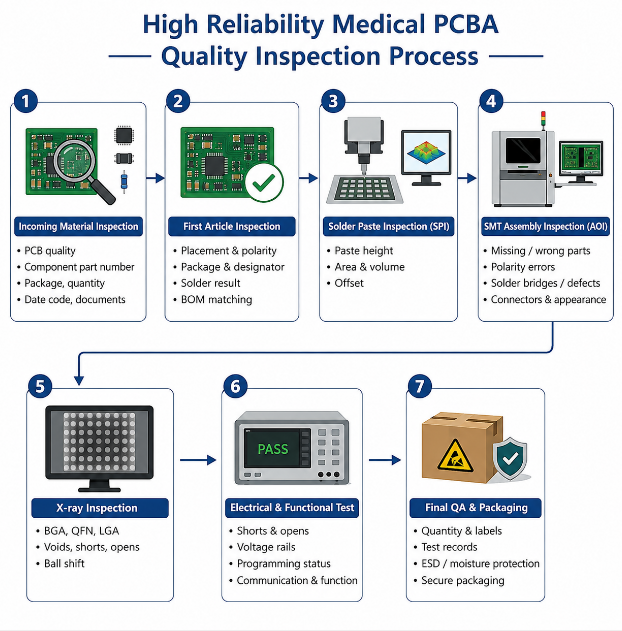
How Does Our Quality Inspection Process Work for High Reliability Medical PCBA?
Our quality inspection process follows the production flow. The goal is to detect defects early, confirm assembly stability and provide clear records before shipment.
Step 1: Incoming material inspection.
We check bare PCB quality, component part numbers, package types, quantity, date codes, solder paste condition and production documents. This prevents wrong materials, mixed lots and sourcing errors.
Step 2: First article inspection.
Before batch assembly continues, we verify placement, polarity, package, reference designator, solder result and BOM matching. This confirms the SMT program, stencil and setup.
Step 3: Solder paste inspection.
SPI checks paste height, area, volume and offset after printing. This reduces solder bridges, insufficient solder and weak joints before placement.
Step 4: SMT assembly inspection.
After reflow, AOI checks missing parts, wrong parts, polarity errors, solder bridges and visible solder defects. Manual inspection checks connectors, labels, THT parts and appearance.
Step 5: Hidden joint inspection.
For BGA, QFN, LGA and bottom-terminated parts, X-ray checks hidden solder joints, voids, shorts, opens and ball shift.
Step 6: Electrical and functional testing.
We check shorts, opens, voltage rails, programming status, communication signals and product functions according to the test plan.
Step 7: Final QA and packaging.
Before shipment, we verify quantity, labels, records, test results and packaging. ESD, moisture and shock protection are applied as required.
What Testing Methods Are Used to Verify Medical PCBA Reliability?
Testing confirms whether the medical PCBA meets electrical and functional requirements. Test coverage should match circuit complexity and product risk.
Common testing methods include:
- Electrical testing: Checks opens, shorts and basic continuity.
- ICT: Tests components, solder joints and circuit nodes when test points are available.
- Functional testing: Verifies power, signals, communication and product functions.
- Programming: Loads firmware and checks boot or communication status.
- Aging test: Runs the PCBA for a defined time to find early failures.
- Thermal check: Reviews heat points under working conditions.
- Custom fixture testing: Simulates product operation for repeatable production testing.
For high reliability medical PCBA, functional testing should match real operating conditions as closely as possible.
How Do We Support Medical PCBA Prototype and Mass Production?
We support high reliability medical PCBA from prototype to mass production by keeping engineering review, material control and inspection records connected across each stage.
For prototypes, we focus on DFM feedback, BOM review, fast assembly, sample inspection and functional verification. This helps engineers find design or sourcing problems before pilot production.
For mass production, we focus on approved materials, fixed process parameters, test fixtures, traceability and packaging consistency. This helps reduce order-to-order variation.
Customers can use prototype results to improve the design, then move toward batch production with fewer changes, fewer delays and better reliability control.
What High Reliability Medical PCBA Services Can EBest Provide?
EBest Circuit provides high reliability medical PCBA services from PCB fabrication to SMT assembly, component sourcing, testing and box assembly. Customers can manage more work through one China-based source factory.
Our services include:
- PCB fabrication: FR4 PCB, multilayer PCB, metal-based PCB, ceramic PCB, flexible PCB, rigid-flex PCB and high frequency PCB.
- Prototype PCB assembly: Sample builds for validation, engineering tests and pilot production.
- Quick turn PCB assembly: Short lead time support for urgent projects.
- Full turnkey PCB assembly: PCB production, sourcing, assembly, inspection, testing and packaging.
- BGA assembly service: Support for BGA, QFN, QFP and fine-pitch components.
- Through-hole and mixed assembly: SMT, THT and mixed assembly for connectors, terminals and control boards.
- Flex PCB assembly: Support for wearable devices, sensors and compact modules.
- Ceramic PCB assembly: Suitable for heat-resistant or stable material requirements.
- Box assembly: Enclosure assembly, labeling, testing and delivery preparation.
- Component sourcing: Supply support for SMD parts, BGA, QFN, QFP and other components.
These services help customers reduce supplier handoffs, unclear responsibility and production risk.
Case Study: High Reliability Medical PCBA for a Patient Monitoring Device
Project background:
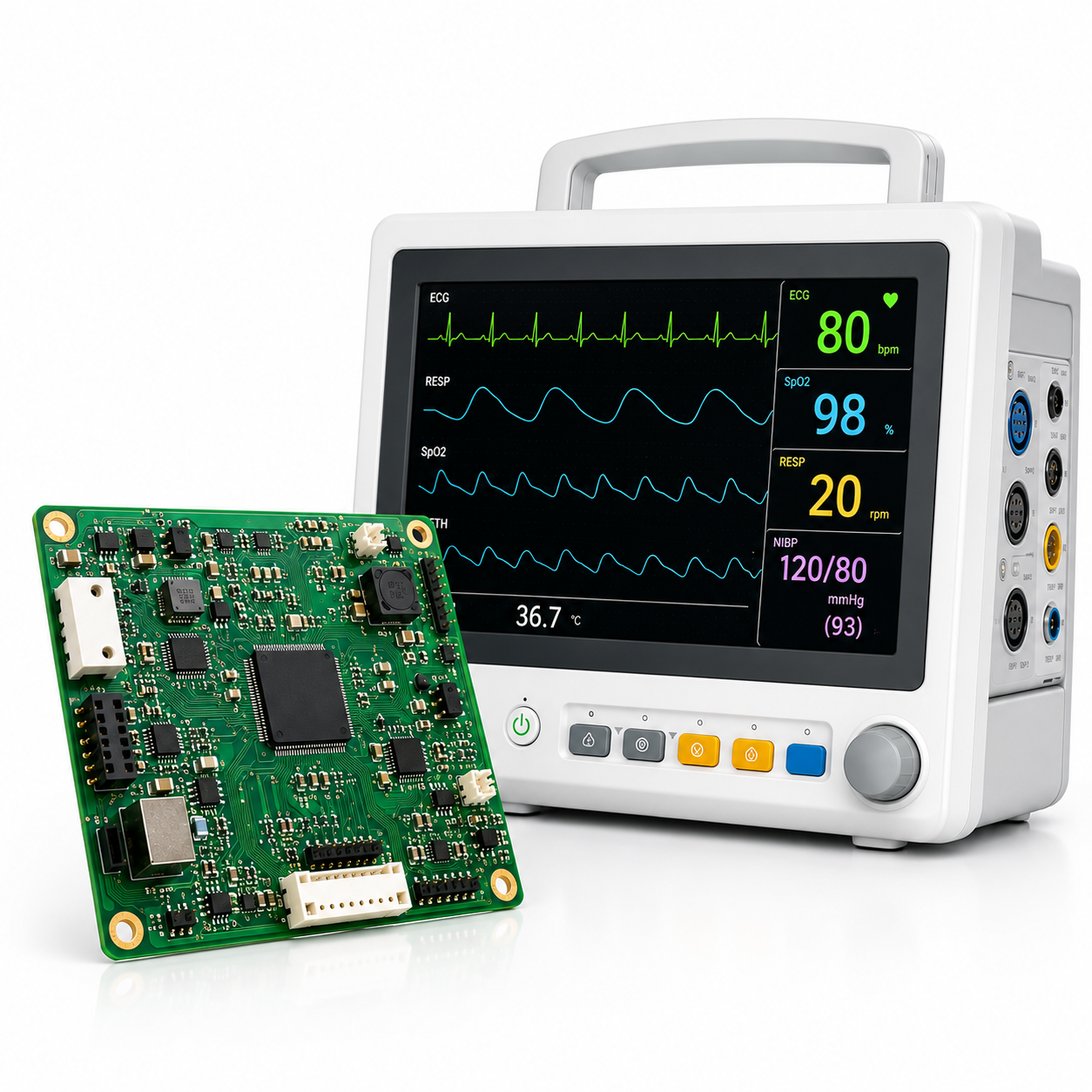
A customer needed a high reliability medical PCBA for a patient monitoring device. The board included sensor input circuits, a microcontroller, power management, display connectors and a wireless module.
Project requirements:
The project required stable sensor signals, reliable BGA and QFN soldering, safe battery power management, repeatable functional testing and traceable production records.
Our solution:
EBest Circuit reviewed the Gerber files, BOM, test points, polarity marks and fine-pitch layout before production. We checked pad design, stencil openings and component spacing to reduce soldering risk.
During production, SPI checked solder paste, AOI checked placement, and X-ray inspected hidden BGA and QFN solder joints. Functional testing covered power rails, display connection, communication interface and sensor input.
Output result:
The prototype passed visual inspection, X-ray inspection and functional testing. The customer received traceable records and used the sample result to support pilot production.
The project helped reduce assembly risk, improve test clarity and create a stable path from prototype validation to batch delivery.
Why Choose EBest as Your High Reliability Medical PCBA Manufacturer?
Choosing EBest Circuit helps medical electronics buyers reduce supplier management, improve assembly stability and move faster from prototype to production. Customers can handle PCB fabrication, component sourcing, assembly, testing and box assembly through one China-based manufacturer.
- Lower coordination cost: PCB fabrication, component supply, SMT assembly, testing and box assembly can be handled together.
- Stable production support: SMT, THT and mixed assembly support different medical electronics designs.
- Dense board capability: EBest can handle 01005 minimum SMD components and 0.25mm minimum BGA pitch.
- Flexible order support: Prototype, low-volume production and repeat orders can be arranged by project stage.
- Fast project response: PCBA lead time can be 1–5 days, depending on file readiness, BOM status and complexity.
- Flexible component handling: Reels, cut tape, tubes, trays and loose parts can be managed.
- Quality confidence: EBest supports ISO 9001:2015, ISO 13485:2016, IATF 16949, AS9100D, UL, RoHS and REACH.
- Scalable PCB capacity: Monthly PCB capability reaches about 260,000 square feet / 28,900 square meters.
- Delivery support: Box assembly, inspection, labeling, packaging and export preparation reduce final delivery problems.
FAQs About High Reliability Medical PCB Assembly
Q1: What files should I send before requesting a quotation?
A1: Send Gerber files, BOM, pick-and-place file, assembly drawing, PCB specification and test requirements. If the project includes firmware, coating, labels or box assembly, share those files early.
Q2: What should I check before approving the first sample?
A2: Check placement, polarity, solder quality, connector fit, firmware version, functional test result, label accuracy and packaging method. For BGA or QFN designs, review X-ray results.
Q3: How can buyers reduce risk before repeat orders?
A3: Lock the approved Gerber files, BOM revision, firmware version, test method, inspection standard and packaging requirement before repeat production.
Q4: What happens if a component becomes unavailable during production?
A4: The safest method is to review approved alternates before replacement. The substitute should match package, rating, tolerance, temperature range and reliability needs.
Q5: Should firmware programming be included in medical PCBA production?
A5: Firmware programming should be included when the board needs software to boot, communicate or complete testing. The programming file, version and test method should be confirmed before production.
Q6: What affects the final medical PCBA cost most?
A6: Cost is affected by PCB complexity, component availability, assembly density, BGA quantity, testing requirements, coating, box assembly and packaging method. DFM review, BOM review and test planning help control cost early.
Q7: How long does high reliability medical PCBA production usually take?
A7: Lead time depends on PCB complexity, BOM availability, SMT density, BGA inspection, testing and packaging needs.
Q8: Can high reliability medical PCBA support low-volume orders?
A8: Yes. Low-volume production is suitable for engineering samples, validation, pilot runs and early market testing.
Q9: When is conformal coating needed for medical PCBA?
A9: Conformal coating is useful when the board may face humidity, dust, condensation or chemical exposure. Connectors, sensors, test points and switches may need masking.
Q10: Can a China-based source factory support global medical electronics buyers?
A10: Yes. A China-based source factory can support global buyers with PCB fabrication, PCBA production, testing, packaging and export delivery.
Conclusion
High reliability medical PCBA requires controlled PCB fabrication, stable component sourcing, precise SMT and THT assembly, BGA inspection, functional testing, traceable records and reliable packaging. These controls help reduce field failure, approval delays and repeat-order variation.
If you are developing patient monitoring devices, diagnostic instruments, wearable healthcare electronics, medical communication modules or custom medical control boards, EBest Circuit can support your project from prototype to batch production. Send your Gerber files, BOM, assembly drawings and test requirements to us today for engineering review and quotation: sales@bestpcbs.com.
You may also like

Tags: High Reliability Medical PCB Assembly, High Reliability Medical PCBA Manufacturer, high-reliability medical pcba