





IPC-TM-650 helps engineers understand how PCB materials, finishes, solder mask, and assembly surfaces behave under controlled tests. If you buy bare boards or assembled PCBAs, this standard gives you a common technical language.
However, many buyers only see method numbers on drawings or reports. This guide explains the practical meaning behind those tests. It also shows how EBest Circuit uses engineering review, process control, and testing support to reduce sourcing risk.
What Is IPC-TM-650?
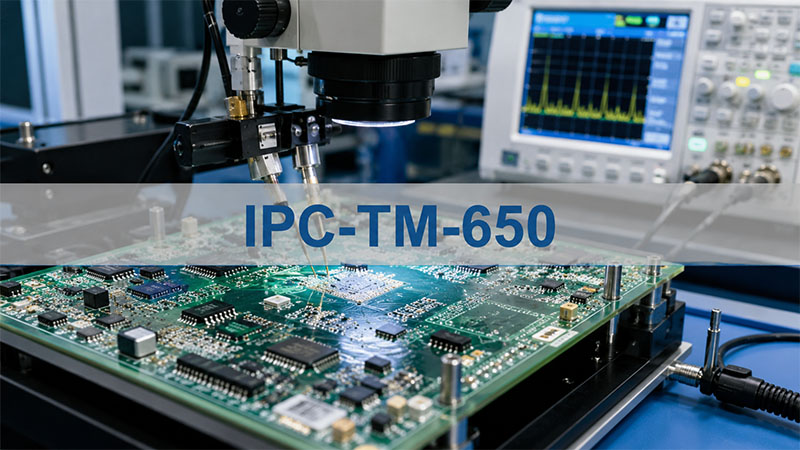
IPC-TM-650 is a test methods manual for printed boards and related electronics materials. It gives defined ways to test chemical, mechanical, electrical, and environmental performance.
In simple terms, IPC-TM-650 helps engineers avoid vague quality claims. Instead, you can ask for a known test method, a clear condition, and a measurable result.
What It Means
For example, a PCB supplier may say a solder mask has strong adhesion. That sounds useful, yet it needs proof. With the right method, you can compare results across batches, suppliers, and design revisions.
Also, IPC-TM-650 does not replace your full product standard. It supports your quality plan. So, engineers often use it together with IPC-A-600, IPC-6012, IPC-A-610, or customer drawings.
| Area | What It Helps Check | Typical Engineering Concern |
|---|---|---|
| Electrical | Insulation and leakage | Long-term signal stability |
| Mechanical | Peel, adhesion, flatness | Assembly fit and durability |
| Chemical | Cleanliness and residues | Corrosion and field failures |
| Environmental | Heat, humidity, and stress | Reliability in real use |
Why Is IPC-TM-650 Important for PCB Manufacturing?
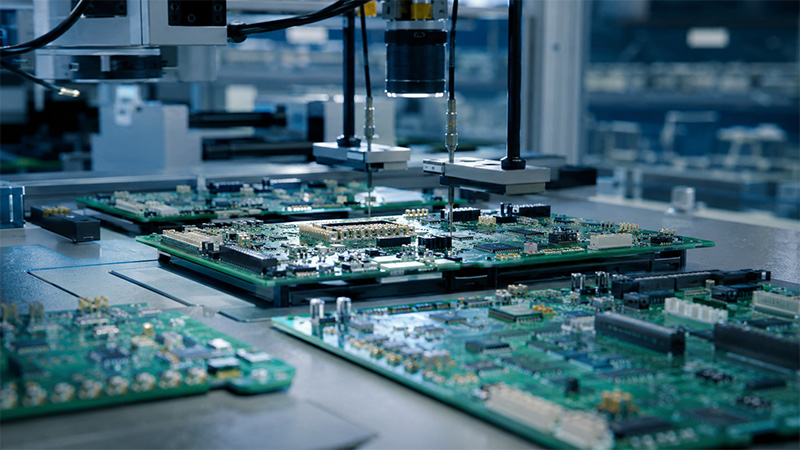
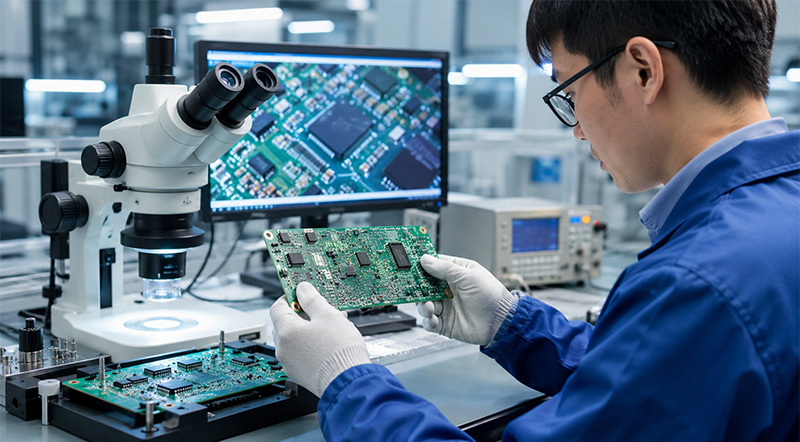
IPC-TM-650 matters because PCB quality cannot rely on appearance alone. A board can look clean and still carry ionic residue. Also, a board can pass visual inspection and still warp during assembly.
Because of this, engineers need practical test methods. These methods help control PCB reliability, material testing, process control, and quality assurance.
Quality Needs Evidence
First, the standard supports supplier communication. Your drawing can state a test method, limit, sample size, and acceptance rule. As a result, both teams work from the same baseline.
Next, it supports repeatable process control. If a process changes, the factory can compare old and new test data. This makes engineering review faster and more factual.
Engineer’s tip: Use IPC-TM-650 when a PCB feature affects reliability, assembly yield, or field service life.
Finally, these tests help during supplier qualification. For instance, medical, automotive, aerospace, and industrial projects often need stronger traceability. In those cases, IPC-TM-650 can support a deeper quality file.
IPC-TM-650 Testing Methods for Solder Mask
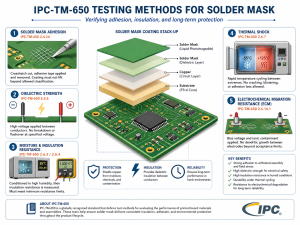
IPC-TM-650 testing methods for solder mask help check how the mask protects copper and supports assembly. The solder mask must resist heat, chemicals, cleaning, and handling.
However, solder mask quality is not only about color or gloss. It also relates to adhesion, thickness, cure level, hardness, and ionic cleanliness.
Why Solder Mask Matters
Solder mask separates conductive features and helps reduce solder bridging. Also, it protects copper from oxidation during storage and use. This matters more on dense boards with small spacing.
For example, a fine-pitch medical sensor board may need stable mask registration. In contrast, a high-power LED board may need better thermal and surface durability.
| Solder Mask Check | What It Looks For | Why Engineers Care |
|---|---|---|
| Adhesion | Mask bond strength | Less peeling after assembly |
| Cure quality | Proper hardening | Better chemical resistance |
| Registration | Opening alignment | Stable pad exposure |
| Cleanliness | Residue level | Lower leakage risk |
Therefore, solder mask testing is useful for boards with dense routing, fine-pitch parts, or harsh operating environments. It gives engineers more confidence before PCBA assembly starts.
How Does IPC-TM-650 Measure Bow and Twist?
IPC TM 650 bow and twist testing helps measure PCB flatness. This matters because warped boards can create placement, soldering, and final assembly problems.
In many cases, engineers refer to ipc tm 650 method 2.4 22 bow & twist. This method gives a structured way to check deviation from a flat plane.
Bow Versus Twist
Bow means the board curves along one direction. Twist means one corner rises while other areas remain lower. Both can affect SMT assembly.
For instance, a warped panel may not sit flat in the printer. Then solder paste height can vary. After that, components may shift or tombstone during reflow.
Also, bow and twist can become worse after thermal stress. High copper imbalance, uneven stack-up, and poor panel design can all add risk.
| Flatness Issue | Common Cause | Assembly Impact |
|---|---|---|
| Bow | Laminate stress | Poor stencil contact |
| Twist | Uneven copper balance | Placement offset |
| Panel warp | Bad panel support | Reflow variation |
| Thermal warp | Stack-up mismatch | Solder joint stress |
As a rule, review flatness early when your board is thin, large, or copper-heavy. This can prevent late-stage assembly delays.
How Is Surface Insulation Resistance Tested Under IPC-TM-650?
Surface insulation resistance testing under IPC-TM-650 checks how well a surface resists current leakage. Engineers often use it for reliability studies and contamination checks.
The keyword ipc-tm-650 2.6.3.7 surface insulation resistance often appears in technical searches. It relates to SIR testing under controlled conditions.
What SIR Shows
IPC TM 650 insulation resistance tests help reveal weak surface insulation. Moisture, flux residue, and ionic contamination can reduce the measured resistance.
Because of this, SIR matters in medical devices, industrial controls, sensors, and communication boards. These products often work in warm or humid settings.
For example, a board may pass electrical testing at room temperature. However, it may show leakage after humidity exposure. SIR testing helps find that risk earlier.
| SIR Factor | Possible Source | Engineering Risk |
|---|---|---|
| Flux residue | Incomplete cleaning | Leakage current |
| Moisture | Storage or use environment | Lower insulation resistance |
| Ionic salts | Process chemicals | Corrosion path |
| Fine spacing | Dense PCB layout | Higher leakage sensitivity |
In short, SIR testing gives more than a pass or fail result. It helps you understand process cleanliness and long-term board behavior.
IPC-TM-650 Cleanliness and Ionic Contamination Testing
IPC TM 650 cleanliness tests help control residues from fabrication and assembly. These residues can come from flux, plating chemistry, cleaning agents, or handling.
IPC TM 650 ionic contamination testing is especially important for high-reliability PCBA. It helps measure mobile ionic material that may affect electrical performance.
Residues Create Risk
Cleanliness is easy to underestimate. A board can look clean under normal light and still carry harmful residues. Therefore, visual inspection alone is not enough.
In particular, ionic residues can absorb moisture. Then they may form leakage paths between conductors. Over time, this can lead to corrosion or dendritic growth.
IPC TM 650 ionic contamination limits depend on the test method, product use, and customer requirement. So, engineers should define limits before production starts.
How EBest Circuit handles this: We review materials, flux type, cleaning process, and testing needs before PCBA production begins.
| Cleanliness Topic | What To Define | Best Time To Review |
|---|---|---|
| Flux chemistry | No-clean or washable | Before SMT setup |
| Cleaning process | Agent and cycle | Before trial run |
| Ionic limit | Customer requirement | Before quotation |
| Sampling plan | Lot and frequency | Before mass build |
Overall, cleanliness control works best when design, process, and inspection teams align early. This is more efficient than fixing failures later.
Common IPC-TM-650 Mechanical and Adhesion Tests
IPC-TM-650 mechanical tests help check whether the PCB can survive fabrication, assembly, and field handling. These tests can include peel strength, tape testing, and adhesion testing.
Engineers often search for ipc tm 650 tape test, ipc tm 650 adhesion test, and ipc tm 650 peel strength. These topics matter when copper, solder mask, or surface layers must stay stable.
Adhesion Affects Reliability
Adhesion is important because PCB layers work as a system. Copper must bond well to the laminate. Also, solder mask must stay attached through heat and cleaning.
For example, poor peel strength can affect heavy copper boards. It can also affect edge plating, press-fit zones, and high-current terminals.
On the other hand, a simple consumer board may not need the same test depth. The right test plan should match product risk, not just a checklist.
| Test Area | Useful For | Common Product Type |
|---|---|---|
| Peel strength | Copper bond check | Power and heavy copper PCB |
| Tape test | Surface adhesion check | Solder mask and marking |
| Adhesion test | Layer stability check | Industrial and automotive PCB |
| Thermal stress | Heat resistance check | Reflowed PCBA |
Most importantly, these tests should support the design goal. A strong test plan starts with your application, not with a random standard list.
IPC-TM-650 Solderability Test and Copper Foil Testing
IPC TM 650 solderability test methods help check whether PCB pads can accept solder properly. This matters during SMT, wave soldering, selective soldering, and manual rework.
Also, ipc-tm-650 thermal conductivity copper foil searches often relate to material behavior. Engineers may need copper data for power, thermal, or high-current designs.
Solderability Drives Yield
Solderability affects first-pass yield. If pads oxidize or the finish performs poorly, solder joints may look dull or incomplete. Then rework cost can rise.
For instance, ENIG, OSP, immersion silver, and HASL each need proper storage and process control. Therefore, surface finish choice should match your assembly path.
| Check | What It Supports | Typical Concern |
|---|---|---|
| Solderability | Pad wetting | Poor joint formation |
| Copper foil | Material stability | Thermal or current load |
| Surface finish | Assembly shelf life | Oxidation or handling |
| Thermal exposure | Reflow performance | Delamination or stress |
In general, solderability review should happen before production. This is especially true when components have fine pitch, bottom termination, or high thermal mass.
IPC-TM-650 for Prototype and Low-Volume PCB Builds
IPC-TM-650 is not only useful for large production. It can also help prototype and low-volume PCB builds move faster with fewer surprises.
Prototype teams often change materials, stack-ups, finishes, or components. Because of this, they need fast engineering feedback before committing to a larger build.
Better Prototype Decisions
First, test data helps you compare design options. For example, you can review flatness risk on a thin board before assembly. Then you can adjust the stack-up or panel plan.
Next, cleanliness and SIR checks can support early reliability review. This is useful for medical, sensing, RF, and industrial products. These products often need stable field behavior.
Also, solderability review helps when your BOM includes fine-pitch ICs or hard-to-source parts. A small issue in surface finish can waste expensive components.
| Prototype Need | Helpful IPC-TM-650 Area | Practical Outcome |
|---|---|---|
| Thin PCB | Bow and twist | Better SMT stability |
| Fine-pitch layout | Cleanliness and SIR | Lower leakage risk |
| High-power board | Copper and adhesion | Stronger thermal design |
| New surface finish | Solderability | Higher assembly yield |
As a result, prototype testing can reduce redesign time. It also helps your team decide what to control during the next production stage.
How EBest Circuit Supports IPC-TM-650 Based PCB Quality Control?
EBest Circuit supports IPC-TM-650 based quality control through engineering review, controlled fabrication, PCBA process planning, and traceable production data. We connect these steps before your order enters production.
However, we do not treat testing as a separate final step. Instead, we use test needs to guide DFM, material choice, process flow, and inspection planning.
1 Account Manager + 3 Engineers
Each project receives one account manager and three engineers. The team covers DFM review, process planning, and quality control. As a result, communication stays clear from RFQ to shipment.
DFM and BOM Review
We include a DFM pre-review report and BOM optimization list with every order. This helps you find layout, material, component, and process risks early.
Certified Manufacturing System
EBest Circuit works under ISO 9001, ISO 13485, IATF 16949, and AS9100D systems. Therefore, we can support medical, automotive, aerospace, and industrial electronics projects.
Own Factories and Supply Chain
We operate our own PCB factory and own PCBA factory. In addition, we work with more than 1,000 supply chain partners. This helps us control lead time, materials, and assembly flow.
Prototype to Volume Support
We support prototypes, small batches, and volume production. For PCBA prototypes, our typical turnaround is about 1.5 weeks from build to shipped tested boards.
Digital MES Traceability
Our digital MES supports fast material and batch traceability. In many cases, teams can trace key production data within 5 seconds. This helps regulated projects manage records better.
20 Years of PCBA Experience
EBest Circuit has 20 years of PCBA experience. We have served more than 10,000 engineers and 1,800 customers. Because of this, we understand both engineering detail and delivery pressure.
To get a quote, send your Gerber files and BOM to sales@bestpcbs.com. We respond with a DFM report and quote within 24 hours.
FAQs About IPC-TM-650 Test Methods
What is IPC-TM-650 used for in PCB manufacturing?
IPC-TM-650 is used to define test methods for PCB materials, solder mask, cleanliness, insulation resistance, bow and twist, adhesion, solderability, and other quality checks.
Is IPC-TM-650 required for every PCB order?
IPC-TM-650 is not needed for every basic PCB order. However, it is useful when your product needs stronger proof of reliability, process control, or material performance.
Which IPC-TM-650 test checks bow and twist?
Bow and twist are commonly linked with IPC-TM-650 method 2.4.22. This method helps check PCB flatness after fabrication or thermal stress.
How does ionic contamination affect PCBA reliability?
Ionic contamination can attract moisture and create leakage paths. As a result, it may reduce insulation resistance and affect long-term PCBA reliability.
Can EBest Circuit support prototypes with IPC-TM-650 based controls?
Yes. EBest Circuit supports prototypes, small batches, and volume builds with DFM review, process planning, PCBA testing, and traceability control.
How do I request IPC-TM-650 test support from EBest Circuit?
You can send your Gerber files, stack-up, drawings, and BOM to sales@bestpcbs.com. We will review the project and suggest suitable quality control steps.
You may also like
Tags: ipc-tm-650, ipc-tm-650 testing methods for solder mask, tm 650 ipc