





Microwave PCBs are the foundation of today’s radar sensors, satellite communication modules, 5G mmWave devices, and high-frequency RF front-end systems. Operating between 300 MHz and 300 GHz, microwave circuits require extremely low signal loss, minimal phase distortion, and precise impedance control. Because of these challenges, engineers and buyers often have many questions when choosing materials, designing stack-ups, or selecting a reliable microwave PCB manufacturer.
This article compiles the common Microwave PCB FAQs, covering materials, stack-ups, design rules, testing, troubleshooting, and how to choose a UL/CE certified microwave PCB manufacturer. Let’s dive in.
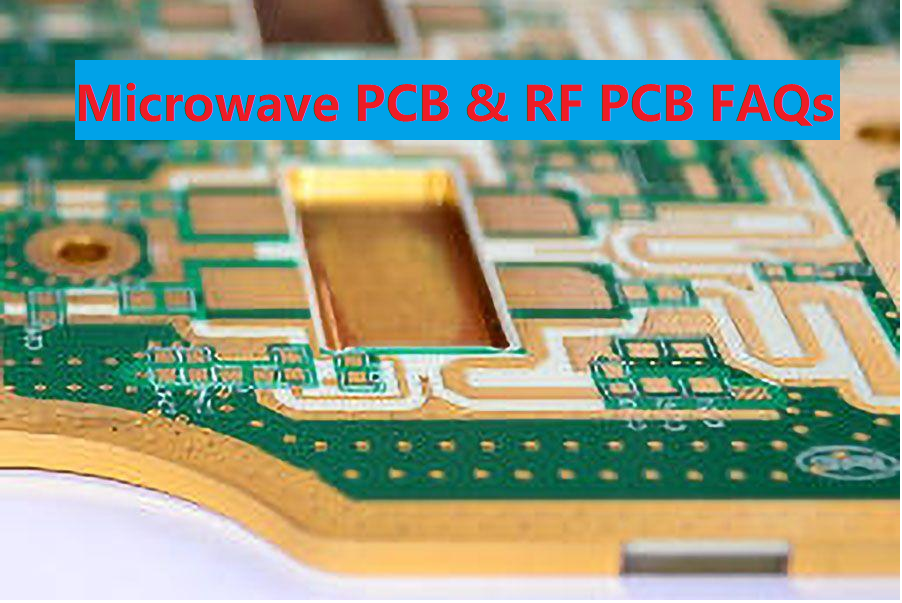
1. What is the difference between RF PCB and microwave PCB?
RF PCBs typically operate below 6 GHz, while microwave PCBs are engineered for 6–100+ GHz applications. Microwave boards require lower-loss materials, tighter impedance control, and more precise manufacturing.
2. Can FR4 be used for microwave PCBs?
Generally no. FR4 has high dielectric loss (Df) and unstable Dk at high frequencies, causing significant signal degradation above ~3–4 GHz. Microwave designs typically use PTFE, ceramic-filled PTFE, hydrocarbon ceramics, or hybrid stackups.
3. What materials are best for microwave PCBs?
Common high-performance materials include:
- Rogers RO4003C / RO4350B
- Rogers RT/duroid 5880, 6002, 6035HTC
- Taconic TLY, RF-35
- Arlon CLTE-XT, IsoClad
- Hybrid FR4 + Rogers constructions
These materials provide low loss, stable dielectric constants, and excellent high-frequency performance.
4. Why is impedance control critical for microwave circuits?
At microwave frequencies, PCB traces behave like transmission lines. Even a 5–10% impedance error can cause:
- Higher insertion loss
- Return loss and reflection
- Phase distortion
- Reduced antenna efficiency
Therefore, maintaining a precise 50Ω or 75Ω impedance is mandatory.
5. What is a grounded coplanar waveguide (GCPW) and why is it used?
GCPW is a transmission line structure where the RF trace is flanked by ground on both sides with a ground plane below.
It is preferred for microwave PCBs because it offers:
- Excellent isolation
- Consistent impedance
- Low radiation loss
- Compact routing for dense layouts
This makes it ideal for RF microwave PCB solutions in 5G and radar applications.
6. Do microwave PCBs require special surface finishes?
Yes. Surface finishes impact insertion loss and skin effect at GHz frequencies.
Recommended finishes:
- Immersion Silver (IAg) → lowest loss
- ENEPIG → stable & reliable for wire bonding
- ENIG → commonly used but slightly higher loss
Avoid heavy plating thicknesses that increase skin resistance.
7. Does the thickness of a microwave PCB affect performance?
Absolutely. PCB thickness affects:
- Impedance
- Loss tangent
- Coupling
- Antenna bandwidth
- Propagation delay
Thinner boards generally provide better high-frequency performance and smaller trace widths.
8. How small can a microwave PCB be?
Microwave PCBs can be extremely compact (millimeter scale), but size is often dictated by:
- Antenna requirements
- Transmission line spacing
- Ground via placement
- Heat management
For mmWave modules (24–80 GHz), PCBs are often less than 20 × 20 mm.
9. Can microwave PCBs support high power?
Some can, but it depends on the material.
Ceramic-filled PTFE laminates like RO3006/3010 support higher power due to:
- Better thermal stability
- Lower expansion
- Higher breakdown voltage
Always calculate thermal dissipation for PA circuits.
10. How do you test a microwave PCB?
Common testing methods include:
- Time Domain Reflectometry (TDR) – impedance
- Vector Network Analyzer (VNA) – S-parameters
- Insertion loss and return loss measurement
- Phase stability tests
- Thermal cycling / reliability testing
Certified manufacturers provide full RF test reports.
11. What causes failure in a microwave control board?
Typical failure points include:
- Overheating of high-power components
- Delamination of PTFE materials
- Dielectric breakdown
- Trace burns or micro-cracking
- Faulty solder joints
- Moisture absorption in high-frequency laminates
Environmental stress factors accelerate failures at GHz speeds.
12. How long does it take to manufacture a microwave PCB?
Lead times depend on stackup complexity:
- Simple 2–4 layer microwave PCB: 7–10 days
- Hybrid PTFE/FR4 stackups: 10–15 days
- Advanced mmWave designs (20–80 GHz): 15–25 days
Prototype + testing may take longer.
13. Are microwave PCBs expensive?
Yes, they cost more than standard FR4 because materials like Rogers/PTFE have higher prices and require specialized equipment.
Cost is influenced by:
- Material grade
- Layer count
- Precision machining
- Tight impedance tolerance
- Surface finish
Large-scale production reduces cost significantly.
14. How do I source microwave PCBs with UL/CE certification?
Choose a manufacturer that specializes in RF & microwave PCB solutions and provides:
- UL-recognized laminates
- CE-compliant process control
- Rogers, Taconic, and Arlon material handling
- Impedance test reports
- Cleanroom lamination for hybrid constructions
15. Can microwave PCBs be multilayer?
Yes. Many microwave designs use 4–12 layer stackups, with PTFE or hydrocarbon layers sandwiched between FR4.
Common structures include:
- PTFE outer layers + FR4 inner layers
- Full PTFE stack for ultra-low-loss radar systems
- PTFE + ceramic for mmWave phased arrays
16. What is the maximum frequency a PCB can support?
It depends on the laminate.
Typical limits:
- FR-4: < 6 GHz (with losses)
- Rogers 4000 series: ~20–40 GHz
- PTFE-based materials: 40–110 GHz
- Ceramic-filled materials: up to 110+ GHz and mmWave bands
For 5G, radar, and satellite systems, PTFE or ceramic laminates are recommended.
17. Do microwave PCBs require controlled dielectric thickness?
Yes. Dielectric thickness tolerance is critical because it directly affects:
- Impedance accuracy
- Coupling and isolation
- Phase delay
- Overall microwave matching performance
High-frequency PCB fabricators must maintain ±10% or even ±5% dielectric thickness tolerance for mission-critical use.
18. Why is copper roughness important in microwave PCBs?
At microwave and mmWave frequencies, skin depth becomes extremely small.
Rough copper dramatically increases:
- Conductor loss
- Insertion loss
- Heating
Many designers specify rolled annealed (RA) copper or low-profile copper (VLP/LP) to keep losses under control.
19. Can microwave PCBs be made flexible (RF flex circuits)?
Yes—flexible microwave PCBs use materials like:
- Rogers 3000 series flexible laminates
- Polyimide-based low-Dk materials
Applications include antennas, phased arrays, and wearable radar sensors.
20. What is the expected lifetime of a microwave PCB?
With proper material selection and thermal design:
- Consumer microwave PCBs: 5–10 years
- Automotive radar PCBs: 10–15 years
- Aerospace/military microwave PCBs: 20+ years
Failure is usually caused by thermal cycling, moisture absorption, or RF overstress.
21. How long does it take to manufacture microwave PCBs?
Typical lead times:
- Standard microwave PCB: 10–15 days
- Complex multilayer microwave PCB: 15–25 days
- Hybrid stack-up with PTFE: 20–30 days
Fast-turn service (5–7 days) is possible but more expensive.
22. What Is the Typical Thickness of a Microwave PCB?
Dielectric layers:
- 0.127 mm
- 0.254 mm
- 0.508 mm
- 0.8 mm
Final PCB thickness:
0.4–1.6 mm depending on application.
23. What Are the Main Applications of Microwave PCBs?
Microwave PCBs are used in:
- 24/60/77 GHz automotive radar
- 5G mmWave radio units
- Microwave antennas
- Satellite transceivers
- PA/LNA modules
- RF filters and couplers
- Medical microwave imaging
- Wireless base stations
- Military radar systems
Above are the common questions that we faced during working, if you have any other questions about microwave PCBs or radio frequency PCBs, just feel free to contact us.
You may also like

Tags: Microwave PCB, Microwave PCB FAQs, microwave pcb material, RF Microwave PCB manufacturer, RF Microwave PCB Solutions