





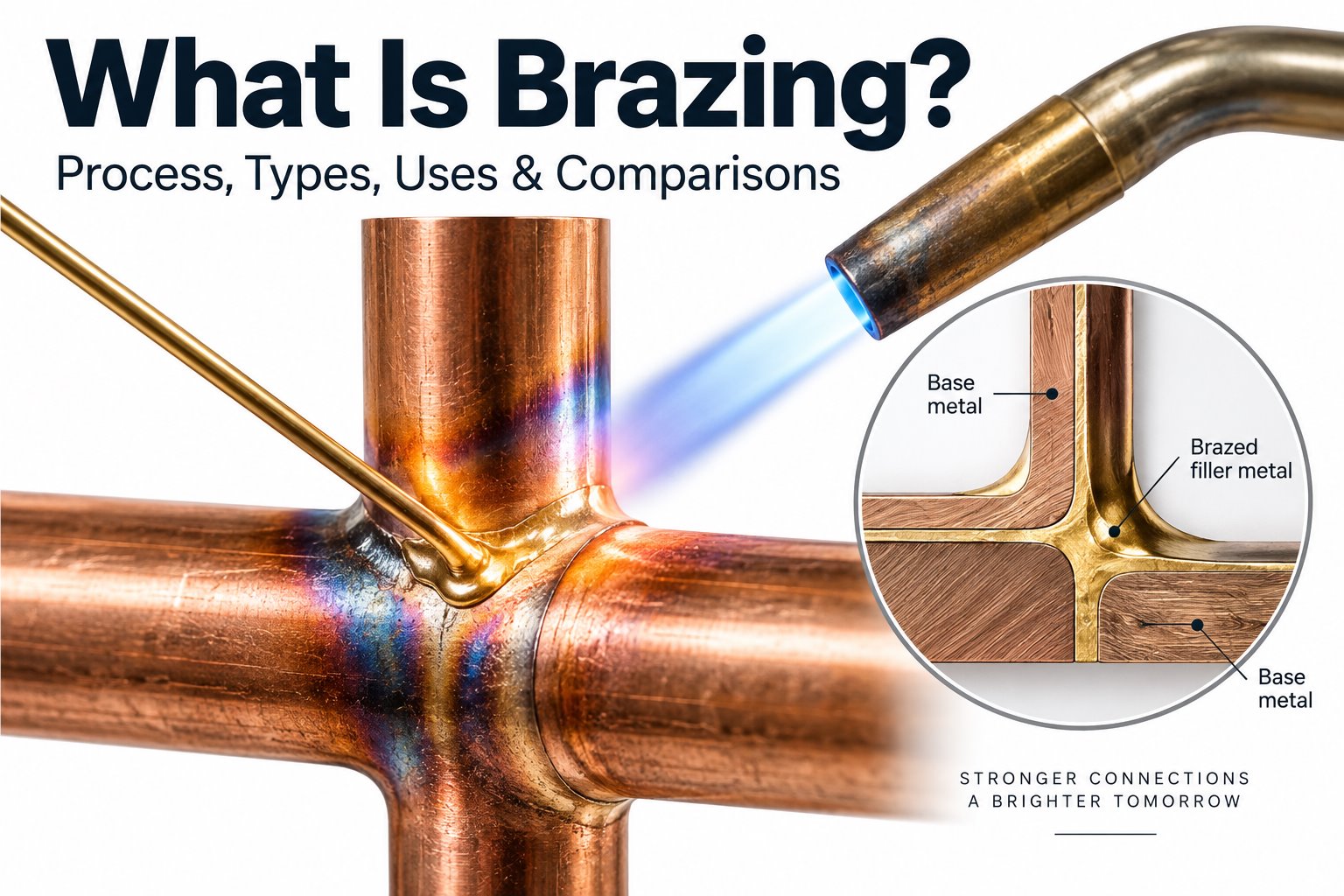
What is brazing? It joins metal parts without melting the base materials themselves. Instead, heat melts a separate filler alloy, which wets the mating surfaces and flows through the joint gap by capillary action. After cooling, the filler solidifies and forms a metallurgical bond between the parts.
This process is useful when welding would create too much distortion, when dissimilar metals need to be joined, or when a clean and leak-tight joint is required. Brazing is common in HVAC, refrigeration, automotive, aerospace, electrical equipment, heat exchangers, tooling, and many other metal assemblies.
Key Takeaways
- Brazing is a metal-joining process that melts a filler metal above 450°C (840°F) while keeping the base metals solid.
- The molten filler enters a close-fitting joint through wetting and capillary action, rather than by melting the parts being joined.
- Successful brazing depends heavily on clean surfaces, correct joint clearance, suitable filler metal, controlled heating, and oxide management.
- Brazing differs from welding because the base metal normally does not melt. It differs from soldering mainly because brazing filler metals melt above 450°C.
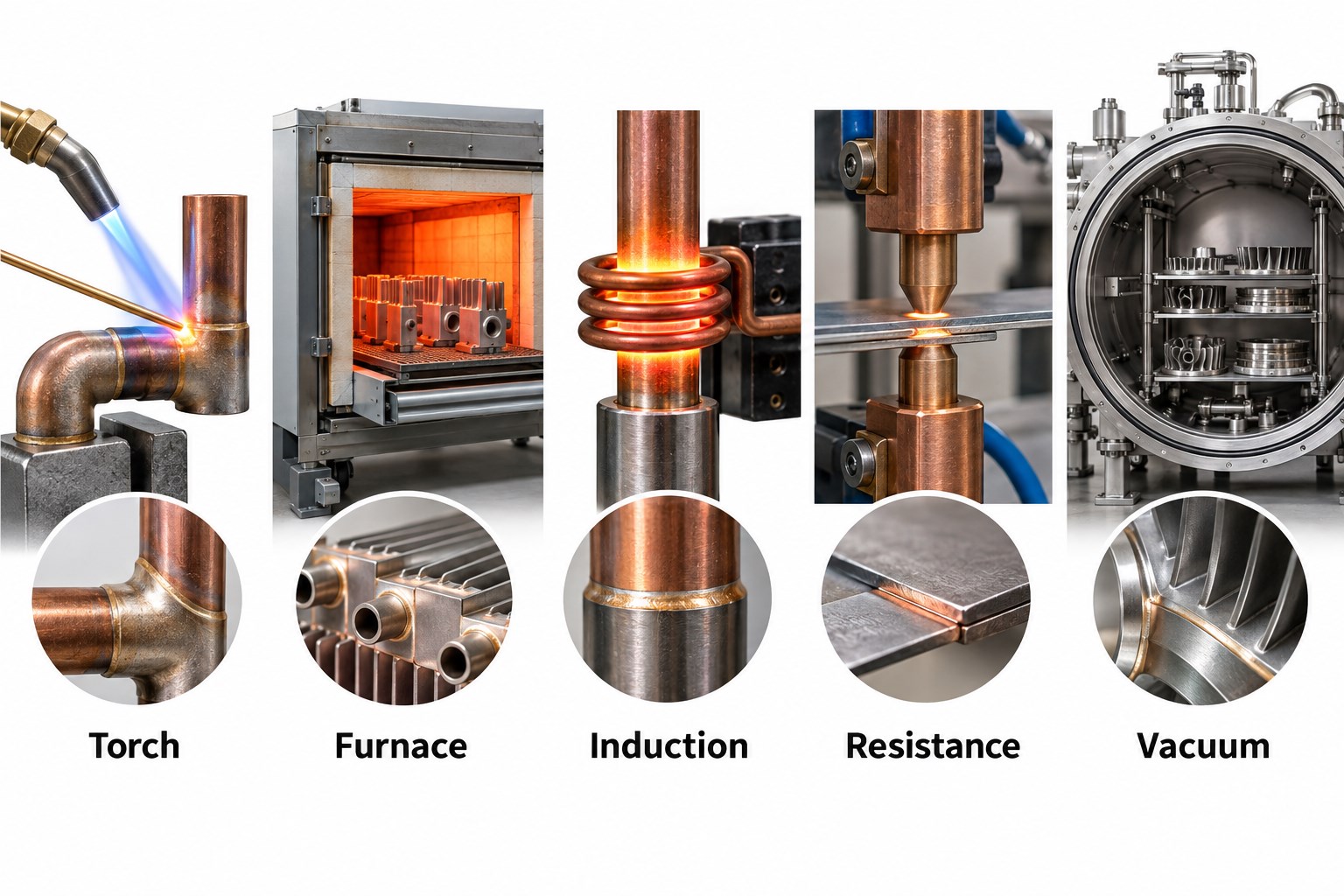
- Common methods include torch, furnace, induction, resistance, dip, and vacuum brazing.
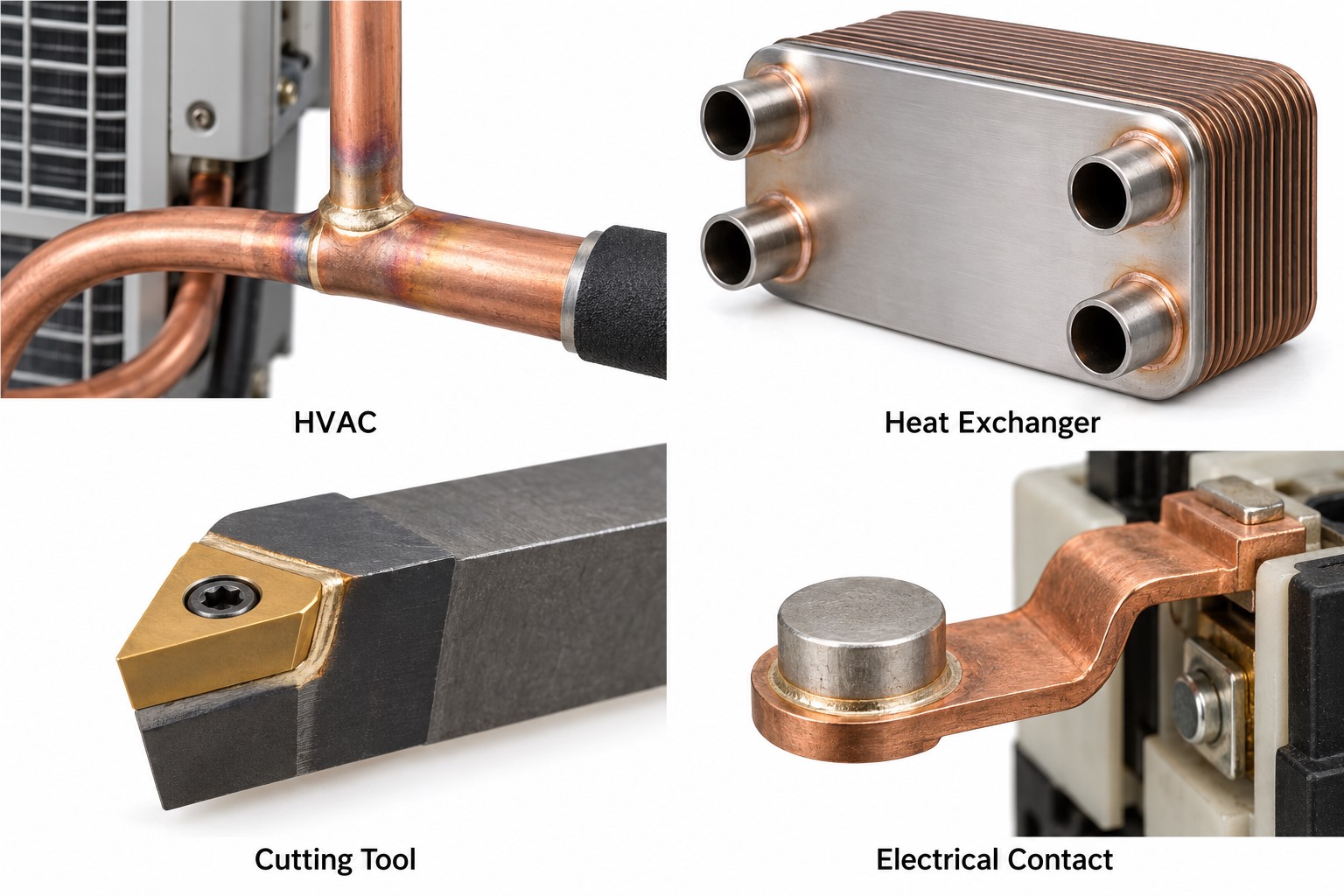
- Brazing is widely used for HVAC tubing, heat exchangers, automotive assemblies, aerospace parts, electrical contacts, cutting tools, and leak-tight metal joints.
- Copper-to-copper joints can sometimes use phosphorus-bearing filler without separate flux, while dissimilar joints require more careful filler and flux selection.
What Is Brazing?
Brazing is a metal-joining process in which a filler metal melts above 450°C (840°F) and flows between closely fitted parts while the base metals remain solid.
The process uses heat to bring the joint area above the filler alloy’s melting range, but below the melting temperature of the components being joined. The filler then wets the surfaces and fills the gap between them.
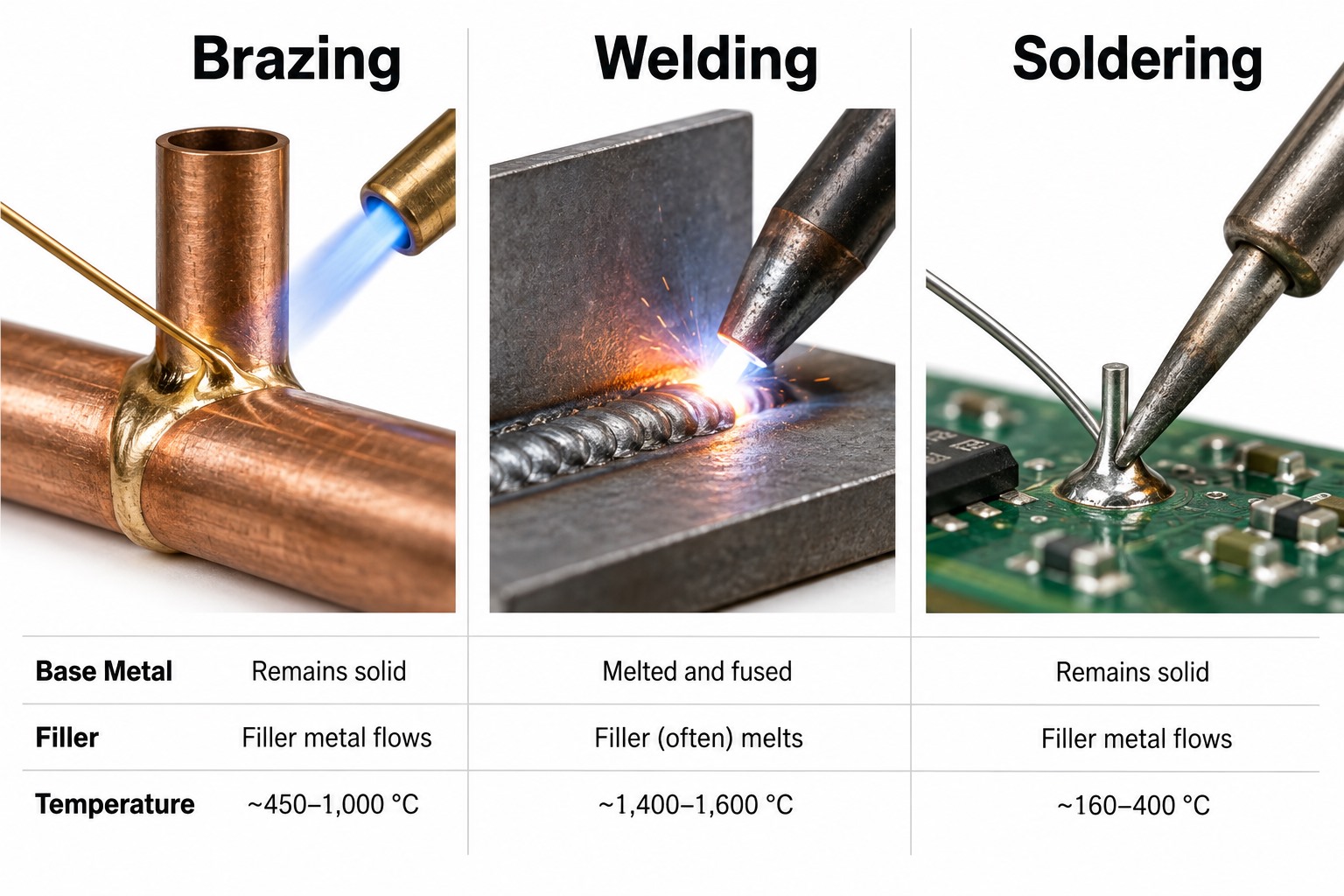
This makes brazing different from welding, where the base material is normally melted to create the joint. It also separates brazing from soldering, which uses filler metals with a liquidus temperature below 450°C.
A brazed joint can connect similar or dissimilar metals, depending on the filler alloy, joint design, surface condition, and service requirements.
How Does the Brazing Process Work?
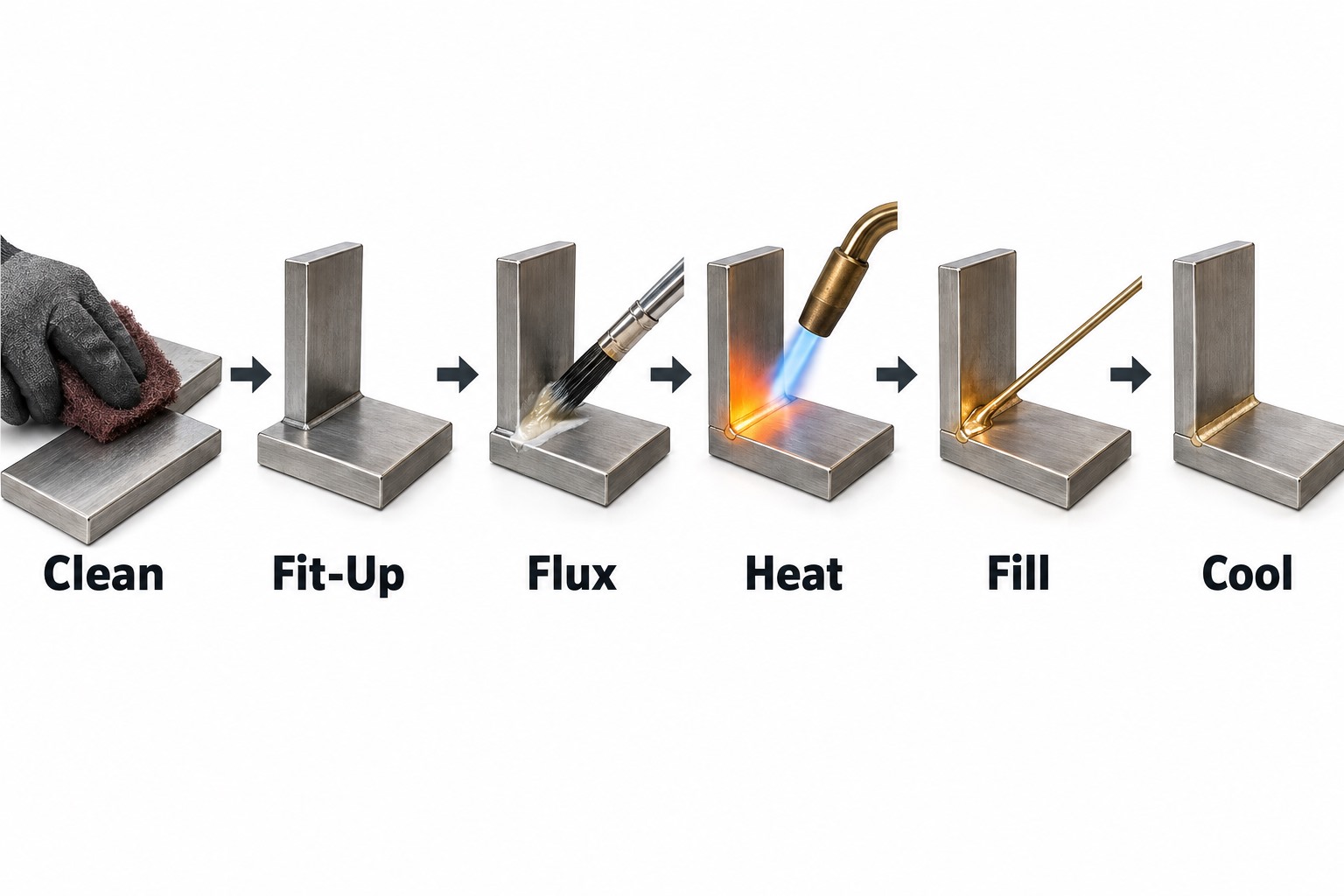
The answer to what is brazing process is straightforward: heat a prepared joint until the filler metal melts and flows through the clearance between the parts.
- Clean the surfaces. Remove oil, grease, dirt, and oxides that could prevent wetting.
- Fit the parts together. Maintain an appropriate and reasonably uniform joint clearance.
- Apply flux if required. Flux limits oxide formation and helps the molten filler wet the surfaces.
- Heat the joint. Bring the assembly to the correct brazing temperature without melting the base metals.
- Introduce the filler metal. The filler melts when it contacts the heated joint area.
- Allow capillary action to distribute the filler. Molten alloy is drawn into the joint.
- Cool the assembly. The filler solidifies and forms the final bond.
- Clean the joint if necessary. Residual flux may need to be removed.
The filler should generally melt because of heat in the workpieces rather than being melted directly by the flame. This helps produce more uniform flow and reduces the risk of overheating the filler before the joint reaches brazing temperature.
Why Are Joint Clearance, Wetting and Capillary Action Important?
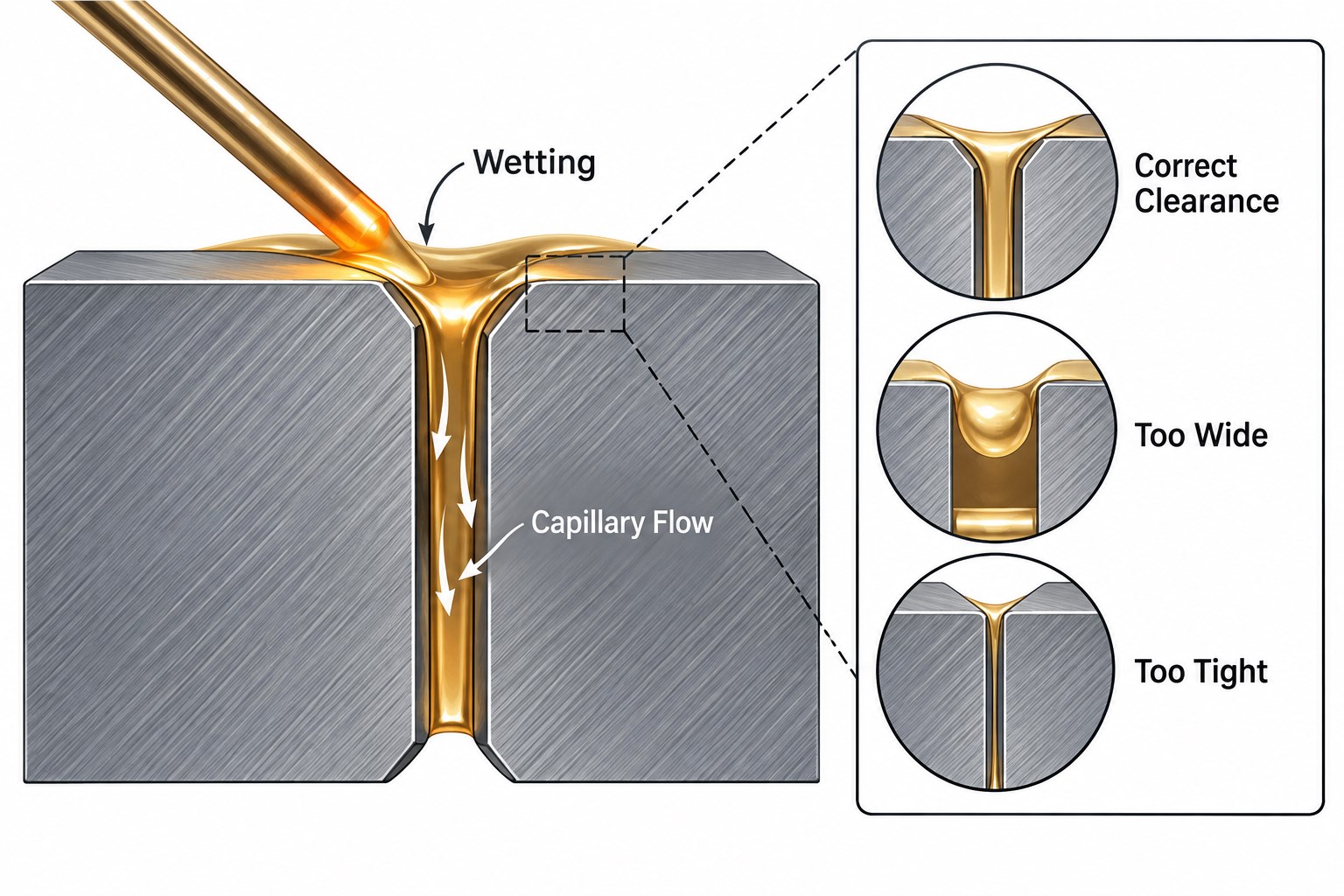
A brazed joint depends on molten filler being able to wet both surfaces and flow through the joint gap. Joint clearance therefore has a direct effect on filler distribution.
If the gap is too large, capillary attraction becomes weaker and the filler may not fill the joint evenly. If the gap is too tight, filler penetration can also be restricted, especially when thermal expansion changes the clearance during heating.
Good wetting also requires clean metal surfaces. Oil, heavy oxidation, or unsuitable surface films can prevent the filler from spreading across the base metal.
Clean surface + suitable clearance + correct temperature → good wetting → capillary flow → complete joint
This is one reason brazing quality cannot be judged only by how much filler is visible around the outside of the connection. A large external fillet does not automatically mean the filler has properly penetrated the internal joint.
What Are Brazing Rods, Filler Metals and Flux?
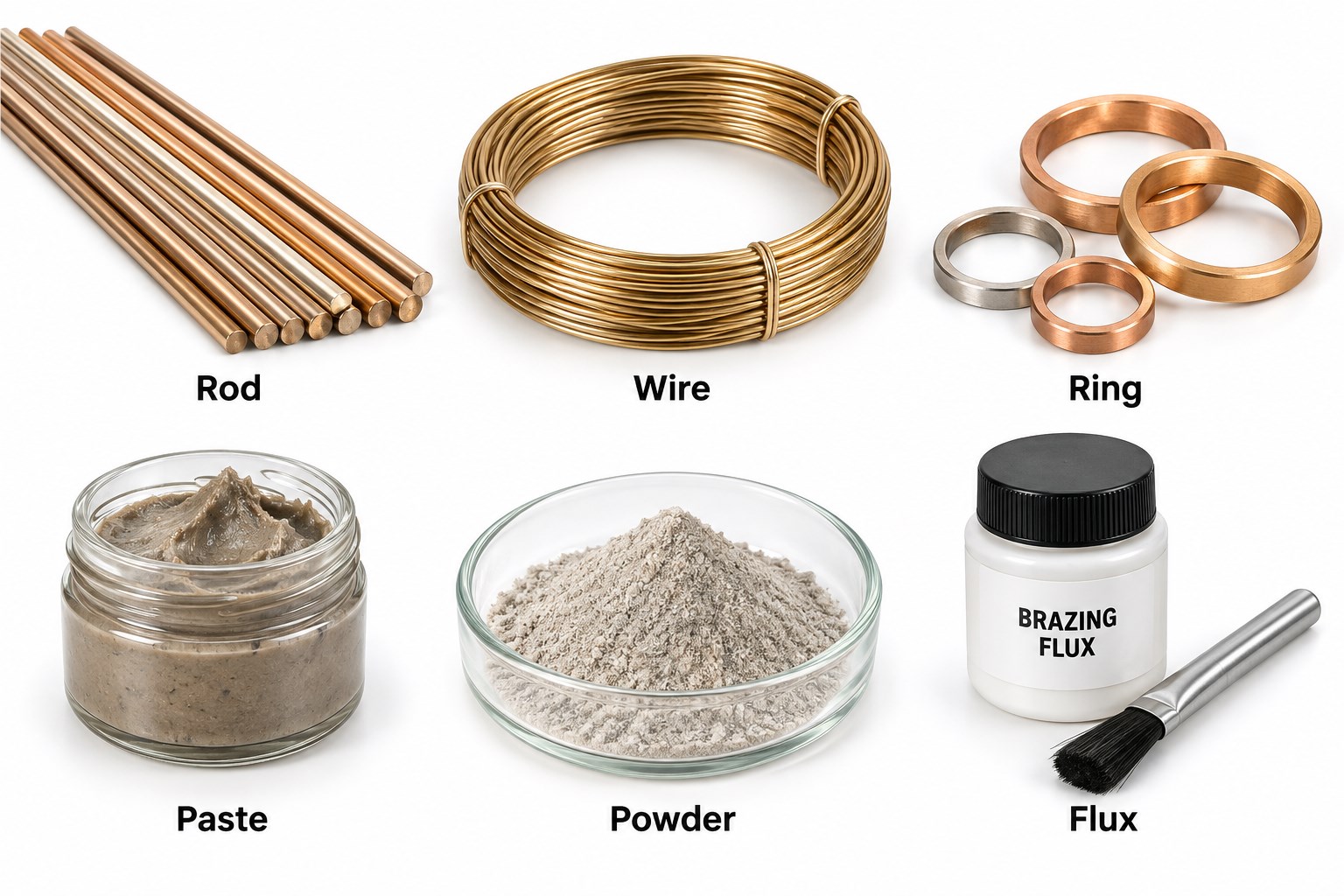
Brazing filler metal is the alloy that melts and forms the joint between the base materials. A brazing rod is simply one physical form in which that filler can be supplied.
Common filler forms include:
- Rod
- Wire
- Ring
- Strip
- Foil
- Preform
- Paste
- Powder
Different filler alloys are selected according to the base metals, brazing temperature, corrosion requirements, service temperature, joint strength, and manufacturing process.
Flux serves a different purpose. It helps control oxides that would otherwise prevent proper wetting and filler flow. Depending on the formulation, flux can dissolve existing oxides and reduce further oxidation during heating.
Not every brazing operation requires external flux. Vacuum brazing and controlled-atmosphere processes can manage oxidation without conventional flux, while some copper-phosphorus fillers can be self-fluxing on copper-to-copper joints.
What Types of Brazing Are There?
Brazing methods are usually classified by how heat is applied to the joint.
| Brazing Method | Heat Source / Environment | Typical Use |
|---|---|---|
| Torch brazing | Gas flame | HVAC, repair, low-volume production |
| Furnace brazing | Controlled furnace | Batch or volume assemblies |
| Induction brazing | Electromagnetic induction | Fast, localized heating |
| Resistance brazing | Electrical resistance | Small, repeatable joints |
| Dip brazing | Molten bath | Specialized assemblies |
| Vacuum brazing | Vacuum furnace | Clean, high-reliability components |
Torch brazing is common for manual work because the heat can be directed at a specific joint. HVAC copper tubing is a typical example.
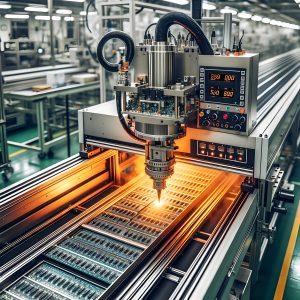
Furnace brazing is useful when many joints must be heated at once. It provides better repeatability and lends itself to higher-volume manufacturing.
Induction brazing heats conductive parts rapidly using an alternating electromagnetic field. It is useful where short cycle times and local heat control matter.
Vacuum brazing is used when oxidation, contamination, flux residue, or high joint cleanliness are critical, such as in aerospace, vacuum hardware, and precision assemblies.
Brazing vs Welding: What Is the Difference?
The most important difference is that brazing normally does not melt the base metals, while welding usually joins parts by locally melting and fusing the base material.
| Factor | Brazing | Welding |
|---|---|---|
| Base metal melts | No | Usually yes |
| Filler metal | Commonly required | Depends on process |
| Joint mechanism | Wetting and capillary flow | Fusion |
| Heat input to base material | Usually lower | Usually higher |
| Distortion | Often lower | Often higher |
| Dissimilar metals | Often easier | Can be more difficult |
| Joint design | Often relies on overlap | Butt, fillet, lap and other joints |
Brazing is useful when dimensional stability matters because the base parts remain below their melting temperature. This can reduce distortion and preserve more of the original component geometry.
Welding is often preferred when a fused structural joint is required or when the joint must become part of the base-metal section itself.
It is not accurate to say that welding is always stronger than brazing. Joint strength depends on material combination, filler alloy, joint overlap, clearance, section thickness, loading direction, and operating temperature.
Brazing vs Soldering: What Is the Difference?
Brazing and soldering are closely related because both join materials using a molten filler while keeping the base metals solid.
The standard temperature distinction is the filler metal’s liquidus temperature:
- Brazing: above 450°C / 840°F
- Soldering: below 450°C / 840°F
| Factor | Brazing | Soldering |
|---|---|---|
| Base metal melts | No | No |
| Filler temperature | Above 450°C | Below 450°C |
| Capillary action | Common | Common |
| Flux may be used | Yes | Yes |
| Typical mechanical capability | Higher | Lower |
| Typical service temperature | Higher | Lower |
| Common examples | HVAC, heat exchangers, tooling | Electronics, wires, connectors |
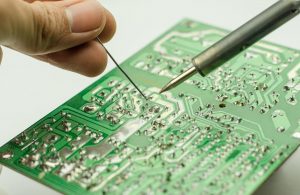
Soldering is especially common in electronics because the lower temperature limits thermal stress on components and PCB materials used in PCBA.
Brazing is more appropriate when higher mechanical strength, higher service temperature, leak-tight tubing, or more demanding metal assemblies are required.
What Metals Can Be Brazed?
Many common engineering metals can be brazed when a compatible filler alloy and process are selected.
Examples include:
- Copper
- Brass
- Carbon steel
- Stainless steel
- Nickel and nickel alloys
- Aluminum
- Silver-containing alloys
- Carbide-to-steel tool assemblies
- Selected dissimilar-metal combinations
Copper is particularly brazing-friendly because many filler alloys wet it effectively, and copper tubing can be joined reliably with proper preparation.
Aluminum also can be brazed, but its stable oxide layer requires suitable flux, atmosphere, filler alloy, and temperature control.
The key point is that brazability depends on the specific base-metal combination, not just on whether each material can be brazed individually.
What Is Brazing Used For?
Brazing is used when metal components need a strong, clean, dimensionally stable, or leak-tight joint without melting the base materials.
Common applications include:
- HVAC refrigeration lines
- Copper tubing
- Heat exchangers
- Radiators
- Automotive components
- Aerospace assemblies
- Cutting tools
- Carbide tips
- Electrical contacts
- Hermetic housings
- Plumbing assemblies
- Industrial tubing
- Refrigeration equipment
- Vacuum hardware
Heat exchangers are a good example because many thin metal sections and internal flow passages may need to be joined while maintaining geometry and leak tightness.
Cutting tools also use brazing to attach carbide inserts or tips to steel bodies. The process allows materials with very different properties to be joined without melting either base component.
What Is Brazing in HVAC and Copper Pipe Work?
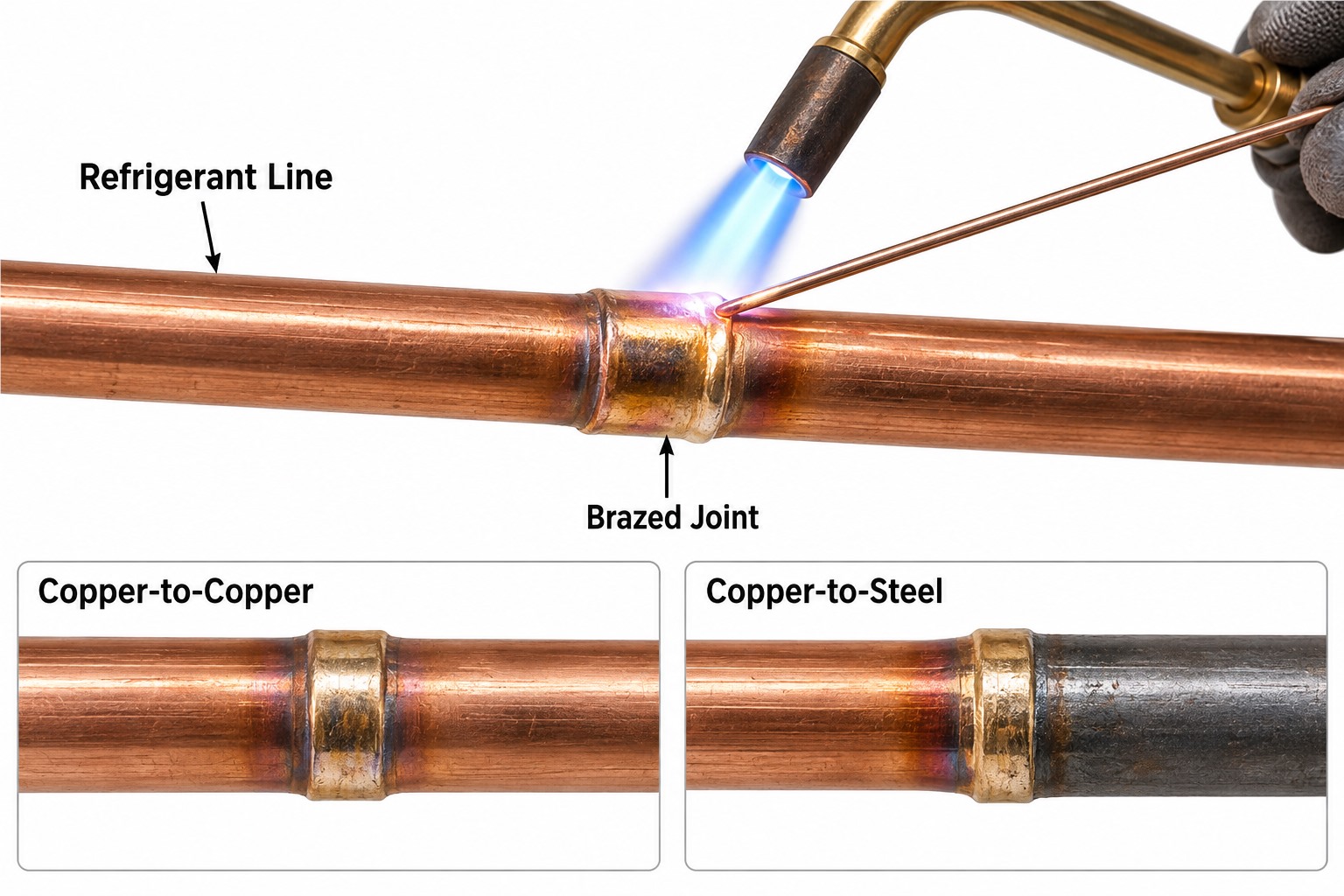
In HVAC and refrigeration systems, brazing is widely used to join copper tubing that carries refrigerant under pressure.
The process is preferred because properly brazed joints can provide:
- Strong mechanical connection
- Leak resistance
- High-pressure capability
- Good temperature resistance
- Compact joint geometry
For copper-to-copper tubing, phosphorus-bearing copper filler alloys are commonly used. Some of these fillers can provide self-fluxing action on clean copper, so separate flux may not always be required.
For copper-to-brass, the filler and flux requirements depend on the alloy system and joint design.
For copper-to-steel, more care is required. Phosphorus-bearing filler metals should not simply be transferred from copper-to-copper practice because brittle compounds can form with ferrous materials. A suitable phosphorus-free filler and compatible flux are normally selected instead.
HVAC brazing quality also depends on tube preparation, fit-up, heating technique, filler distribution, and oxidation control inside and outside the tubing.
What Are the Advantages and Limitations of Brazing?
Brazing offers several manufacturing advantages, but it also places tight requirements on surface condition and joint design.
| Advantages | Limitations |
|---|---|
| Lower distortion than many welding processes | Joint clearance is important |
| Joins dissimilar metals | Surface cleanliness is critical |
| Good for thin sections | Filler compatibility must be verified |
| Can create leak-tight joints | Service temperature is limited by filler alloy |
| Suitable for complex assemblies | Flux residues may require cleaning |
| Can be automated | Poor joint design can reduce strength |
| Base metals remain solid | Heating must still be controlled |
Because the base metals do not melt, brazing can preserve thin sections and precision geometries better than some fusion processes.
The trade-off is that brazing is less forgiving of contaminated surfaces, unsuitable clearances, or incorrect alloy selection. A visually neat joint can still perform poorly if filler has not penetrated the intended joint area.
FAQ About Brazing
1. What temperature is considered brazing?
Brazing uses filler metals with a liquidus temperature above 450°C (840°F) while remaining below the melting temperature of the base metals.
2. Does brazing melt the base metal?
No. The base metals remain solid during brazing. Only the filler metal is melted and distributed through the joint.
3. Is brazing stronger than soldering?
Brazed joints generally support higher mechanical loads and service temperatures than soldered joints, but actual strength depends on the filler alloy, base materials, clearance, joint geometry, and loading.
4. Can copper be brazed?
Yes. Copper is commonly brazed in HVAC, refrigeration, plumbing, heat exchangers, and electrical assemblies.
5. Does copper brazing need flux?
Not always. Certain phosphorus-bearing filler metals are self-fluxing on copper-to-copper joints, although other material combinations may require flux.
6. Is brazing the same as welding?
No. Welding normally melts and fuses the base material, while brazing joins solid base metals using a separate molten filler.
Brazing is most successful when the filler alloy, flux or atmosphere, joint clearance, and heating method are selected as one system rather than as separate choices. For engineering projects, the base-metal combination and service conditions should always be defined before choosing the brazing process.
You may also like






Tags: brazing vs welding, types of brazing, what is brazing, what is brazing process, what is brazing used for