





An smt traceability log helps you isolate affected boards without holding an entire production batch. It connects each lot or serial number to the materials, process records, inspection results, tests, rework, and shipment history behind it.
Do not settle for a supplier’s “full traceability” claim. Ask what can be retrieved for one finished board and one material lot. This guide shows what evidence to request before production.
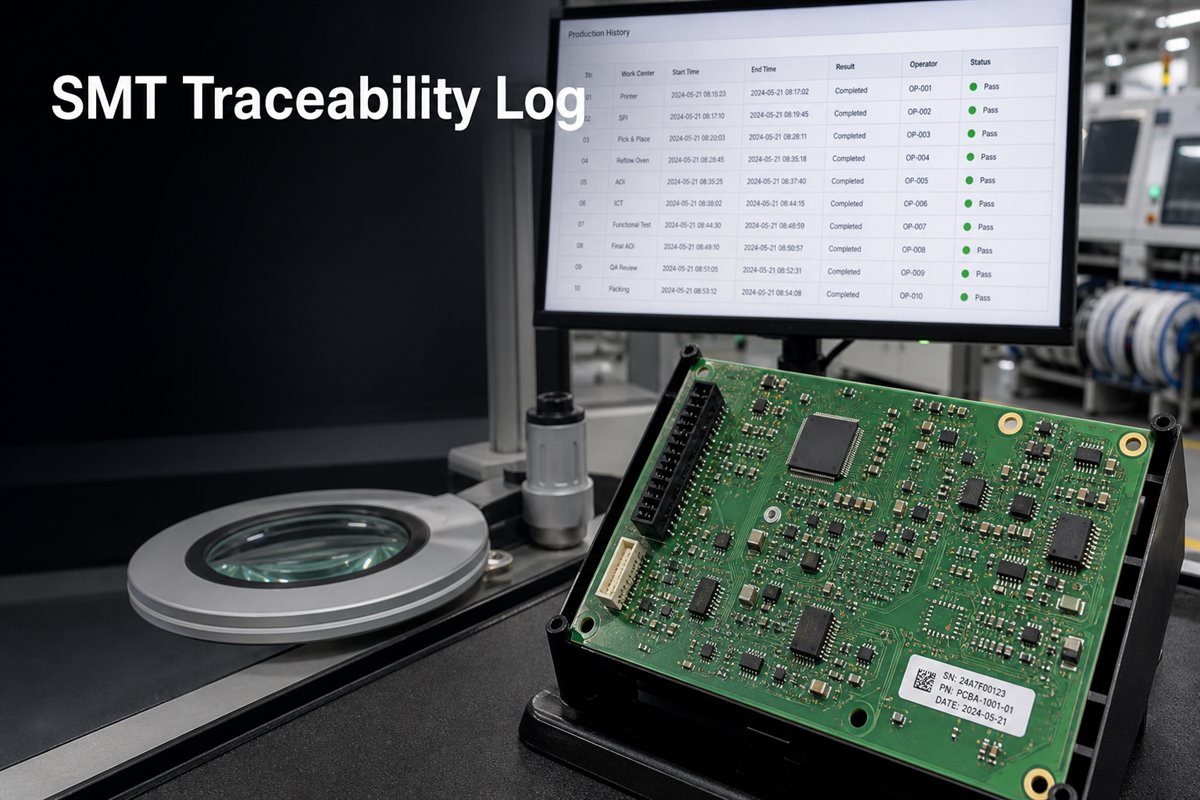
What Should an SMT Traceability Log Prove?
An SMT traceability log should give you a connected production history, not scattered spreadsheets and signatures. For a returned PCBA, it should answer:
- Which PCB, component, and solder-paste lots were used?
- Which BOM, assembly drawing, and SMT program revisions controlled the build?
- Which line, machine, stencil, feeder setup, and production window were involved?
- Did SPI, AOI, X-ray, ICT, or functional testing identify an abnormal condition?
- Was the board repaired, retested, or released under an approved disposition?
- Which other boards and shipments share the same material or process history?
The benefit is faster investigation: one identifier leads your team to the relevant build evidence. Agree on the required depth before production; a commercial assembly may need lot-level records, while a field-critical product may need unit-level linkage.
How SMT Traceability Limits a Suspect Batch
Smaller containment scope: instead of holding every board built during a broad time window, you can focus on units that share the suspect material or process history.
Backward investigation should show:
- The work order, product revision, and production time for a failed board
- The PCB, component, solder paste, and other controlled material lots used
- The SMT line, machine program, stencil, and relevant process references
- Inspection, test, repair, and retest results linked to that board or lot
Forward investigation should show:
- Every board, panel, or work order that consumed the suspect material
- The affected serial-number or lot-number range
- Current inventory, work-in-process, and shipped quantities
- Inspection, screening, repair, and release status for the affected population
The result is less unnecessary sorting, retesting, replacement, and delivery disruption. Traceability does not prove that a board is defect-free; it gives your team better evidence for containment and root-cause analysis.
Which Electronic Component Traceability Records Matter?
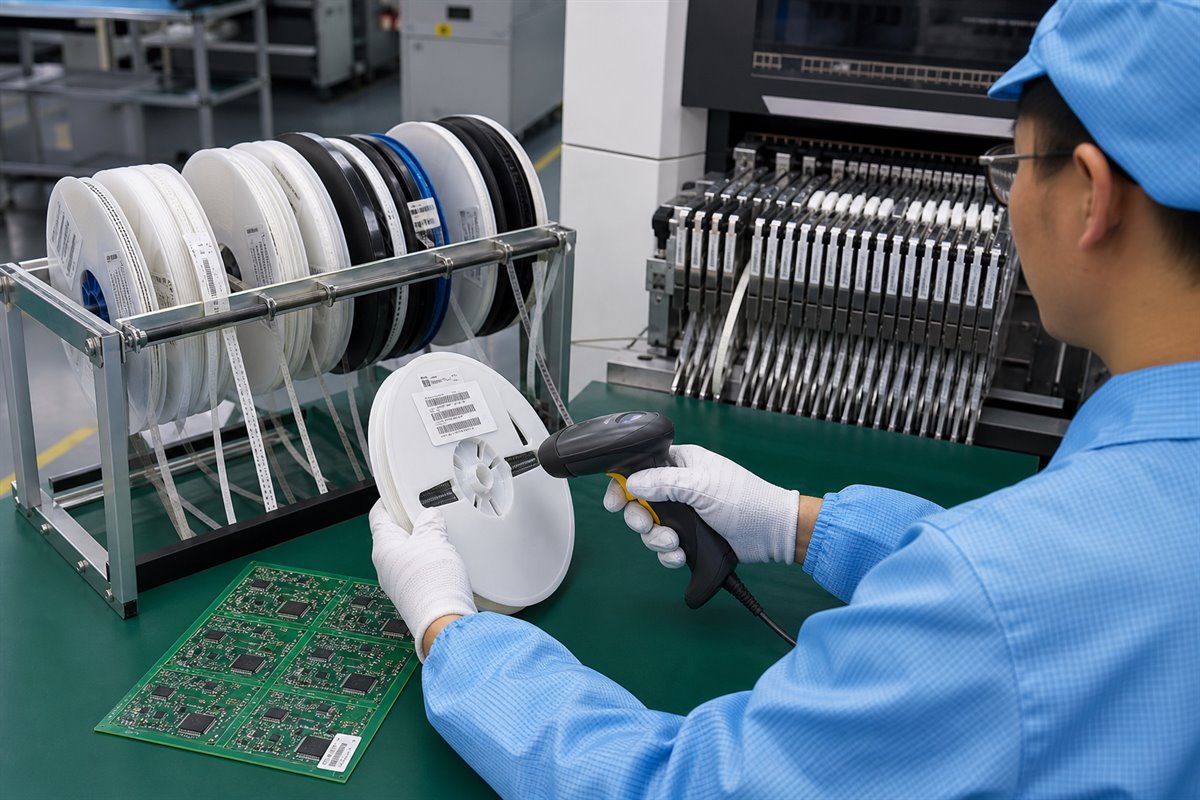
Faster material investigation: connect the approved BOM to the actual reel, tray, tube, or package used. An internal part number alone cannot distinguish supplier, manufacturer, date-code, or lot variations.
Useful material records may include:
- Customer part number and manufacturer part number
- Manufacturer and approved sourcing channel
- Supplier lot and manufacturer lot information when available
- Date code and quantity received
- Internal reel, tray, tube, or package identifier
- Incoming acceptance status
- Moisture-sensitivity and floor-life status when applicable
- Storage or baking records when required
- Feeder load, replenishment, unload, and return events
- Approved substitution or deviation reference
Specify which labels, certificates, and incoming records must be retained; they do not prove the same facts. For customer-supplied parts, define the received quantity, lot identity, acceptance condition, shortage policy, and unused-material disposition before kitting.
PCB Traceability Requirements for SMT Process Records
Fewer revision mistakes: PCB traceability requirements should link the approved build files to the route actually used. Correct components cannot prevent a failure caused by the wrong revision, stencil, placement program, or reflow setup.
Core process fields can include:
- Work order and production lot
- PCB part number, revision, and panel identification
- BOM, centroid, assembly drawing, and SMT program revision
- Line, machine, and production timestamps
- Stencil identification and revision
- Solder paste product, batch, opening time, and expiry status
- Printer, placement, and reflow program references
- Feeder position and material-loading confirmation where required
- Reflow profile or approved recipe reference
- Process alarm, interruption, or approved deviation
Not every machine parameter belongs in the customer report. The practical benefit is being able to retrieve the controlled setup when an issue occurs. During NPI, engineering changes, and repeat orders, the record should identify the released Gerber, BOM, centroid, assembly, programming, and test revisions that apply.
PCBA Traceability for Inspection, Test, and Rework
Clear pass history: PCBA traceability should link inspection and test evidence to the same board, panel, or lot. An equipment list does not prove that your assembly passed an inspection.
Depending on the agreed manufacturing plan, linked quality records may include:
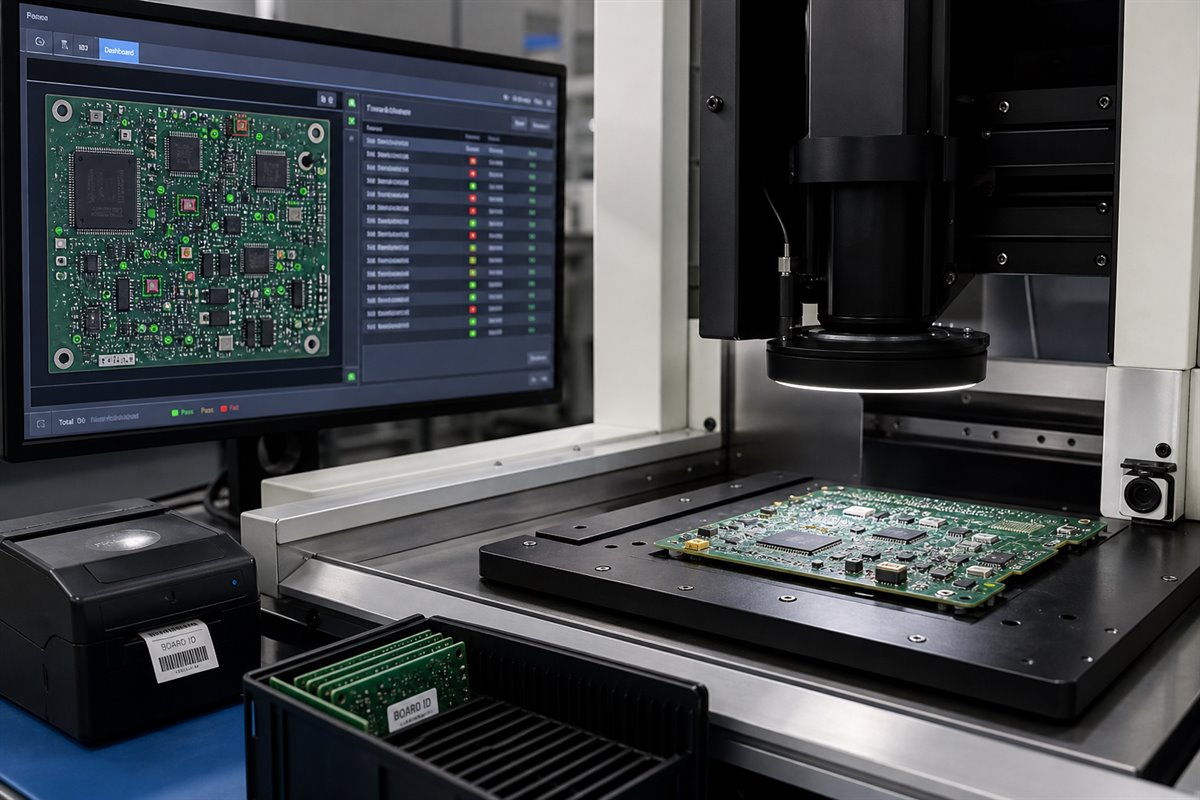
- Solder paste inspection status and relevant findings
- AOI result, defect code, image reference, and review status
- X-ray result for selected hidden joints or samples
- First-article or visual inspection approval
- ICT, flying probe, boundary-scan, or functional test result
- Test program, fixture, procedure, or golden-sample revision
- Repair action, replaced component, and operator
- Retest result and final release status
- Nonconformance, deviation, or concession reference
The log must distinguish “not required,” “not performed,” “passed,” and “no record available.” Confirm which checks are included and which need your procedures, fixtures, firmware, limits, or expected results. Repair and retest must remain visible so a reworked unit is not mistaken for a first-pass board.
Component-Level Traceability vs Lot-Level Traceability
Choose enough detail to protect the project without paying for unusable data. Lot-level records cost less to manage; unit- or component-level linkage can reduce the scope of field containment.
| Traceability level | Typical linkage | Buyer benefit | Important limitation |
|---|---|---|---|
| Lot-level | A production lot is linked to shared material and process records | Practical for many commercial builds and repeat orders | May not identify the exact material used on one individual board |
| Panel-level | A panel ID is linked to production and inspection events | Narrows the affected population within a work order | Unit history may be lost after depanelization unless mapping is retained |
| Unit-level | Each PCBA serial number is linked to its route and results | Supports precise field-return and test-history review | Requires stable identification and consistent data integration |
| Component-level | A specific material lot or reel is linked to its placement or usage | Supports focused material containment and where-used analysis | Availability depends on labeling, equipment integration, and replenishment control |
IPC-1782 uses a risk-based approach agreed between user and supplier; it does not mean every assembly automatically receives the same record depth. Base the decision on product risk, field-replacement cost, customer requirements, volume, service life, and likely containment cost.
How PCB Component Traceability and Supplier Quality Work Together
Verify the claim before ordering: ask for a redacted record from one completed lot. It should connect the approved source and received material to the boards that consumed it. Traceability cannot compensate for weak sourcing or incoming control.
A useful audit sample should demonstrate:
- Approved BOM and revision
- Purchase and receiving references
- Material labels and incoming acceptance status
- Work order and kitting record
- Material-to-line or material-to-board linkage
- SMT program and controlled process references
- Inspection and test evidence
- Rework and retest closure, if applicable
- Packing and shipment linkage
Test both directions: select one material lot and ask which boards used it; then select one finished board and request its materials, route, inspections, and tests. If the supplier must manually assemble unrelated files, containment may be slower than its claim suggests. Approved alternates should also carry an approval reference and affected-build identification.
Electronics Assembly Traceability Requirements Before Quotation
Fewer quotation gaps: put electronics assembly traceability requirements in the RFQ. Late requirements can change labeling, equipment setup, inspection, testing, reporting, cost, and lead time.
Define these items before quotation:
- Required level: lot, panel, unit, or component linkage
- Board identification method and code content
- Customer serial-number allocation rules
- Mandatory material, process, inspection, and test fields
- Required label, certificate, image, or report retention
- Record format, delivery method, and retention period
- Applicable customer or end-market requirements
- Treatment of customer-supplied materials and approved alternates
- Rework, retest, deviation, and release documentation
- Shipment label and serial-number mapping
Send released Gerber files, BOM, centroid data, assembly drawings, approved alternates, inspection criteria, test requirements, programming files when applicable, and the traceability specification.
EBest Circuit (Best Technology) can confirm the supported record scope for PCB fabrication, sourcing, SMT assembly, inspection, and agreed testing. The customer defines the required depth, regulatory obligations, acceptance criteria, firmware and functional requirements, and final product validation.
A Realistic SMT Production Traceability Example
An industrial controller PCBA returns from the field with an intermittent power fault. Its serial number leads to the work order, revisions, SMT line, power IC lot, solder paste batch, AOI result, functional test, and repair history.
A forward search then identifies every board that used the same power IC lot. If only a limited group shares that history, the customer can focus containment and additional testing on those boards. If failures cross material lots but share a production window or test setup, the investigation can move toward process or test evidence.
The customer benefit is a defensible affected population without reconstructing the build from emails, memory, and unrelated reports. Traceability supports the investigation; it does not automatically prove root cause.
Avoid a record gap after production: send the released fabrication and assembly files, BOM, volume, product requirements, and requested record package to <strong>sales@bestpcbs.com</strong>. EBest Circuit will confirm the supported linkage before the build begins.
SMT Traceability Log FAQs
What is the main purpose of an SMT traceability log? It connects a board or production lot to its materials, approved revisions, SMT process history, inspection, testing, rework, and shipment records. This helps investigate failures and isolate the affected population.
Does every PCBA need unit-level traceability? No. The appropriate depth depends on product risk, customer requirements, field-replacement cost, production volume, and the likely containment need. Many projects can use lot-level records, while others require serialized unit history.
Is MES the same as SMT traceability? No. MES can collect and connect manufacturing data, but the required identifiers, fields, equipment links, retrieval rules, and data quality still need to be defined and verified.
Which files should a buyer provide before requesting traceability? Provide the released Gerber files, BOM, centroid data, assembly drawings, approved alternates, inspection and test requirements, programming inputs when applicable, and the required traceability specification or record list.
Can a traceability log prove regulatory compliance? Not by itself. It can provide manufacturing and material evidence within an agreed scope, but the customer must define the applicable regulations, acceptance criteria, required retention period, and final compliance documentation.
You may also like


Tags: PCBA traceability, smt traceability, smt traceability log