





Is IPC-A-600 the right standard to control PCB acceptance before batch production? For high-reliability printed boards, clear acceptance rules can reduce quality disputes, rework costs, and delivery uncertainty. This standard gives a practical visual basis for judging whether a bare PCB is acceptable before assembly or shipment.
For industrial electronics, automotive modules, medical devices, power control products, and high-density boards, IPC A 600 helps align quality expectations with actual fabrication results. It supports consistent inspection, clearer project communication, and smoother order handover from quotation to final delivery.
What is the IPC-A-600?
IPC-A-600, also called Acceptability of Printed Boards, is a widely used standard for judging the appearance and acceptability of bare printed circuit boards. It focuses on visible and measurable board conditions before components are assembled.
The standard uses pictures, illustrations, and acceptance descriptions to show target condition, acceptable condition, and nonconforming condition. This makes it easier to evaluate surface defects, plated holes, annular rings, conductor issues, solder mask quality, and internal board conditions.
In practical PCB production, IPC-A-600 works as a common quality language. It helps both sides avoid vague inspection terms such as good quality or minor defect. Instead, the finished board can be checked against a recognized standard.
IPC A 600 is especially useful when the project involves multilayer PCB, HDI PCB, impedance control boards, high-frequency boards, or long-term supply programs. These projects usually require stable inspection rules before batch approval.
Why is IPC-A-600 Important for PCB Quality Inspection?
IPC-A-600 is important because PCB quality problems are often discovered too late. Once bare boards enter assembly, hidden defects may cause soldering issues, open circuits, reliability problems, or field returns.
By applying IPC-A-600 during final inspection or incoming inspection, many risks can be controlled earlier. This helps reduce rework, production delay, and uncertainty during project delivery.
For high-value PCB projects, visual acceptability is not only about appearance. A small crack, insufficient plating, poor hole quality, or solder mask misregistration may affect product stability. IPC A 600 provides a clearer way to judge these conditions.
It also improves communication with the PCB manufacturer. When acceptance criteria are defined in advance, both quotation and production can follow the same quality expectation, which helps avoid disputes after shipment.
What Does IPC-A-600 Acceptability of Printed Boards Cover?
IPC-A-600 covers the acceptability requirements for bare printed boards. It focuses on visible and measurable board conditions before component assembly.
- Board surface condition: Checks scratches, dents, stains, exposed fibers, foreign material, and other visible surface issues.
- Conductors and circuit patterns: Covers conductor width, spacing, nicks, cuts, opens, shorts, and edge quality.
- Annular rings and pads: Reviews pad registration, breakout, land condition, and hole-to-pad alignment.
- Plated through holes: Checks plating voids, cracks, nodules, barrel quality, and hole wall condition.
- Laminate quality: Covers delamination, measling, crazing, weave exposure, burns, and material separation.
- Solder mask condition: Reviews solder mask coverage, registration, skips, lifting, bubbles, and exposure around pads.
- Marking and legend quality: Checks whether markings are clear, readable, correctly positioned, and durable.
- Board edge and routing quality: Covers edge burrs, chips, rough routing, edge plating, and board outline condition.
- Internal board structure: Reviews layer registration, internal separation, voids, cracks, and copper-related defects.
- Cleanliness and workmanship: Covers visible contamination, residues, stains, and overall board appearance before acceptance.
How is IPC-A-600 Used in PCB Inspection and Acceptance?
IPC-A-600 is usually used during final inspection at the PCB factory, incoming inspection after delivery, and quality review before assembly. It helps define whether a board can be accepted, reworked, or rejected.
A practical inspection process normally starts with the project class. The board should be assigned as Class 1, Class 2, or Class 3 according to use environment, reliability level, and product risk. After that, inspection criteria can be applied more accurately.
Then, the board is checked against the relevant visual and dimensional criteria. External features can be inspected directly, while internal conditions may require microsection analysis, X-ray inspection, or cross-section verification.
For stable cooperation, IPC A 600 should be mentioned clearly in quotation documents, fabrication notes, quality agreements, and inspection reports. This makes acceptance more transparent and reduces back-and-forth communication.
What is the Latest Revision of IPC A 600?
The latest revision is IPC-A-600M, released on May 1, 2025. It supersedes IPC-A-600K and is the current version for printed board acceptability reference.
IPC-A-600M provides updated photographs and illustrations for target, acceptable, and nonconforming conditions on bare printed boards. It also adds or updates coverage for items such as printed board edge plating, board cavities, edge burrs, conductor thickness, annular ring registration, copper penetration, and plating voids.
| Revision | Release Date | Status | Notes |
|---|---|---|---|
| IPC-A-600M | May 1, 2025 | Current version | Latest revision for printed board acceptability |
| IPC-A-600K | July 2020 | Superseded | Previous major revision |
| IPC-A-600J | Earlier revision | Superseded | Used in older quality documents |
| IPC-A-600G | Earlier revision | Superseded | Found in legacy specifications |
For new PCB projects, use IPC-A-600M unless the drawing, purchase document, or quality agreement clearly specifies another revision.
What is IPC-A-600 Class 1, Class 2, and Class 3?
IPC-A-600 divides printed boards into three quality classes. Each class reflects a different level of reliability, product lifetime, inspection strictness, and application risk. The correct class should be confirmed before quotation and production, because it directly affects manufacturing control, inspection cost, and delivery planning.
Class 1: General Electronic Products
Class 1 applies to products where basic function is the main requirement. These products usually have a short service life, simple working conditions, and lower reliability pressure. Minor cosmetic or workmanship variations may be acceptable if the board can still perform its basic function.
Class 2: Dedicated Service Electronic Products
Class 2 is widely used for commercial electronics, industrial control products, power devices, instruments, and standard electronic equipment. It requires stable performance, acceptable workmanship, and reliable operation during normal service life. For many PCB projects, Class 2 offers a practical balance between quality, cost, and delivery time.
Class 3: High-Reliability Electronic Products
Class 3 is used for products where failure may cause high cost, safety concerns, system shutdown, or serious performance risk. It has the strictest acceptance criteria among the three classes. Boards under this class usually require tighter control of plating, annular rings, laminate quality, solder mask, cleanliness, and internal structure.
What is the Difference between IPC-A-600 Class 2 and Class 3?
IPC-A-600 Class 2 and Class 3 are both used for reliable printed boards, but their inspection strictness is different. Class 2 is suitable for stable commercial and industrial use, while Class 3 is selected for critical applications where long-term reliability is more important than cost savings.
| Comparison Item | IPC-A-600 Class 2 | IPC-A-600 Class 3 |
|---|---|---|
| Reliability level | Standard reliable performance | Highest reliability requirement |
| Typical use | Commercial electronics, industrial control, power products, instruments | Aerospace, medical devices, defense electronics, automotive safety modules |
| Acceptance strictness | Moderate | Strict |
| Service life expectation | Normal product life cycle | Long-term or mission-critical use |
| Failure impact | May affect function or maintenance cost | May cause serious system, safety, or operational risk |
| Hole plating | Standard acceptable plating quality | Tighter plating integrity control |
| Annular ring | Standard acceptance tolerance | Stricter breakout and registration control |
| Internal defects | Some limited conditions may be acceptable | Much lower tolerance for internal defects |
| Solder mask quality | Standard coverage and registration | Stricter mask alignment and protection |
| Inspection cost | Lower | Higher |
| Production difficulty | Easier to manufacture and approve | Requires tighter process control |
| Lead time impact | Usually shorter | May require more inspection time |
| Best choice | Balanced cost and quality | Critical reliability and harsh environments |
For most standard PCB projects, Class 2 is often practical and cost-effective. Class 3 should be selected when product failure is unacceptable, operating conditions are demanding, or the final equipment requires higher reliability control.
What is the Difference between IPC-A-600 and IPC 6012?
IPC-A-600 and IPC 6012 are often used together, but their functions are different. IPC-A-600 is mainly an acceptability guide, while IPC 6012 is a performance specification for rigid printed boards.
| Comparison Item | IPC-A-600 | IPC 6012 |
|---|---|---|
| Main role | Acceptability of printed boards | Qualification and performance specification |
| Main purpose | Judges whether the finished board is acceptable | Defines how the rigid PCB should be built and tested |
| Inspection style | Visual guide with acceptance examples | Technical requirement document |
| Focus area | Appearance, visible defects, board acceptability | Material, construction, performance, testing |
| Board stage | Bare PCB inspection | PCB fabrication and qualification |
| Typical use | Final inspection and incoming inspection | Design release, manufacturing control, quality agreement |
| Content type | Pictures, illustrations, acceptance levels | Written requirements, test conditions, performance rules |
| Applies to | Bare printed boards | Rigid printed boards |
| Helps answer | Is this board acceptable? | Does this board meet the required specification? |
| Relationship | Supports acceptance judgment | Sets performance and qualification requirements |
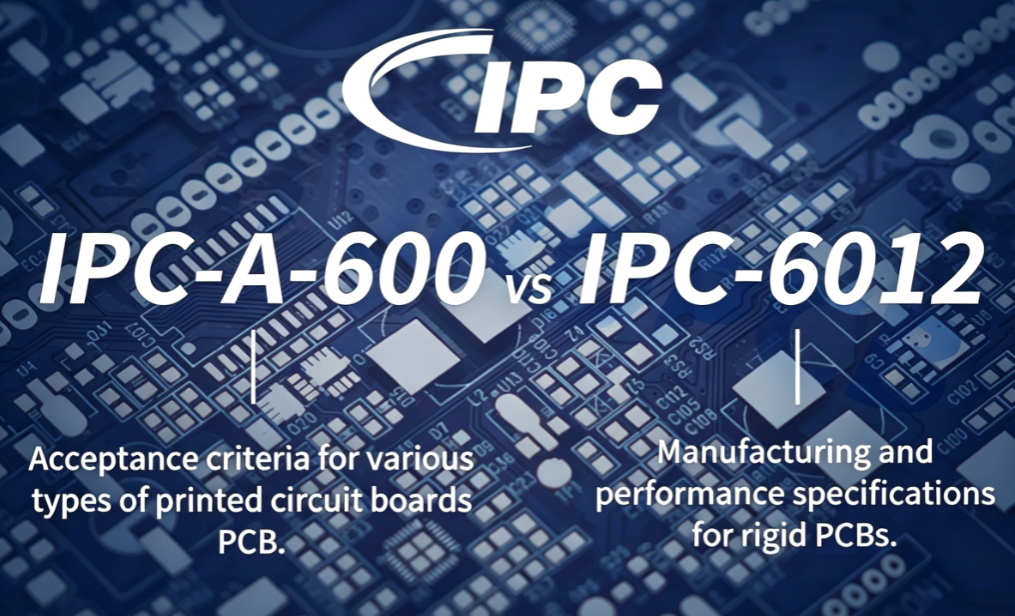
In simple terms, IPC 6012 defines the technical requirements, while IPC-A-600 helps judge the finished board condition. For controlled PCB production, IPC 6012 can be used as the specification basis, and IPC A 600 can be used as the acceptance reference.
What is the Difference between IPC-A-600 and IPC-A-610?
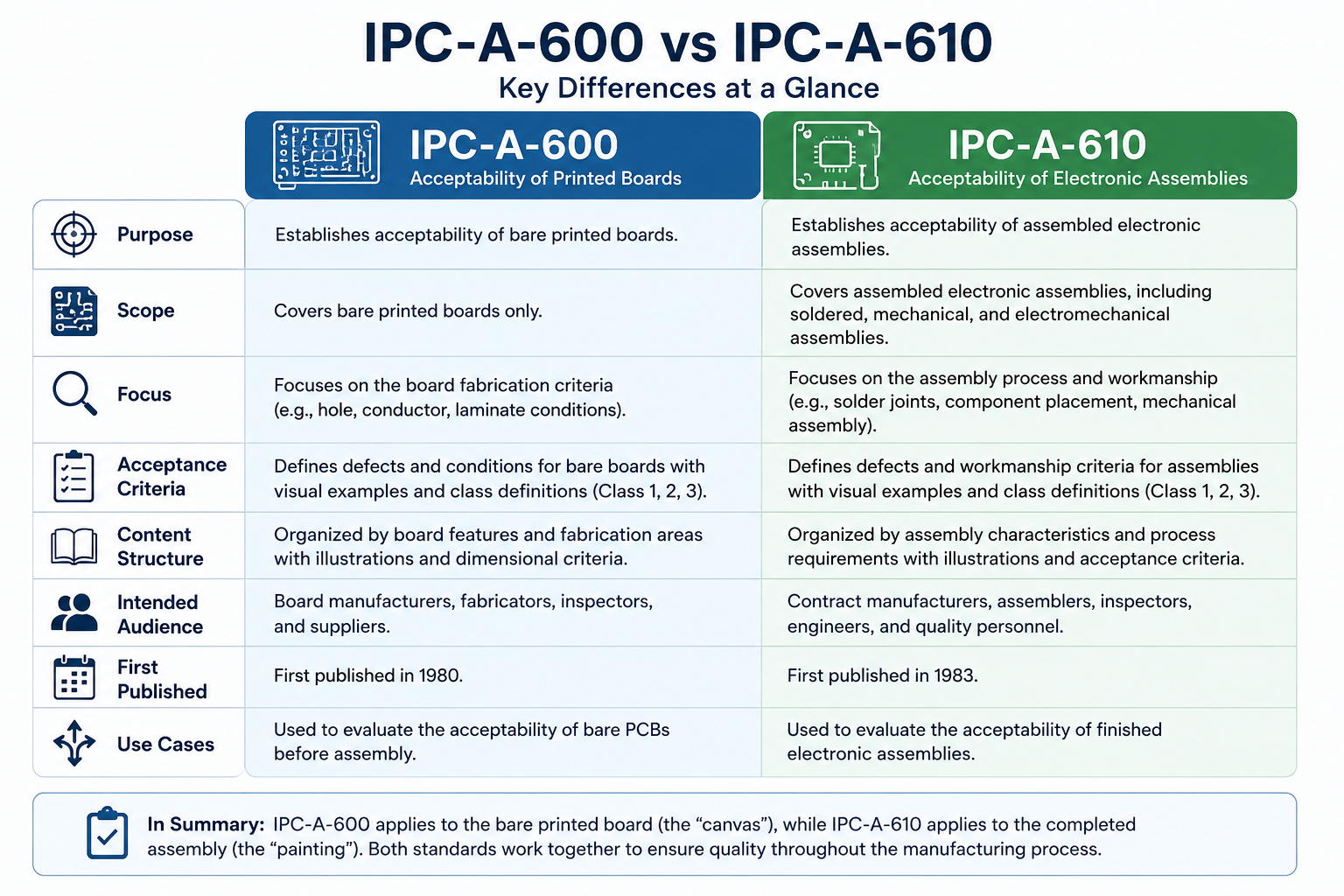
IPC-A-600 and IPC-A-610 are different because they inspect different production stages. IPC-A-600 applies to bare printed boards, while IPC-A-610 applies to assembled electronic boards after components are mounted.
| Comparison Item | IPC-A-600 | IPC-A-610 |
|---|---|---|
| Inspection object | Bare PCB | Assembled PCB |
| Components included | No components mounted | Components already assembled |
| Main focus | PCB fabrication quality | PCBA workmanship quality |
| Typical stage | Before SMT or through-hole assembly | After SMT or through-hole assembly |
| Common checks | Plated holes, annular rings, laminate, solder mask, conductors | Solder joints, component placement, polarity, cleanliness |
| Quality concern | Bare board defects | Assembly defects |
| Used by | PCB fabrication inspection team | PCBA inspection team |
| Helps answer | Is the bare board acceptable? | Is the assembled board acceptable? |
| Related defects | Delamination, plating voids, mask misalignment, conductor damage | Solder bridge, insufficient solder, tombstoning, wrong polarity |
| Best use | PCB manufacturing acceptance | PCB assembly acceptance |
If the issue is related to the bare board itself, IPC-A-600 is the right reference. If the issue is related to soldering, mounted components, placement accuracy, or assembly workmanship, IPC-A-610 should be used.
Where Can I Download the IPC A 600 PDF for Free?
IPC A 600 PDF is a copyrighted standard, so a complete legal copy should be obtained through official IPC channels or authorized standard distributors. Free downloads from unknown websites may be outdated, incomplete, or unauthorized.
Using an unofficial IPC A 600 PDF can create several risks. The file may contain old revision content, missing pages, poor image quality, or incorrect formatting. This may lead to wrong inspection decisions during PCB acceptance.
For professional PCB quality control, the safest choice is to purchase or access the standard through official sources. If training or certification is required, using the correct licensed version is also important.
If a supplier, assembler, or production partner mentions IPC-A-600, the exact revision should be confirmed in writing. This avoids confusion between IPC-A-600K, IPC-A-600M, and other older versions.
FAQs About IPC A 600 Standard
Q1: How do I know which IPC-A-600 class to use for my PCB order?
A1: The class should match the product use, working environment, service life, and reliability level. For most standard electronic products, Class 2 is commonly used. For safety-related or high-reliability products, Class 3 is usually more suitable.
Q2: Should IPC-A-600 be written on the PCB drawing?
A2: Yes, it is better to write the required standard, class, and revision clearly on the PCB drawing or purchase document. This helps the PCB manufacturer follow the same inspection basis from production to final approval.
Q3: Can a PCB pass electrical testing but still fail IPC-A-600 inspection?
A3: Yes. Electrical testing checks circuit continuity and isolation, while IPC-A-600 also reviews physical board conditions such as plating quality, solder mask, annular rings, laminate defects, and visible workmanship.
Q4: Does IPC-A-600 affect PCB price?
A4: It can affect price when stricter class requirements, additional inspection, microsection testing, or tighter production control are required. Class 3 boards usually cost more than Class 2 boards because the acceptance criteria are stricter.
Q5: Is IPC-A-600 useful for prototype PCB orders?
A5: Yes. Even for prototypes, IPC-A-600 can help confirm whether the bare board meets basic acceptance expectations before assembly or functional testing. This is especially useful for complex PCB, HDI PCB, and high-frequency PCB projects.
Q6: What information should be provided before production?
A6: It is helpful to provide Gerber files, stack-up, material requirements, copper thickness, surface finish, board thickness, impedance requirements, quantity, and the required class. Clear information helps reduce production uncertainty.
Q7: Can EBest manufacture PCBs according to IPC-A-600 requirements?
A7: Yes. EBest can support custom PCB manufacturing with controlled inspection requirements. You can send your PCB files and quality requirements for review before quotation.
Get IPC-A-600 Standard PCB Manufacturing from EBest
At EBest, our PCB boards are manufactured and inspected according to IPC-A-600 acceptability requirements. From material selection, hole plating, solder mask, conductor quality, board surface, to final inspection, we follow clear quality control steps to help ensure stable PCB performance and reliable delivery.
If your project requires custom PCB, HDI PCB, RF PCB, Metal Core PCB, Ceramic PCB, or turnkey PCBA service, send your Gerber files, stack-up, quantity, material requirements, and IPC-A-600 class to sales@bestpcbs.com. Our team will review your files and provide a fast quotation with a suitable manufacturing solution.
You may also like

Tags: ipc a 600 acceptability of printed boards, ipc a 600 class 2 vs class 3, ipc a 600 latest revision, ipc a 600 pdf, IPC A 600 vs IPC 6012