





Car LED Ambient Light Aluminum PCB is a thermally enhanced metal-core circuit board designed for automotive interior lighting, helping LED ambient light modules stay cooler, more uniform, and more stable inside the cabin. This article explains how to choose, design, and manufacture the right Car LED Ambient Light Aluminum PCB so auto interior brands can improve lighting consistency, reliability, and product value.
EBest Circuit (Best Technology) is a professional Car LED Ambient Light Aluminum PCB manufacturer with strong experience in thermal-focused PCB design and production for automotive interior lighting applications. We understand that compact ambient light boards must do more than fit into tight spaces. They also need stable heat dissipation, solid vibration resistance, and reliable long-term performance, so production teams can improve product quality and reduce failure risk. For design teams, we support compact structures, efficient heat transfer, and custom board solutions that better match modern automotive interior styling without sacrificing thermal performance.
For supply chain and automotive program sourcing, we offer dependable quality control, scalable production capacity, and responsive delivery support, while for advanced development projects, we continue to optimize high-temperature materials and heat-dissipation structures to improve cabin adaptability and product durability. For project discussion or order support, please call us at +86-755-2909-1601.
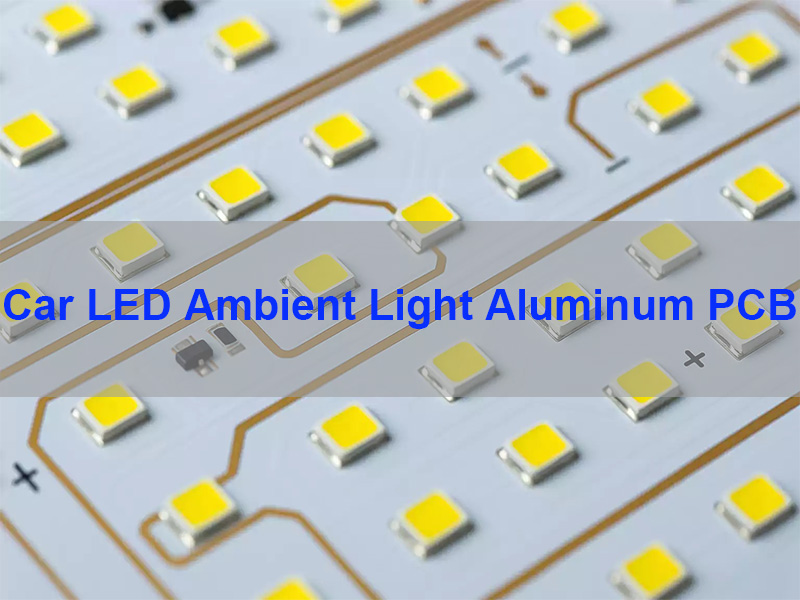
What Is Car LED Ambient Light Aluminum PCB?
A Car LED Ambient Light Aluminum PCB is a metal-core printed circuit board built for automotive cabin lighting, where heat control, board rigidity, and stable LED mounting matter more than in many ordinary consumer applications.
Its basic structure usually includes a copper circuit layer, a thermally conductive insulation layer, and an aluminum base. This structure helps move heat away from the LED area more efficiently than a standard board used only for general signal routing.
Why this structure fits interior lighting
Automotive ambient lighting often runs in slim enclosed spaces. That means the board must support steady lighting output while fitting into trim pieces, door panels, dashboards, and center console assemblies.
What makes it different from a regular PCB
The value of this product is not just that it carries current. It also helps manage heat, supports a cleaner lighting effect, and provides a stronger base for decorative LED modules used in modern vehicle interiors.
In real-world applications, this board type is chosen because it helps turn a lighting concept into a product that looks refined and behaves predictably over time.
Why Is Aluminum Better Than Standard FR4 for Automotive Ambient Light Boards?
For automotive ambient lighting, aluminum is often preferred when thermal stability is an important part of the design target. The reason is simple. LEDs are sensitive to heat, and the board itself becomes part of the thermal solution.
Aluminum PCB and FR4 comparison
| Factor | Aluminum PCB | FR4 PCB |
|---|---|---|
| Heat spreading | Better suited for LED thermal control | More limited in thermal transfer |
| Support for long light bars | More favorable in many thermal layouts | Often needs more help from the housing |
| Structural rigidity | Good for many rigid lighting modules | Common and versatile, but less thermal-focused |
| Use in decorative cabin lighting | Strong fit | Depends more heavily on the total design |
Why thermal performance matters in visual products
When heat is not controlled well, the lighting effect can become less stable over time. Brightness consistency and long-term appearance are closely tied to how well the board supports heat flow.
Overall, aluminum gives automotive ambient light boards a more practical thermal platform and supports a more stable interior lighting product.
Why Is a Better Car LED Ambient Light Aluminum PCB Supplier Worth Choosing Early?
If you are developing automotive interior lighting, supplier choice affects much more than board delivery. It shapes thermal performance, visual consistency, assembly stability, and the ease of moving from prototype to production.
A good Car LED Ambient Light Aluminum PCB supplier does not simply build to print. The supplier should also understand light uniformity, thermal transfer, tight mechanical envelopes, and the practical needs of automotive interior modules.
What customers usually want from this product
Customers often look for slim board structures, dependable heat dissipation, stable LED mounting, and support for long light bars or decorative lighting modules. In many projects, the PCB must also fit narrow trims, curved housings, or customized interior parts.
What EBest Circuit can support
EBest Circuit (Best Technology) provides Car LED Ambient Light Aluminum PCB solutions for custom automotive lighting applications. We support engineering review, custom fabrication, process optimization, and scalable production for auto interior manufacturers.
Typical product parameters
| Item | Typical Option |
|---|---|
| Board type | Aluminum PCB for automotive ambient lighting |
| Base material | Aluminum core |
| Copper thickness | 1 oz to 3 oz |
| Board thickness | 0.8 mm to 2.0 mm |
| Surface finish | ENIG, HASL, OSP |
| LED support | Monochrome, RGB, RGBW, side-emitting LED |
| Typical uses | Door trim light, dashboard strip, footwell light, console light |
Therefore, selecting the right supplier early helps reduce redesign risk and improves the chance of getting a cleaner, more stable lighting result from the first build.
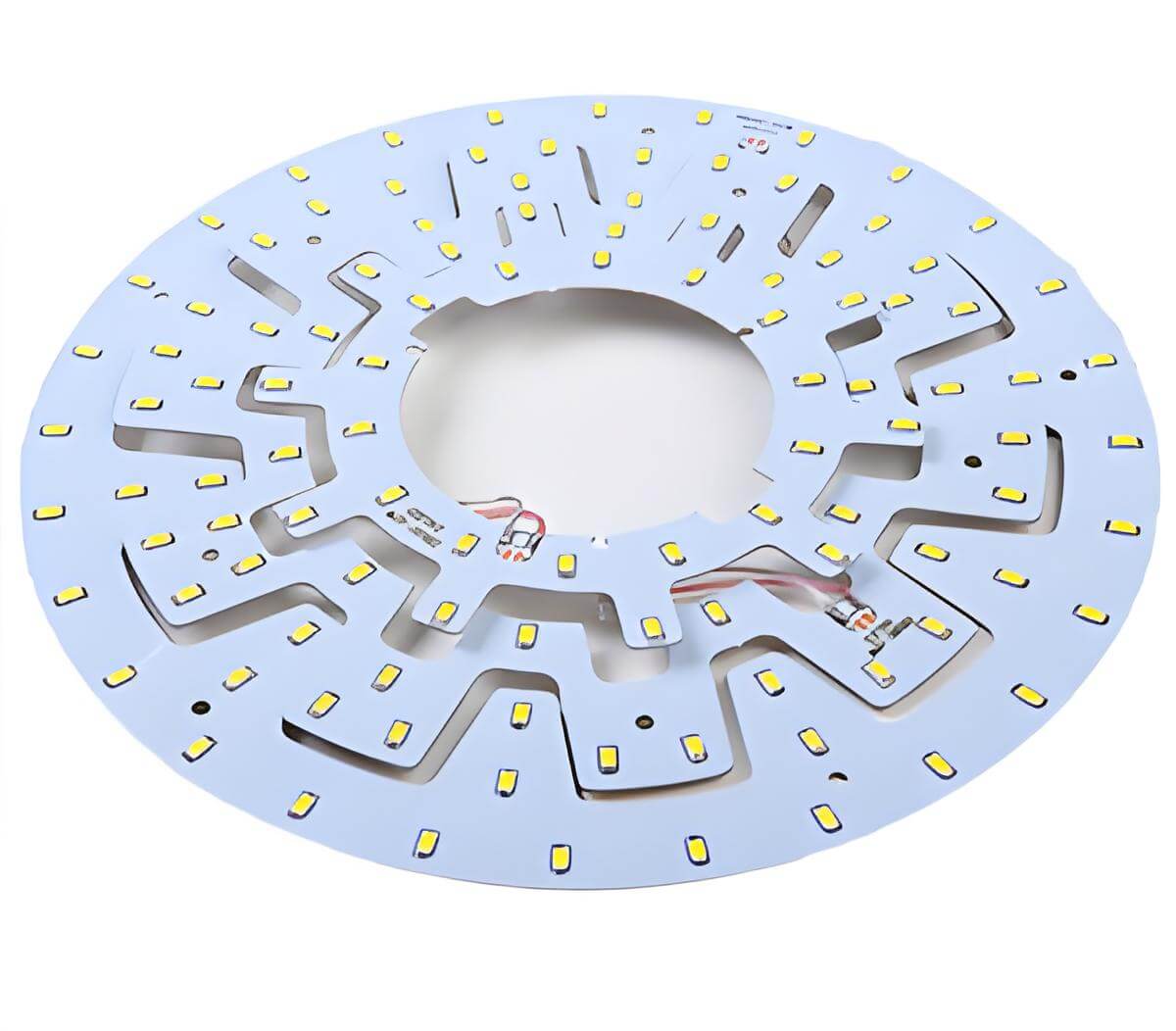
Why Choose Us for Car LED Ambient Light Aluminum PCB?
The main reason is straightforward. Customers need a supplier that can balance quality, lead time, manufacturability, and consistent execution without making the project harder than it needs to be.
Quality that supports visual consistency
For ambient light products, poor board quality often becomes a visible problem. Uneven soldering, poor flatness, unstable surface finish, or weak process control can all affect how the lighting looks after assembly.
We focus on stable fabrication control so the final LED Car Ambient Light Aluminum PCB is easier to assemble and more consistent across batches.
Lead time that supports product development
Automotive lighting programs often move through sample review, design updates, validation, and launch preparation. Fast response during those stages helps customers keep the project moving without unnecessary interruption.
Service that solves technical issues earlier
We support file review, design-for-manufacturing suggestions, and practical process feedback. This helps customers discover thermal, mechanical, or assembly issues before they become production problems.
Supply coordination that improves continuity
Long-running programs need stable execution. Our approach helps reduce variation between lots and supports more consistent delivery for interior lighting applications.
In practice, customers stay with a capable supplier because stable results matter more than a simple board quote in automotive lighting programs.
What Services and Certifications Support Reliable Automotive Ambient Lighting PCB Production?
A reliable ambient light PCB supplier should provide more than fabrication alone. Customers often need coordinated support covering file review, prototype builds, PCBA planning, and documented quality systems.
Our service scope
| Service | What It Helps Achieve |
|---|---|
| Custom aluminum PCB fabrication | Thermal-focused board structure for interior lighting |
| DFM review | Better manufacturability and fewer production surprises |
| Prototype support | Faster validation of new lighting concepts |
| PCBA support | LED mounting and electrical assembly coordination |
| Inspection support | Process verification and defect control |
| Engineering collaboration | Faster resolution of layout and production issues |
Our certifications
| Certificate | Why It Matters |
|---|---|
| ISO 9001 | Supports controlled quality management |
| IATF 16949 | Matches automotive system expectations |
| ISO 13485 | Reflects disciplined process control |
| AS9100D | Demonstrates high-reliability manufacturing capability |
| RoHS | Supports material compliance needs |
| REACH | Helps with material declaration requirements |
| UL | Adds confidence in recognized material systems |
As a result, strong service coverage and recognized certifications give customers more confidence that the supplier can support both technical execution and long-term program control.
What Problems Commonly Delay Car LED Ambient Light Aluminum PCB Projects?
Most project delays do not come from one dramatic issue. They usually come from a series of small but critical mistakes in thermal planning, LED layout, process fit, or mechanical coordination.
Common problems customers face
| Problem | Why It Happens | Our Practical Response |
|---|---|---|
| Uneven light output | LED spacing or optical path is not optimized | Support layout review and build coordination |
| Heat concentration | Thermal path is too weak | Improve aluminum-core structure planning |
| Assembly instability | Pad design or process window is not ideal | Apply DFM review before production |
| Fit problems in narrow trims | Outline or connector position is unsuitable | Support customized profile and structure |
| Batch inconsistency | Process control is not stable | Use controlled fabrication and inspection flow |
Why these issues matter
Ambient lighting is a highly visible product. Small defects that might be tolerated in hidden electronics become obvious in a vehicle cabin, especially at night or in premium interior designs.
From an engineering perspective, solving these issues at the PCB stage improves both visual performance and production repeatability.
How Does Thermal Design Affect Car Ambient Light LED Aluminum PCB Reliability?
Thermal design affects how the lighting behaves across time, not just on day one. If the LED area runs too hot, the result may be faster brightness decline, more color variation, and added stress on solder joints and nearby components.
What reliable thermal design tries to achieve
A good thermal design should move heat away from the LED source efficiently, reduce concentrated hot areas, and maintain stable operating conditions across the light module.
What helps improve thermal behavior
| Design Point | Why It Helps |
|---|---|
| Aluminum base selection | Improves heat transfer path |
| Balanced copper layout | Supports current flow and heat spreading |
| Sensible LED spacing | Reduces local thermal crowding |
| Proper board-to-housing interface | Helps the full module release heat better |
| Early thermal review | Reduces redesign risk later |
Why this matters for interior products
Interior ambient lighting is close to the user’s eye. Any instability in brightness or color can affect the perceived quality of the whole vehicle interior.
In short, better thermal design helps the lighting stay more stable, more consistent, and more suitable for long-term automotive use.
How Can LED Layout Improve Light Uniformity in Ambient Light Car LED Aluminum PCB Designs?
Light uniformity starts at the layout stage. Even with good LEDs and a good diffuser, poor board layout can still create hot spots, dim zones, or visible point sources.
Layout decisions that influence the final visual result
The spacing between LEDs, the direction of light output, the distance to the diffuser, and the way the board fits the optical path all affect how smooth the final lighting looks.
Common layout-related visual issues
| Visual Issue | Likely Cause |
|---|---|
| Hot spots | LEDs are too close or too exposed |
| Dark gaps | LED pitch is too large |
| Uneven brightness | Current or thermal balance is inconsistent |
| Visible point light | Optical blending is not sufficient |
What a better layout review should consider
A useful review should look at the PCB, the diffuser, the housing, and the desired light effect together. Treating the board as a separate electrical item is rarely enough for ambient lighting products.
Notably, good layout improves both appearance and manufacturability, which makes it one of the highest-value design decisions in these projects.
How Do You Reduce Flicker and Improve Electrical Stability in LED Ambient Light Car Aluminum PCB Applications?
Flicker is one of the fastest ways to make an ambient lighting product feel low-grade. Even if the board looks fine physically, unstable dimming behavior can hurt the user experience immediately.
Where flicker problems often begin
The root cause is usually related to driver behavior, dimming strategy, grounding, current path design, or noise control in the total circuit.
Practical methods that help
| Method | Benefit |
|---|---|
| Stable dimming design | Smoother visual output |
| Controlled current paths | Better electrical consistency |
| Cleaner grounding strategy | Lower risk of unstable behavior |
| Sensible component placement | Better overall control of the circuit |
| Early validation testing | Helps catch visual issues before production |
Why this matters more in cabin lighting
Ambient lighting is usually observed in dark or semi-dark conditions. Small fluctuations become easier to notice, especially in decorative light strips and premium interior settings.
This means, electrical stability is not just an engineering target. It is part of the visual quality customers experience directly.
How Is Car LED Ambient Light Aluminum PCB Manufactured Step by Step?
The manufacturing flow should protect both thermal structure and assembly readiness. For automotive interior lighting boards, consistent process control is essential because the final product is expected to look good and perform steadily.
Typical production flow
- Engineering file review
- Material preparation
- Circuit imaging and etching
- Drilling or profile shaping
- Solder mask and surface finish
- Electrical testing
- Inspection and verification
- Assembly support if required
- Final packing and shipment
Where process control matters most
The most sensitive points often include insulation layer consistency, board flatness, circuit precision, profile accuracy, and surface quality before LED mounting.
Why process discipline matters
A board that is only electrically correct is not enough for ambient lighting. It must also be structurally stable, cleanly finished, and ready for consistent LED assembly.
To sum up, controlled manufacturing is what turns a design file into a lighting board that works reliably in real automotive interior products.
What Design Rules Help Aluminum PCB for Car LED Ambient Light Perform Better?
Design quality affects how easily the board can be built and how well it performs after installation. The best results usually come from treating thermal, electrical, optical, and mechanical factors as one connected system.
Useful design priorities
| Design Topic | Why It Matters |
|---|---|
| Copper routing width | Supports current handling and voltage stability |
| LED pitch | Influences uniformity and light blending |
| Board outline | Determines fit inside trim or housing |
| Connector position | Affects assembly convenience |
| Pad structure | Impacts solder quality |
| Thermal path planning | Supports steady LED operation |
A practical design mindset
Good design is not only about making the circuit work. It is also about making the board easier to assemble, easier to integrate, and less likely to create downstream problems.
From a product standpoint, design for manufacturability helps protect both engineering intent and production stability.
What Testing Should Be Used for Aluminum PCB for Automotive LED Ambient Lighting?
Testing should confirm more than continuity. For automotive interior lighting boards, testing needs to support appearance quality, dimensional consistency, and reliable assembly performance.
Typical inspection and verification items
| Test or Check | Why It Matters |
|---|---|
| Electrical test | Confirms continuity and isolation |
| Dimensional inspection | Verifies fit in the housing |
| Surface inspection | Checks cleanliness and finish quality |
| Solderability review | Supports stable LED assembly |
| Light-up validation | Helps confirm functional behavior |
| Thermal verification | Supports stable operation in use |
Why testing should match product reality
A board may pass a simple electrical check and still create problems later if flatness, profile accuracy, or thermal behavior was not reviewed properly.
Consequently, good testing helps ensure the board is not only functional, but also suitable for the visual and structural demands of automotive cabin lighting.
What Applications Use Aluminum PCB for Automotive LED Ambient Lighting Most Often?
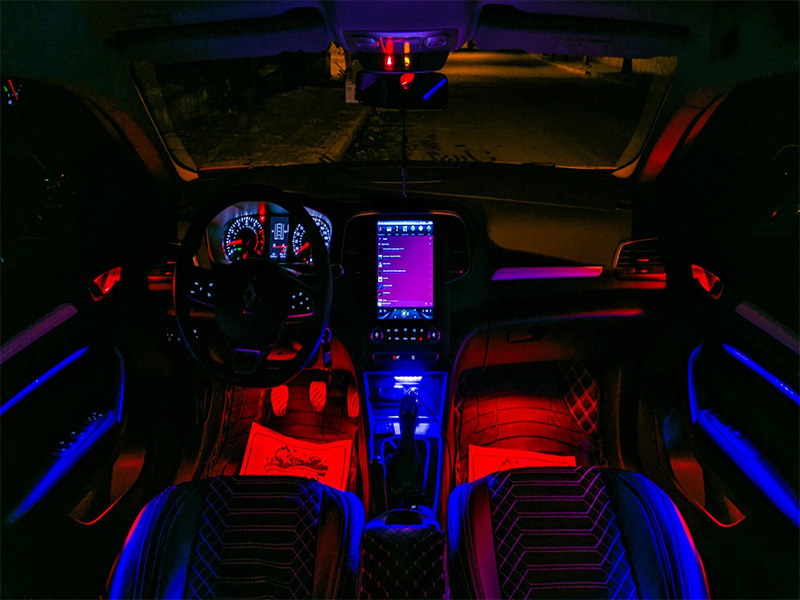
This product is mainly used in automotive interiors where decorative lighting needs to look refined, fit into tight spaces, and remain stable over long operating periods.
Common applications
| Application | Why This PCB Fits Well |
|---|---|
| Door trim light bars | Slim profile and steady light effect |
| Dashboard accent strips | Stable decorative lighting in visible areas |
| Center console lighting | Good fit for narrow structured spaces |
| Footwell lighting | Reliable support for cabin atmosphere lighting |
Four high-demand industry directions
| Segment | Typical Need |
|---|---|
| Passenger vehicles | Stylish and consistent interior light effects |
| Electric vehicles | Smart cockpit lighting and modern cabin design |
| Premium vehicle interiors | Higher expectations for visual refinement |
| Commercial vehicle cabins | Durable decorative lighting for frequent use |
Likewise, this board type is chosen when lighting is expected to be part of the cabin experience, not just a small functional add-on.
How Do Real Project Cases Show the Value of Car LED Ambient Light Aluminum PCB?
Case-based thinking helps make the product easier to understand. In real projects, the board is often selected because it solves a combination of thermal, structural, and visual challenges at the same time.
Case 1 Door trim ambient light strip
A long and narrow door light module needed smoother visual output without concentrated bright points. A thermal-focused aluminum board structure supported a more even result after optical integration.
Case 2 Dashboard decorative light bar
A dashboard assembly required a rigid board that could fit a slim space while keeping the brightness effect stable across the visible line. The aluminum structure helped support that target more effectively.
Case 3 Center console accent lighting
The project required a compact light module placed near premium trim parts. Better board planning supported stable assembly and reduced the risk of visual inconsistency after installation.
Case 4 Footwell RGB ambient module
This type of module often needs good color consistency and repeatable assembly results. A well-controlled board and process flow help reduce variation between builds.
Meanwhile, these cases show that the right PCB does not just support the LED. It supports the final interior experience the customer actually sees.
How Can You Start a Car LED Ambient Light Aluminum PCB Project with EBest Circuit?
The best time to involve the supplier is before the design becomes difficult to change. Early review helps identify issues in board structure, LED layout, profile design, and production readiness.
What you can send us
- Gerber files
- Board thickness requirement
- Copper thickness requirement
- Mechanical drawing or outline file
- LED type or light module description
- Surface finish request
- Application details
What we can help with
EBest Circuit (Best Technology) provides Car LED Ambient Light Aluminum PCB products for automotive interior lighting projects. We support customized fabrication and practical engineering review based on your actual design needs.
If you need Car LED Ambient Light Aluminum PCB products, EBest Circuit (Best Technology) is ready to support your project. Pls feel free to send your requirements or order inquiry to sales@bestpcbs.com.
Ultimately, early technical communication helps shorten revision cycles and makes the final product easier to move toward stable production.
FAQs About Car LED Ambient Light Aluminum PCB
Why use Aluminum PCB for Car LED Ambient Light instead of a regular PCB?
Because ambient lighting modules benefit from stronger thermal support and better structural stability. In many automotive interior designs, aluminum gives the board a more suitable foundation for long-term LED use.
How does Aluminum PCB for Automotive LED Ambient Lighting help light quality?
It helps the lighting system stay more thermally stable, which supports better brightness consistency and a more controlled visual effect over time. It also works well in slim interior lighting modules where heat needs extra attention.
Can Car LED Ambient Light Aluminum PCB support RGB or RGBW lighting designs?
Yes. It can be used for monochrome, RGB, and RGBW interior lighting modules, provided the board structure, layout, and assembly plan are matched to the product design.
What files are usually needed to order Aluminum PCB for Car LED Ambient Light?
Most projects start with Gerber files, board thickness details, copper requirements, profile drawings, LED information, and basic application notes. The more complete the input, the easier it is to review the project accurately.
A well-designed aluminum PCB helps automotive ambient lighting stay cooler, look more uniform, and integrate more smoothly into modern interior products.
Tags: Aluminum PCB for Automotive LED Ambient Lighting, Aluminum PCB for Car LED Ambient Light, Ambient Light Car LED Aluminum PCB, Car Ambient Light LED Aluminum PCB, Car LED Ambient Light Aluminum PCB, LED Car Ambient Light Aluminum PCB