





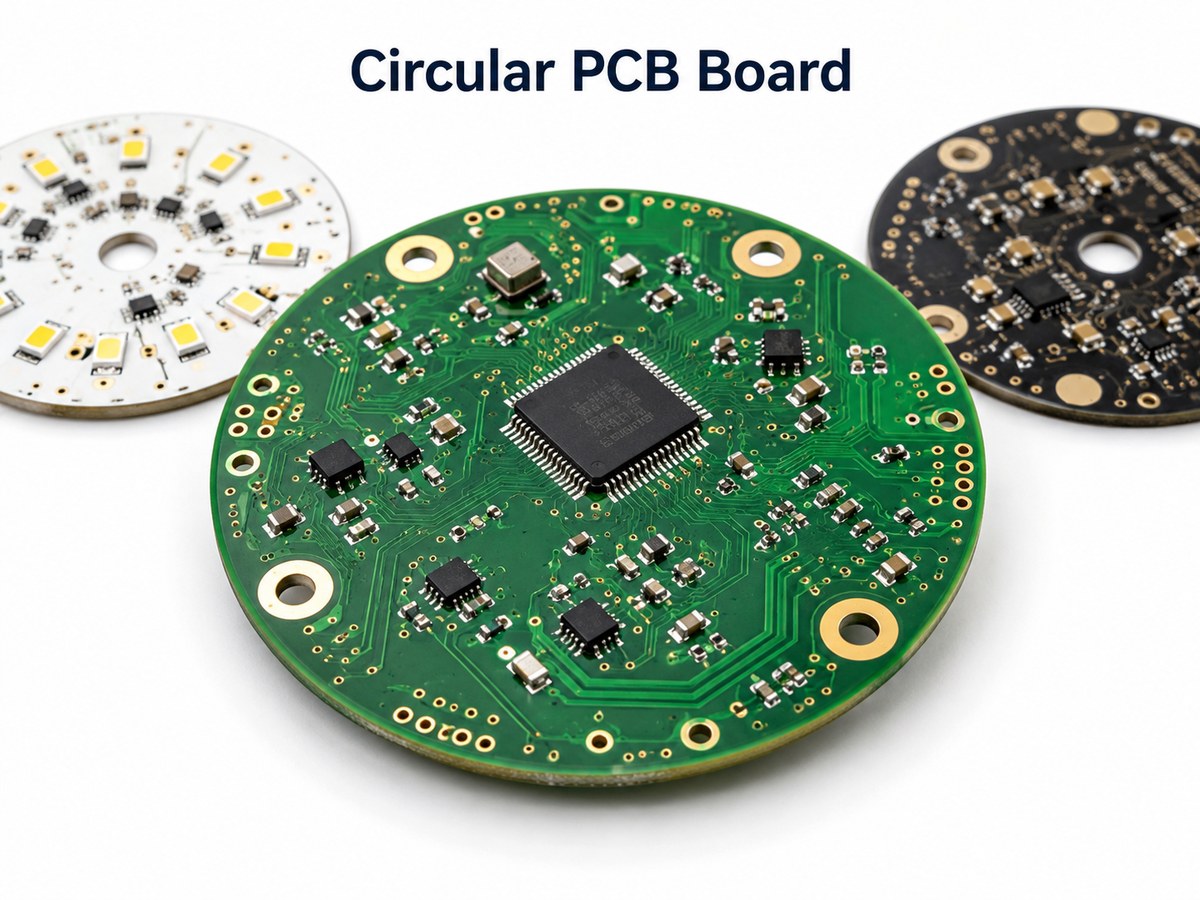
A circular PCB board is usually selected because the electronics must fit a round enclosure, surround a central component, or arrange LEDs and sensors evenly around a fixed point. Electrically, it works like a rectangular PCB. Mechanically, however, it creates different layout, panelization, and assembly constraints.
Before ordering a custom round PCB, engineers need to define more than its diameter. Material, operating voltage, center holes, mounting points, component height, thermal path, and production quantity all affect manufacturability and cost.
What Is a Circular PCB Board?
A circular PCB board is a printed circuit board with a round, ring-shaped, semicircular, or partly curved profile. It may include a solid center, a large inner opening, mounting holes, edge cutouts, or connector notches.
Common constructions include:
- Solid round PCB for sensors or controllers
- Ring PCB with a center opening
- Round PCB LED module
- Flexible circular circuit
- Rigid-flex circular PCB
- Segmented circular assembly made from several boards
Circular circuit boards can be single-sided, double-sided, or multilayer. They can use plated holes, thermal vias, surface-mount components, through-hole parts, or edge connectors.
The main design difference is the usable space near the curved edge. Traces and components must remain inside the outline while maintaining enough clearance for routing, solder mask registration, handling, and depaneling.
When Is a Circular PCB Better Than a Rectangular PCB?
A circular PCB is useful when its shape improves mechanical fit, lighting uniformity, sensor coverage, or product size. It is commonly selected for products with:
- Round or cylindrical enclosures
- Central shafts, cameras, lenses, or speakers
- Radially positioned LEDs
- Rotary switches and encoders
- Circular touch interfaces
- Ring antennas or charging coils
- Symmetrical sensor arrays
For example, a round PCB LED board can place each LED at the same distance from the center. This supports more even illumination than placing the same LEDs on a rectangular board inside a round lamp housing.
A rectangular PCB is still the better choice when the enclosure allows it. It usually provides better panel utilization, easier routing, simpler fixture design, lower depaneling complexity, and more usable corner space. A round outline is therefore a mechanical solution, not an automatic upgrade.
Where Are Circular PCB Boards Commonly Used?
Circular PCB boards are found in products where electrical functions follow a round mechanical or optical structure.
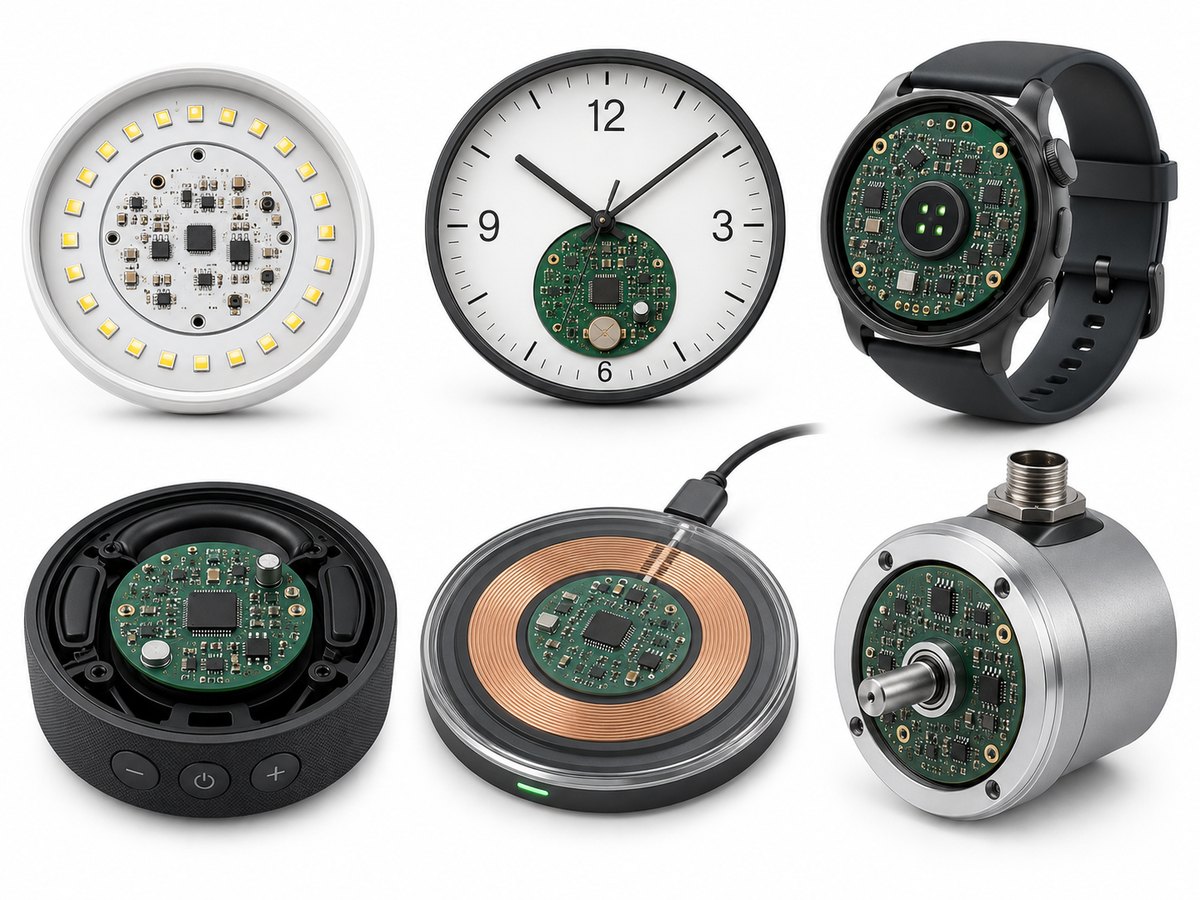
- LED downlights, ring lights, spotlights, and automotive lamps
- Wall clocks and circular display modules
- Wearable sensors and smartwatches
- Speakers, microphones, and audio controls
- Rotary encoders and industrial control knobs
- Wireless charging transmitters and receivers
- Pressure sensors and circular instrument panels
- Medical monitoring devices
- Smart home controls and personal care products
- Motor, fan, and actuator assemblies
The application usually determines the board material. A basic wall clock may only require a two-layer FR4 board. A high-power LED lamp may need an aluminum circular PCB, while a wearable product may require a flexible or rigid-flex design.
What Types and Materials of Circular PCB Boards Are Available?
Material selection depends on heat, electrical complexity, bending, environment, and product life. The round shape does not determine the substrate.
| PCB type | Best suited for | Main consideration |
|---|---|---|
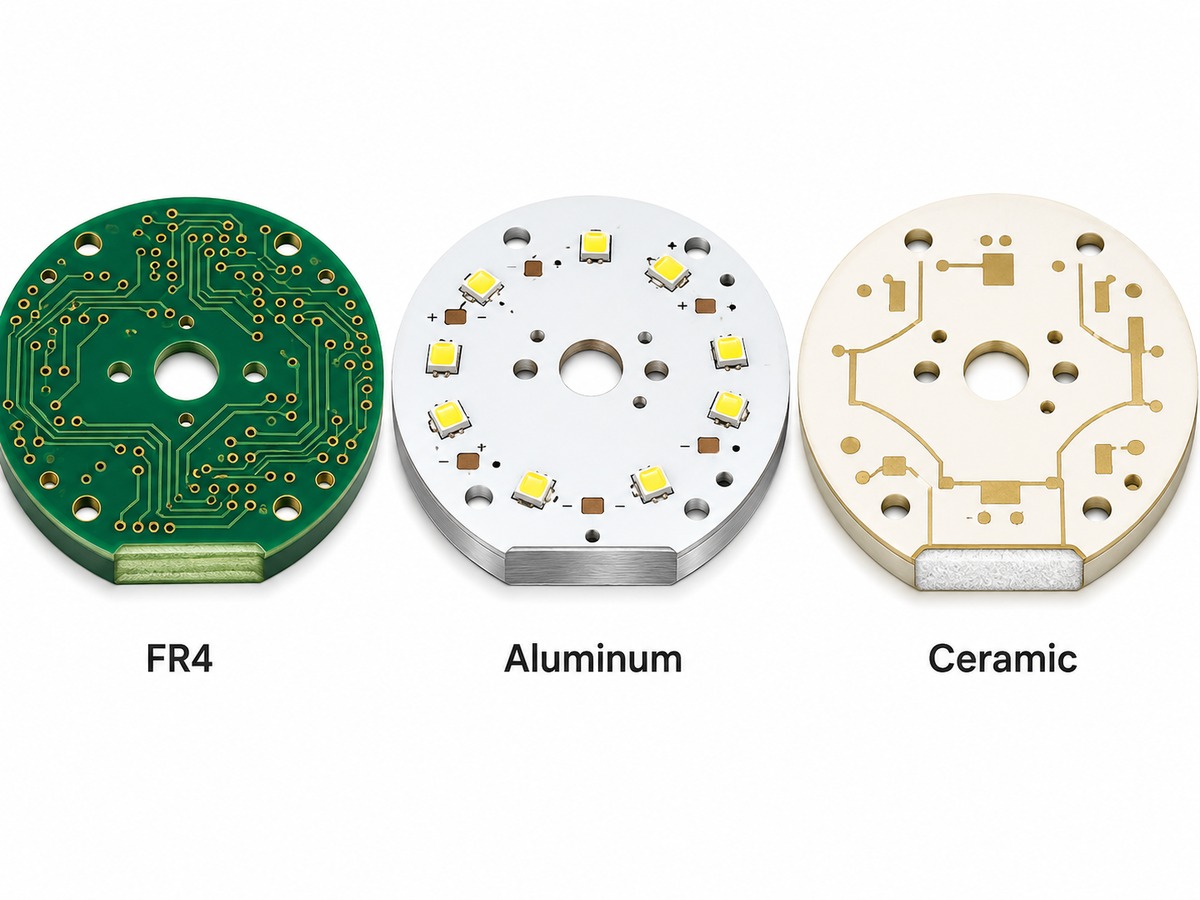
| FR4 circular PCB | Sensors, controls, clocks, communication modules | Economical and suitable for multilayer routing |
| Aluminum circular PCB | LED lighting and power modules | Transfers heat into a metal housing |
| Copper-base circular PCB | High-power LEDs and dense power circuits | Better heat spreading but higher cost |
| Ceramic circular PCB | High-temperature, RF, medical, or aerospace use | Strong thermal and dimensional performance |
| Flexible circular PCB | Wearables and curved assemblies | Requires controlled bending and support |
| Rigid-flex circular PCB | Compact folded electronics | Higher design and manufacturing complexity |
FR4 is the practical choice for most low- and medium-power electronics. Aluminum PCB is widely used for round PCB LED products because it transfers heat into the lamp housing. Ceramic PCB is justified when high thermal conductivity, electrical insulation, or high-temperature stability is critical.
Circular PCBs can use green, black, white, blue, or red solder mask. White is common in lighting products because it reflects more light, while black is often selected for appearance or optical control.
How Do 12V, 24V and 48V Affect Circular PCB Design?
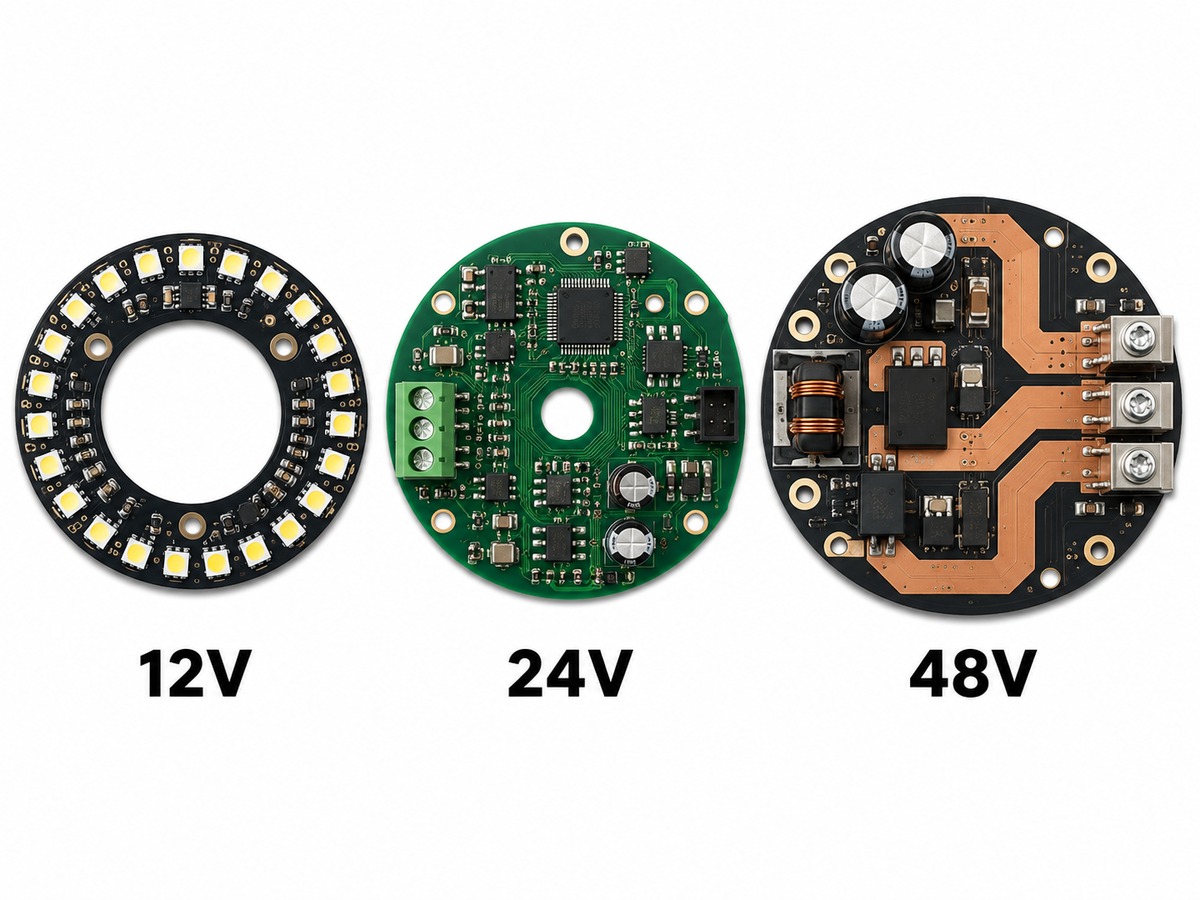
A circular PCB does not have a fixed voltage rating because of its shape. Terms such as circular PCB board 12V or 24V circular PCB describe the circuit’s operating voltage.
The designer must verify:
- Maximum input voltage, not only nominal voltage
- Maximum continuous and peak current
- Trace width and copper thickness
- Component and capacitor voltage ratings
- Connector current and voltage ratings
- Protection against reverse polarity and surges
- Electrical clearance between conductors
- Heat generated by drivers, resistors, and power devices
Current usually has a greater effect on trace width and copper temperature than nominal voltage. A 12V LED board may draw more current than a 24V board delivering the same power, so the 12V version may need wider traces or larger copper pours.
A 48V circular board needs more attention to component voltage margin, transients, humidity, and connector spacing. For LED circuits, the input voltage must also be separated from the forward voltage of an individual LED.
For quotation and DFM review, provide both the nominal voltage and the maximum current.
How Do You Specify Circular PCB Board Size and Mounting Features?
The board outline should be defined by exact dimensions rather than a photograph or an approximate diameter.
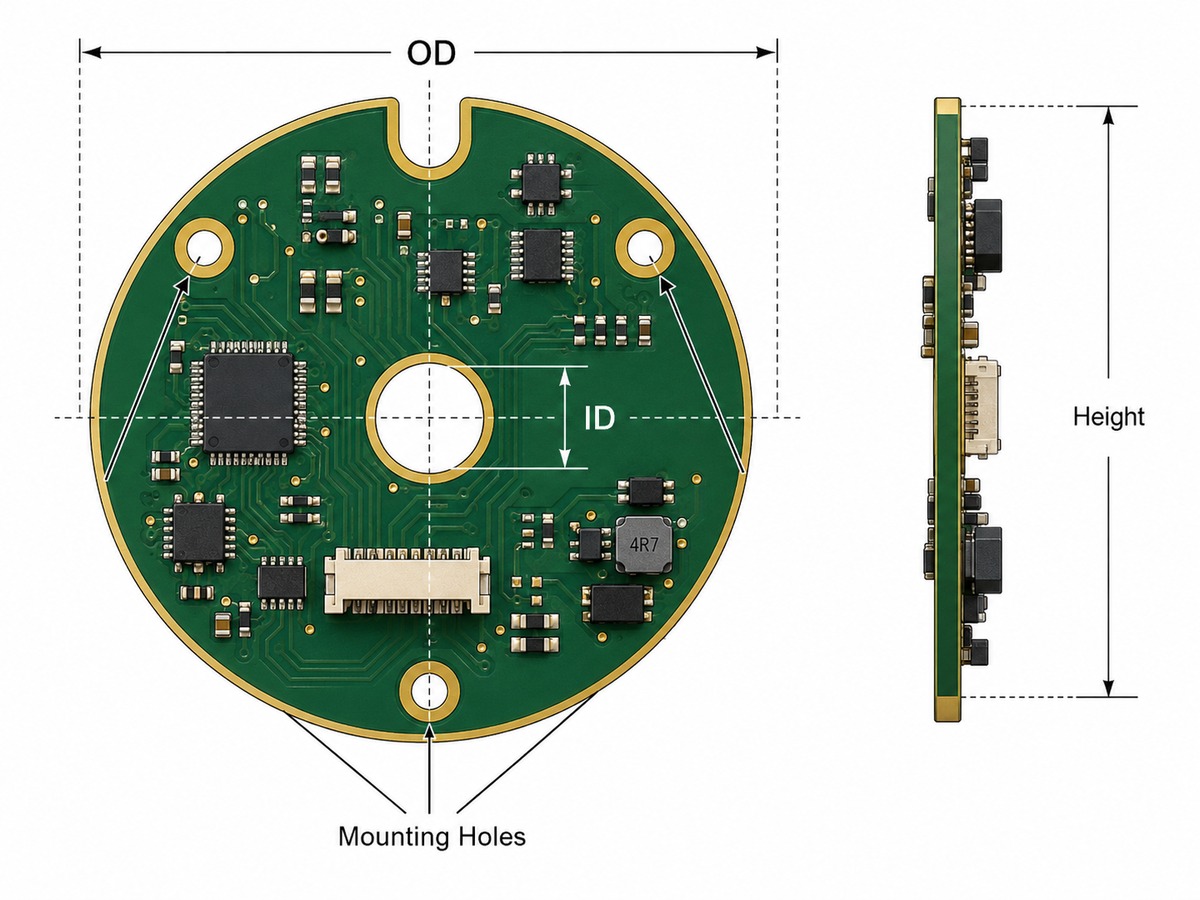
A useful mechanical drawing should include:
- Finished outer diameter
- Inner diameter or center-hole size
- Board thickness
- Mounting-hole diameter
- Hole-center radius and angular position
- Slots, notches, or flat edges
- Connector openings
- Maximum component height
- Critical mechanical tolerances
- Enclosure and heat-sink contact areas
Calling a board “50 mm round” is not enough. The manufacturer still needs to know whether 50 mm is the finished board diameter, enclosure opening, or maximum allowable size.
Mounting holes must also specify plating, grounding, finished-hole tolerance, and the type of hardware. Metal screws can damage solder mask or contact nearby copper, so traces and components must remain clear of the entire screw-head and washer area.
A DXF file is useful for the outline and hole positions. A STEP model is better when connectors, tall parts, heat sinks, lenses, and enclosure walls must be checked together.
For replacement circular PCB boards, matching the diameter alone does not guarantee compatibility. Connector position, polarity, current rating, firmware, and mounting-hole angles must also match.
What Layout and Thermal Rules Matter for Circular PCBs?
The layout should follow the board’s mechanical shape rather than treating it as a rectangular design with the corners removed.
Useful layout rules include:
- Keep parts away from routed edges and panel tabs
- Check component height against curved enclosure walls
- Place repeated LEDs or sensors at consistent angular intervals
- Keep decoupling capacitors close to IC power pins
- Maintain direct return paths for high-speed or sensitive signals
- Reserve space for programming and test contacts
- Avoid narrow high-current traces that follow decorative curves
- Keep brittle ceramic components away from depaneling points
Thermal design must follow the complete heat path from the component junction, through the package and PCB, into the housing or heat sink, and finally into the surrounding air. A large copper pour spreads heat but cannot solve the problem if the heat has nowhere to leave the board.
FR4 boards may use thermal vias, internal copper planes, or a rear heat spreader. Aluminum circular PCBs rely on good contact with the metal housing; uneven mounting pressure or poor thermal interface material can cancel much of the substrate’s advantage.
How Are Circular PCB Boards Panelized and Assembled?
Circular boards are normally fabricated and assembled inside a rectangular production panel. Temporary rails and tabs hold each board during printing, placement, reflow, inspection, and testing.
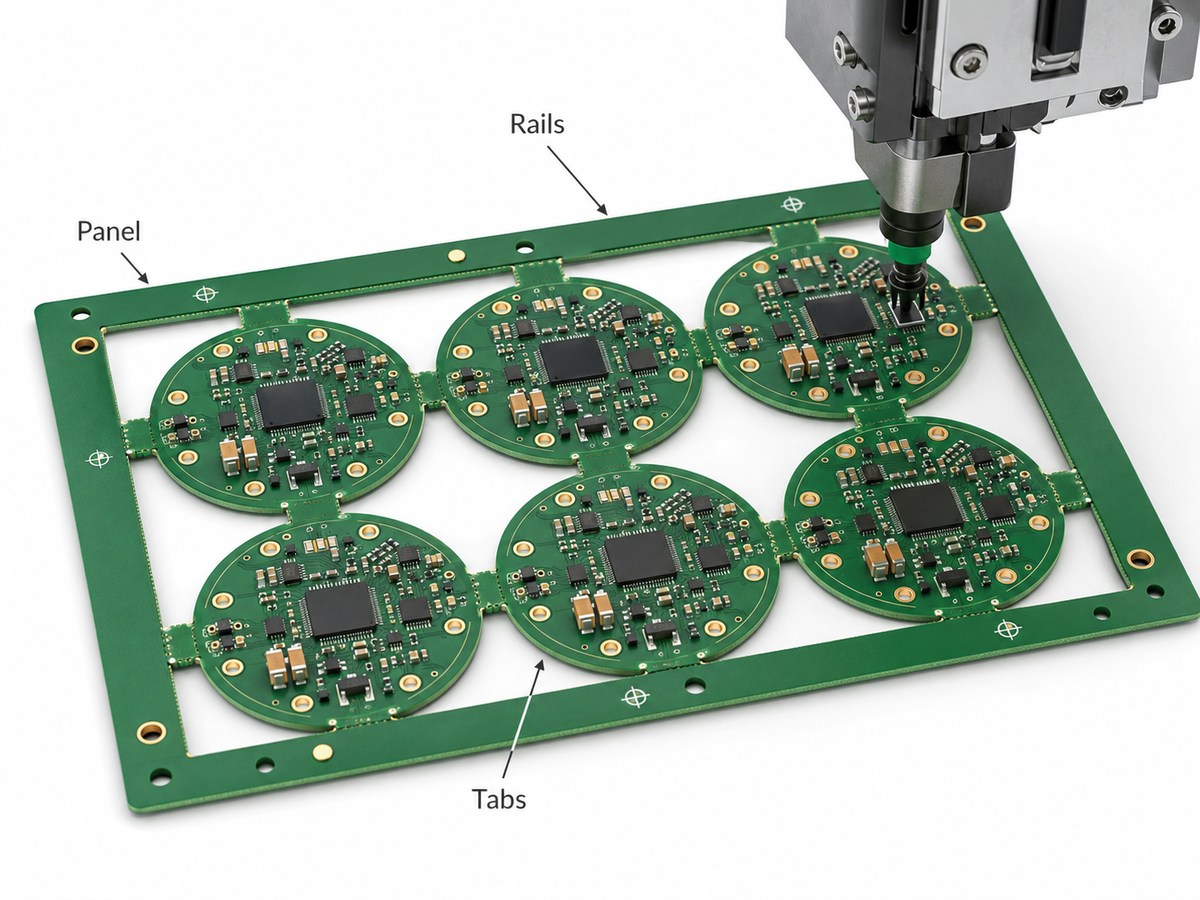
A typical assembly panel may include:
- Breakaway rails
- Routed connection tabs
- Mouse-bite perforations
- Tooling holes
- Global and local fiducials
- Support areas for stencil printing
- Clearance for depaneling tools
The panel must remain rigid during SMT assembly. A thin circle PCB held by only a few narrow tabs may flex during solder paste printing or component placement.
Tab locations also matter. Depaneling stress can crack ceramic capacitors, LEDs, solder joints, connectors, and brittle substrates. Mouse bites are economical but may leave small edge protrusions, while routed tabs create a cleaner edge after trimming.
What Determines Circular PCB Board Price?
The outline affects cost, but it is rarely the only major pricing factor.
| Cost factor | Pricing effect |
|---|---|
| Diameter | Larger boards consume more panel area |
| Inner cutouts and notches | Increase routing time |
| Layer count | Adds material, lamination, drilling, and inspection |
| Substrate | FR4 is usually less costly than metal or ceramic |
| Copper thickness | Heavy copper needs more material and process control |
| Tight dimensions | Require additional measurement and routing control |
| Surface finish | ENIG, OSP, HASL, and immersion silver have different costs |
| Panel efficiency | Poor nesting increases material waste |
| Assembly density | Fine-pitch and bottom-terminated parts add process requirements |
| Testing | Programming, fixtures, and functional testing add cost |
| Quantity | Prototype setup is distributed across fewer pieces |
A circular PCB board under $30 may be available as a generic LED module or prototype board, but this price target is not useful for a custom PCBA. A reliable quotation needs production files, material, quantity, BOM, assembly scope, testing, and packaging requirements.
When comparing suppliers, check what the price includes. One quotation may cover only bare boards, while another includes stencil, components, AOI, electrical testing, and shipping.
How Do You Choose a Circular PCB Board Manufacturer?
A suitable manufacturer must understand the board’s mechanical and assembly constraints, not only how to route a round outline.
Ask the supplier to review:
- Finished diameter and profile tolerance
- Inner holes and curved slots
- Copper-to-edge spacing
- Screw-hole construction
- Material and thermal requirements
- Panel layout and tab positions
- SMT fiducials and tooling holes
- Depaneling method
- Test access
- Component substitutions
- Functional testing requirements
For round PCB LED products, confirm experience with metal-core substrates, LED polarity control, thermal-pad soldering, LED binning, board flatness, heat-sink contact, and optical consistency.
For sensor and control boards, test planning is equally important. Compact circular layouts often leave little room for test pads, so programming and fixture access should be planned before the layout is finalized.
EBest Circuit supports custom circular PCB fabrication and assembly, including prototype review, material selection, panelization, component sourcing, SMT assembly, inspection, and testing. Review our PCB manufacturing capabilities and PCB assembly services when defining the fabrication, sourcing, inspection, and testing scope. Providing a mechanical drawing or STEP model with the PCB files helps the engineering team identify enclosure and assembly conflicts before production.
What Files Are Required for a Custom Circular PCB Quote?
For bare PCB fabrication, provide:
- Gerber or ODB++ files
- NC drill files
- Board outline drawing
- Outer and inner diameters
- Hole and slot dimensions
- Mechanical tolerances
- Layer count and board thickness
- Material type and copper weight
- Surface finish and solder mask color
- Quantity
For PCB assembly, also include:
- Bill of materials
- Pick-and-place file
- Assembly drawing and polarity information
- Approved manufacturer part numbers and substitution rules
- Programming files and test instructions
- Input voltage and current
- Packaging requirements
A STEP model is recommended for boards installed in tight circular housings. It allows the manufacturer to check connector direction, component height, screw clearance, heat-sink contact, and interference with the enclosure wall.
For a replacement board without Gerber files, provide photographs of both sides, measurements, component markings, connector information, wiring details, voltage, current, and the original product model. Reverse engineering may be possible, but visual similarity does not prove electrical compatibility.
FAQs
Q1: Is a circular PCB more expensive than a rectangular PCB?
It can be, mainly because circular boards may use panel material less efficiently and require more routing. Material, layers, tolerance, assembly complexity, and testing often affect the p00rice more than the board shape.
Q2: Can the same circular PCB operate at 12V, 24V, and 48V?
Not without checking the design. Components, connectors, spacing, protection circuits, capacitors, and copper paths must be rated for the intended voltage and current.
Q3: What material is best for a round PCB LED module?
FR4 suits low-power lighting. Aluminum PCB is more practical when the LEDs produce enough heat to require direct transfer into a metal housing. Copper-base or ceramic boards are used for higher thermal loads or specialized environments.
Q4: How small or large can a circular PCB board be?
The practical range depends on routing equipment, panel size, board thickness, fixtures, and assembly handling. Very small boards may require array processing, while large boards may face flatness and panel-size limits.
Q5: Can I order a replacement circular PCB without Gerber files?
Possibly, but the supplier needs enough electrical and mechanical information to reproduce it. Firmware-protected or undocumented boards may not be practical to copy.
Q6: Can circular PCBs use black, white, blue, or red solder mask?
Yes. White is common for lighting, black is often used for appearance or optical control, and green remains practical for general manufacturing and inspection.
Q7: How are screw holes positioned on a circular PCB?
They are normally defined by hole diameter, distance from the board center, and angular position from a reference axis. Plating, grounding, tolerance, and hardware clearance must also be specified.
Q8: Can circular PCB boards be assembled with standard SMT equipment?
Yes. They are normally placed in a rectangular panel with suitable rails, tooling holes, fiducials, and support tabs. Loose individual boards may require a custom carrier.
A circular PCB board is most useful when the electronics must fit a round housing, surround a central feature, or support evenly distributed LEDs and sensors. The best purchasing decision comes from defining the mechanical outline, material, voltage, current, thermal path, panelization, and testing requirements before requesting a quote.
For a custom circular PCB board or assembled PCBA quotation, send your production files, mechanical drawing, BOM, quantity, and operating requirements to EBest Circuit at sales@bestpcbs.com.
You may also like


Tags: circle PCB board, circular circuit boards, circular pcb board, custom PCB manufacturing, round PCB LED