





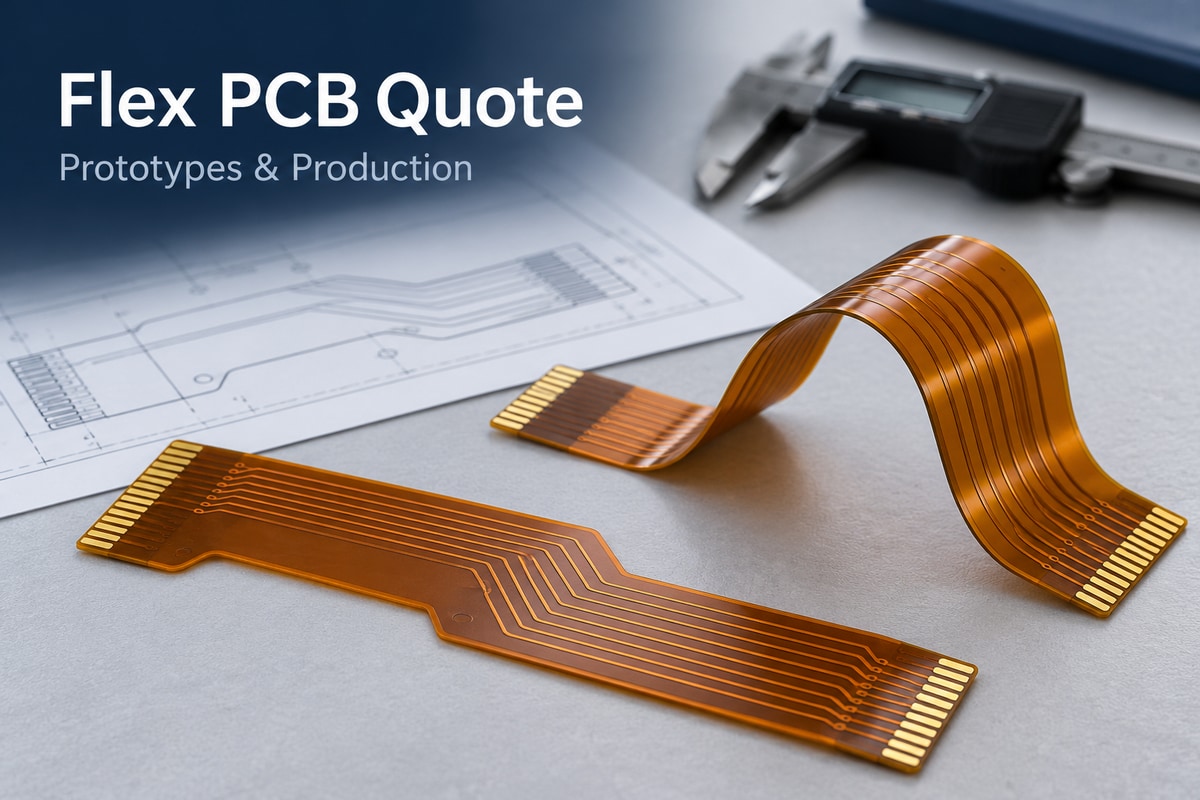
A flex PCB quote defines the price of a particular flexible circuit, at a stated quantity, against an agreed design and manufacturing scope. Board dimensions alone cannot establish that price. Copper construction, coverlay openings, stiffeners, panel layout and testing can make two circuits with the same outline cost different amounts.
At EBest Circuit (Best Technology), we support flexible PCB project review, fabrication and optional assembly for prototype and production requirements. Our engineering review connects the electrical design with bend areas, stackup and manufacturing details before those assumptions become an order. For a quotation based on your design, contact sales@bestpcbs.com with your current files and target quantities.
What Does a Flex PCB Quote Include?
A flex PCB quote should identify the finished circuit, delivered quantity and included charges. Bare-board pricing covers fabricated circuits without mounted components; component sourcing and assembly are separate unless expressly included.
The quotation should make these items easy to find.
- Unit pricing — Price per circuit at each quantity.
- Setup and tooling — Applicable engineering, tooling and fixture charges.
- Inspection and testing — Included checks and any separately priced reports.
- Delivery terms — Lead-time starting point, freight and tax treatment.
- Quotation basis — Drawing revision, currency, validity and open assumptions.
Tooling and non-recurring engineering (NRE) may be charged separately or included in the unit price. That distinction affects the comparison between an initial order and a repeat build.
Compare the total order value, not just the unit price. Freight, taxes or special testing may sit outside the headline figure. Production completion, dispatch and arrival are also different milestones. A lower quote that omits a required stiffener or changes the copper construction does not represent the same circuit.
What Drives Flex PCB Cost Beyond Board Size?
Flex PCB cost depends on the material consumed and the work required to turn it into acceptable circuits. The external length and width describe only part of that work.
Panel utilization and circuit shape
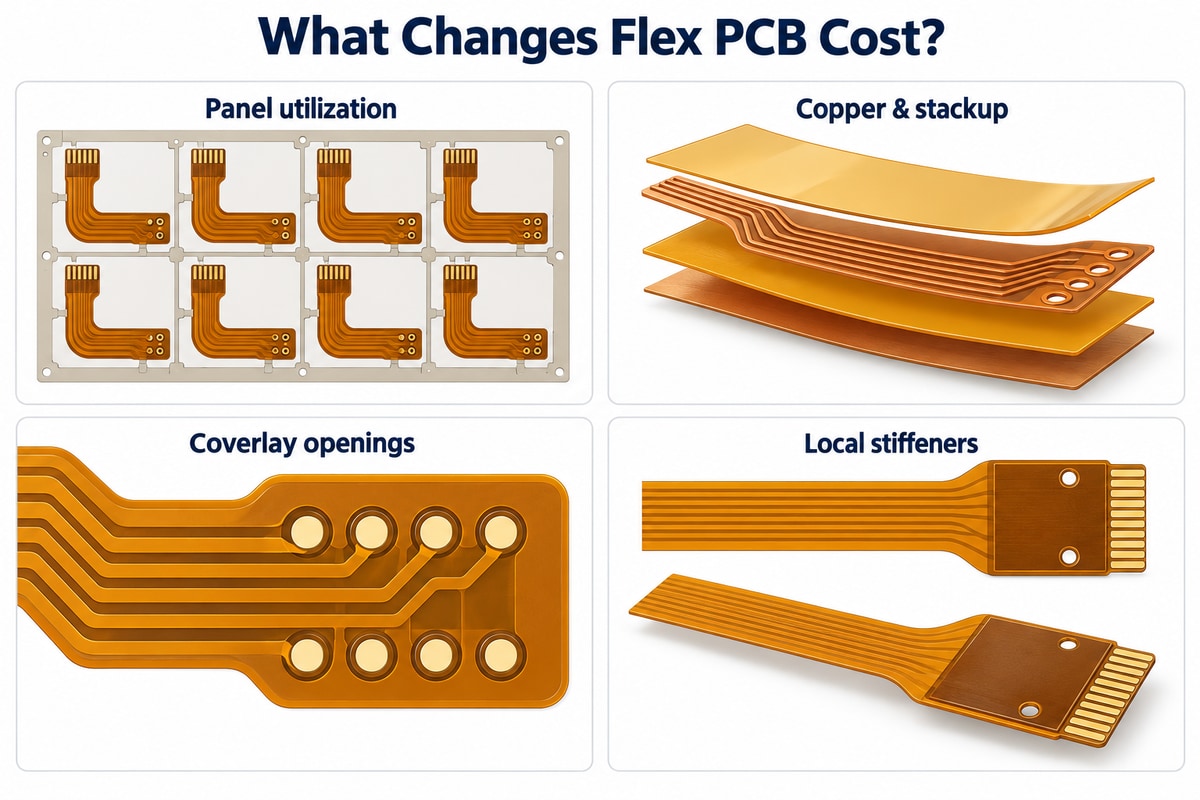
Fabrication uses manufacturing panels. An irregular outline, long narrow tail or spacing requirement can reduce the number of circuits that fit on a panel. Routing clearances, tooling features and test coupons also consume space. Two designs with equal circuit area can therefore use different amounts of production material per delivered piece.
Copper construction and bend requirements
Copper foil type, thickness and the dielectric construction influence both electrical performance and mechanical flexibility. Rolled-annealed (RA) and electrodeposited (ED) copper are not interchangeable solely because their nominal thickness matches. Repeated motion requires assessment of the complete construction and bend geometry; a copper label alone does not establish cycle life.
Thicker copper also changes etching and coverlay encapsulation requirements. Specifying starting foil thickness without defining the required finished copper can leave a material difference between quotations, particularly where plating contributes to the final conductor thickness.
Coverlay and local reinforcement
Coverlay consists of a protective film and adhesive with openings for exposed features. Opening size, spacing and registration affect how it can be processed. Fine-pitch pads may require a different opening arrangement from widely spaced contacts.
Stiffeners add material, adhesive and bonding operations in selected regions. Their location and finished thickness matter as much as their material. A connector tail with a controlled insertion thickness is a different requirement from a reinforced mounting area. Adding a local FR-4 stiffener to a flex circuit does not, by itself, make it a rigid-flex PCB.
Electrical requirements and verification
Controlled impedance involves the conductor geometry and its dielectric and reference-plane arrangement. Verification may also require coupons and measurement. Continuity and isolation testing address a different question from repeated-bend qualification; one cannot substitute for the other. Special validation or reporting therefore needs its own defined scope.
At EBest Circuit, our DFM review can address these construction details alongside the bend requirement. This helps establish what is actually being priced before a material or geometry change is treated as a cost reduction.
Prototype vs Production: How Does Quantity Change the Quote?
Increasing quantity can reduce the effective cost per circuit by spreading setup and tooling across more pieces. The discount is not fixed, and total purchase value can still increase.
Effective cost per circuit = U + F ÷ Q
Here, U is the recurring price per circuit, F is separately charged fixed costs, and Q is the delivered quantity. Freight and taxes are excluded. If setup is already included in U, do not add it again.
With an unchanged fixed charge, increasing quantity from 100 to 1,000 circuits reduces the fixed-cost contribution per circuit to one-tenth. It does not reduce the entire unit cost to one-tenth; materials, processing and testing remain.
- Prototype builds limit inventory exposure while connector, stackup or bend-zone details are still changing.
- Production batches may justify different tooling or more efficient panel layouts once the design is stable.
- Scheduled releases may price differently from one committed manufacturing batch, even at the same annual volume.
Compare quantity options using the same revision, construction, delivery format and acceptance requirements. Buying extra circuits before a design revision can turn a lower unit price into unusable inventory.
Flex PCB Online Quote: When Is the Price Confirmed?
A flex PCB online quote is ready for purchasing when its technical basis and commercial terms are agreed. Dimensions and quantity can support an initial estimate, but manufacturing files may reveal requirements that change the price.
Online submission can include engineering review. The distinction is between a provisional estimate and an offer based on agreed requirements.
| Quote condition | Budget estimate | Confirmed quotation |
|---|---|---|
| Design basis | Preliminary inputs and assumptions | Agreed files and revision |
| Materials and thickness | Provisional material and stackup choices | Defined materials, stackup and tolerances |
| Cost coverage | Some charges remain estimated | Included charges and exclusions stated |
| Purchasing use | Budget and feasibility planning | Ordering within stated validity and terms |
| Design changes | Price refined as details develop | Scope changes trigger price review |
For example, a general connector reinforcement may later become a specified stiffener, adhesive and finished insertion thickness. That added definition can change the build cost.
Price confirmation does not automatically release production. Final manufacturing approval may still be pending, and the quotation’s lead-time conditions determine when the schedule begins.
Which Design Details Are Needed for a Firm Flex PCB Quote?
A firm flex PCB quote needs consistent electrical data, mechanical specifications and delivery requirements. Gerber or ODB++ data and drill files describe the circuitry; fabrication drawings and stackup notes define construction details that artwork alone may not show.
The table uses illustrative inputs—not EBest capability limits, minimum quantities or a validated production stackup. Open specifications must be resolved before firm pricing.
| Parameter | Example input | Details to confirm |
|---|---|---|
| Product type | Two-layer bare flex PCB | Plated interconnections and fabrication scope |
| Finished outline | 80 × 20 mm | Drawing revision, cutouts and dimensional tolerances |
| Order quantities | 100 / 1,000 / 10,000 individual circuits | Same revision and acceptance requirements |
| Base construction | Polyimide; 18 µm starting copper foil | Foil type, dielectric construction, finished copper |
| Coverlay | Both sides; openings per artwork | Film thickness, adhesive thickness, opening requirements |
| Local reinforcement | Polyimide stiffener at connector tail | Bonding side, outline, adhesive, finished thickness tolerance |
| Mechanical use | Installation bend; no continuous movement | Bend location, radius and handling conditions |
| Surface finish | ENIG on exposed solderable features | Finish specification and mating-contact requirements |
| Verification | Continuity and isolation testing | Acceptance criteria; additional impedance or reliability tests |
| Delivery | Finished circuits to specified destination | Individual/panel format, required date and freight terms |
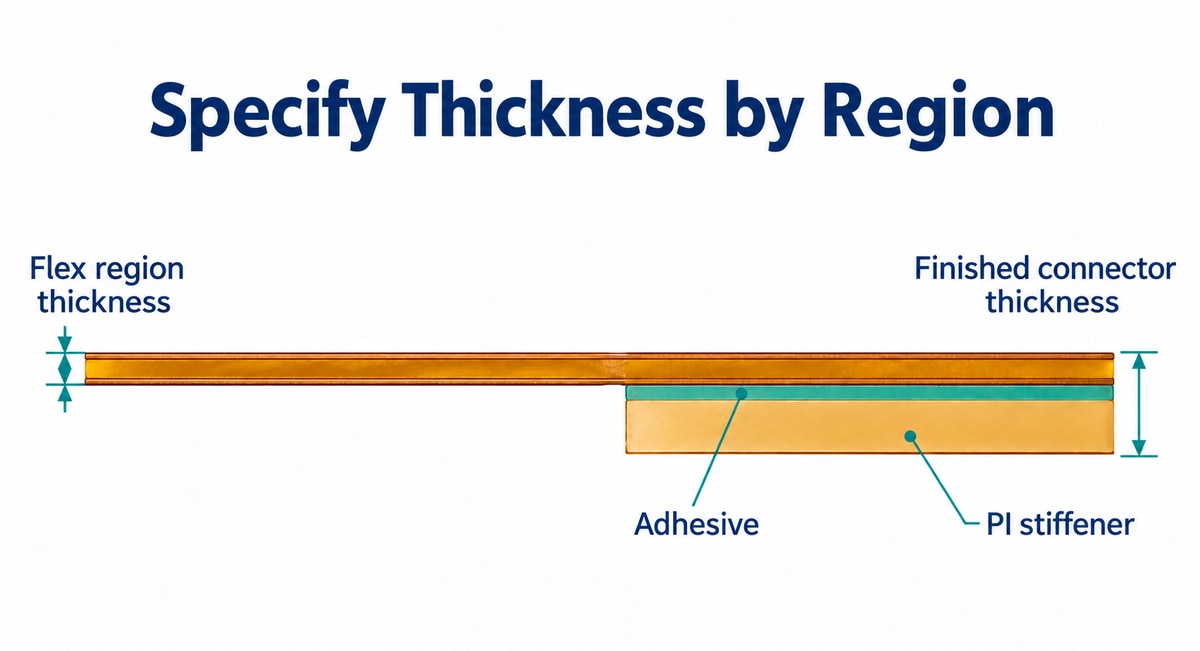
Thickness needs a location. The flexible region and reinforced connector region have different cross-sections. “0.20 mm thick” is ambiguous without the location, included layers and tolerance. The connector manufacturer’s mating requirements should determine the insertion-zone target.
Copper thickness needs a manufacturing reference. Starting foil and finished conductor thickness are not automatically equal, particularly where plating adds copper. Naming both where relevant prevents different manufacturing assumptions from appearing equivalent.
For repeated movement, the bend specification also needs travel, cycle requirements and operating conditions. An installation-bend example does not establish dynamic-flex suitability. BOM and component-placement data are needed when assembly is included; they are not core inputs for a bare-board quote.
Get a Custom Flex PCB Quote from EBest Circuit
We can review single-sided, double-sided and multilayer flexible circuit projects for prototype and production requirements. The final manufacturing scope is established from your design.
Our support connects the quotation to the details that affect the finished circuit.
- Material and stackup review addresses the proposed construction and application requirements.
- Bend and stiffener review considers movement, local reinforcement and connector fit.
- DFM review identifies manufacturing questions before build release.
- Prototype and production planning aligns the build scope with your quantity requirements.
We also support flexible PCB assembly for populated circuits. Flex handling, component placement and local support can then be reviewed alongside fabrication requirements.
If your electrical artwork is ready but connector thickness or coverlay details are still developing, those items can be discussed during quotation. Send the current revision, quantity options and bare-board or assembly scope so we can review the package and prepare a project-specific offer.
FAQs About Flex PCB Quotes
Can I request an estimate before the flex PCB design is finished?
Yes. A preliminary outline, proposed construction and quantity can support a budget discussion. The estimate should identify what remains provisional; an unresolved connector area or bend requirement may still affect the final price.
Do repeat orders always avoid tooling charges?
No. Reuse depends on the design revision, tool condition and the supplier’s retention arrangements. A repeat part number alone does not establish that every setup or fixture charge will disappear.
Can material alternatives be quoted separately?
Yes. A baseline option and a clearly identified alternative make the price difference easier to evaluate. The alternative still needs to satisfy the electrical, mechanical and environmental requirements; matching nominal thickness is not sufficient evidence of equivalence.
Should a flex PCB quote be based on individual circuits or panels?
Either format can be used, but the delivery unit must be explicit. A panel price needs the number of circuits per panel and the agreed treatment of defective positions. Otherwise, it cannot be compared directly with a price per accepted individual circuit.
Will a revised drawing require a new quotation?
A change to material, outline, copper, coverlay, stiffeners or testing can affect price or schedule. An administrative correction may not. Referencing the revised file and describing the change allows the quotation to be reviewed without ambiguity.
Can confidential design files be reviewed under an NDA?
Discuss the confidentiality arrangement with us before sending restricted files. Where an NDA is required, the parties should agree its scope and sign it before the covered information is exchanged.
For a flex PCB quote that reflects your prototype build or production plan, email sales@bestpcbs.com. Tell us the application and the quantities you are considering so we can review the construction and quotation scope together.
You may also like






Tags: Flex PCB Cost, Flex PCB quote