What Is an HS Code for Electronic Products?
An HS code for electronic products is a customs classification number used to identify goods in international trade. For electronics, the correct HS code depends on the product’s main function, structure, component level, and shipment condition.
There is no single universal HS code electronic category for all electronic goods. A bare printed circuit board, an assembled PCBA, an integrated circuit, an electronic controller, an electronic scale, and electronic waste may all fall under different headings.
Most electronic goods are found in Chapter 85, which covers electrical machinery, electrical equipment, and related parts. However, not every product with electronic parts belongs in Chapter 85. Some goods are classified by another main function, such as weighing, measuring, communication, computing, or medical use.
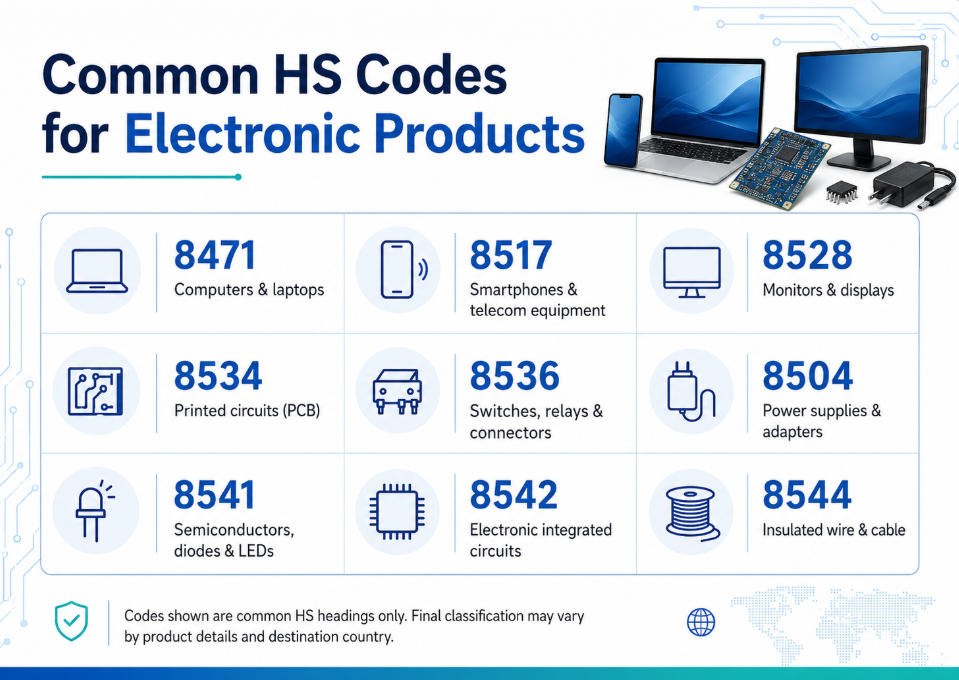
“`
Why “Electronic Products” Does Not Have One Fixed HS Code
“Electronic products” is a commercial phrase, not a precise customs classification. Customs authorities do not classify a product only because it contains a circuit board, battery, chip, or sensor. They classify it by what the product is, what it does, and how it is presented at import or export.
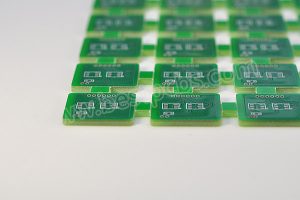
For example, a bare PCB is different from an assembled PCB. A bare printed circuit board may fall under HS code 8534. But once ICs, resistors, capacitors, connectors, relays, sensors, or power devices are mounted, the product may become a functional PCBA. That PCBA may need to be classified according to its final function.
| Product | Likely Classification Logic |
|---|---|
| Bare FR4 PCB | Printed circuit |
| Ceramic bare PCB | Printed circuit, if it meets the definition |
| Motor control PCBA | Electric control apparatus or equipment part |
| IC chip | Electronic integrated circuit |
| LED component | Semiconductor device or LED category |
| Scrapped PCB | Electronic waste and scrap |
| Electronic bathroom scale | Weighing machinery |
The simple rule is: classify by principal function and shipment condition, not by the broad word “electronic.”
Common HS Codes for Electronic Products
The table below gives common HS heading references for electronics-related products. The first six digits are usually the international HS level. Extra digits vary by country, such as U.S. HTS codes, EU CN/TARIC codes, UK commodity codes, or China customs codes.
| Product Type | Common HS Heading | Typical Product Examples | Key Note |
|---|---|---|---|
| Bare PCB / printed circuit board | 8534 | FR4 PCB, ceramic PCB, rigid-flex bare PCB | Applies to printed circuits without mounted active or discrete components |
| Electrical control board / control panel | 8537 | Control cabinets, equipped control panels | Used for electric control or distribution |
| Parts for control apparatus | 8538 | Parts for 8535, 8536, or 8537 goods | Used when the part is principally for those apparatus |
| Semiconductor devices | 8541 | Diodes, transistors, LEDs, photovoltaic cells | Usually component-level classification |
| Electronic integrated circuits | 8542 | Processors, controllers, memories, amplifiers | Used for ICs, not complete electronic products |
| Other electrical machines with individual functions | 8543 | E-cigarettes, signal generators, special electrical apparatus | Used when not specified elsewhere in Chapter 85 |
| Electronic waste and scrap | 8549 | Waste PCB assemblies, e-waste, scrap electronics | Used for electrical and electronic waste or scrap |
| Electronic scale | 8423 | Bathroom scales, kitchen scales, platform scales | Classified by weighing function |
| Power supply / converter | 8504 | Adapters, transformers, static converters | Classified by power conversion function |
| Communication device | 8517 | Network equipment, communication modules, smartphones | Used when the main function is communication |
This table is a practical reference, not a final customs ruling. Always check the destination country’s complete tariff schedule before shipment.
Printed Circuit Board HS Code
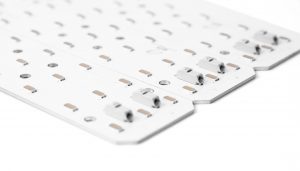
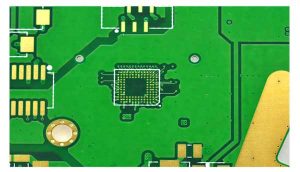
The common HS code for a bare printed circuit board is 8534.00, which covers printed circuits. For PCB suppliers and buyers, this heading is often relevant to FR4 bare PCB, ceramic bare PCB, aluminum PCB without components, copper base PCB without components, HDI bare PCB, rigid-flex bare PCB, high-frequency bare PCB, and heavy copper bare PCB.
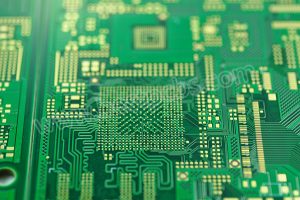
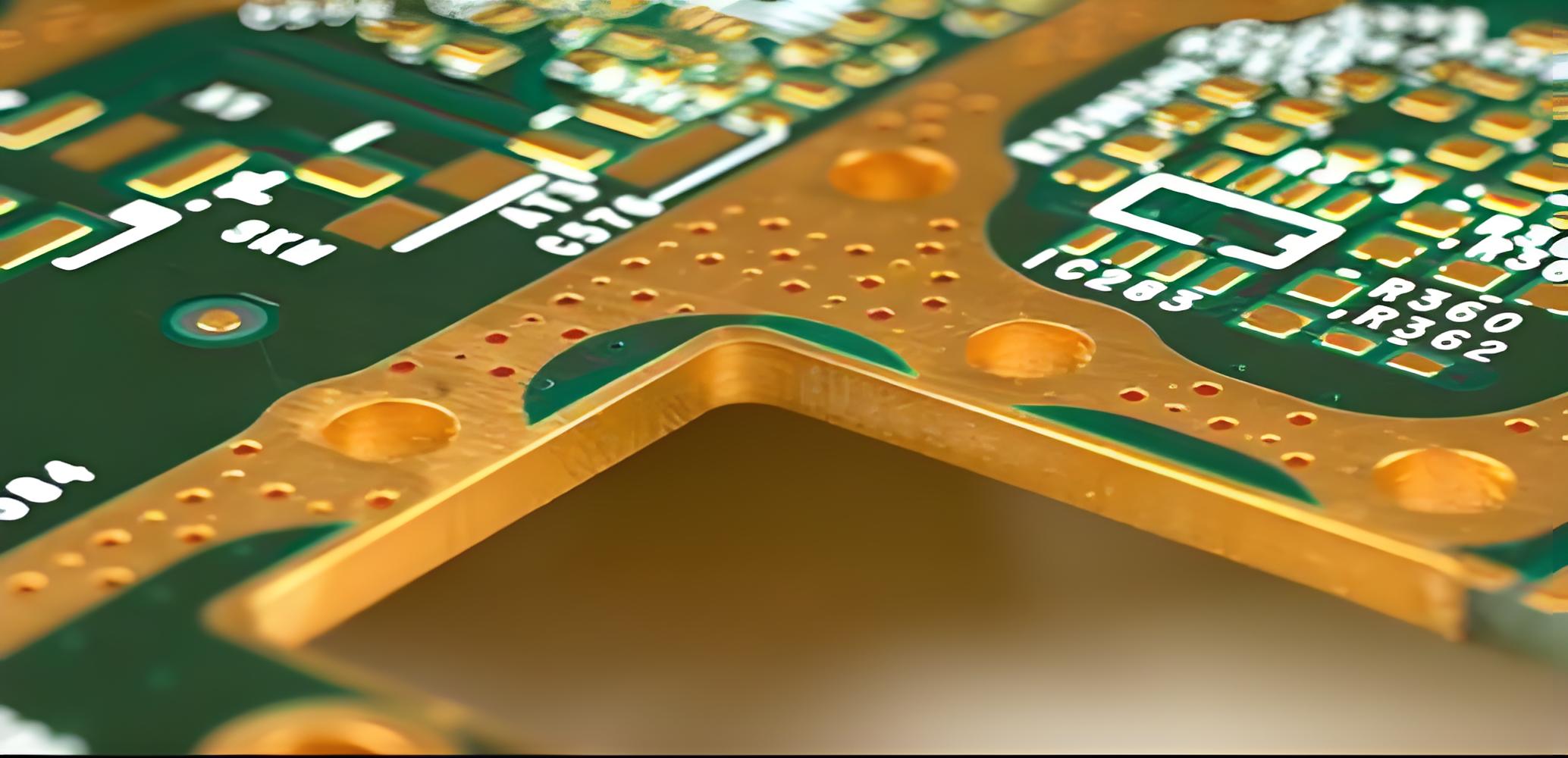
A bare PCB may include conductive traces, pads, plated through holes, solder mask, silkscreen, and surface finish. Common finishes such as HASL, ENIG, OSP, immersion silver, or immersion tin usually do not change the board’s basic identity as a bare printed circuit.
However, if electronic components are mounted on the board, the product may no longer be treated as a bare printed circuit. It may become a PCBA and require a different classification.
Bare PCB vs PCBA: Why the HS Code May Change
A bare PCB is mainly a circuit carrier. It provides conductive paths and an insulating base for assembly. A PCBA is different because it has mounted components and may perform a complete electronic function.
This difference matters in customs classification.
| Product Description | Possible Classification Direction |
|---|---|
| 6-layer FR4 bare PCB | 8534 printed circuit |
| Alumina ceramic bare PCB | 8534 if it meets printed circuit requirements |
| LED driver PCBA | May be classified by driver or power function |
| Industrial control PCBA | May involve 8537 or equipment-part classification |
| Communication module PCBA | May involve communication-related headings |
| Scrap PCBA for recycling | May involve 8549 electronic waste and scrap |
For commercial invoices, avoid vague descriptions like “electronic board.” A better description would be bare printed circuit board, FR4 bare PCB, ceramic printed circuit board, LED driver PCBA, motor control PCBA, communication module assembly, or industrial control board assembly.
Clear product descriptions help customs brokers review the correct HS code more efficiently.
HS Code for Electronic Integrated Circuits
The common HS heading for electronic integrated circuits is 8542. This heading is commonly used for processors, controllers, memories, amplifiers, other ICs, and parts.
| Product | Common Classification Direction |
|---|---|
| Microcontroller / MCU | 8542.31 processors and controllers |
| Memory IC | 8542.32 memories |
| Amplifier IC | 8542.33 amplifiers |
| Other IC | 8542.39 other electronic integrated circuits |
This heading is normally used for IC components, not for a complete assembled board that contains ICs. For example, a microcontroller chip may fall under 8542.31. But an industrial control PCBA containing that microcontroller does not automatically use 8542. The assembled board must be classified by its own function and import condition.
This is one of the most common mistakes in electronics trade. The presence of an IC does not turn the whole product into an integrated circuit.
HS Code 8541: Semiconductor Devices, LEDs, and Related Components
HS code 8541 is commonly used for semiconductor devices. Typical products may include diodes, transistors, thyristors, diacs, triacs, LEDs, photovoltaic cells, semiconductor sensors or transducers, and mounted piezo-electric crystals.
For PCB and PCBA sourcing, 8541 is usually more relevant to BOM-level components than to complete assemblies.
If the shipment contains individual LED components, 8541 may be relevant. If the shipment contains a complete LED lamp, LED module, LED driver PCBA, or lighting device, classification should be reviewed by the product’s finished function.
HS Code Electronic Controller
An electronic controller may fall under different HS headings depending on structure and function. A common direction is 8537 when the product is a board, panel, console, cabinet, or similar base equipped with apparatus for electric control or the distribution of electricity.
This may apply to products such as industrial control panels, electrical control cabinets, motor control boards, power distribution control units, and equipment control assemblies.
However, not every controller board is automatically 8537. A small embedded controller PCBA inside a machine may be classified as a part of that machine. A communication controller may be treated differently from a power control panel. A controller IC may fall under 8542, while a controller assembly usually requires a separate functional review.
For more accurate classification, prepare:
- Main product function
- Voltage rating
- Whether it controls electricity or distributes power
- Whether it includes relays, switches, fuses, breakers, connectors, or terminals
- Whether it is imported alone or as part of a complete machine
- Whether it is suitable only for one specific type of equipment
HS Code Electronic Waste
Electronic waste is commonly associated with 8549, which covers electrical and electronic waste and scrap. This heading may be relevant for scrapped PCBs, waste PCB assemblies, discarded electronic devices, e-waste for material recovery, damaged electronic assemblies, and non-reusable electronic scrap.
A used electronic product is not always electronic waste. If it can be repaired, refurbished, reused, or resold for its original purpose, it may be treated differently from scrap. If the shipment is clearly for recycling, precious metal recovery, dismantling, or disposal, 8549 becomes more relevant.
Exporters should be careful with descriptions such as “used electronics,” “defective boards,” “scrap PCB,” and “waste electronic assemblies.” These descriptions may trigger environmental controls, import restrictions, or additional documentation requirements.
HS Code for Electronic Cigarette
Electronic cigarettes are commonly associated with 8543.40, which covers electronic cigarettes and similar personal electric vaporising devices. However, electronic cigarettes are also a regulated product category in many markets.
Classification may depend on whether the product is rechargeable, refillable, disposable, nicotine-containing, or supplied with cartridges or consumables.
Importers should also check nicotine-related rules, battery transport requirements, labeling requirements, age-restricted product regulations, destination-country import restrictions, and whether disposable devices are treated differently.
HS code classification does not mean the product is automatically allowed for import. Regulatory compliance must be checked separately.
HS Code Electronic Scale
An electronic scale is usually classified by its weighing function, not by the fact that it contains electronics. A common heading is 8423, which covers weighing machinery, including personal weighing machines, household scales, conveyor scales, hopper scales, other weighing machinery, and parts.
| Product | Possible HS Direction |
|---|---|
| Electronic bathroom scale | 8423.10 |
| Household kitchen scale | 8423.10 or national subheading |
| Conveyor scale | 8423.20 |
| Hopper scale | 8423.30 |
| Industrial scale ≤30 kg | 8423.81 |
| Industrial scale 30–5000 kg | 8423.82 |
| Other weighing machinery | 8423.89 |
| Scale parts | 8423.90 |
This is a useful reminder: a product with a PCB, sensor, display, and battery is not always classified in Chapter 85. If the main function is weighing, heading 8423 may be more appropriate.
Consumer Electronics HS Code Finder: How to Search Correctly
A consumer electronics HS code finder can help with initial research, but it should not replace product analysis. Many tools return broad suggestions, and a vague description can lead to the wrong heading.
A better search method is to use the product’s actual function rather than a broad phrase.
Instead of searching only:
- electronic products HS code
Search more specific terms such as:
- bare printed circuit board HS code
- electronic integrated circuit HS code
- motor control panel HS code
- LED semiconductor HS code
- electronic weighing scale HS code
- electronic waste HS code
- communication module HS code
Then compare the result with the legal heading description, chapter notes, product datasheet, and destination-country tariff schedule.
How to Find HS Code for Electronics
To find the correct HS code for electronics, use a structured method instead of copying a code from an old invoice.
Step 1: Define the Exact Product
Write a clear description. Is it a bare PCB, PCBA, IC, connector, controller module, finished device, spare part, or electronic waste?
Step 2: Identify the Principal Function
Ask what the product mainly does. Does it control electricity, transmit signals, process data, measure weight, illuminate, convert power, store information, or act as a machine part?
Step 3: Separate Components, Modules, and Finished Goods
A connector, IC, bare PCB, assembled PCBA, and complete device may use different HS codes even if they belong to the same project.
Step 4: Review Chapter Notes and Heading Descriptions
Printed circuits, integrated circuits, semiconductor devices, electrical parts, and electronic waste all have specific classification boundaries.
Step 5: Check the Destination Country’s Full Code
The first six digits are commonly used internationally, but each country may add extra digits. The United States, European Union, United Kingdom, China, and other markets may use different national extensions.
Step 6: Prepare Technical Documents
Product photos, datasheets, BOM, Gerber files, assembly drawings, functional descriptions, and end-use statements can help a customs broker review the correct classification.
Step 7: Confirm High-Risk Products
For high-value electronics, wireless products, medical electronics, battery products, electronic cigarettes, and e-waste, confirm the code with a customs broker or request an official ruling where available.
Common Mistakes When Classifying Electronic Products
A common mistake is using one old HS code for every future electronics shipment. This can create problems because electronics are often shipped at different product levels: bare board, PCBA, module, finished product, spare part, or scrap.
Another mistake is classifying by material instead of function. For example, a ceramic PCB should not be classified simply as a ceramic article if it meets the definition of a printed circuit.
Importers also sometimes declare assembled PCBAs as bare PCBs. This can cause customs questions if the product contains ICs, capacitors, connectors, relays, or other components. A commercial invoice that says “printed circuit board” may be challenged if the actual goods are functional assembled boards.
Electronic waste also needs careful wording. “Used electronics” and “electronic waste” are not the same. If the goods are intended for recycling, dismantling, or recovery, additional environmental rules may apply.
What Information Should Buyers and Suppliers Prepare?
For electronics shipments, a detailed product description is more useful than a short trade name. Buyers and suppliers should prepare a simple classification file before export.
- Product name
- Bare PCB, component, PCBA, module, finished product, or waste
- Main function
- End-use application
- Voltage and power rating
- Material and structure
- Whether components are mounted
- BOM or main component list
- Product photos
- Datasheet
- Country of origin
- Destination country
- Whether the goods are new, used, defective, scrapped, or for recycling
- Whether batteries, wireless modules, or regulated materials are included
For PCB and PCBA projects, this is especially important. The same project may include prototypes, bare boards, assembled boards, test samples, components, and box-build products. The HS code should follow the actual shipment content, not only the project name.
HS Code Selection for PCB and PCBA Projects
PCB and PCBA projects often involve several product levels. Each level may require a different customs description and classification direction.
| Shipment Type | Better Commercial Description | Classification Direction |
|---|---|---|
| Bare PCB | Printed circuit board, no mounted components | 8534 |
| Ceramic PCB substrate with conductor pattern | Ceramic printed circuit board | 8534 if it meets printed circuit definition |
| SMT assembled PCB | Printed circuit board assembly for a specific function | Depends on function |
| Control PCBA | Electronic control assembly for industrial equipment | May involve 8537 or equipment-part review |
| IC shipment | Electronic integrated circuits | 8542 |
| LED component shipment | LEDs or semiconductor devices | 8541 |
| Scrap board shipment | Electronic waste and scrap PCB assemblies | 8549 |
For B2B electronics manufacturing, this level of detail helps reduce customs delays and keeps the commercial invoice aligned with the actual goods.
How EBest Circuit Supports PCB and PCBA Export Projects
For PCB and PCBA export projects, the most important step is to describe the goods accurately before shipment. A bare PCB, assembled PCBA, electronic control module, IC component, finished device part, and scrap assembly should not use the same broad product description.
EBest Circuit supports PCB design, PCB prototyping, mass production, component sourcing, and PCB assembly. The product range includes FR4 PCBs, multilayer PCBs, metal core PCBs, ceramic PCBs, flexible PCBs, rigid-flex PCBs, high-frequency PCBs, HDI PCBs, heavy copper PCBs, busbar PCBs, and PCBA solutions.
For smoother export documentation, buyers should provide Gerber files, BOM, assembly drawings, product photos, quantity, application, and destination country before shipment. These details help the supplier prepare clearer commercial invoice descriptions and support customs broker review.
FAQ About HS Code Electronic Products
hs code for electronic products
There is no single HS code for all electronic products. The correct code depends on the product’s main function and shipment condition. A bare PCB may fall under 8534, an IC under 8542, a semiconductor device under 8541, an electronic controller may involve 8537, and an electronic scale may fall under 8423.
hs code electronic waste
Electronic waste is commonly associated with 8549 when the goods are electrical or electronic waste and scrap. This may include scrapped PCBs, waste PCB assemblies, discarded electronic components, or electronic materials used for recovery or disposal. Used electronics that can be repaired or reused may require a different review.
hs code for electronic integrated circuits
Electronic integrated circuits are commonly classified under 8542. This heading includes processors, controllers, memories, amplifiers, and other ICs. It usually applies to IC components themselves, not to a complete PCBA simply because the board contains integrated circuits.
hs code electronic controller
An electronic controller may fall under 8537 when it is equipped for electric control or power distribution. However, small embedded controller PCBAs, equipment-specific control boards, or communication control modules may be classified differently based on function, host equipment, and import condition.
printed circuit board hs code
A bare printed circuit board is commonly classified under HS code 8534. This applies to printed circuits formed on an insulating base, such as FR4 PCB, ceramic PCB, aluminum PCB, and other bare circuit boards. If components are mounted, the product may become a PCBA and require a different classification.
electronic cigarette hs code
Electronic cigarettes are commonly associated with 8543.40 for electronic cigarettes and similar personal electric vaporising devices. However, disposable devices, nicotine cartridges, consumables, and battery-related parts may be treated differently in some markets. Always check destination-country regulations before import.
hs code 8542
HS code 8542 covers electronic integrated circuits, including processors, controllers, memories, amplifiers, other ICs, and parts. It is normally used for component-level IC products. A complete assembled board or finished electronic device does not automatically fall under 8542.
hs code 8541
HS code 8541 covers semiconductor devices such as diodes, transistors, thyristors, LEDs, photovoltaic cells, semiconductor-based transducers, and mounted piezo-electric crystals. It is more commonly used for individual electronic components than for complete electronic modules or finished products.
hs code electronic scale
An electronic scale is usually classified under heading 8423 because its principal function is weighing. Even if it contains a PCB, sensor, display, and battery, it is generally treated as weighing machinery rather than a generic electronic product.
consumer electronics hs code finder
A consumer electronics HS code finder can help with initial research, but it should not be used as the only basis for customs declaration. Search by specific product function, such as bare PCB, IC, electronic scale, controller panel, or communication module, and then verify the full code in the destination-country tariff schedule.
how to find hs code for electronics
To find an HS code for electronics, define the product clearly, identify its principal function, check whether it is a component, module, finished device, part, or waste item, and review the relevant chapter notes. For high-value or regulated products, confirm the code with a customs broker or official customs authority.
Is PCBA classified the same as bare PCB?
Usually no. A bare PCB may fall under 8534, while a PCBA contains mounted components and may perform a specific function. The PCBA may need to be classified as a control device, communication module, power device, equipment part, or another functional electronic assembly.
What HS code should be used for ceramic PCB?
A ceramic PCB may fall under 8534 if it is a bare printed circuit and meets the printed circuit definition. If electronic components are mounted, the ceramic PCBA should be reviewed by its actual function and end-use rather than by substrate material alone.
Can one shipment use multiple HS codes?
Yes. One shipment may require multiple HS codes if it includes different goods, such as bare PCBs, ICs, connectors, assembled PCBAs, cables, housings, and spare parts. Putting all goods under electronic products can create customs risk.
Who decides the final HS code?
The importer of record is usually responsible for the final HS code declared in the destination country. Suppliers can provide technical descriptions and suggested codes, but final classification should be confirmed by the importer, customs broker, or official customs authority.
Conclusion
The correct HS code for electronic products depends on function, structure, and shipment condition. A bare PCB is commonly linked with 8534, electronic integrated circuits with 8542, semiconductor devices with 8541, electronic controllers may involve 8537, electronic waste may involve 8549, and electronic scales usually fall under 8423.
For PCB and PCBA projects, the safest approach is to describe the shipment accurately: bare board, assembled board, control module, IC, semiconductor component, finished equipment part, or scrap electronic assembly. Clear descriptions help reduce customs delays and keep export documents consistent with the actual goods.
If you’re sourcing reliable PCB/PCBA manufacturing — OEM, ODM, prototyping, mass production, or custom engineering solutions — reach out to our engineering team for technical support and a quote at sales@bestpcbs.com.