





The comparison npn vs pnp transistor is fundamental to understanding how bipolar junction transistors (BJTs) behave in real electronic circuits. Although NPN and PNP transistors serve the same basic function—using a small control current to regulate a larger current—their internal structure, biasing logic, current direction, and application scenarios differ in important ways.
These differences directly affect schematic design, component selection, PCB layout, grounding strategy, and even system-level safety behavior. Engineers who clearly understand npn vs pnp can make cleaner designs, avoid common wiring mistakes, and improve long-term reliability in both analog and digital systems.
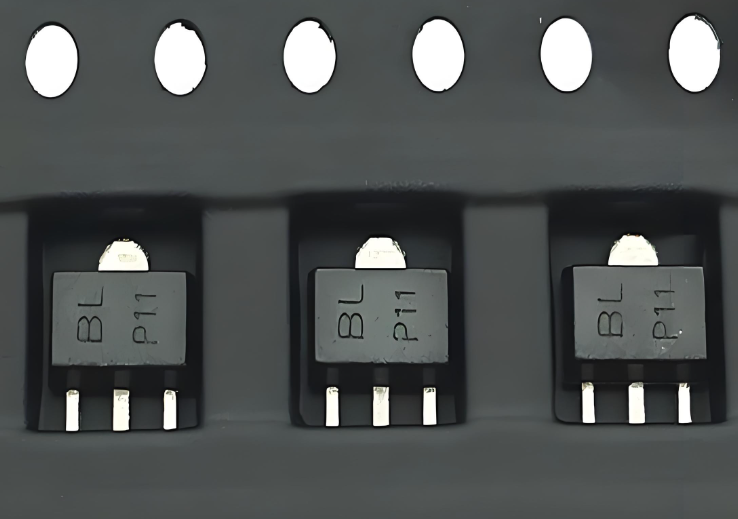
What Is an NPN Transistor?
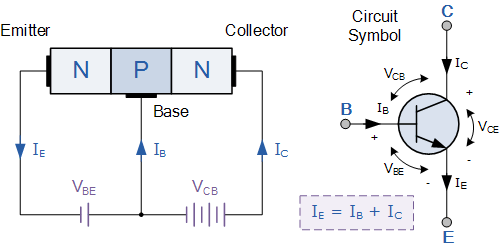
An NPN transistor is a type of bipolar junction transistor made from three semiconductor regions arranged as N-type emitter, P-type base, and N-type collector. The name “NPN” reflects this physical structure.
In an NPN transistor:
- Electrons are the majority charge carriers
- The emitter is heavily doped to inject electrons
- The base is thin and lightly doped
- The collector collects electrons flowing through the device
Because electrons move faster than holes, NPN transistors generally offer better switching speed and higher gain compared to PNP devices. This is one key reason NPN transistors dominate modern electronic designs.
How Does a NPN Transistor Work?
An NPN transistor operates by forward-biasing the base–emitter junction. When the base voltage is raised approximately 0.7 V above the emitter (for silicon devices), electrons begin to flow from the emitter into the base.
Most of these electrons do not recombine in the base. Instead, they are pulled into the collector by the collector–base electric field. As a result:
- A small base current controls
- A much larger collector current
This behavior allows the NPN transistor to function as:
- A current amplifier
- A digital switch
In PCB applications, NPN transistors are most commonly used as low-side switches, where the load connects to the supply voltage and the transistor completes the path to ground.
Advantages and Limitations of NPN
Advantages of NPN Transistors
- Faster switching due to electron mobility
- Simple biasing with ground-referenced logic
- Excellent compatibility with microcontrollers and digital ICs
- Wide availability in signal, power, and RF variants
- Lower cost in most voltage and current ratings
Limitations of NPN Transistors
- Not ideal for high-side switching without level shifting
- Ground noise can affect sensitive analog stages
- Load remains connected to supply when transistor is off
What Is a PNP Transistor?
A PNP transistor is also a bipolar junction transistor, but its internal structure is reversed: P-type emitter, N-type base, and P-type collector.
In a PNP transistor:
- Holes are the majority charge carriers
- Current flows from emitter to collector
- Control logic is inverted compared to NPN
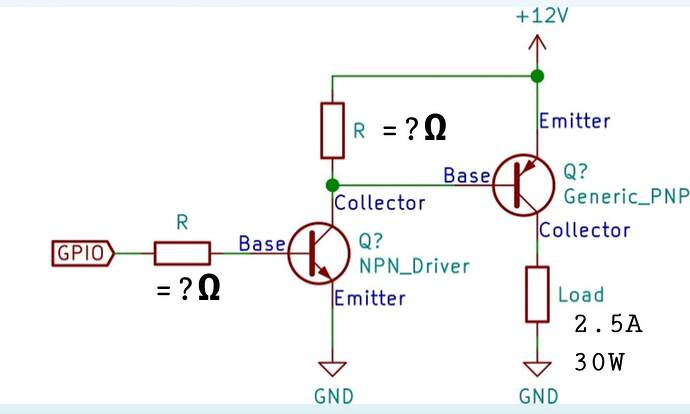
PNP transistors are commonly used when the design requires switching or controlling current on the positive side of the power supply.
How Does a PNP Transistor Work?
A PNP transistor turns on when the base voltage is lower than the emitter voltage by about 0.7 V. This forward-biases the base–emitter junction and allows holes to move from the emitter into the base.
Once active:
- Holes continue into the collector
- Current flows from emitter → collector → load
Because of this current direction, PNP transistors are well suited for high-side switching, where the transistor supplies current from the power rail to the load.
Advantages and Limitations of PNP
Advantages of PNP Transistors
- Natural solution for high-side switching
- Useful in power distribution and sourcing circuits
- Allows loads to be fully disconnected from supply
- Common in automotive and industrial controls
Limitations of PNP Transistors
- Slower switching due to hole mobility
- Less intuitive control logic for beginners
- Harder to interface directly with low-voltage logic
- Often requires pull-down or level-shifting circuits
NPN vs PNP Symbol: How to Identify Them?
The transistor symbol provides a clear visual clue:
- NPN transistor: emitter arrow points outward
- PNP transistor: emitter arrow points inward
A commonly used memory aid is:
“NPN: Not Pointing iN.”
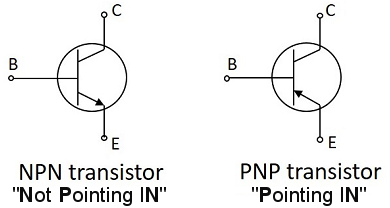
Correctly identifying transistor symbols is critical during schematic review and PCB footprint validation, especially when layouts are shared across teams.
Why Would You Use a PNP Transistor?
You would choose a PNP transistor when the design requires:
- Switching on the positive supply rail
- A default-off load when control signal is inactive
- Current sourcing rather than sinking
- Simplified high-side power control
PNP transistors are frequently used in:
- Automotive electronics
- Industrial automation
- Power monitoring circuits
- Sensor supply control
Key Differences Between NPN and PNP Transistors
| Aspect | NPN Transistor | PNP Transistor |
| Semiconductor structure | N-P-N | P-N-P |
| Majority carriers | Electrons | Holes |
| Turn-on condition | Base higher than emitter | Base lower than emitter |
| Current flow | Collector → Emitter | Emitter → Collector |
| Typical role | Low-side switch | High-side switch |
| Logic compatibility | Excellent | More complex |
When to Use NPN vs PNP Transistors?
Choosing npn vs pnp depends on system architecture and control logic:
- Use NPN when working with microcontrollers, logic ICs, or ground-referenced signals
- Use PNP when switching loads from the positive rail
- Consider PCB grounding, noise paths, and return currents
- Evaluate system behavior during power-up and fault conditions
In advanced designs, NPN and PNP transistors are often paired in complementary stages to achieve push-pull outputs, level shifting, or bidirectional drive.
FAQs
1. Is an NPN transistor better than a PNP transistor?
Neither is universally better. NPN is more common, while PNP excels in high-side control.
2. Can NPN and PNP transistors be used together?
Yes. Many amplifiers and drivers rely on complementary NPN/PNP pairs.
3. Why are NPN transistors used more often?
They switch faster, cost less, and interface easily with logic circuits.
4. How do I identify NPN vs PNP on a PCB?
Check the schematic symbol, component marking, or datasheet pinout.
5. Can I directly replace a PNP with an NPN transistor?
No. Their biasing and current directions differ and require redesign.
Tags: npn vs pnp, npn vs pnp transistor