





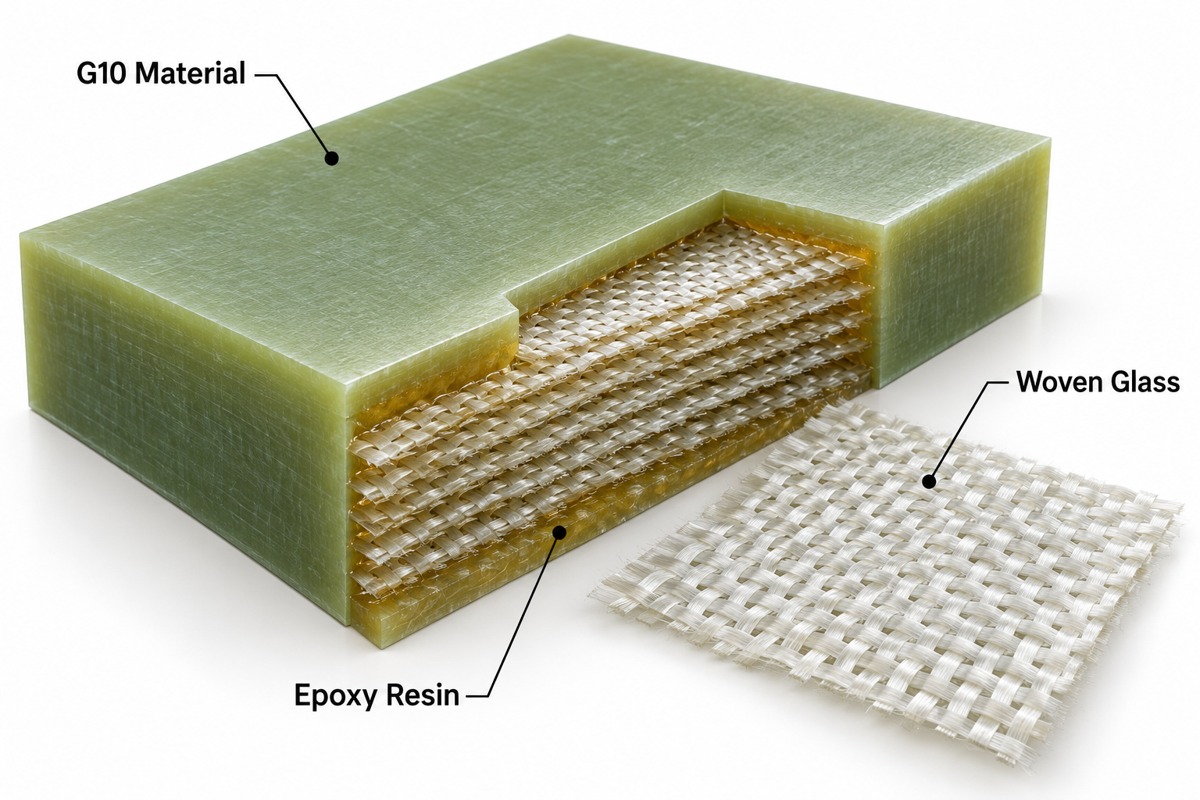
g10 material is a rigid electrical-insulating composite made from woven glass fabric bonded with cured epoxy resin under heat and pressure. It combines structural strength, low moisture absorption and electrical insulation, making it useful for spacers, terminal supports, backing plates and other machined parts. G10 and FR-4 share a glass–epoxy construction, but G10 alone does not establish the flame-retardant performance associated with FR-4. A plain G10 sheet is also not the same product as copper-clad PCB laminate.
At EBest Circuit, we help customers translate electrical, thermal and mechanical requirements into manufacturable circuit boards. For a circuit-board project, our FR-4 PCB manufacturing review starts with the specified laminate grade, stackup and copper requirements—not simply a green sheet described as “G10.”
Key Takeaways
- G10 is a woven-glass-reinforced epoxy thermoset, not a metal or an unreinforced plastic.
- The material provides both electrical insulation and mechanical support; its properties depend on the specific grade, direction and test conditions.
- G10 and FR-4 are not interchangeable flame-rating specifications. Some commercial products are qualified and sold as G10/FR-4.
- Service temperature, glass-transition temperature and soldering exposure describe different limits.
- Glass reinforcement makes machining abrasive; tool selection, edge support and dust control matter.
- For PCB fabrication, specify copper-clad laminate, finished thickness, copper weight and the required material qualification.
What Is G10 Material Made Of?
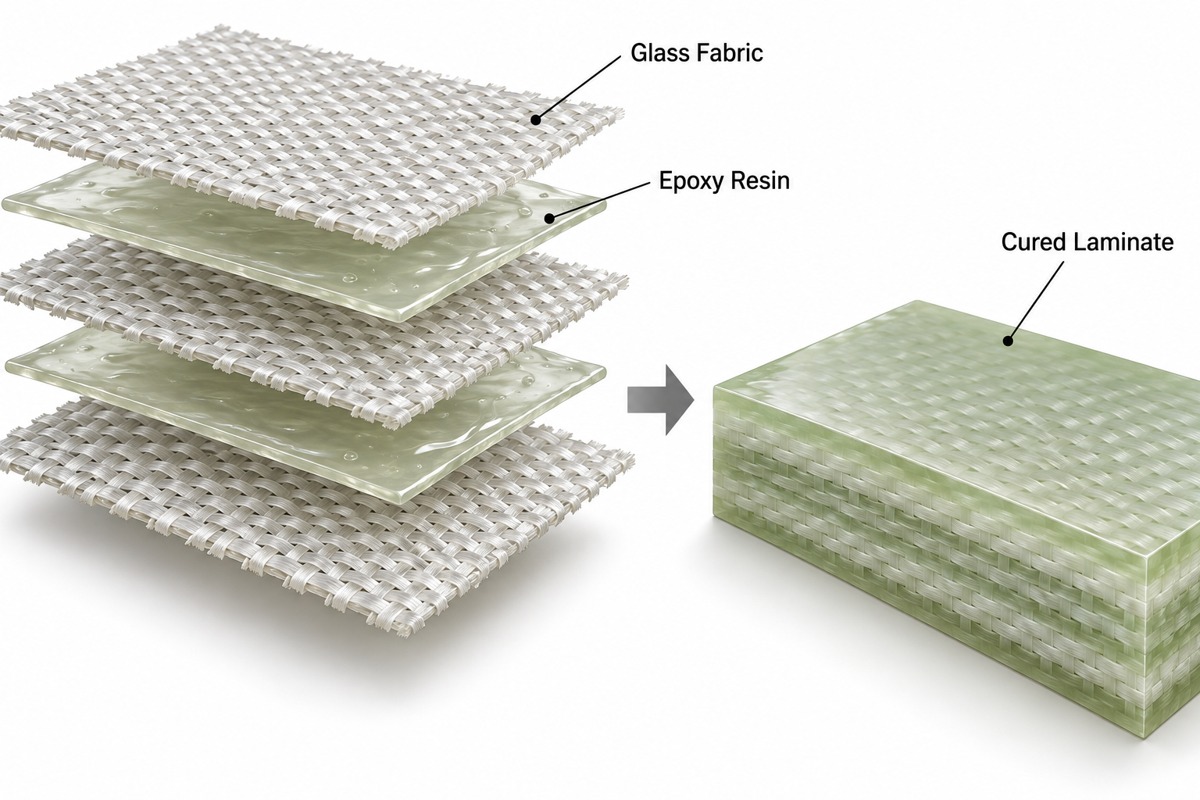
G10 consists of continuous woven glass cloth and an epoxy resin system that cures into a rigid thermoset matrix. The glass carries much of the mechanical load; the resin bonds the layers and insulates them.
Manufacture generally involves impregnating glass cloth with resin, stacking the required plies, and consolidating the stack under controlled heat and pressure. After curing, the panel can be cut or machined. It does not melt and flow again like a thermoplastic.
Pigments, resin formulation, cloth construction and processing can vary between products. Color does not identify a grade or prove electrical performance.
G10 Material Properties
G10 material properties include high stiffness, electrical insulation and moisture resistance, but numerical values must come from the selected product’s data sheet. Mechanical direction and electrical test frequency can change the result.
For a concrete reference, Attwater’s EPGC201 product, described as closest to NEMA G10, lists the following typical values. These are one supplier’s material data, not EBest Circuit production limits or universal G10 specifications.
| Property | Published typical value |
| Density | 2 g/cm³ |
| Flexural strength | 485 MPa |
| Relative permittivity at 1 MHz | 5.2 |
| Dissipation factor at 1 MHz | 0.025 |
| Electric strength, flat rapid test | 15 kV/mm |
| Continuous thermal rating | 130°C |
| Intermittent thermal rating | 140°C |
Do not multiply electric strength by the part thickness to set a finished assembly’s working voltage. Creepage, clearance, humidity, surface contamination, edges and the applicable equipment standard still govern insulation design.
How Is G10 Different from FR-4?
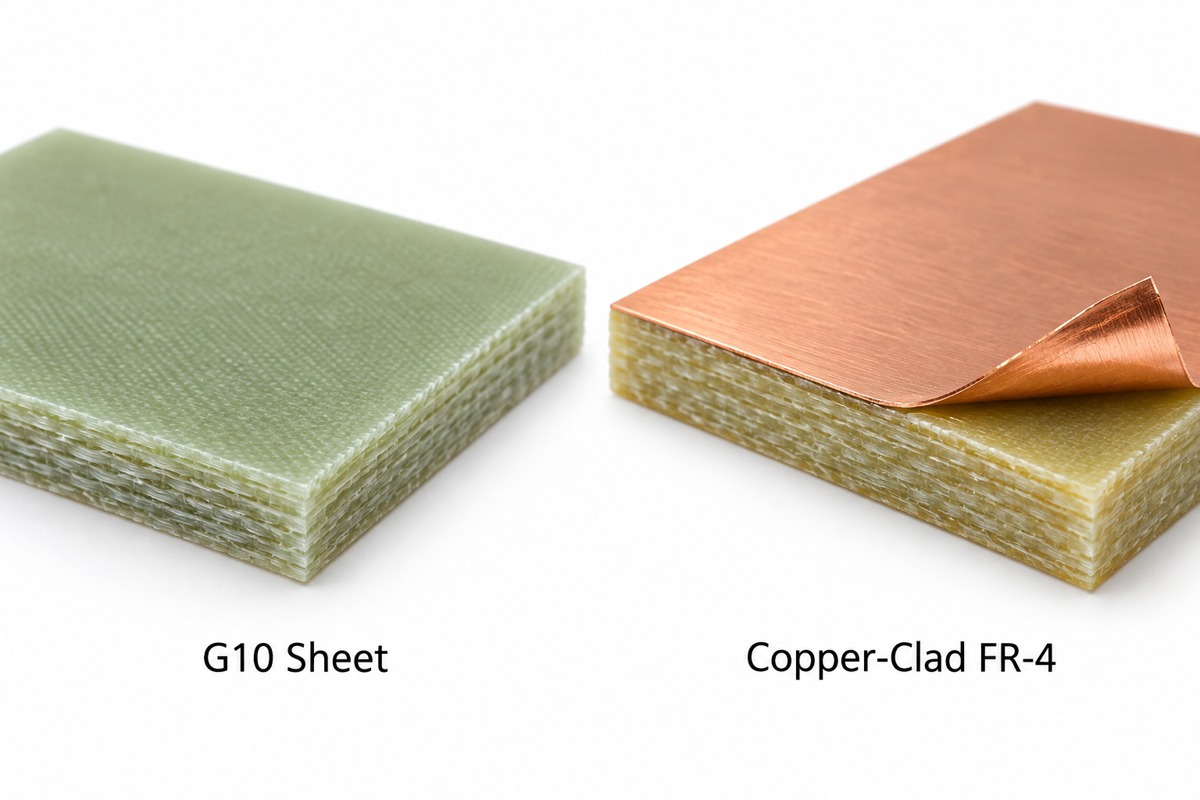
The main distinction is that FR-4 specifies a flame-retardant glass–epoxy grade, while the name G10 by itself does not establish that flame performance. Their shared construction explains why suppliers sometimes list a dual-qualified “G10/FR-4” product.
| Feature | G10 | FR-4 |
| Reinforcement and binder | Woven glass and epoxy | Woven glass and flame-retardant epoxy system |
| Typical purchase form | Insulating sheet, machined stock, rod or tube | Unclad insulation stock or copper-clad PCB laminate |
| Fire-performance selection | Do not infer a rating from the name alone | Verify the exact grade, listing and thickness |
| PCB procurement | Generic sheet designation is insufficient | Specify an actual laminate and stackup |
For example, Acculam Epoxyglas G10/FR4 is explicitly described as flame-retardant and qualified to NEMA FR4 and MIL-I-24768/27. That statement applies to the named product; it does not make every G10 sheet flame-retardant.
What Is the G10 Material Temperature Range?
The usable G10 material temperature range depends on the resin formulation, exposure time and required retained properties; it is not one universal minimum-to-maximum range. The EPGC201 example above lists 130°C continuous and 140°C intermittent ratings.
Those ratings are not the same as Tg, the glass-transition temperature, and they do not authorize an arbitrary solder-reflow profile. A short manufacturing excursion and years of service impose different stresses. For a PCB, check the laminate’s Tg, decomposition behavior, expansion and assembly suitability separately.
For cold environments, also check thermal contraction, fastener loads and thermal cycling. A material used in one cryogenic insulation design is not automatically qualified for another assembly.
Where Is G10 Used?
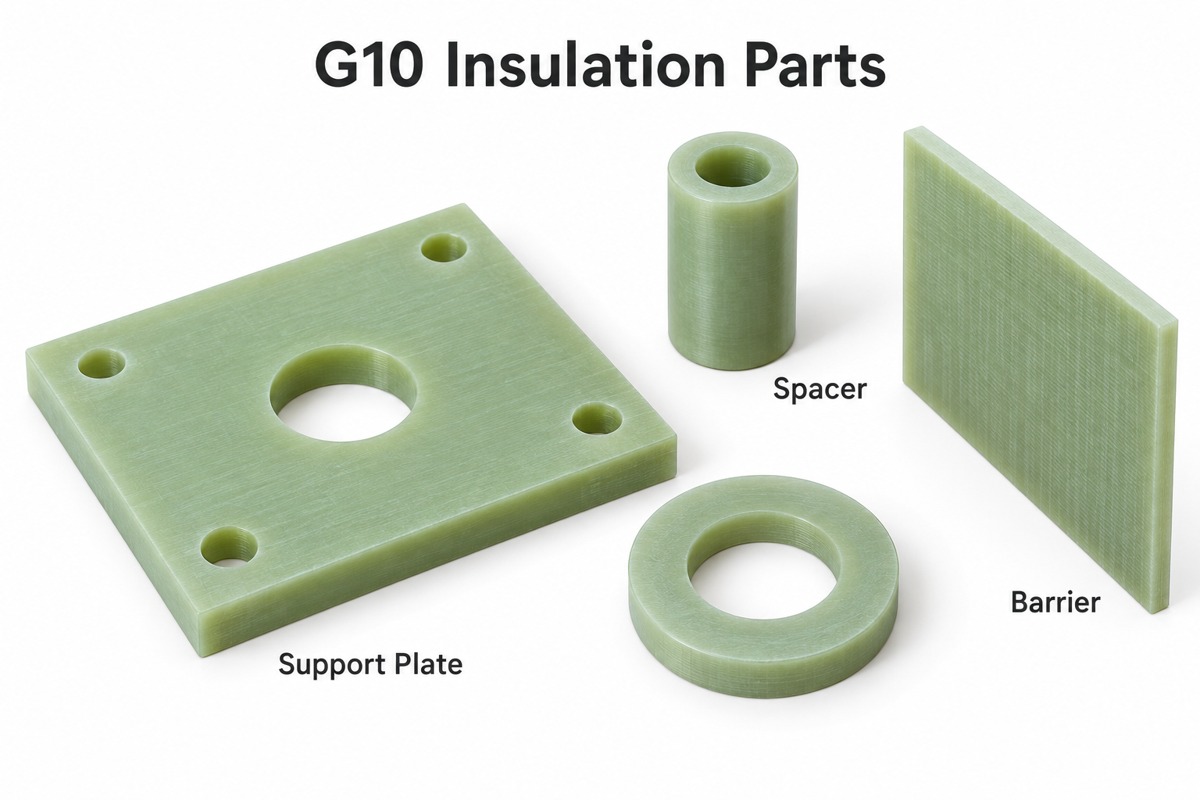
G10 is used where a part must support a load without creating an electrical conduction path, including terminal supports, insulating spacers, coil supports and phase barriers.
- Electrical equipment: barriers, bushes, washers and terminal mounting plates.
- Mechanical assemblies: nonmetallic support plates, fixtures and brackets.
- Marine equipment: backing plates where strength and moisture resistance are useful.
- Consumer products: textured knife-handle scales and similar grip components.
The grip of a knife scale depends on its texture and shape, not just the G10 name. Likewise, a marine backing plate still needs appropriate sealing, fastener design and load assessment. These applications do not establish suitability for food contact or another regulated use.
How to Cut G10 Material
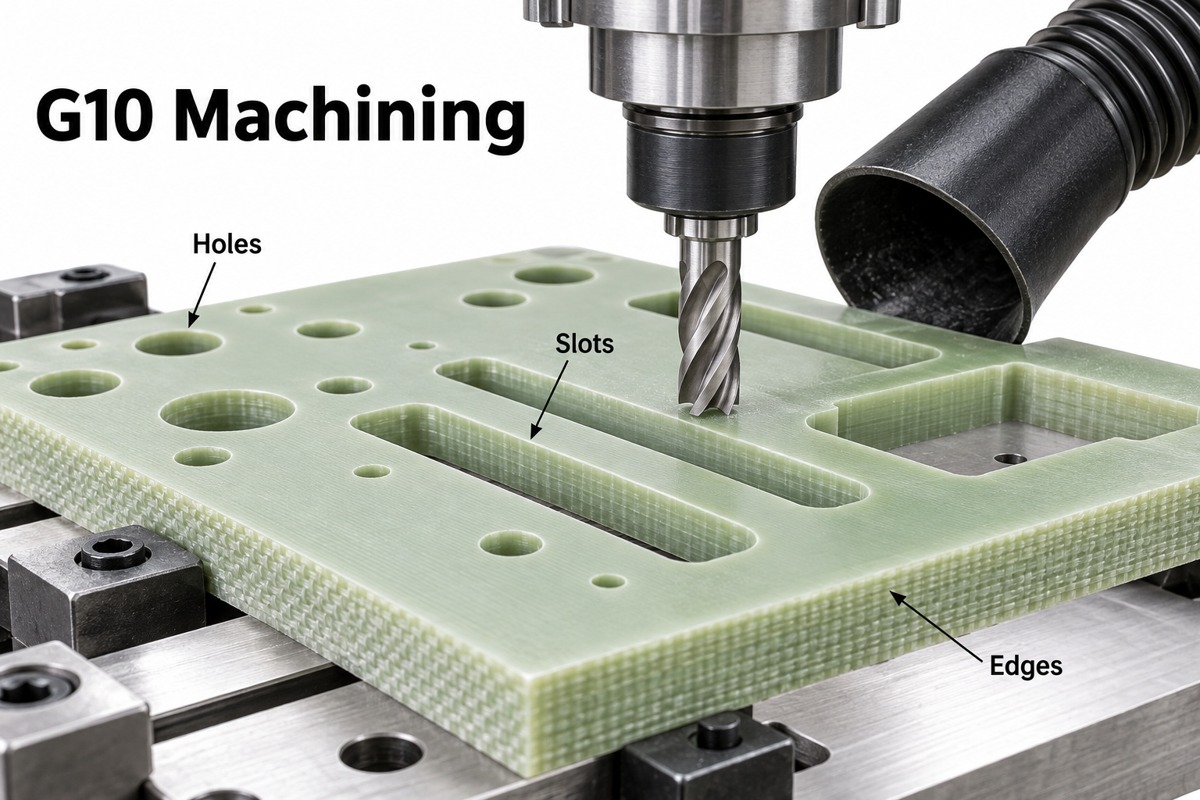
G10 is commonly cut and drilled with tooling suitable for abrasive glass-reinforced composites, with support near the cut and effective dust extraction. Carbide tooling is a common choice; the tool supplier’s recommendations should set cutting conditions.
Use these machining controls:
- Clamp the sheet securely and use sacrificial backing where needed to limit breakout.
- Choose a cutter and feed that cut the fibers instead of rubbing and overheating the resin.
- Inspect hole exits and routed edges for fraying, chipping and interlayer separation.
- Use extraction and protective measures specified by the material safety data sheet and workplace assessment.
Do not treat glass–epoxy dust as ordinary harmless shop debris. Avoid uncontrolled dry sanding, and do not assume laser cutting is suitable: resin damage, fumes and edge quality require process-specific assessment.
Can a G10 Sheet Be Used as a PCB Substrate?
Glass–epoxy can form a PCB’s dielectric structure, but an ordinary unclad G10 sheet is not a drop-in replacement for a qualified copper-clad PCB laminate. It has no ready-made copper circuitry and may lack the required material qualification.
For a manufactured circuit board, define:
- The laminate manufacturer, grade and required qualification.
- Finished board thickness and tolerance—for example, a specified 1.6 mm board rather than unspecified sheet stock.
- Copper weight, layer arrangement and dielectric thicknesses.
- Flammability requirements and the assembly temperature exposure.
- Electrical requirements, including impedance or high-frequency loss where relevant.
A 1 MHz dielectric value from an insulation-sheet data sheet is not sufficient to design a high-speed channel. Our PCB design review connects the material selection to routing, stackup and fabrication requirements. Assembly requirements must also be compatible with the chosen laminate.
What Changes the Cost of G10 Parts?
G10 part cost is driven by stock thickness, material utilization, machining time, tool wear and inspection requirements—not only the sheet’s unit price.
A flat rectangular spacer with two holes usually needs less machining than a thin part with deep pockets and closely toleranced slots. Surface finish, edge quality, batch quantity and certification documentation can also change the purchase price. Compare quotations for the same grade, dimensions and machining scope; generic “G10 price” listings may describe very different products.
FAQ About G10 Material
Is G10 the same as Garolite?
Garolite is a trade name used for several laminate grades. G10 identifies a particular glass–epoxy material class; “Garolite” alone does not tell you the resin, reinforcement or flame performance.
Is G10 electrically conductive?
Standard glass–epoxy G10 is an electrical insulator. Surface contamination, moisture, damaged edges or added conductive coatings can change an actual part’s behavior. Do not confuse glass reinforcement with conductive carbon fiber.
Is G10 waterproof?
G10 has low water absorption, not guaranteed zero absorption. For immersed or humid service, use the selected grade’s conditioned electrical and mechanical data and assess exposed edges and fastener penetrations.
Does G10 melt?
Cured G10 is a thermoset and does not remelt like a thermoplastic. Excess heat can still reduce stiffness, damage the resin and eventually cause decomposition. “Does not melt” does not mean unlimited heat resistance.
Is G10 stronger than aluminum?
There is no useful universal yes-or-no comparison. Tensile, flexural and compressive performance differ, and G10 is directional. Compare the actual laminate and aluminum alloy under the same loading, thickness and environmental conditions.
Can black G10 be identified by color alone?
No. Black pigment does not establish the laminate grade, fire rating or electrical properties. Use the product designation, data sheet and material documentation rather than appearance.
How Can EBest Circuit Support Your Glass–Epoxy PCB Project?
We support PCB fabrication and PCB assembly projects that need the right laminate, manufacturable stackup and compatible assembly process. If a drawing currently says only “G10,” we can review what the circuit board actually needs before fabrication.
Contact our engineering team at sales@bestpcbs.com with your design and operating requirements. We will help clarify the PCB material specification rather than assume that generic insulating stock meets it.
You may also like


Tags: g10 material, g10 material properties, g10 material temperature range, how to cut g10 material, what is g10 material made of