





An IMS circuit board can help keep LEDs, power semiconductors, converters, and motor controls within their temperature limits—but only when the dielectric, metal base, copper, mechanical design, and cooling interface work together. Choosing a supplier by the phrase “metal core PCB” alone can leave you with a board that fits the drawing but misses the thermal or sourcing objective.
This guide compares five companies serving Canadian IMS projects and shows which type of buyer each may suit. It separates claimed Canadian fabrication from onshore/offshore or partner-factory models, then gives you published capability data to compare before requesting quotations.
What Is an IMS Circuit Board, and When Should You Use One?
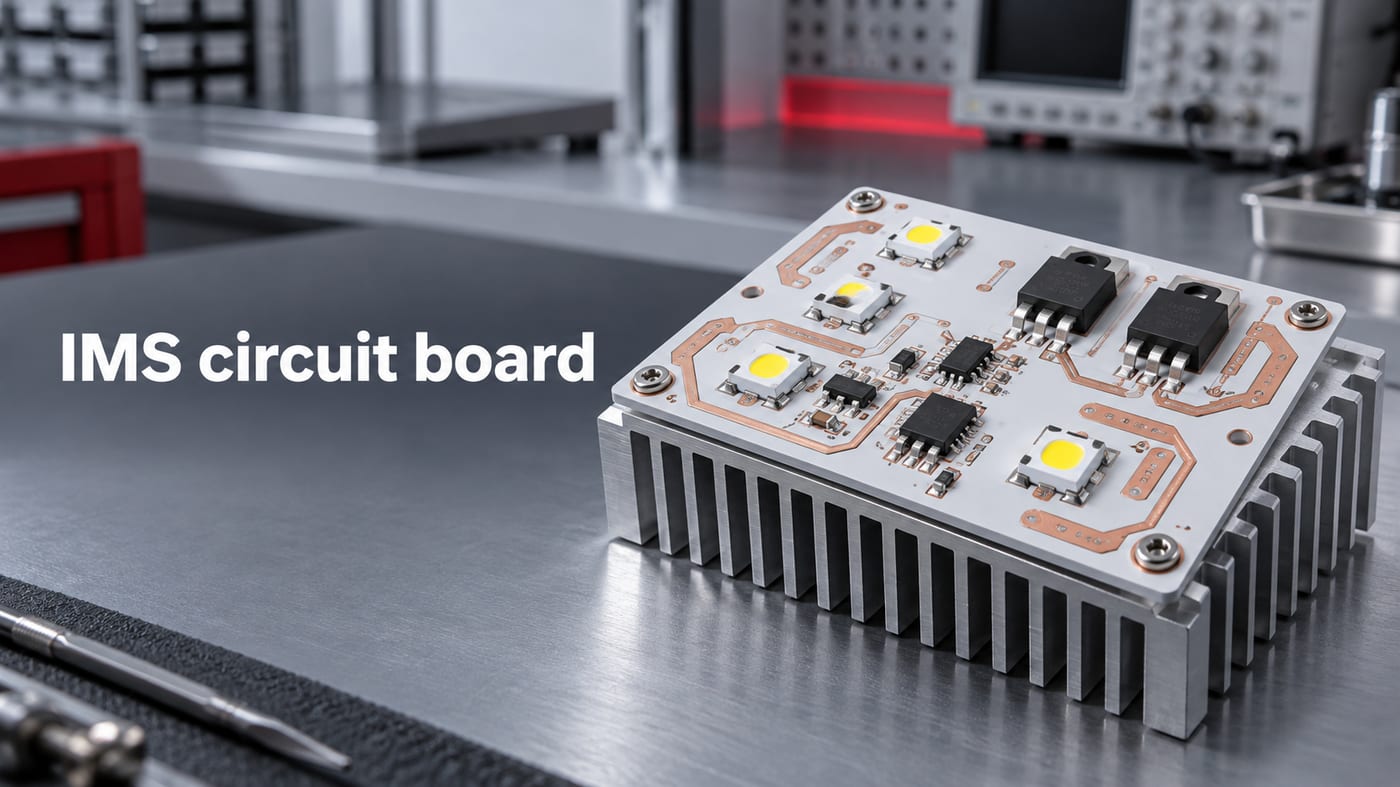
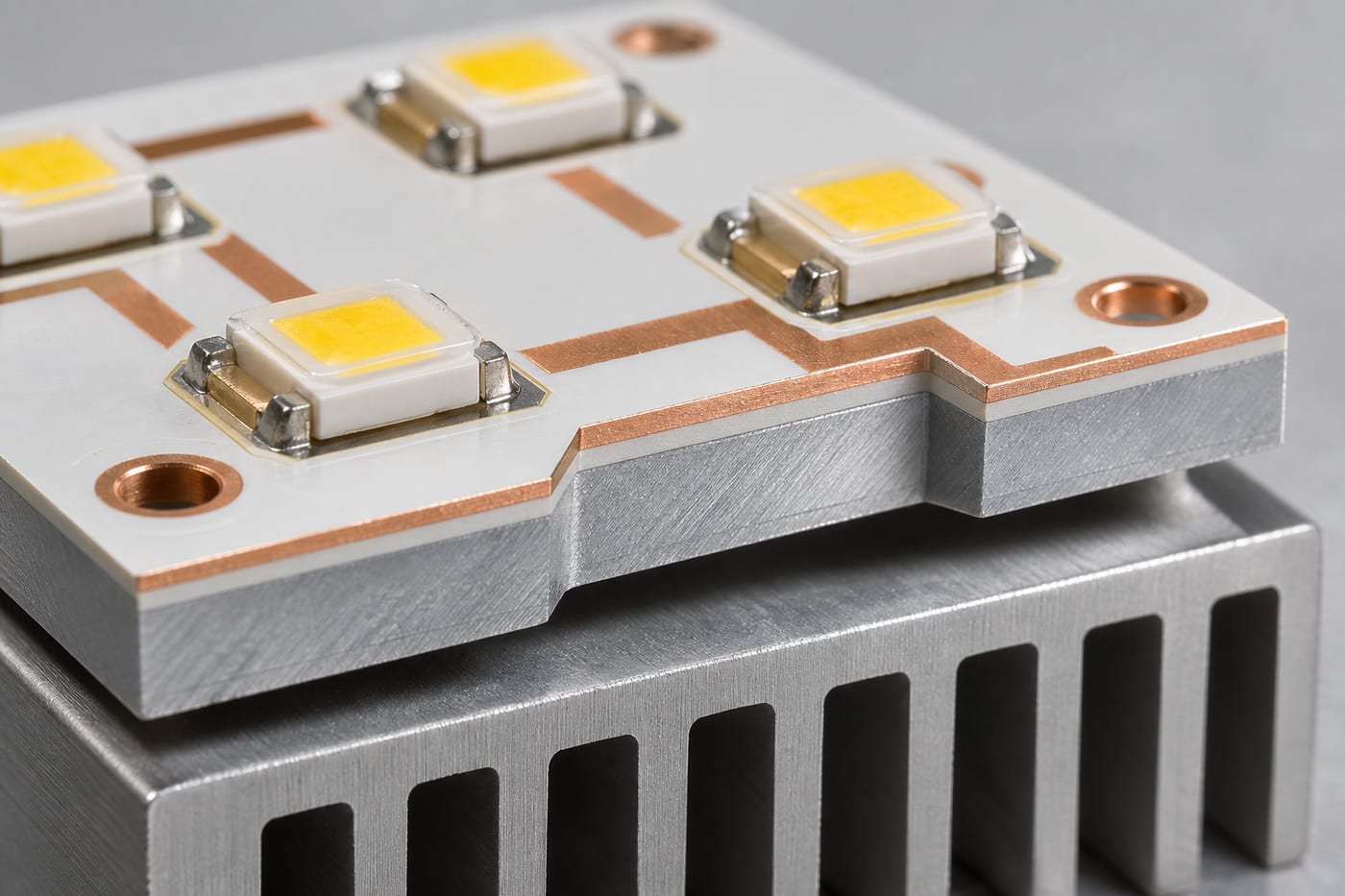
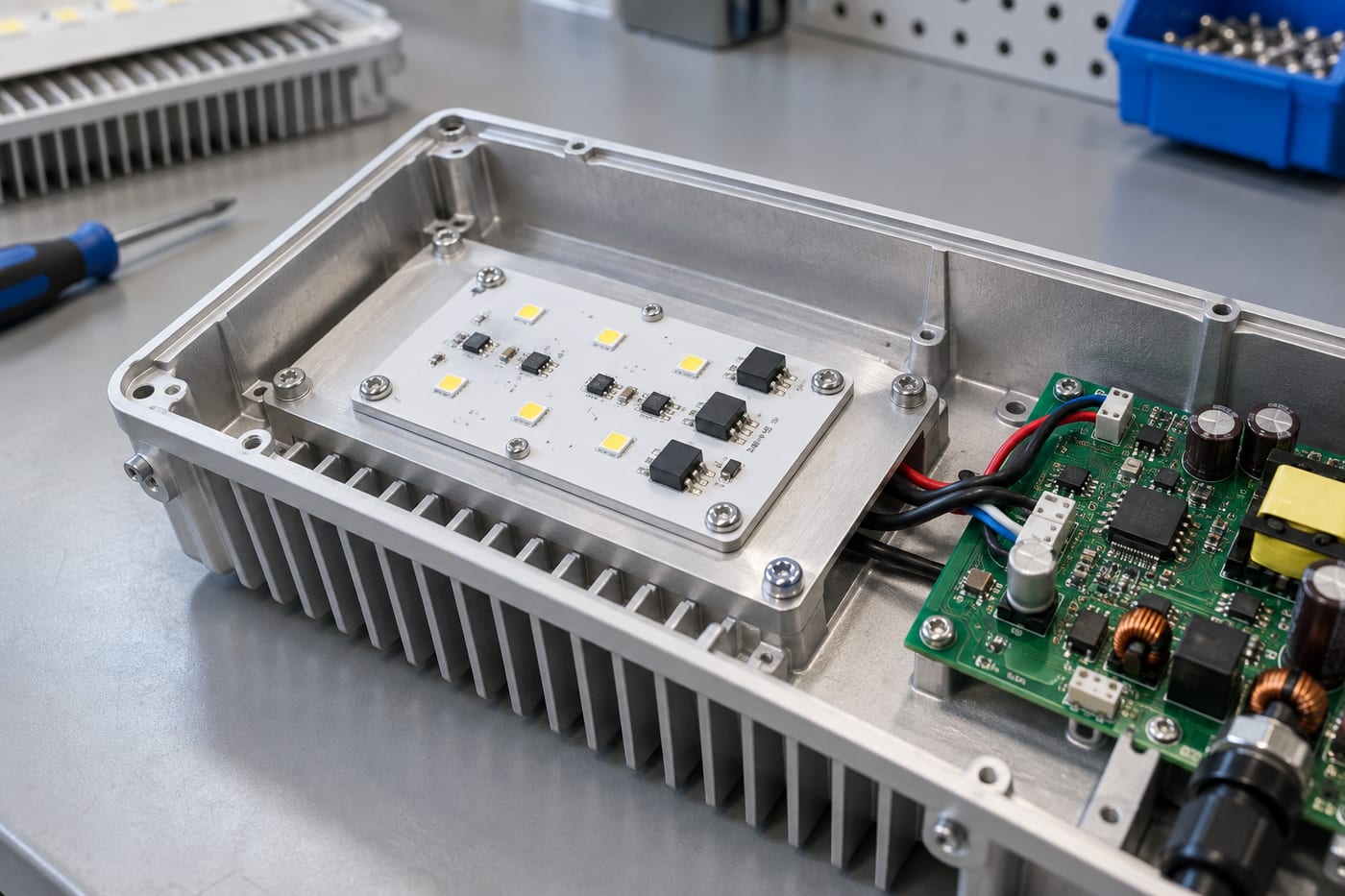
An IMS circuit board uses a thermally conductive dielectric to separate the circuit copper from an aluminum or copper base. Its main value is moving heat from LEDs and power components into a housing or heatsink, helping reduce overheating, performance loss, and temperature-related ageing.
IMS is worth considering when ordinary FR-4 cannot move heat away fast enough and the product provides an effective cooling path through the metal base. Typical benefits include:
- LED lighting: lower LED junction temperature to reduce light degradation and premature failure;
- Power supplies and converters: move heat away from MOSFETs, rectifiers, and other power devices;
- Chargers and motor controls: spread heat more effectively under higher current or continuous load;
- Automotive and industrial electronics: provide a stable path from heat-generating components to the product enclosure.
IMS is not a direct answer to every high-temperature problem. Changing from FR-4 to a metal base may bring little improvement when the main bottleneck is the component package, thermal interface, heatsink, or airflow. Thick-copper FR-4, copper-base PCB, ceramic substrate, or another thermal solution may also fit better when the design needs dense multilayer routing, very high heat concentration, or a large electrical-isolation area.
Use IMS when the product needs the PCB to transfer heat effectively into a metal base, housing, or heatsink—not simply because the product becomes hot.
How Were the Top IMS Circuit Board Manufacturers in Canada Selected?
The companies were selected because they have a Canadian business presence and publicly describe metal-core, aluminum PCB, copper-core, or MCPCB capabilities. The order is not a quality ranking. Instead, it shows different sourcing models: confirmed Canadian production, local engineering access, integrated assembly, broad PCB coverage, and Canadian coordination with offshore or partner capacity.
Each company was compared using information a buyer can check before disclosing a complete design package:
- clear IMS, MCPCB, aluminum-core, or copper-core capability;
- support for prototypes, production, or both;
- access to engineering or DFM review;
- published quality or certification information;
- assembly or broader PCB support where available;
- clarity about Canadian and partner-factory production.
Published capability is only the first filter. The quotation for your part number should identify the actual material, dielectric thickness, thermal conductivity, copper weight, construction, finish, testing, records, and production location—not merely repeat the broad limits shown on a website.
Top 5 IMS Circuit Board Manufacturers in Canada
The following comparison focuses on the differences that can influence a real purchasing decision.
| Company | Canadian presence | Published IMS-related offer | May suit customers needing |
|---|---|---|---|
| CCI Canadian Circuits | Surrey, British Columbia | Metal-core PCB manufacturing and stocked thermal materials | Canadian-made prototypes, rush work, or complex custom PCBs |
| Candor Industries | Toronto, Ontario | Aluminum and copper-core PCBs | Direct Canadian fabrication and thermal-board options |
| Siber Circuits | Markham, Ontario | Aluminum/copper MCPCB with onshore and offshore capacity | Flexible sourcing, certification needs, and different volumes |
| RLX Solutions | Ontario | Aluminum MCPCB, copper core, PCB assembly, and procurement | One supplier for board fabrication and a broader build scope |
| J-Cube Technologies | Montreal, Quebec | MCPCB/LED and high-power boards through manufacturing partners | Fast quoting and access to a partner manufacturing network |
1. CCI Canadian Circuits — suitable for Canadian-made custom and quick-turn work
CCI is a Surrey-based Canadian PCB manufacturer offering metal-core boards alongside HDI, rigid-flex, mixed-dielectric, and heavy-copper products. Its stocked thermal materials and wider PCB range may benefit Canadian-made prototypes or programs containing several board technologies.
Best fit: local fabrication, rush prototypes, and mixed PCB programs.
Limitation: its public IMS page does not show a complete numeric process envelope, so specified dielectric, copper, thickness, and panel requirements remain part-specific.
2. Candor Industries — suitable for aluminum and copper-core projects
Toronto-based Candor offers both aluminum and copper-core PCBs for applications such as LED lighting, power electronics, and automotive systems. It is a useful option when buyers want to compare the metal-base choice directly with a Canadian fabricator or source IMS and conventional PCBs within the same program.
Best fit: local fabrication and aluminum-versus-copper evaluation.
Limitation: the selected dielectric and complete IMS construction still need to be identified for the specific board.
3. Siber Circuits — suitable when onshore and offshore options matter
Markham-based Siber offers aluminum and copper MCPCBs supported by onshore and offshore production capacity. This model can give buyers more flexibility as cost, volume, and capacity needs change between prototypes and production.
Best fit: Canadian project support with a choice of production routes.
Limitation: projects requiring Canadian origin need the actual factory and its applicable credentials identified for the order.
4. RLX Solutions — suitable for a coordinated PCB and assembly route
Ontario-based RLX offers aluminum and copper-core boards together with component procurement and PCB assembly. Its published metal-core parameter table makes early screening easier, while the combined service can reduce handoffs when the required deliverable is an assembled PCBA.
Best fit: IMS fabrication, sourcing, and assembly under one project.
Limitation: the selected board construction, assembly process, inspection, and delivery schedule must be feasible together—not only as separate capabilities.
5. J-Cube Technologies — suitable for sourcing through a Canadian contact
Montreal-based J-Cube offers MCPCB, LED, heavy-copper, high-power, and conventional PCB products through a manufacturing-partner network. Buyers can gain a Canadian contact and broader sourcing reach without assuming that every board is fabricated in Canada.
Best fit: Canadian coordination with partner-factory capacity.
Limitation: it is a weaker match when the contract requires a named Canadian manufacturing plant or advance approval of the actual factory.
Which Canadian IMS Circuit Board Manufacturer Best Fits Your Project?
CCI or Candor is the more natural starting point when confirmed Canadian fabrication and direct local engineering contact come first. RLX stands out when the required deliverable extends from the IMS board into component procurement and assembly. Siber offers more flexibility between onshore and offshore capacity, while J-Cube may suit buyers comfortable using a Canadian contact to manage partner production.
| Your main requirement | Stronger starting point | Why it may fit | Important limitation |
|---|---|---|---|
| Canadian-made quick-turn prototype | CCI, Candor | Local fabrication and engineering access | Exact IMS material and rush slot remain project-specific |
| Choice of aluminum or copper base | Candor, Siber, RLX | All publicly describe relevant metal-base options | The complete dielectric and construction still require quotation |
| IMS plus other advanced PCB types | CCI, Candor | Broader PCB portfolios support mixed board programs | Not every advanced process necessarily combines with IMS |
| Bare board plus component sourcing and assembly | RLX | Published fabrication and PCBA services reduce handoffs | Manufacturing and assembly locations should match origin needs |
| Canadian coordination with scalable partner capacity | J-Cube, Siber | More sourcing flexibility across volume and cost targets | Domestic origin may not apply to the actual board |
| Controlled or regulated project | CCI, Siber, RLX | Publicly described quality or controlled-program credentials | Eligibility must apply to the production site and required scope |
A mandatory origin or approved-factory requirement should drive the first cut. Once that condition is satisfied, compare quotations for the same construction and deliverable. A named dielectric with material evidence is not equivalent to an unspecified “2 W/mK aluminum PCB,” and a bare-board price is not equivalent to a quote that includes assembly, testing, and delivery.
The strongest supplier is therefore the one whose operating model fits the purchase requirement and whose quotation converts the design into one repeatable construction—not the company displaying the longest capability list.
What IMS Circuit Board Capabilities Should You Compare?
A published capability table helps you reject an obvious mismatch before spending time on a detailed RFQ. RLX Solutions states that it manufactures metal-core boards in Ontario and publishes the following metal-core capabilities on its website:
| IMS capability | Published RLX range |
|---|---|
| Base metal | Aluminum 1100, 3003, 5052 or 6061; copper C1100 |
| Construction | Single-sided, double-sided or multilayer MCPCB |
| Dielectric thermal conductivity | 1.0–9.0 W/m·K |
| Dielectric thickness | 75–150 μm |
| Copper weight | 1–10 oz |
| Finished board thickness | 0.8–3.2 mm |
| Minimum mechanical hole | 0.5 mm |
| Minimum trace/space | 6/6 mil |
| Surface finishes | Lead-free HASL, ENIG, OSP or immersion silver |
| Panel separation | V-score or routing |
Use the table as a first-pass fit check. A 2 oz ENIG aluminum board with 6/6 mil routing falls within the individual published limits; a design requiring a mechanical hole below 0.5 mm or a dielectric below 75 μm clearly needs a special review.
The figures are RLX’s published ranges, not a Canadian industry standard, and they do not prove that every maximum and minimum can be combined in one board. The usable construction still depends on board size, layer structure, copper weight, material availability, and delivery requirements.
Thermal conductivity must also be read together with dielectric thickness and thermal resistance. The better supplier is not the one showing the highest isolated W/m·K value, but the one able to document and repeat a complete construction that meets the product’s thermal and electrical-isolation needs.
When Is Manufacturing in Canada Worth the Additional Cost?
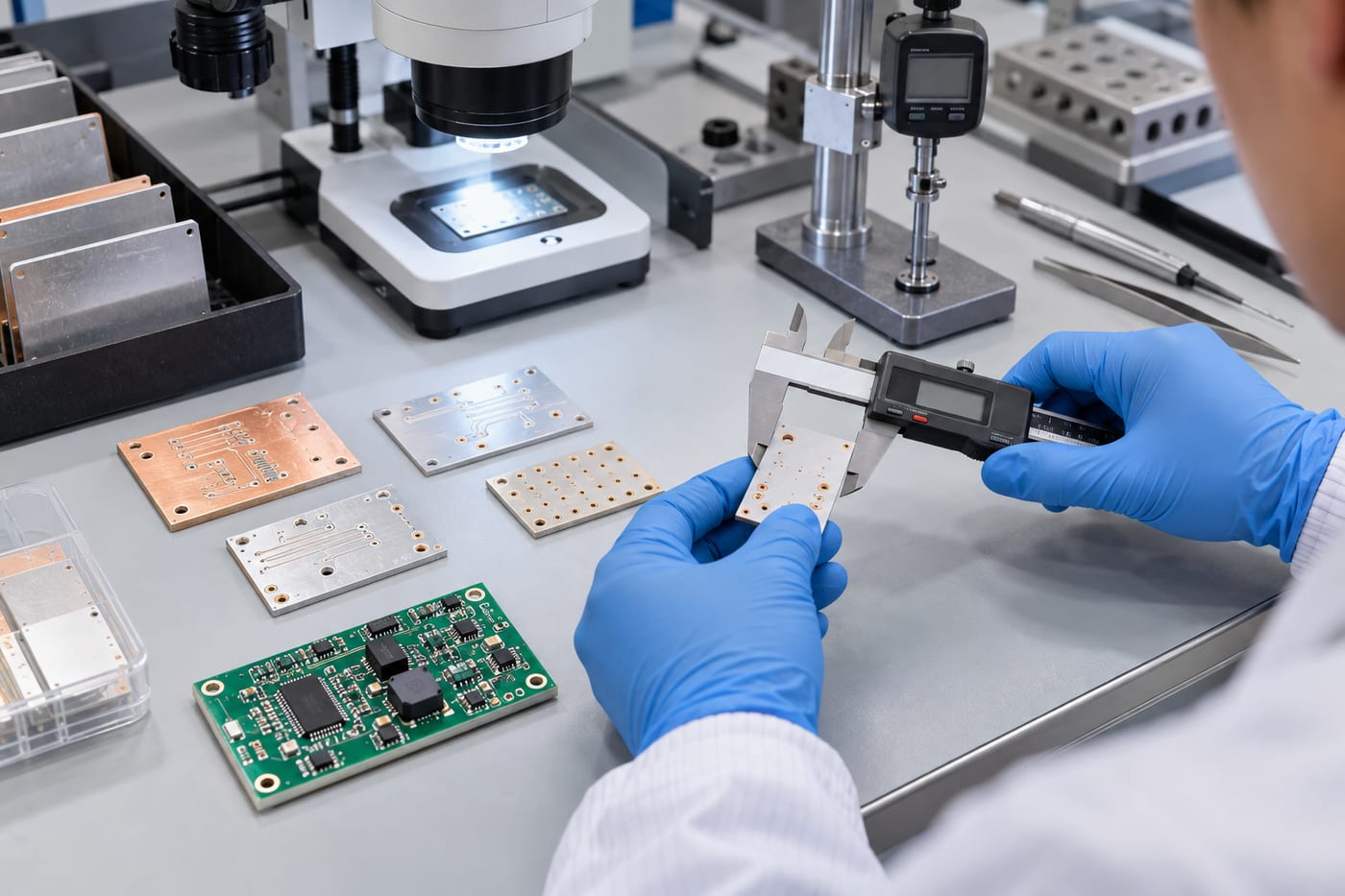
Canadian manufacturing can be worth a higher board price when it solves a business or program constraint that offshore production cannot address as easily.
It may provide meaningful value when you need:
- A confirmed Canadian country of origin: required by the customer, contract, funding condition, or purchasing policy;
- Faster physical engineering interaction: useful for unusual prototypes, failure analysis, or repeated design changes;
- Short domestic transport: valuable when a schedule cannot absorb international freight or customs variability;
- Controlled-project eligibility: relevant when program rules restrict technical-data access or production routes;
- Low-volume responsiveness: useful when the cost of engineering delay exceeds the savings available from a lower unit price;
- Simpler supplier oversight: helpful when your team must audit or visit the production facility.
Domestic production is harder to justify when the project has stable files, flexible delivery, no origin restriction, and enough volume for offshore manufacturing savings to outweigh freight and coordination costs. It can also become expensive when the required dielectric, copper construction, board size, or production capacity is not routinely available locally.
Compare total project cost rather than board price alone. Include tooling, material minimums, engineering charges, assembly, testing, certificates, freight, duty, schedule risk, and the cost of repeating qualification at another factory.
Why Compare EBest Circuit with IMS Circuit Board Manufacturers in Canada?
EBest Circuit is a China-based manufacturer serving Canadian customers. It is not a Canadian manufacturer, so it is not the right route when your contract requires Canadian fabrication or Canadian country of origin.
When overseas production is acceptable, EBest Circuit gives you another reference point for capability, scope, and total cost:
- Reduce supplier handoffs: IMS fabrication, component sourcing, SMT/THT assembly, inspection, and agreed testing can be coordinated within one project;
- Catch mismatches before they reach production: the board material, copper, outline, panel, component package, and assembly requirements are reviewed as one build;
- Move into repeat production with fewer resets: approved files, material requirements, BOM decisions, and inspection scope stay connected to the project;
- Source mixed board technologies together: programs containing IMS plus FR-4, heavy-copper, ceramic, flex, or rigid-flex boards do not automatically require a separate contact for each technology;
- Compare an overseas route on the same finished result: the quotation can cover the bare board alone or the completed PCBA scope required for delivery to Canada.
The customer benefit is a decision based on delivered value rather than country or unit price alone. A Canadian route may justify its premium through domestic origin, proximity, or easier plant oversight. EBest Circuit may be more attractive when overseas production is permitted and you want IMS fabrication and PCBA handled within a broader manufacturing scope.
To compare the finished result, send the same released files, quantity, material and thermal requirements, assembly scope, inspection needs, and delivery destination to each shortlisted company. For an EBest Circuit review, send your package to sales@bestpcbs.com.
FAQs About IMS Circuit Board Manufacturers in Canada
Are IMS circuit boards and metal-core PCBs the same?
The terms are often used interchangeably for boards with circuit copper, a thermally conductive insulating layer, and a metal base. However, “metal-core PCB” can describe several constructions, so the quoted stack-up—not the product label—determines what you are buying.
Are all five companies manufacturing IMS circuit boards in Canada?
No. Their operating models differ. Some describe Canadian fabrication, while others use onshore, offshore, or manufacturing-partner capacity. If origin matters, the quotation and purchase documentation should identify the factory and country of origin for the specific part number.
Which Canadian manufacturer is best for a fast IMS prototype?
CCI Canadian Circuits and Candor Industries are reasonable starting points when Canadian fabrication and quick engineering contact are priorities. Actual lead time depends on material availability, tooling, construction, quantity, and current capacity.
Should I choose aluminum or copper for an IMS circuit board?
Aluminum is commonly selected for a practical balance of weight, cost, and heat spreading. Copper can improve spreading and support demanding current or heat-density conditions, but it is heavier and more expensive. Select the metal base as part of the complete thermal and mechanical design.
Is the highest dielectric thermal conductivity always the best choice?
No. Finished performance also depends on dielectric thickness, thermal resistance, isolation, heat-transfer area, copper design, base metal, interfaces, and cooling conditions. A higher W/mK value does not automatically produce a lower component temperature.
Can a Canadian IMS supplier also assemble the board?
Some companies offer assembly directly or through an integrated network, while others focus on bare-board fabrication. An assembly quotation should make the production location, BOM control, soldering process, inspection, testing, and responsibility for the finished PCBA visible before the order is placed.
What should I send for an IMS circuit board quotation?
Send manufacturing data, a fabrication drawing, quantity, board dimensions, copper weight, finished thickness, surface finish, material or thermal target, isolation requirement, panel preference, testing, documentation, and target delivery. Include the BOM and placement files when assembly is required.
How should I make the final supplier decision?
Compare every supplier against the same technical and commercial scope. Choose the company that can document the proposed construction, manufacture it through an acceptable facility, support qualification, and keep the approved material and process consistent for repeat orders.
Whether you choose Canadian production or an overseas alternative, your final decision should protect the product’s thermal performance, electrical isolation, assembly fit, schedule, and repeatability. If overseas manufacturing is acceptable, EBest Circuit can review your IMS circuit board requirements together with the required fabrication, assembly, inspection, and delivery scope. Send the project package to sales@bestpcbs.com.
You may also like




Tags: IMS Circuit Board, IMS circuit board manufacturers, metal core PCB manufacturers Canada