





Why does IPC-4552 matter when choosing ENIG surface finish for a reliable PCB project? IPC-4552 helps engineers, buyers, and quality teams understand how Electroless Nickel / Immersion Gold should be specified, measured, and accepted during PCB manufacturing. This article explains what IPC-4552 is used for, the latest version, Rev A vs Rev B, ENIG thickness requirements, official PDF sources, and the difference between IPC-4552 and IPC-4556.
What is the IPC-4552 Standard?
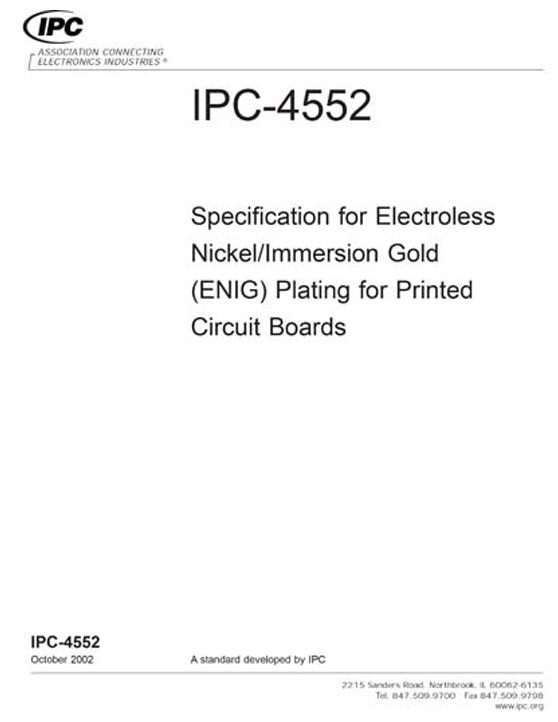
IPC-4552 Standard is the IPC performance specification for ENIG surface finish on printed circuit boards. ENIG means Electroless Nickel / Immersion Gold. It is widely used because it provides a flat soldering surface, good shelf life, and strong compatibility with fine-pitch SMT components, BGA packages, and high-density PCB designs.
In PCB manufacturing, surface finish is not only a final appearance treatment. It directly affects solderability, assembly yield, contact reliability, storage stability, and long-term product performance. That is why IPC-4552 is important. It gives PCB manufacturers, EMS companies, OEMs, and quality engineers a shared technical reference for controlling ENIG plating.
The official IPC product page states that IPC-4552B sets requirements for Electroless Nickel / Immersion Gold deposit thickness for applications including soldering, wire bonding, and contact finish. It can also be used to specify acceptance criteria with the IPC-6010 family of printed board standards, including IPC-6012, IPC-6013, and IPC-6018.
What is IPC-4552 Standard Used for?
IPC-4552 Standard is used to define, control, inspect, and accept ENIG surface finish on printed circuit boards. It helps confirm that nickel and gold deposits are suitable for real manufacturing use, not only for visual appearance. Main uses of IPC-4552 include:
- Defining ENIG surface finish requirements: IPC-4552 gives a technical reference for Electroless Nickel / Immersion Gold finish.
- Controlling nickel and gold thickness: ENIG reliability depends on controlled deposit thickness. The nickel layer works as a stable barrier layer, while the gold layer protects the nickel surface.
- Supporting solderability: ENIG is often selected for SMT assembly, BGA assembly, fine-pitch components, and dense PCB layouts.
- Providing acceptance criteria for PCB production: The standard helps customers and suppliers avoid unclear inspection judgments.
- Supporting high-reliability electronics: ENIG is common in medical electronics, industrial control boards, communication products, aerospace electronics, automotive electronics, test instruments, and high-density PCB assemblies.
- Helping engineers write clearer fabrication notes: A clear drawing note such as “ENIG per IPC-4552B” is more useful than a simple “gold finish” description.
- Reducing surface finish disputes: IPC-4552 gives manufacturers and customers a shared language for discussing thickness, solderability, measurement, and quality records.
What Is the Latest Version of IPC-4552?
The current version listed by the official IPC store is IPC-4552B. The official title is Specification for Electroless Nickel / Immersion Gold Plating for Printed Boards, and the IPC store lists the publication date as May 1, 2021.
This point is important because older web pages, supplier documents, and customer drawings may still mention IPC-4552, IPC-4552A, IPC-4552 Amendment 2, or IPC-4552 Rev A. These references may still apply to legacy projects if the customer drawing specifically requires them. However, for new PCB designs, IPC-4552B is normally the version that should be checked first.
IPC-4552B is also connected with more refined expectations for ENIG process control. Industry commentary notes that IPC-4552B was issued as a revision of IPC-4552A, which was issued in 2017. Rev A addressed nickel corrosion more directly, while Rev B further influenced industry evaluation of ENIG surface finish quality.
What Are Differences Between IPC 4552 Rev A and Rev B?
IPC-4552 Rev A and IPC-4552 Rev B both focus on ENIG surface finish, but Rev B reflects later industry practice and more detailed expectations for ENIG process control and inspection. Rev A is still seen in some older customer drawings, while Rev B is the current revision for new ENIG specification review.
| Customer Concern | IPC-4552 Rev A | IPC-4552 Rev B |
|---|---|---|
| Revision Status | Older revision, often found in legacy drawings | Current revision listed by IPC |
| Publication Period | Released in 2017 | Published in 2021 |
| Main Scope | ENIG deposit thickness and performance control | ENIG deposit thickness, performance control, and updated inspection focus |
| Nickel Corrosion Focus | Addressed nickel corrosion more directly | Further refined industry evaluation of ENIG quality |
| Thickness Measurement | Requires controlled thickness measurement | Gives stronger attention to measurement reliability and process control |
| Process Control | Suitable for ENIG process control | More aligned with current ENIG manufacturing practice |
| Best Use | Legacy projects where customer documents require Rev A | New PCB projects and current ENIG specifications |
| Buyer Recommendation | Use when the drawing clearly requires it | Prefer for new projects unless customer documents specify another revision |
What is ENIG Thickness for IPC 4552?
ENIG thickness for IPC-4552 refers mainly to two layers: electroless nickel thickness and immersion gold thickness. These two layers work together, but they have different functions.
The electroless nickel layer is the main functional layer. It is deposited over copper and works as a barrier between copper and solder. It also helps provide a stable surface for soldering, contact use, and certain bonding applications. Without a reliable nickel layer, the gold surface alone cannot provide long-term PCB finish performance.
The immersion gold layer is much thinner. Its main job is to protect the nickel layer from oxidation before assembly. It helps preserve solderability during storage, shipment, handling, and SMT assembly. However, immersion gold is not intended to be a thick conductive layer.
Public IPC material for IPC-4552 with Amendments 1 and 2 lists the electroless nickel thickness as 3 to 6 µm [118.1 to 236.2 µin]. It also lists the default minimum immersion gold deposit thickness as 0.05 µm [1.97 µin] at minus four sigma from the mean, measured on a 1.5 mm × 1.5 mm pad or equivalent area. For special procurement documentation, it lists an exception minimum of 0.04 µm [1.58 µin].
In practical production, ENIG thickness should not be treated as “the thicker, the better.” Excessive gold thickness may increase cost and may also indicate process imbalance. Too little gold may reduce protection of the nickel surface. Therefore, the best ENIG finish is a controlled finish, not simply a thicker finish.
What Are ENIG Specification for IPC 4552?
IPC-4552 ENIG specification covers deposit thickness, surface coverage, solderability, adhesion, measurement, and production control. It is not only a simple plating thickness table. For reliable PCB manufacturing, the ENIG process must be stable from copper preparation to final inspection.
The table below summarizes commonly referenced ENIG specification points based on publicly accessible IPC-4552 material and related IPC product descriptions. For formal production acceptance, customers should always confirm the requirement against the official IPC-4552B document and their own approved drawing.
| Specification Item | IPC-4552 ENIG Requirement |
|---|---|
| Electroless Nickel Thickness | 3 to 6 µm / 118.1 to 236.2 µin |
| Immersion Gold Thickness, Default | Minimum 0.05 µm / 1.97 µin at -4 sigma from the mean |
| Immersion Gold Thickness, Procurement Exception | Minimum 0.04 µm / 1.58 µin at -4 sigma from the mean when required on procurement documentation |
| Measurement Pad Size | 1.5 mm × 1.5 mm / 0.060 in × 0.060 in, or equivalent area |
| Visual Coverage | Uniform plating and complete coverage of the surface to be plated |
| Adhesion / Tape Test | No evidence of plating removed |
| Solderability | Meets solderability requirements; older public material references Category 3 durability with 6 months shelf life |
| Thickness Measurement Method | Commonly checked by XRF in production |
| Main Applications | Soldering, wire bonding, and contact finish |
The official IPC product page states that IPC-4552B sets ENIG deposit thickness requirements for soldering, wire bonding, and contact finish applications. Public IPC material for IPC-4552 with Amendments 1 and 2 provides the specific nickel and gold thickness values shown above.
For production-quality ENIG PCBs, the factory should control more than the final thickness. The process also depends on copper cleaning, micro-etching, activation, nickel bath control, gold bath control, rinsing, drying, inspection, packaging, and storage.
What are Differences Between IPC-4552 and IPC-4556?
IPC-4552 and IPC-4556 are both surface finish standards, but they apply to different final finishes. IPC-4552 is for ENIG, while IPC-4556 is for ENEPIG. The main difference is that ENEPIG adds a palladium layer between nickel and gold.
| Comparison Item | IPC-4552 | IPC-4556 |
|---|---|---|
| Surface Finish Type | ENIG | ENEPIG |
| Full Name | Electroless Nickel / Immersion Gold | Electroless Nickel / Electroless Palladium / Immersion Gold |
| Layer Structure | Nickel + Gold | Nickel + Palladium + Gold |
| Palladium Layer | No palladium layer | Includes palladium between nickel and gold |
| Typical Use | Fine-pitch SMT, BGA, general high-reliability PCB finish, contact finish | Wire bonding, advanced packaging, demanding soldering and bonding applications |
| Solderability | Good solderability when well controlled | Good solderability with broader finish capability |
| Wire Bonding | Can support some applications depending on process and requirement | More suitable for broader wire bonding requirements |
| Cost Concern | Usually more economical than ENEPIG | Usually higher cost because of palladium and extra process control |
| Surface Finish Selection | Suitable when flatness, shelf life, and SMT assembly compatibility are key | Suitable when soldering plus stronger bonding or contact flexibility is required |
The official IPC-4556A product page states that IPC-4556A defines ENEPIG deposit thicknesses for soldering, wire bonding, and contact finish applications. It also states that IPC-4556A applies to Electroless Nickel / Electroless Palladium / Immersion Gold as a surface finish for printed boards.
Where Can I Download Official IPC 4552 PDF?
The official IPC 4552 PDF should be downloaded or purchased from IPC or authorized standards distributors. IPC standards are copyrighted documents, so engineers, PCB buyers, and quality teams should avoid unofficial “free PDF download” websites. These copies may be outdated, incomplete, or not approved for formal engineering or commercial use.
You can access IPC-4552 through the following valid sources:
- IPC / Global Electronics Association Official Store
Official purchase/download page for IPC-4552B:
https://shop.electronics.org/ipc-4552/ipc-4552-standard-only/Revision-b/english - IPC-4552B Official Table of Contents Preview
Public preview PDF from IPC / Global Electronics Association. This is useful for checking the document structure, scope, and section arrangement, but it is not the full standard:
https://www.electronics.org/TOC/IPC-4552B-toc.pdf - ANSI Webstore
Authorized standards distributor page for IPC-4552B-2021:
https://webstore.ansi.org/standards/ipc/ipc4552b2021 - DIN Media
Standards distributor page with PDF download purchase option for IPC 4552B:
https://www.dinmedia.de/en/standard/ipc-4552b/344272418
FAQs About IPC-4552 Standard
Q1: Is IPC-4552 only related to ENIG surface finish?
A1: Yes. IPC-4552 is mainly related to ENIG, which stands for Electroless Nickel / Immersion Gold. It defines requirements for the nickel and gold deposits used on printed circuit boards. If the PCB uses ENEPIG instead of ENIG, IPC-4556 is the more relevant standard.
Q2: Why do PCB drawings often mention IPC-4552B?
A2: PCB drawings mention IPC-4552B because it gives a clear technical reference for ENIG finish control. Instead of simply writing “gold finish” or “ENIG,” engineers can specify ENIG per IPC-4552B to reduce misunderstanding between the buyer, PCB manufacturer, and quality team.
Q3: Does IPC-4552 control both nickel and gold layers?
A3: Yes. IPC-4552 covers both the electroless nickel layer and the immersion gold layer. Nickel works as the main barrier layer over copper, while immersion gold protects the nickel surface from oxidation before soldering or contact use.
Q4: Is thicker immersion gold always better for ENIG PCBs?
A4: No. ENIG thickness should be controlled within the required range. A thicker gold layer does not always mean better quality. Excessive gold may increase cost and may affect solder joint behavior, while insufficient gold may reduce nickel protection. Stable process control is more important than simply increasing gold thickness.
Q5: How is ENIG thickness usually measured in PCB production?
A5: ENIG thickness is commonly measured by XRF equipment. XRF testing helps check the nickel and gold deposit thickness without damaging the PCB. For formal acceptance, the measurement method, test location, and acceptance criteria should follow the required IPC revision and customer specification.
Q6: Can IPC-4552 be used for high-reliability electronics?
A6: Yes. IPC-4552 is often used when ENIG finish is required for high-reliability electronics, such as industrial control boards, medical electronics, communication equipment, automotive electronics, aerospace electronics, and test instruments. These products usually need stable solderability, reliable surface finish control, and traceable inspection records.
Conclusion
IPC-4552 Standard is a key reference for ENIG PCB surface finish. It helps define electroless nickel and immersion gold requirements, supports solderability, improves inspection consistency, and gives customers a clearer way to specify ENIG on PCB drawings.
For new PCB projects, IPC-4552B is the current version to review. For thickness control, commonly referenced public IPC material lists nickel at 3 to 6 µm and immersion gold default minimum at 0.05 µm. However, final acceptance should always follow the official standard, customer drawing, and approved procurement specification.
A clear ENIG requirement should include the surface finish type, IPC revision, thickness expectation, inspection method, and acceptance criteria. This helps reduce ambiguity before fabrication and supports more consistent PCB quality.
You may also like


Tags: ipc4552 enig specification, ipc4552 enig thickness, ipc4552 pdf download, IPC‑4552