
An RF PCB manufacturer must control material behavior, stackup, impedance, copper quality, fabrication accuracy, assembly details and test expectations, because small process changes can affect signal loss, reflection and final RF performance.
For buyers, choosing an RF PCB supplier is different from buying a simple FR-4 board. The quote should confirm whether the board needs Rogers, Taconic, PTFE, high-Tg FR-4, controlled impedance, special copper, RF connectors, PCBA, inspection or RF-related test documentation. EBest Circuit helps buyers review these requirements before the order moves into production.
Is your RF PCB quote missing the details that decide signal performance?
RF PCB projects often become expensive when the supplier quotes the board like a normal rigid PCB.
- The material name is selected, but laminate availability, stackup and processing route are not confirmed before quotation.
- Impedance traces are drawn, but dielectric thickness, copper profile and reference planes are not reviewed together.
- The design includes RF connectors or shielded sections, but assembly drawings, connector orientation and inspection access are checked too late.
- The buyer needs repeatable RF performance, but the quote does not define what inspection, electrical test or RF-related documentation is expected.
- The first supplier price looks lower, but later material substitution, stackup changes or DFM revisions reset the schedule.
EBest Circuit supports RF PCB buyers with engineering review before production:
- We review Gerber or ODB++ files, stackup notes, impedance requirements, material preferences and RF connector details before quote assumptions are locked.
- We can discuss high-frequency material options such as Rogers, Taconic, PTFE and high-Tg FR-4 based on the real project requirements and availability.
- We connect RF PCB fabrication with PCBA, component sourcing, assembly drawings and inspection planning when the project needs assembled boards.
- We flag DFM issues early, including trace geometry, copper balance, via structures, solder mask clearance, connector footprint and panelization.
- We help buyers compare suppliers by build risk, communication quality, material route and quote clarity, not only by the first unit price.
What an RF PCB Manufacturer Must Control
An RF PCB manufacturer must control the full signal path, from laminate selection and stackup to copper quality, fabrication accuracy, assembly and testing.
RF boards are sensitive to dielectric behavior, copper surface, trace geometry, via transitions, ground design and connector placement. A supplier that only checks board outline and hole count may miss the factors that decide final performance. The best RF PCB quote should show that the manufacturer understands the board’s electrical function, not only its mechanical drawing.
Where RF PCB Projects Usually Lose Performance
RF PCB projects usually lose performance when design assumptions and manufacturing assumptions are not reviewed together.
| Risk Area | What Goes Wrong | What to Confirm Before Quote |
|---|---|---|
| Material | The selected laminate is not available or not suitable for the build route | Material grade, thickness, availability and substitute rules |
| Stackup | Reference planes, dielectric spacing and copper are not aligned with impedance needs | Stackup drawing and controlled impedance notes |
| Fabrication | Etching, copper, via and surface finish choices affect signal consistency | Trace geometry, drill table, plating and finish requirements |
| Assembly | Connector orientation, shield area or component placement creates rework | BOM, CPL, assembly drawing and RF connector details |
| Testing | The buyer expects RF performance evidence, but the quote only includes standard checks | Inspection scope, electrical test and any RF-specific documentation needs |
How EBest Circuit Helps RF PCB Buyers Reduce Build Risk
EBest Circuit helps RF PCB buyers reduce build risk by reviewing material, stackup, fabrication, PCBA and testing requirements before production starts.
For RF and microwave projects, we do not treat the board as a generic PCB. We ask for the files and constraints that influence performance: material preference, impedance notes, copper requirements, surface finish, RF connector details, assembly scope, test expectations and target delivery plan.
Need an RF PCB quote that checks material and impedance risk?
Send your Gerber or ODB++ files, stackup, impedance notes, material preference, BOM, CPL and RF connector requirements. EBest Circuit can review the build path before production.
Material | Stackup | Impedance | PCBA | RF test planning
RF PCB Materials and Laminate Selection
RF PCB material selection should match signal performance, fabrication feasibility, assembly needs and sourcing availability.
EBest Circuit’s capability sources include high-frequency material references such as Rogers 4003, Rogers 4350, Rogers 5880, Taconic laminates, PTFE, Isola 370HR, FR408HR and high-Tg FR-4 options. The right choice depends on the project. Some materials require special confirmation, custom sourcing or project-specific lead-time review, so the material line should be confirmed before the buyer treats a quote as final.
Stackup, Impedance and Transmission Line Review
Stackup and impedance review should confirm how RF traces, dielectric layers, reference planes and copper work together.
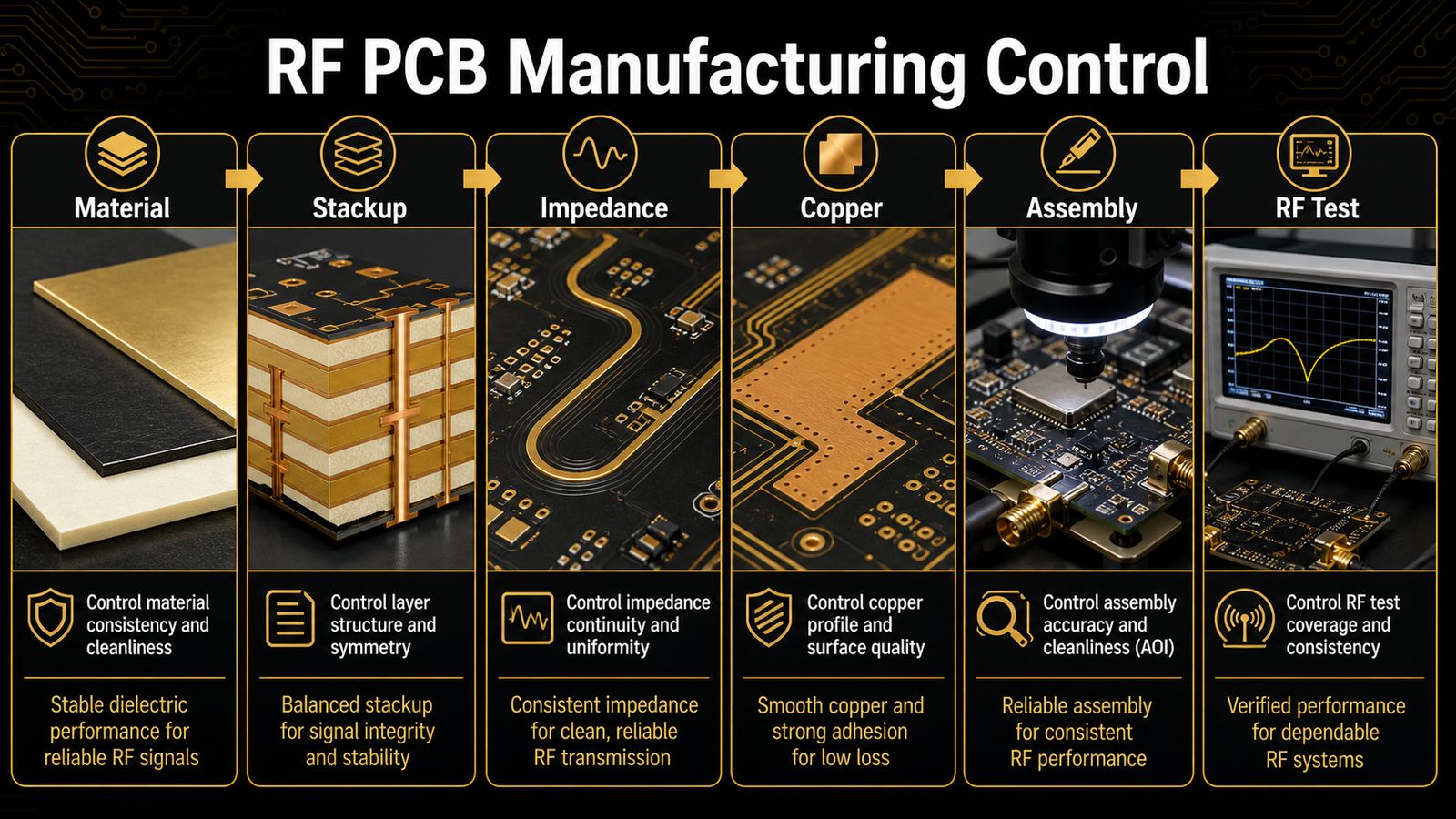
RF traces may use microstrip, stripline, coplanar or other controlled structures depending on the design. The manufacturer should understand which traces are critical, what impedance notes apply, and how the stackup will be built. If these details are missing, ask for DFM review before the order is released.
Copper, Etching, Surface Quality and Plating Control
Copper and etching quality affect RF transmission because trace profile, surface quality and plating choices can change signal behavior.
Buyers should provide critical trace details and avoid assuming that every copper or finish choice behaves the same. Surface finish should be selected based on assembly, contact needs, storage and RF performance expectations. If the design has tight RF lines, special materials or fine features, the fabrication route should be reviewed before price approval.
RF PCB Fabrication and Assembly Planning
RF PCB fabrication should be planned with assembly when the board includes RF connectors, shielding, sensitive components or test fixtures.
Assembly details can affect RF performance after the bare board is finished. Connector alignment, solder joint quality, shielding, grounding, component placement and inspection access all matter. EBest Circuit can connect RF PCB fabrication with prototype PCB assembly, component sourcing and test planning when a project needs assembled boards.
RF Testing, Inspection and Documentation
RF PCB testing and inspection should be defined by the buyer’s product risk, not assumed from a generic PCB checklist.
Standard checks may include visual inspection, AOI, dimensional review and electrical test. RF-related validation may require additional project-specific instructions, fixtures or documentation. If your project needs special RF test evidence, include that requirement in the RFQ rather than adding it after production starts.
Cost and Lead-Time Factors for RF PCB Manufacturing
RF PCB cost and lead time depend on material selection, stackup complexity, impedance control, fabrication risk, assembly scope and test expectations.
| Factor | Why It Changes the Quote | How Buyers Can Help |
|---|---|---|
| Material | RF laminates and special substrates can change sourcing and lead time | Provide approved material choices and substitute rules |
| Stackup | Controlled dielectric and copper planning affect build route | Send stackup and impedance notes early |
| Fabrication complexity | Fine RF geometry, vias and finish requirements add review work | Mark critical RF traces and tolerances clearly |
| Assembly | RF connectors, shields and sensitive parts require careful handling | Send BOM, CPL and assembly drawings with the PCB files |
| Testing | Special validation can require fixtures, setup time or documentation | Define test scope before quote approval |
Compare RF PCB manufacturers with a clearer RFQ package.
EBest Circuit can review your material, stackup, impedance, fabrication, assembly and testing notes together so the quote reflects the actual RF board.
RF PCB | Microwave PCB | Material review | PCBA | Test scope
RF PCB Supplier Evaluation Checklist
An RF PCB supplier should be evaluated by material understanding, engineering response, fabrication control, assembly support and quote clarity.
- Can the supplier discuss the material route and availability before final quote approval?
- Does the supplier review stackup and impedance notes instead of quoting from outline and layer count only?
- Can fabrication and PCBA be reviewed together when the product needs assembled boards?
- Does the quote explain what inspection, electrical test and RF-related documentation are included?
- Does the engineering team respond with practical DFM questions before production?
RFQ Checklist for RF PCB Manufacturing
A strong RF PCB RFQ should include design files, RF constraints, material preferences, assembly files and test expectations.
- Gerber or ODB++ files, drill files and fabrication drawing
- Stackup, material preference, dielectric notes and controlled impedance requirements
- Critical RF trace notes, via structures, copper requirements and surface finish
- BOM, CPL, assembly drawing, RF connector details and approved alternates if PCBA is needed
- Inspection, electrical test, RF-related validation or documentation requirements
- Quantity, prototype stage, forecast, packaging and target delivery plan
FAQ About Choosing an RF PCB Manufacturer
What is an RF PCB manufacturer?
An RF PCB manufacturer builds printed circuit boards for radio-frequency and microwave circuits where material behavior, impedance, copper quality, stackup and test planning can affect signal performance.
What should buyers send for an RF PCB quote?
Send Gerber or ODB++ files, drill files, stackup notes, material preference, controlled impedance requirements, BOM, CPL, assembly drawings, RF connector details, test expectations, quantity and target delivery plan.
Can EBest Circuit support Rogers or other RF materials?
EBest Circuit’s capability sources include RF material references such as Rogers, Taconic, PTFE and high-Tg FR-4 options. Final material availability and processing route should be confirmed against the specific project files and order requirements.
Should RF PCB fabrication and assembly be quoted together?
Yes, when the RF board includes connectors, shields, sensitive components or test requirements. Quoting PCB and PCBA together helps catch footprint, clearance, soldering and inspection issues earlier.
Need an RF PCB manufacturer for a prototype or production build? Send your Gerber or ODB++ files, stackup, material preference, impedance notes, BOM, CPL, RF connector details, test requirements, quantity and target delivery plan to sales@bestpcbs.com. EBest Circuit can review RF PCB fabrication, PCBA and quote risks before production starts.
You may also like




Tags: PCB Quote, RF PCB, RF PCB Manufacturer