





Sintering vs soldering in power electronics is a comparison of how a connection forms and how it carries heat and mechanical stress during operation. Silver sintering builds a metallic connection from particles without melting the silver into a bulk liquid; soldering melts a filler alloy that wets the joining surfaces and then solidifies. Both can connect power devices to a substrate, but they require different materials, surface conditions and manufacturing processes.
EBest Circuit provides ceramic substrates, PCB fabrication and PCB assembly support for electronics projects. Matching the substrate structure and surface finish to the intended attachment process helps connect packaging requirements with board manufacturing. For support with the PCB or ceramic-substrate portion of your project, contact sales@bestpcbs.com.
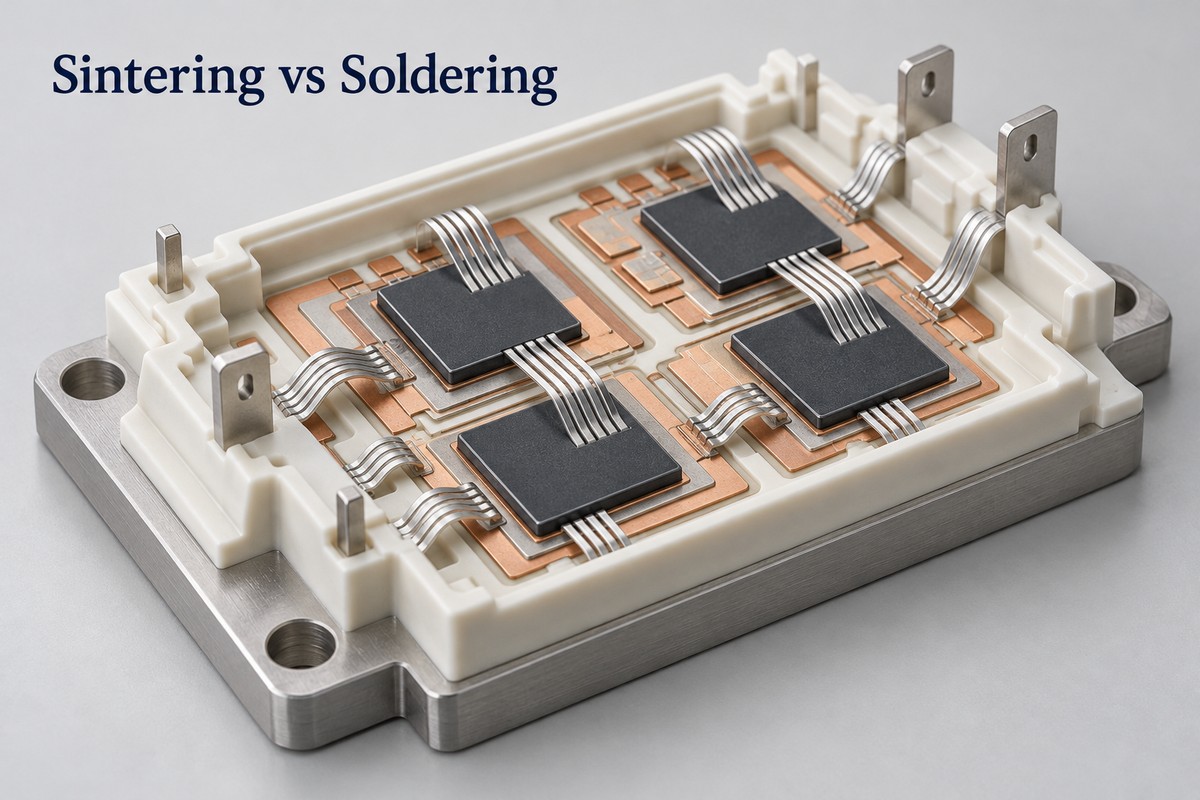
How Do Sintering and Soldering Form a Joint?
Soldering forms a joint through a molten filler metal; conventional silver sintering forms one through bonding between solid metal particles and the joining surfaces. This article focuses on silver sinter attachment in electronics, rather than every process described as sintering in materials manufacturing.
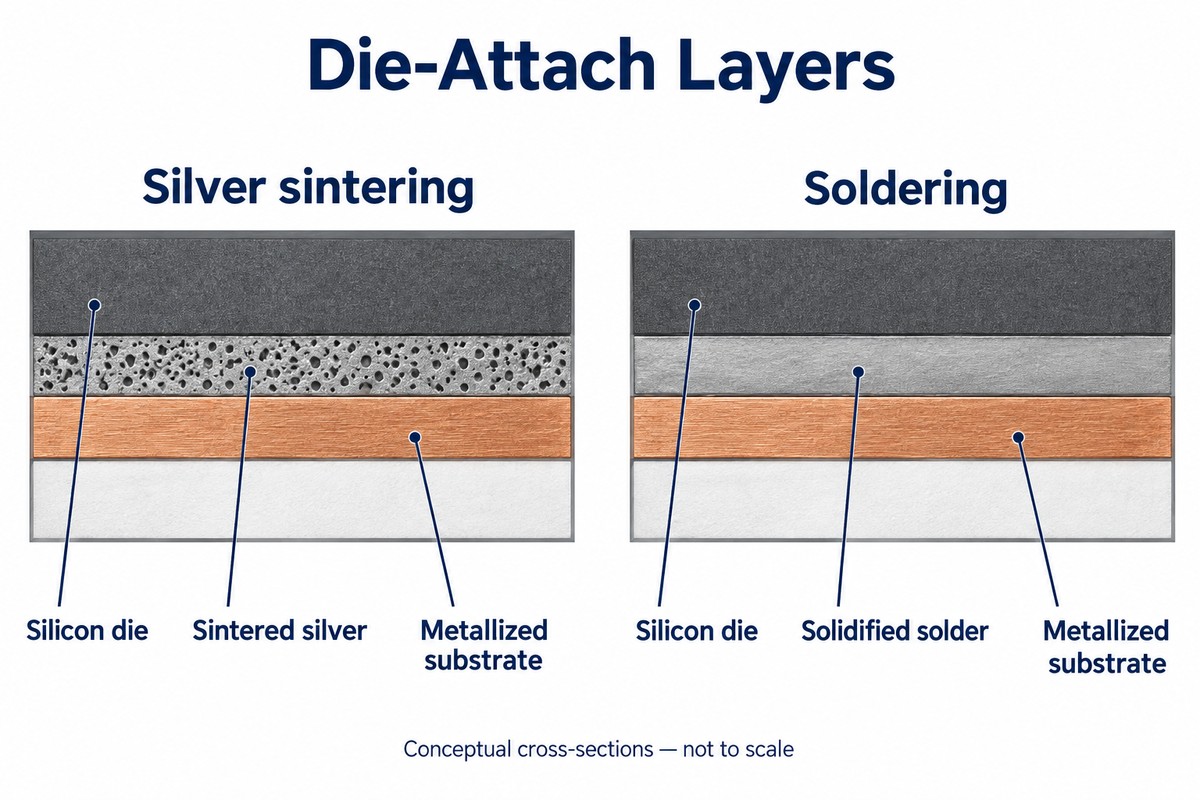
During soldering, heat melts the solder alloy. Suitable surface preparation and flux or a controlled atmosphere allow the liquid to wet the metallization. Cooling leaves a solid metallic connection.
In silver sintering, a deposited paste is processed to remove its vehicle and develop connections between silver particles. These connections grow into a metallic network bonded to the mating surfaces. Drying and sintering may be separate stages, depending on the material.
| Feature | Silver sintering | Soldering |
|---|---|---|
| Starting attachment material | Silver particles in a formulated paste | Solder alloy, supplied as paste, preform or another suitable form |
| Joint-forming mechanism | Particle bonding and development of a connected metal structure | Melting, wetting and solidification of the filler alloy |
| Typical finished layer | Sintered silver with process-dependent porosity | Solidified solder alloy with interfaces formed against the metallization |
| Example use | Power semiconductor die attachment | Die attachment, module attachment and board-level component assembly |
Sintering a ceramic substrate itself is a different manufacturing step. A ceramic board does not automatically have a sintered die-attach layer.
How Do Processing and Operating Temperatures Differ?
The temperature used to make a joint is not its allowable operating temperature. Three separate quantities often become mixed together in this comparison.
- Processing temperature is the temperature needed to form the connection under the specified time, atmosphere and pressure conditions.
- Melting temperature is a property of the metal or alloy. An alloy may melt over a range rather than at one sharp temperature.
- Operating temperature is limited by the assembled device, including its semiconductor, interfaces, insulation and packaging materials.
Soldering must heat the filler sufficiently to melt and wet the surfaces. Silver particles can sinter far below the melting point of bulk silver, so the resulting joint does not remelt when simply returned to its original sintering temperature.
That distinction helps explain the interest in sintering for hot-running power devices. It does not mean that the complete module can operate anywhere near silver’s melting point. Other materials and interfaces will impose much lower limits.
Likewise, solder can lose useful mechanical performance before it melts. A solid solder joint is not necessarily a reliable joint at every temperature below its liquidus.
How Does the Bond Layer Affect Heat Transfer?
A highly conductive attachment material helps only when the complete connection provides an effective heat path. The chip-to-substrate layer is one part of a path that may also include ceramic, copper, a baseplate and a cooling interface.
For a uniform layer with one-dimensional heat flow, its approximate thermal resistance is R = t / (k × A), where t is thickness, k is thermal conductivity and A is area. Real assemblies also have interface resistance and heat spreading.
- Thickness determines how far heat must travel through the layer.
- Effective bonded area determines how much of the interface actually conducts heat.
- Pores, voids and delamination can interrupt that path, but their effects depend on size, distribution and location.
Sintered silver can offer higher thermal conductivity than common tin-based solder alloys. However, a bulk-metal value is not automatically the effective conductivity of a porous sintered layer.
Distributed microscopic pores are also different from a large unbonded region directly beneath a hot area of the die. Comparing only a percentage of empty space can miss this distinction. The useful comparison is the thermal performance of the actual attachment structure, including its interfaces.
How Do Sintered and Soldered Joints Respond to Thermal Cycling?
Both joint types experience stress when connected materials expand by different amounts. Repeated temperature changes can accumulate damage even when no material reaches its melting point.
In a soldered structure, time-dependent deformation and repeated strain can contribute to fatigue cracking. As a crack grows, the effective electrical and thermal connection may deteriorate.
Silver sintering can improve cycling durability in appropriately designed power modules. It does not eliminate failure mechanisms. Cracks within the sintered layer, interface separation or damage elsewhere in the module can still limit life.
Two test descriptions need particular care when comparing results.
| Test | How heating is applied | What the result represents |
|---|---|---|
| Passive thermal cycling | The surrounding temperature is changed | The assembly’s response to the specified environmental temperature cycle |
| Power cycling | Electrical operation heats the semiconductor | The response to the specified local temperature swings and heating durations |
Results from these tests are not interchangeable. Temperature range, peak temperature, dwell time, die size, construction and failure criterion all affect the reported lifetime. A lifetime multiplier from one module cannot be transferred directly to another joint design.
Does Silver Sintering Always Require Pressure?
No. Commercial silver sinter materials support both pressure-assisted and pressureless processes. The paste formulation and intended attachment determine which route is appropriate.
With pressure-assisted sintering, an applied load helps bring particles and surfaces into contact during the joining cycle. The tooling must distribute that load without damaging the die or underlying structure.
Pressureless sintering avoids an externally applied sintering load, but it still requires controlled deposition, placement, atmosphere and heating. It is not a process that can be achieved by leaving any silver paste in a standard oven.
| Process route | Distinct manufacturing consideration |
|---|---|
| Pressure-assisted | Load distribution, tooling contact, die support and substrate flatness |
| Pressureless | Paste suitability, drying and heating schedule, bond-line formation and surface compatibility |
The usable die area and achievable joint properties depend on the selected material and process. Removing pressure from a qualified pressure-assisted recipe does not turn it into a qualified pressureless recipe.
Which Surface Finishes Support Sintering and Soldering?
Compatibility depends on the exposed metal and the complete metallization stack on both sides of the joint. The substrate material alone does not determine whether a connection will form successfully.
Silver and gold surfaces are supported by various commercial silver sinter systems. Copper is also supported by selected formulations, with processing conditions that address its surface state. These are material-specific capabilities, not a universal list of interchangeable finishes.
For soldering, the finish must permit wetting and a suitable metallurgical interface with the chosen alloy. Layer thickness and barrier metals matter as well as the name of the outer finish.
- On the die, backside metallization must suit the attachment material and remain bonded to the device.
- On the substrate, the finish, underlying metal and surface cleanliness must support the intended joint.
- Across the interface, oxidation or contamination can interfere with attachment even when the nominal metals are compatible.
ENIG, for example, describes a nickel-and-gold finish rather than a universal joining specification. Some sinter products are intended for particular ENIG applications, but that does not establish compatibility for every gold thickness, die size or thermal process.
Can Sintering Replace Soldering in PCB Assembly?
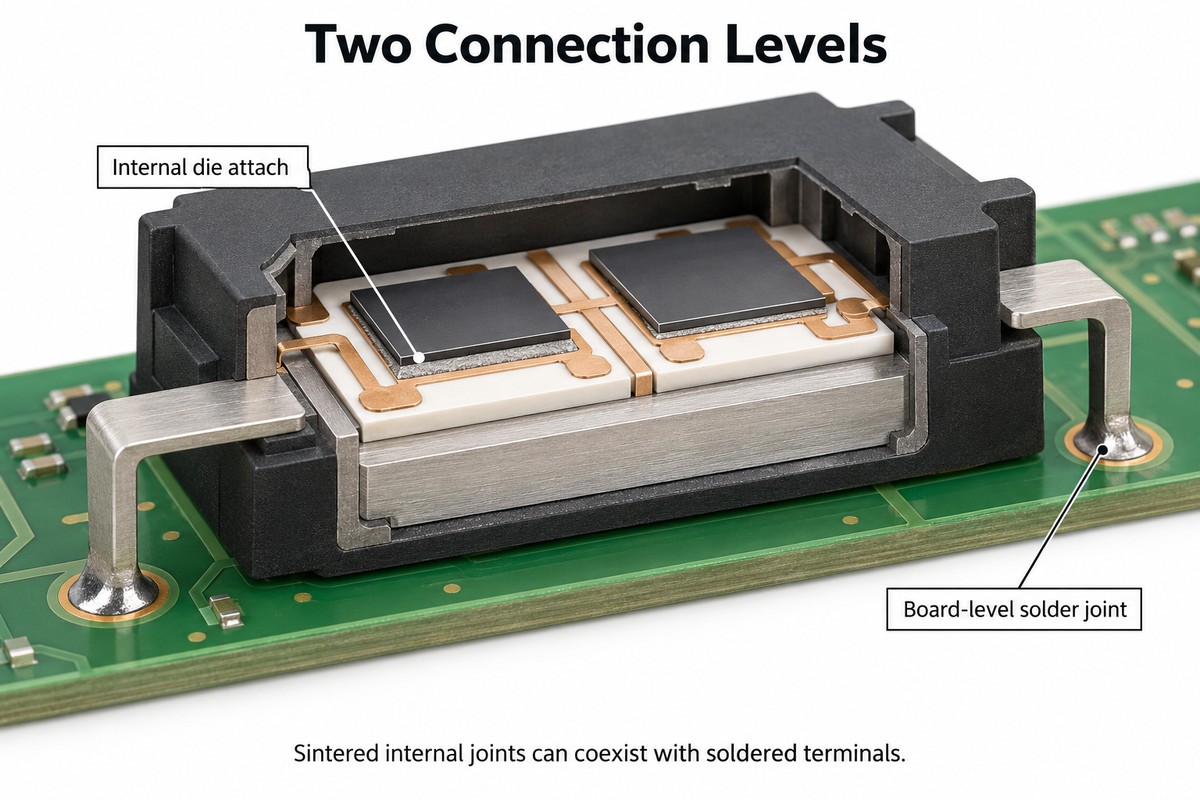
Sintering can replace selected attachment layers, but it is not a general replacement for soldering every component onto a PCB. The connection’s location makes the difference.
| Connection location | How the processes relate |
|---|---|
| Bare power die to a metallized substrate | Silver sintering can be an alternative to a suitable solder die-attach process |
| Substrate or module to a baseplate | Sintering and soldering can be alternatives where materials, area and tooling support the selected route |
| Packaged components to a circuit board | Conventional SMT and through-hole soldering remain established assembly methods |
A power module may contain sintered internal joints while its external terminals are soldered to another board. The two processes can therefore coexist within one product.
Changing the internal attachment also changes production requirements. Sintering may introduce dedicated tooling, paste-handling steps or a different heating cycle. Soldering may fit an existing assembly line more readily, but still requires suitable thermal and reliability margins.
Cost follows the complete process, including material consumption, equipment, cycle time, yield and inspection. A universal cost ratio would hide these differences. The appropriate comparison is between feasible processes for the same connection and service conditions.
FAQs About Sintering vs Soldering
Is silver solder the same as silver sinter paste?
No. An electronic solder alloy containing silver still forms its joint through melting and solidification. Silver sinter paste is formulated to create a sintered metallic connection. The shared word “silver” does not make the materials interchangeable.
Is sintering the same as conductive adhesive curing?
No. A conventional conductive adhesive relies on a cured polymer binder containing conductive particles. A sinter material develops metallic connections between particles. Hybrid materials exist, so the material’s actual bonding mechanism matters more than its silver content alone.
Can a sintered joint be reworked like a soldered joint?
Not by simply repeating a normal solder-reflow cycle. A completed silver sinter joint does not become liquid at its original processing temperature. Removal and replacement need an attachment-specific method and may risk damage to the die or substrate; reworkability should not be assumed.
Is copper sintering the same process as silver sintering?
Both create connections from metal particles, but their pastes and processing conditions are not interchangeable. Copper’s surface oxidation requires particular attention. A copper formulation needs its own atmosphere, surface preparation and heating requirements.
Does a sintered joint have to be completely pore-free?
No. A sintered metal layer can retain porosity and still meet its intended requirements. Pore size, distribution, interface bonding and measured performance matter. A large interface separation cannot be treated as harmless simply because smaller pores are expected within the material.
For a practical sintering vs soldering comparison, define the connection location, thermal path and intended service conditions together. EBest Circuit can support the PCB and ceramic-substrate manufacturing discussion around your assembly requirements. Contact sales@bestpcbs.com to discuss your project.
You may also like

Tags: sintering vs soldering